Most people get what to wear to a college football game in November wrong in the same way: they dress for the tailgate, not the game. A sunny 10 a.m. parking lot and a 7:30 p.m. kickoff can be 20 degrees apart, and the bleachers take the rest of your warmth away.
The short version is three layers you can add and take off, a hat and gloves in your pocket until you need them, and closed-toe shoes that handle a wet grass walk. Pick the stack that matches the temperature at kickoff, not the daily high, and the rest is easy.
Table of Contents
- What to Wear to a College Football Game in November
- How cold will it be at a college football game?
- How do I dress for team spirit without sacrificing comfort?
- What are the best layers for a November football game?
- What should I wear for pants, shoes and a game-day jacket?
- What accessories are useful at a November college football game?
- How should I dress for rain, wind or an especially cold game?
- Frequently Asked Questions
- Can I wear my team jersey to a college football game in November?
- How warm should I dress for a November college football game?
- What kind of shoes are best for a football game at night?
- Can I bring a coat or blanket into a college football stadium?
- Should I wear school colors if I am not a student or season-ticket holder?
- What should I do if it rains during a college football game?
- Conclusion
What to Wear to a College Football Game in November
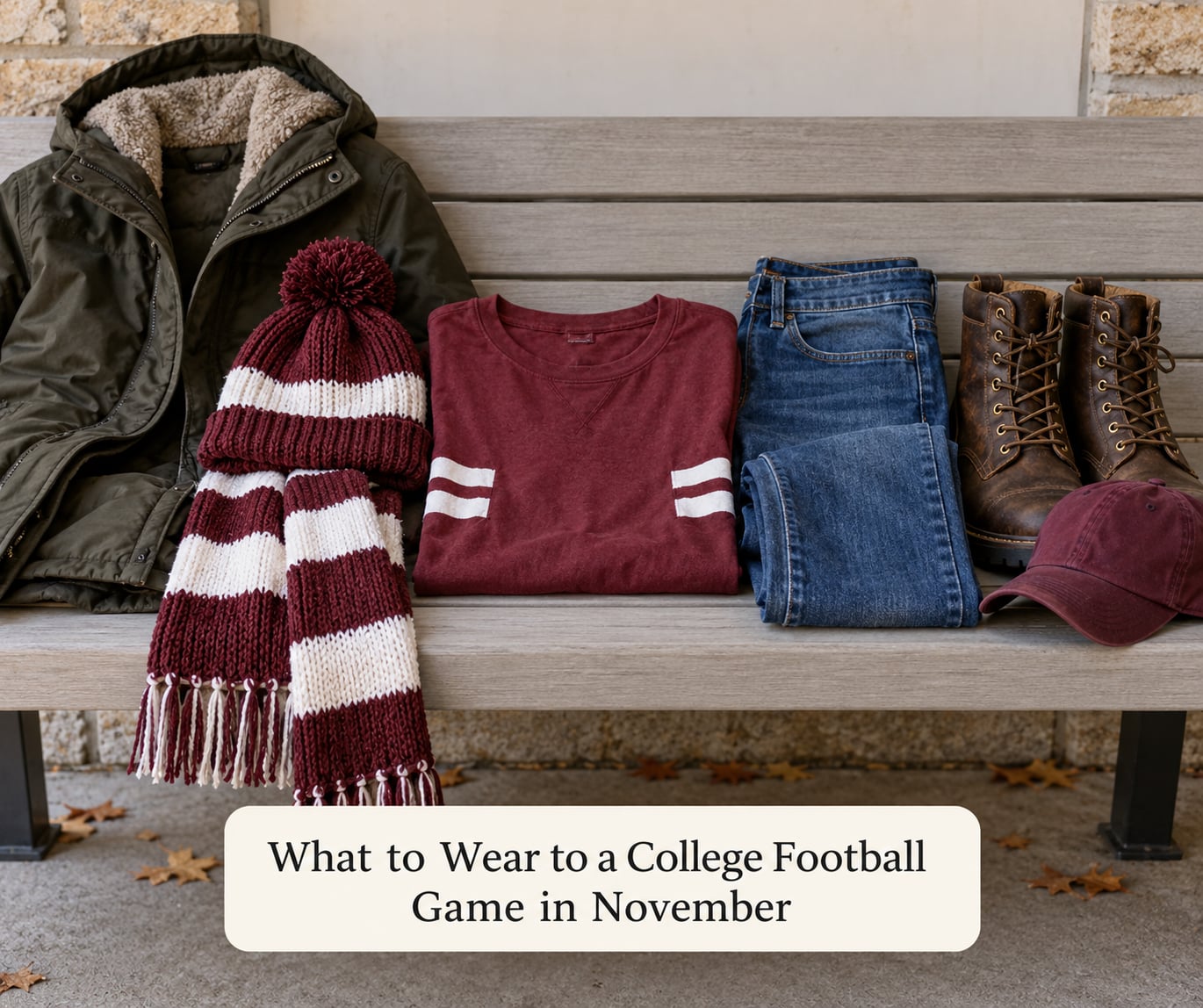
- A moisture-wicking long sleeve or a thermal base layer in a neutral color
- A fleece, sweatshirt, quarter-zip or flannel in your team color
- A packable jacket, insulated vest or sherpa jacket you can tie around your waist
- Jeans, leggings or lined cargo pants
- Closed-toe shoes with a decent sole: boots, sneakers or waterproof shoes
- A beanie, gloves and a spare pair of socks, stuffed in a pocket until kickoff
Adjust that list for where you are sitting. A covered upper deck or a suite behaves more like October. Open end-zone bleachers in the north behave more like January, and the difference is the metal under your legs and the wind coming straight off the field.
Colors are a choice, not a requirement. A quiet base layer with one loud team piece on top keeps you warm without looking like a mascot.
How cold will it be at a college football game?
Late-season cold depends on two things: where the stadium is, and what time the game starts. A noon start in the South can be mild enough for a sweatshirt alone. A night game in the Midwest or Northeast in late November can sit in the low 30s with a wind off the field, and the stands will feel colder than the app says.
That is why the daily high is the wrong number. Look up the forecast for the specific hour of kickoff, then subtract a few degrees in your head for the seat. Metal bleachers and concrete pull heat out of you from underneath, which is why plenty of people feel colder in 45 degrees than others do in 38.
Use these bands as a starting point.
- Above 70 degrees: a team tee or jersey, jeans or shorts, sneakers. A light layer in your bag for the night trip home.
- 60 to 70 degrees: a long sleeve or thermal under a sweatshirt, no coat, or a jacket you can carry.
- 50 to 60 degrees: base layer, sweatshirt, and a light jacket or vest. Gloves at kickoff if you get cold easily.
- 40 to 50 degrees: thermal base, fleece or quarter-zip, and a real jacket. Hat and gloves are not optional.
- Below 40 degrees: thermal base, mid layer, insulated outer, hat, gloves, two pairs of socks, hand warmers in your pocket. Plan on a blanket too.
Regional difference matters. Northern-tier stadiums are frequently exposed and windy, and the same outfit that works in an October game in the South will not survive a late-November night game in the Midwest.
How do I dress for team spirit without sacrificing comfort?
Put your fancier pieces on the outside. If you lead with the jersey, you have nowhere to put a sweatshirt. A plain thermal or black long sleeve underneath leaves room for a fleece pullover, and the team color still shows at the neckline, on your hat and on your scarf.
A few combinations that work without buying a new closet:
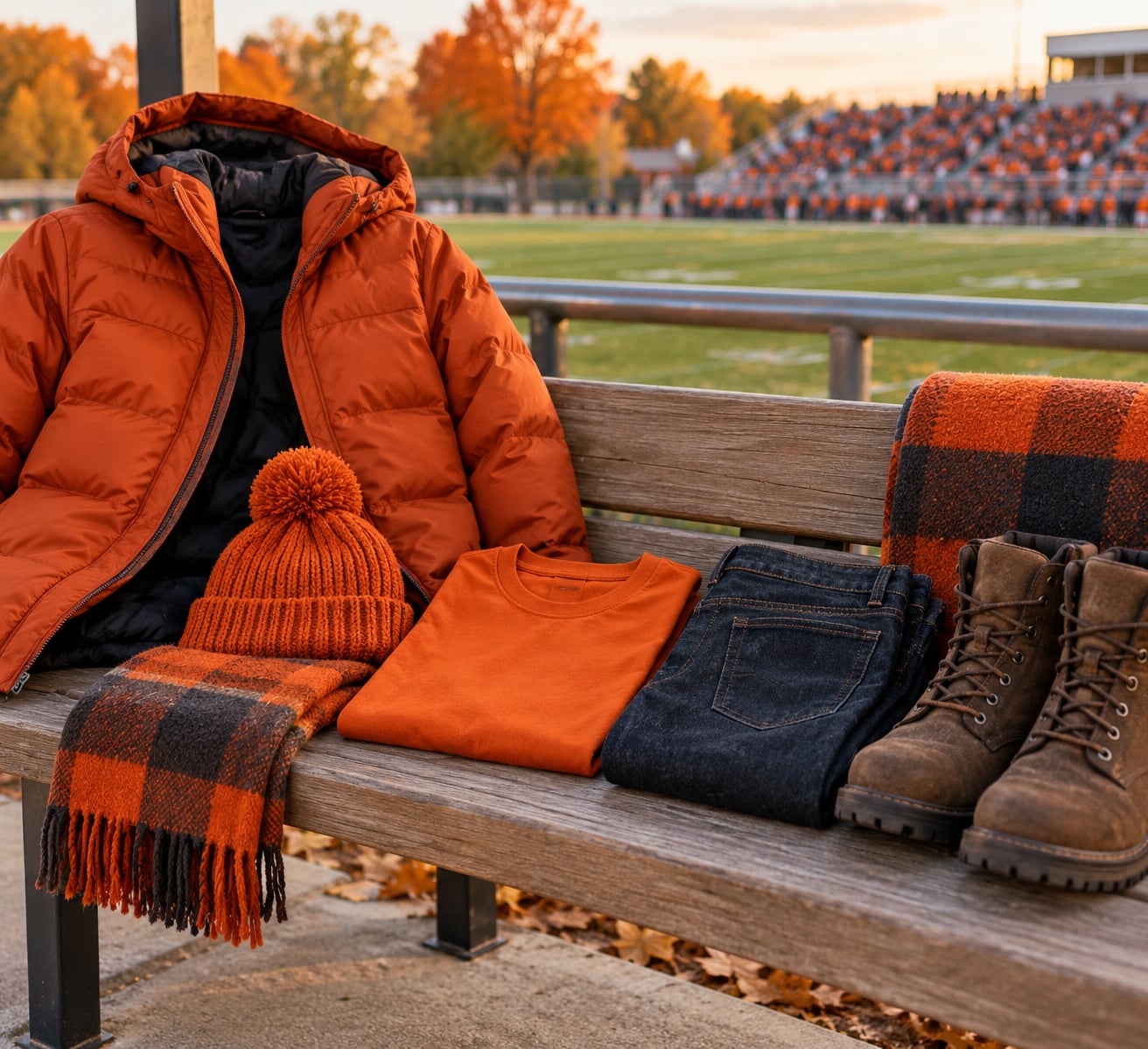
- Team tee under an open sherpa jacket, with jeans and boots
- Logo beanie, solid-color quarter-zip in a team color, black jeans
- Team scarf over a plain puffer, no shirt logo needed
- Blanket with the school mark over a simple jeans-and-sweater base
- Oversized team hoodie worn as your mid layer, with a lighter jacket over it
- Solid navy or heather gray fleece plus one bright team accessory
Attending with kids, or bringing someone who is pregnant, is easier in a half-zip and a roomy jacket than anything fitted. Nobody at a November game is looking closely at anybody’s silhouette, and the adults in the group will be grateful for the extra room when the wind picks up.
What are the best layers for a November football game?
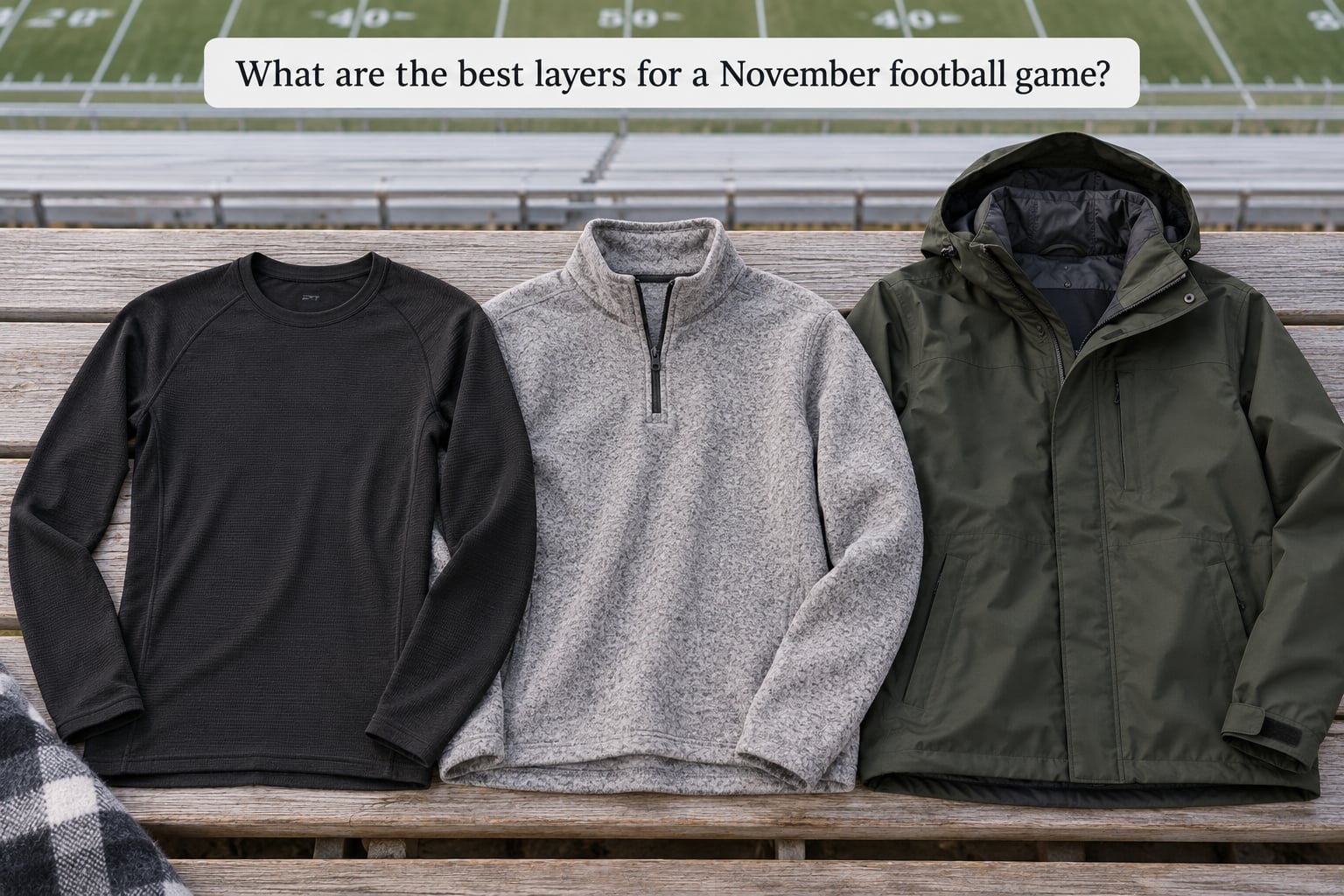
Three layers is the system most people arrive at, and it works. Each one has a job.
- Base layer. A thin thermal or moisture-wicking long sleeve. Cotton holds sweat and then holds cold, so skip it for the layer closest to your skin.
- Mid layer. Your warmth engine: fleece, sweatshirt, flannel, quarter-zip, or an insulated vest. This is the layer that makes or breaks a 45 degree night.
- Outer layer. The weather barrier: a packable jacket, a puffer, a rain shell, or a sherpa-lined jacket. This is the one you tie around your waist at the tailgate and put back on at dusk.
Where conditions get specific, swap a layer rather than adding a fourth:
- Cold morning, mild afternoon: thermal base under a sweatshirt, coat tied at your waist until kickoff, then a thin overshirt once the sun is out.
- Rain: swap the fleece for a lighter mid layer so the jacket is not fighting a wet sweatshirt.
- Wind: the outer layer has to block wind, not just trap heat. A windbreaker over a fleece beats a thin coat with nothing under it.
- Indoor or covered seating: the base layer and the mid layer usually do it. Keep the coat for the walk in and the walk out.
- Sunny, cold, clear day: you lose heat to the sun at the tailgate and gain it back after dark. Layers you can strip are worth more here than a single heavy coat.
What should I wear for pants, shoes and a game-day jacket?
Bottoms follow the same rule as tops: something warm enough for cold metal, loose enough to sit in for three hours.
- Jeans work for most 40s and 50s. Straight or bootcut fits tuck over boots without bunching.
- Lined or thermal leggings under jeans add real warmth and look like nothing from the waist up.
- Leggings or joggers are the warm, flexible option for the student section or for standing most of the game.
- Cargo or utility pants work in mild weather, but thin ones are miserable below 45.
For shoes, closed toe with a grippy sole is the requirement. Boots handle mud and gravel from the parking lot far better than sneakers. If you wear sneakers, skip the thin canvas pairs and pick something with a rubber sole and a full toe.
Socks do more work than people give them credit for. Wear two pairs in the cold bands, and make sure they are wool or a wool blend rather than thin cotton. Change them before kickoff rather than after you have already spent an hour cold.
For the game-day jacket, favor roomy over fitted and lighter over bulky. You will want it open by the third quarter. A jacket with pockets earns its place, because that is where the hat, gloves, phone and ticket live.
What accessories are useful at a November college football game?
Most fans underestimate the small items. These are the ones that change how the second half feels:
- A knit beanie or stocking hat, worn or in your pocket until the sun goes down
- Gloves, ideally with liners, or a cheap pair of hand warmers that stay in your pocket until the third quarter
- A scarf or a blanket with the school mark, doubling as a layer
- A clear stadium bag that meets the school’s published policy, checked before you leave the house
- A phone battery and a small hand warmer pouch for the concrete
- Sunscreen for the tailgate and the sunny first half, even when the air is cold
- Ear protection if you are in the louder end of the student section
Skip anything that swings, clangs or blocks the view of the person in front of you. A costume headband works for one game and is miserable for the other seven.
What to pack in your stadium bag, in one list: clear bag, hand warmers, blanket, seat cushion or seat cover, phone battery pack, poncho, spare socks, sunscreen, lip balm, a small towel, and a plastic bag for anything wet. Check the school’s own policy page for what actually passes the gate.
How should I dress for rain, wind or an especially cold game?
Wet plus cold is the hardest combination of the season, because the wind pushes water through your outer layer and the damp mid layer stops insulating.
- Water-resistant outerwear instead of a cotton coat, and a lighter mid layer underneath
- Waterproof or water-resistant shoes, and a spare pair of socks sealed in a baggie
- A compact poncho in the bag rather than an umbrella, since most venues restrict umbrella size or shape
- A hat with a brim or a hood that actually seals at the neck
- A spare base layer, so you can change if the first one is soaked by the fourth quarter
What not to wear: open-toed shoes, anything with a thin sole, silk or rayon that goes cold instantly, a fine wool sweater with nothing under it, and a white sneaker you care about. Also skip the plan of one hoodie and no jacket, which is the single most common reason people leave early.
What to Wear to a College Football Game in November for Different Budgets
The thrift-and-team-tee route is the most reliable one. A team color tee from a thrift store or a resale shop, worn over a thermal and under a jacket you already own, reads as deliberate rather than cheap. Nobody outside your group of ten is looking at the tag.
The flexible everyday wardrobe option is five pieces that do all the work: a black or heather base layer, one fleece in a team color, one neutral jacket, dark jeans, and boots. Every outfit in this guide is some arrangement of those five.
The coordinated option is for tailgates, senior day and bowl games: a dress in a team color with tall boots, or a cable knit sweater with jeans and a sherpa jacket. Build it on the same three layers so you are still warm at the end of the night.
Frequently Asked Questions
Can I wear my team jersey to a college football game in November?
Yes, and most fans do. Just wear a thin thermal or long sleeve underneath rather than the jersey against your skin, so you have something to add at kickoff. Add a fleece or quarter-zip over the jersey, and tie a jacket around your waist for the third quarter. A jersey on its own works above 60 degrees and fails below 45.
How warm should I dress for a November college football game?
Dress for the temperature at kickoff time, not the daily high, and subtract a few degrees for the seat. Three layers covers most nights: a thermal base, a fleece or sweatshirt mid layer, and a real outer layer. Below 40 degrees, add a beanie, gloves, two pairs of socks and hand warmers in your pocket.
What kind of shoes are best for a football game at night?
Closed-toe shoes with a thick rubber sole handle cold concrete and wet grass best. Boots are the safest bet for a parking-lot walk in mud or gravel. If you prefer sneakers, avoid thin canvas shoes and pick a pair with a full toe and grippy outsole. Wear two pairs of wool or wool-blend socks when the temperature is below 50.
Can I bring a coat or blanket into a college football stadium?
A coat almost always comes in, and many stadiums let you keep it on or check it. A blanket is generally fine, though some venues restrict oversized items, so check the school’s published bag and prohibited-items page before you leave. A clear bag that matches the stated size limit is the safest way to avoid a long security line.
Should I wear school colors if I am not a student or season-ticket holder?
Wear them if you want to. School colors are about showing up, not credentials, and nobody is checking your student ID in the stands. A common approach is one loud team piece, like a hat or scarf, over neutral layers, so you still look coordinated in the cold. Announced color calls, such as a white-out, are worth checking before game day.
What should I do if it rains during a college football game?
Swap your fleece for a lighter mid layer so your jacket is not layered over a wet sweatshirt, and wear water-resistant outerwear. Pack a compact poncho, since most stadiums limit umbrella size, and a spare pair of socks in a sealed baggie. If you soak through, a spare base layer in your bag will save the rest of the game.
Conclusion
Start with three things before you leave: the temperature at kickoff, the school’s bag policy, and whether there is a color call for that game. Then dress in team-colored layers you can add and shed, closed-toe shoes, and a hat and gloves in your pocket rather than on your head. That is the whole difference between a good November gameday and a cold one.