Holding in college football is a foul for grasping, pulling or otherwise restricting an opponent other than the ball carrier. It costs 10 yards, it is enforced from the previous spot of the scrimmage, and the down is repeated. Both the offense and the defense can be flagged, and in college both get the same 10 yards.
That single sentence answers the mechanics, but it does not answer the question fans actually ask at a stadium: why did the play I just watched get erased, and why did the official throw the flag on that one and not the three before it? This guide walks through the whole sequence, from how an official decides holding happened to exactly where the ball is spotted afterward, plus the four other flags that get mixed up with holding every single Saturday.
Table of Contents
- What Is a Holding Penalty in College Football?
- Holding Penalties at a Glance
- How Officials Detect a Holding Violation
- What Happens When Holding Is Flagged
- How the Penalty Changes the Down and Field Position
- Accepted Holding Penalties and When the Down Stays the Same
- Common Holding Calls in College Football
- Holding vs. Other Offensive Penalties
- Frequently Asked Questions
- Is holding always a 10-yard penalty in college football?
- Does an offensive holding penalty automatically make it first-and-10?
- Where is the spot of enforcement for a college football holding penalty?
- What happens if the same player commits holding on consecutive plays?
- Can a defensive holding penalty give the offense a first down?
- Conclusion
What Is a Holding Penalty in College Football?
Holding is illegal use of the hands to stop, redirect or restrain an opponent who is not the ball carrier. The NCAA rulebook puts it in Rule 9-1-8, and the language is narrow: a player may not grasp, pull or hold an opponent’s hand, arm, wrist, shoulder, back or any part of the uniform.
It does not matter which way the play is going. An offensive lineman extending an arm into a pass rusher is holding. A linebacker grabbing a receiver’s arm before the quarterback releases the ball is holding. A cornerback with a fistful of a wideout’s jersey is holding.
One distinction trips up a lot of new fans: a foul and a penalty are not the same thing. The foul is the action that breaks a rule. The penalty is the enforced consequence of that foul. Officials throw a flag, they talk it over, and then they decide whether there was a foul and which team committed it.
Holding Penalties at a Glance
| Foul | Who can be flagged | Yards in college | Enforced from | Result |
|---|---|---|---|---|
| Holding | Any player except the ball carrier | 10 yards | Previous spot | Down repeated, down may be lost |
| Defensive holding | Defensive player only | 10 yards | Previous spot | Down repeated, down may be lost |
| Pass interference | Defensive player only | 10 yards | Previous spot | Automatic first down |
| Illegal contact (NFL only) | Defensive player within 3 yards | 5 yards | Previous spot | Automatic first down in the NFL |
| Holding in the end zone | Any player except the ball carrier | Safety | End zone | Two points for the defense |
One thing that jumps out of that table is how little college football has in common with the NFL. In the league, defensive holding is 5 yards and comes with an automatic first down. In college it is the same 10-yard penalty the offense takes, and the yardage alone does not grant a new down.
How Officials Detect a Holding Violation
Officials do not run every play looking for a grip. The standard in the rulebook is judgment: the official must decide whether the contact materially restricted the opponent’s ability to move, or whether the play was allowed to develop. If a blocker and a rusher have hands on each other but both can still make their reads, most crews let it go.
These are the visual cues that usually produce a flag.
- Arms extended into a rusher’s chest or shoulder pads. Widening the lane by pushing rather than by technique.
- Two hands on one opponent’s chest. One hand to establish a block is a technique; two is control.
- A wrist grab or arm bar. Pinning the arm to the body so the player cannot use it is the clearest textbook case.
- Jersey pulling. Grabbing the shoulder pads or the back of the jersey to steer rather than block.
- Contact that removes a defender from the play. If the defender cannot pursue the ball or the quarterback because he is being held, the flag is justified even when the hold looks light.
It helps to think about it as a two-part test: did the player change the opponent’s position with his hands in a way a normal block would not, and did that change matter to the outcome of the play? Both questions have to be yes.
There is no such thing as illegal contact in college football, by the way. Fans import that from the NFL, where defenders within 3 yards of the ball must play pure pass coverage, hand strikes to the face are illegal, and incidental contact is not incidental. College officials apply holding rules to the space instead.
What Happens When Holding Is Flagged
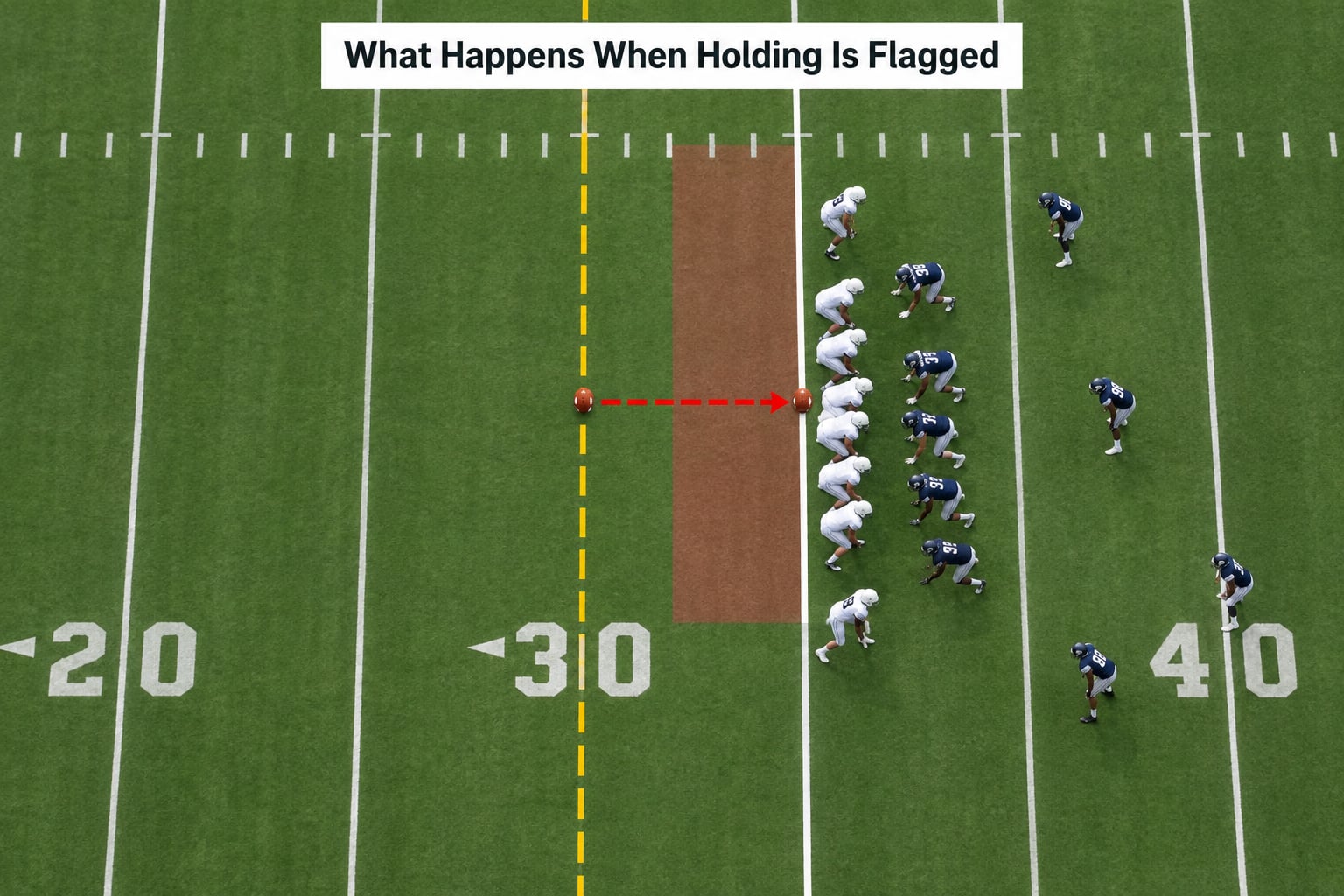
The enforcement runs in five steps, and the order matters when you are trying to follow what the crew is doing during a conference.
- The flag goes up. Any official on the field can throw it, not just the referee. The ball stays live, because the rule assumes the coach wants the play to finish.
- The play ends and the ball becomes dead. Once the runner is down or the whistle sounds, the flagged play is over and the game clock stops.
- The crew confers. Officials meet, sort out which team committed the foul, and decide whether there was a foul at all. This is where the “did he really hold it” argument gets settled.
- The offended captain is offered the decline. The team that was fouled can accept the penalty or reject it and keep the result of the play. Almost nobody declines.
- The referee announces and spots it. He gives the foul, the team, the number if the jersey is visible, the distance, and the next down. The ball is placed at the previous spot and 10 yards are marked off from there.
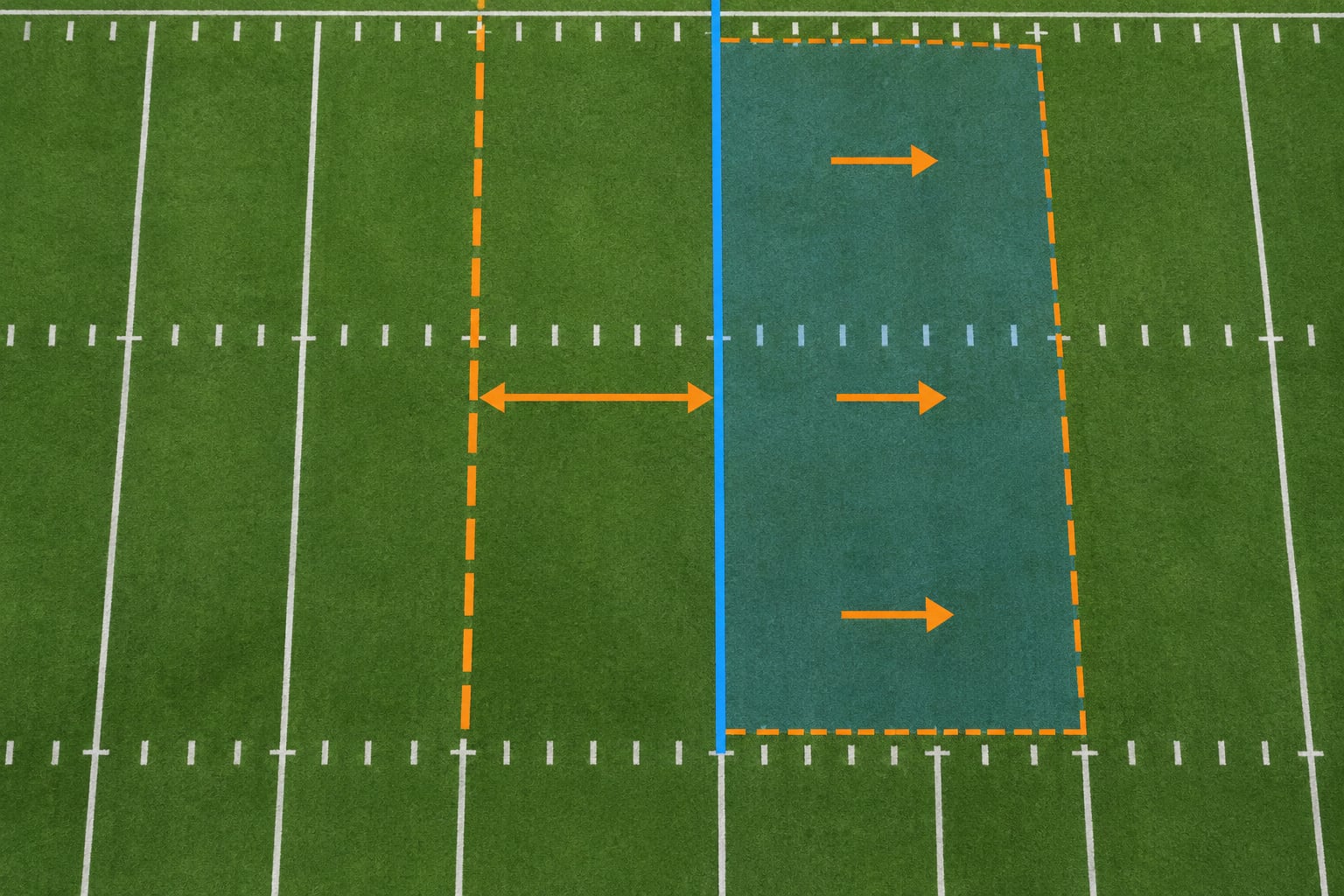
That last step is where most confusion lives. Holding is enforced from the previous spot, not from where the flag was thrown. The previous spot is the line of scrimmage as it was when the ball was snapped, before the penalty. The previous neutral zone rule extends the enforcement back behind that line when needed so the offense cannot gain from its own foul.
Worked example: first and 10 from the 30. The running back breaks through for a 25-yard gain and the official flags holding at the line. Accept the penalty and the ball is put back at the 30, 10 yards marked, making it second and 20. The 25-yard run is gone.
Two more enforcement rules explain a lot of odd-looking spots. First, a penalty cannot take the ball closer than half the distance to the goal line, so a 10-yard loss near the end zone often ends up as a shorter loss. Second, holding in the end zone is a safety, which is why a late grab at the goal line is occasionally the most expensive thing a defense can do.
How the Penalty Changes the Down and Field Position
The yardage is always the same, so the only variable is the down. Because holding does not carry a loss of downs by itself, the result depends on the situation when the ball was snapped.
| Situation when flagged | Result | New situation |
|---|---|---|
| First down, holding by either team | 10-yard loss, down repeated | Second and 10 |
| Second down, defensive holding | 10-yard loss, down repeated | Third and 10 |
| Third down and short | 10-yard loss | Fourth and long |
| Fourth down | 10-yard loss, down repeated | Fourth and 20 |
| Repeat offender, coach chooses | Loss of down added to the 10 yards | Next down with a new set of downs |
Notice that in four of those five rows the offense simply loses ground and the down count keeps moving the wrong way. Nobody gains a down from yardage alone in college football.
How College Football Holding Penalties Affect the Down
Holding has no built-in loss of downs, so a team can be handed a new set of downs only when the penalty runs on a first down and the yardage carries the ball past the first-down marker. Start first and 10 at the 20, take a 10-yard holding penalty, and the ball is spotted at the 20 again, which is first and 10 all over again.
The one exception is a coach who decides the repeated holding is by a specific player bad enough to warrant it. In that case the 10-yard penalty still applies and the down is lost as well, which on third down can turn a fourth-and-4 into a fourth-and-14 and then into a punt.
Consecutive holding by the same player is the common version of that. The officials hold the number aside, report it to the coordinator between plays, and if the pattern continues the coach is told the next one is a loss of down. It is announced differently on the field, so fans usually know before the broadcast explains it.
Accepted Holding Penalties and When the Down Stays the Same
A declined penalty and an accepted penalty produce two very different outcomes, and the difference is easy to miss on television because both start with a flag and both end with the referee talking.
When the offended team declines, the result of the play stands and the penalty is thrown out. A 25-yard run with a hold on it stays a 25-yard run, and the down counts normally from wherever the ball ended up. That is why defenses rarely decline offensive holding and why offenses rarely decline defensive holding.
When the penalty is accepted, the yardage is enforced from the previous spot and the down count is handled under the rules above. Accepting does not automatically create a new first down in college football, even for the team that benefits from the flag. If a defense is called for holding on a first-and-10 from the 40, the offense takes the ball at the 40 and it is second and 10. Pass interference is the foul that gives you the new down, not holding.
One thing to expect after any accepted flag: the clock situation changes. A flagged play stops the game clock, and in both the NCAA and the NFL there is a ten-second runoff for many defensive penalties, which is a big reason a defense will sometimes accept a holding call rather than fight it.
Common Holding Calls in College Football
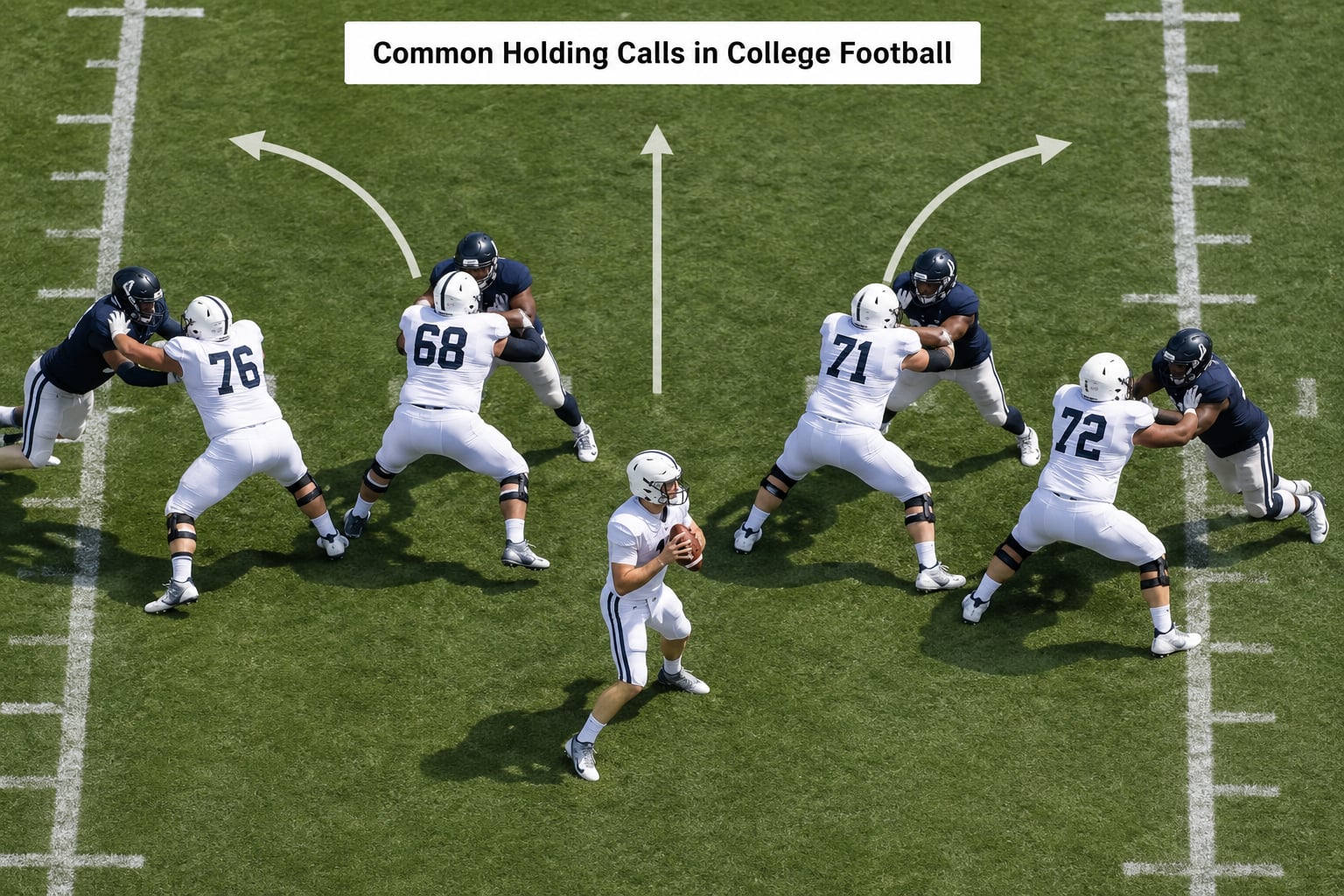
Holding shows up in a handful of shapes, and once you can name the shape it becomes much easier to follow a broadcast.
The two-hand grab at the line
An offensive guard who cannot win on technique reaches out with two hands to shove a defensive lineman past the pocket. Because the lineman cannot pursue the quarterback, the crew flags it. This is the most common offensive holding call in the game.
The hold on a pass rusher
Similar shape, different consequence. When the quarterback holds the ball a beat longer, a lineman grabbing a rusher’s arm becomes visible to the official who is responsible for contact behind the pocket.
The defensive grab before the throw
A cornerback holds the receiver’s arm or shoulder before the ball is thrown. That is holding, and the ball stays live because it is not interference.
The grab during the flight of the ball
This is the one that splits fan threads. If the defender takes hold of the receiver’s arm or body while the ball is in the air and the play becomes more than a marginal pull, it is pass interference instead, because the foul now impedes a pass in progress. Same hands, same player, different rule, decided by the position of the ball at the moment of contact.
Holding in the red zone and on the goal line
The half-the-distance rule compresses enforcement near the goal line, so a 10-yard loss can become a 4-yard loss. Holding with the ball already in the end zone is a safety, so defenders get very quiet with their hands in short-yardage situations.
Holding on special teams
Punts, kickoffs, extra points and field goal tries all fall under the same foul. It matters most on kick coverage, where a hold by either team can wipe out a long return and turn coverage into a short field.
Holding used to run the clock
Late in a game, a team losing can hold on purpose: take the flag, burn 25 seconds, repeat it. The defense’s answer is to be disciplined, accept the first flag and use its timeouts.
Holding vs. Other Offensive Penalties
Four flags get tangled up with holding on every broadcast. This table is the fastest way to sort them out.
| Foul | What actually happened | Ball status | Yards in college |
|---|---|---|---|
| Holding | Hand-to-hand control of an opponent who is not the ball carrier | Play continues | 10 |
| Illegal use of hands | A strike or contact to the head, neck or shoulder area | Play continues | 10 |
| Illegal contact | Contact inside the strike zone that is not incidental | Not a college football foul | N/A in college |
| Pass interference | Contact with a receiver while the pass is in the air that goes beyond a marginal pull | Dead ball | 10, automatic first down |
| Block in the back or clipping | Contact from behind or at the knees, usually away from the ball | Play continues | 10 |
| False start | Movement before the snap, an entirely different phase | Dead ball before the snap | 5, loss of down on repeat |
Two more sit close to holding. Offensive pass interference, where an eligible receiver blocks before the quarterback throws, was reduced to a 10-yard penalty with no first down, so it no longer looks like a pass-interference-flagged deep ball. And roughing the passer is its own foul entirely, aimed at contact with the quarterback rather than with a blocker.
Frequently Asked Questions
Is holding always a 10-yard penalty in college football?
Yes. In college football, holding is 10 yards whether it is committed by the offense or the defense, and there is no shorter version of the foul. The exception is holding in the end zone, which is a safety. Contrast that with the NFL, where defensive holding is 5 yards with an automatic first down.
Does an offensive holding penalty automatically make it first-and-10?
No. Taking a 10-yard loss on a first down does not hand the offense a new set of downs; it puts them in second and 10. A new first down from penalty yardage only happens when the enforcement carries the ball past the first-down marker, which is rare in college football.
Where is the spot of enforcement for a college football holding penalty?
The previous spot, meaning the line of scrimmage as it stood before the play began, not the place where the flag was thrown. A separate rule extends enforcement back behind the line when needed, and a penalty can never take the ball closer than half the distance to the goal line.
What happens if the same player commits holding on consecutive plays?
The 10-yard penalty applies again as normal. Officials also report the number to the coordinator, and if the pattern continues the coach is warned that the next one carries a loss of down on top of the yardage. That is the mechanical version of a well-known second-and-long mistake.
Can a defensive holding penalty give the offense a first down?
Not from yardage alone. Defensive holding in college football is the same 10-yard penalty and the down is repeated, so the offense still has to earn the first down. Pass interference is the foul that grants an automatic first down, which is why fans often mishear holding calls as drive-killers when they are simply yardage.
Conclusion
How college football holding penalties work comes down to four things: an official decides a player materially restricted an opponent, the flag makes the play dead, the crew confers, and the ball goes back to the previous spot with 10 yards marked off. What happens to the down after that depends entirely on the situation the offense was in when it broke huddle.
So when you hear the flag and then the announcement, listen for the two pieces of information that explain everything: which team was penalized, and what down is coming up. Everything else, including the part where a 25-yard run disappears, follows from those.