Targeting is a foul in which a player launches at an opponent, or strikes the head or neck area of a defenseless opponent with the helmet, forearm, fist, elbow or shoulder. Under NCAA rules, any hit that goes beyond making a legal tackle, a legal block, or playing the ball is targeting. The penalty is 15 yards, plus an automatic ejection for the rest of the game.
This guide follows the 2026 NCAA Football Rules Book, not the NFL. The change worth knowing about came from the Football Rules Committee, which replaced the old first-half and second-half carryover structure with a progressive three-strike suspension and an appeals process. Most explainers still describe the old version.
Here is how targeting penalties work in college football, from the definition in the rulebook to the replay booth to the box score three months later.
Table of Contents
- What Is a Targeting Penalty in College Football?
- College Football Targeting Penalties at a Glance
- How Do Officials Identify Targeting?
- What Happens When a Targeting Penalty Is Called?
- Is Every Targeting Call Automatically Reviewed?
- How Does Review Change or Confirm a Targeting Call?
- How Do Targeting Penalties Affect Offensive and Defensive Strategy?
- Targeting Rules in College Football vs. the NFL
- Frequently Asked Questions
- Is contact to the head always a targeting penalty in college football?
- How is college football targeting different from roughing the passer?
- Can another penalty offset a confirmed targeting foul?
- What is the standard for reversing a targeting call during replay review?
- Does a targeting penalty automatically give the offense a first down?
- Conclusion
What Is a Targeting Penalty in College Football?
Targeting is not a tackle that is simply too hard. It is a foul where a player goes outside the limits of a legal tackle, a legal block, or playing the ball. The rulebook splits that into two separate fouls, and an official can call either one.
Crown-of-the-helmet targeting (Rule 9-1-3) covers a defender who initiates forcible contact against an opponent’s head or neck area, or against a receiver who has not had the opportunity to defend against a pass. Leading with the top of the helmet, with the forearm, fist, elbow or shoulder is a prime example.
Head or neck contact with a defenseless opponent (Rule 9-1-4) covers contact with a player who is vulnerable because of position, and a defender must avoid initiating contact with the head or neck area in that situation.
What crown of the helmet actually means
The phrase is narrower than most people assume. The NCAA tightened its definition in 2022 to the top segment of the helmet, described as a circular area within a 6-inch radius from the apex. Contact below that line is a personal foul for illegal contact, not automatic targeting, and an official calling targeting on a graze to the ear is asking for a conversation after the game.
One edge case surprises viewers every season: a crown-of-helmet call can stand even when the player who was hit was not defenseless at all. If the tackler launched with the top of his helmet into a receiver who was perfectly protected, that is still targeting.
What is not targeting
A hard, legal tackle is not targeting. Neither is incidental contact when a defender is wrapping up a ball carrier and the football moves, contact after the runner has gone to the ground and slid feet-first, or a defender striking the torso on an otherwise clean pursuit. The distinction is intent plus position, and it is decided on the field with two eyes and then again in the booth.
A short history of the targeting rule
The rule has been rewritten four times in under two decades, which is why so much published material is stale. The targeting foul itself was adopted in 2008. By 2013 the automatic ejection was mandatory, ending the era where an official could decline to eject. The crown-of-the-helmet definition was tightened in 2022. And the most recent rewrite replaced the penalty structure with the progressive system covered later in this guide.
College Football Targeting Penalties at a Glance
Everything a viewer needs to know in one table. The two rows are separate fouls in the NCAA rulebook, and the enforcement and consequences are identical.
| Element | Crown-of-helmet targeting (9-1-3) | Head or neck contact with a defenseless opponent (9-1-4) |
|---|---|---|
| Protected player | Any opponent, including one who is not defenseless | A defenseless player in one of the listed situations |
| Illegal act | Launching at or initiating forcible contact to the head or neck area | Initiating contact with the head or neck area of a vulnerable player |
| Key phrase | Crown of the helmet, the area within a 6-inch radius from the apex | Forcible contact; when in question, it is a foul |
| Enforcement | 15-yard penalty | 15-yard penalty |
| Spot of the foul | Where the foul occurs | Where the foul occurs |
| Review | Eligible for instant replay under review criteria | Eligible for instant replay under review criteria |
| Confirmed result | Automatic ejection and disqualification for the rest of the game | Automatic ejection and disqualification for the rest of the game |
How Do Officials Identify Targeting?
An official running to the monitor is not reacting to one hard hit. There is a sequence of checks, and each one has to point the same direction before the flag is warranted.
- Position of the player being hit. Is he actually defenseless at the moment of contact, or is he upright, balanced and able to defend himself?
- Who initiated contact. Did the tackler drive through the upper body with the top of his helmet, or was the contact driven by the runner lowering his head into an otherwise legal wrap-up?
- Initiation of forcible contact. A defender who launches, is airborne, or has lowered his helmet to create force is treated differently from one who arrives under control.
- Football moves. Officials use the movement of the ball as a real check. If the ball pops free on contact, that supports the call.
- The action, not the outcome. A player who gets launched into the end zone without a penalty is usually a player who was not defenseless. The rule polices the act, not how the victim landed.
It helps to separate four things that get mashed together on the couch. Targeting requires launching or forcible contact to the head or neck. Dangerous play is a separate foul covering actions like a player driven to the ground by an airborne teammate. A personal foul is ordinary illegal contact, such as a hit to the helmet that misses the targeting standard. And incidental contact is contact that happens during a legal tackle and is simply not a foul.
What Happens When a Targeting Penalty Is Called?
A confirmed targeting foul produces three things at once: 15 yards, an automatic ejection, and disqualification for the remainder of the game. It is enforced at the spot of the foul, it is a no-gain situation, and the offense gets a new series with a first down. The penalty does not offset, and the offense does not get a new set of downs because of anything replay decides afterward.
Under the old structure, where the call happened mattered enormously. A first-half ejection carried no suspension. A second-half ejection cost the player the first half of the following game, which meant a player could miss a game he was never going to play in, and in the case of Miami defensive lineman Xavier Lucas after a College Football Playoff semifinal, it reached a national championship game.
New for 2026: the three-strike suspension structure
The latest change fixed the part of the rule nobody could defend. Carryover is now progressive and tied to how many targeting fouls a player commits in a season, not to which half the call happened in.
| Offense number in the season | Game penalty | Suspension carried into the next game |
|---|---|---|
| First | Ejection and disqualification for the rest of the game | None |
| Second | Ejection and disqualification for the rest of the game | Miss the first half of the next game |
| Third | Ejection and disqualification for the rest of the game | Miss the entire next game |
There is an appeals path attached to it. The first two targeting penalties go to the National Coordinator of Football Officials, who reviews the video and can change the suspension. A third offense is the end of the line, with no appeal that removes the game.
Targeting is not the same as unsportsmanlike conduct or a flagrant foul
This is the most common mix-up on game day, and the penalties are not interchangeable.
| Foul | What it covers | Yardage | Ejection | Repeat-offender consequence |
|---|---|---|---|---|
| Targeting | Launching or forcible contact to the head or neck | 15 yards at the spot of the foul | Automatic | Progressive three-strike suspension under 2026 rules |
| Flagrant foul 1 | Disregard for the safety of players | 15 yards and loss of down | Not automatic | Two in one game bring a personal foul escalation |
| Flagrant foul 2 | Flagrant 1 plus egregious, threatening or dangerous conduct | 15 yards and loss of down | Automatic | Separate progressive suspension track |
| Unsportsmanlike conduct | Disrupting the play, taunting, or a bench-clearing incident | 15 yards | Automatic on the second such penalty in one game | No carryover |
| Ordinary personal foul | Illegal contact outside targeting | 15 yards at the spot of the foul | No | None |
Offensive targeting exists too. An offensive player who uses the crown of the helmet or launches at a defender can be flagged under the same standard, which is a fact that gets lost when a discussion only looks at one side of the ball.
Is Every Targeting Call Automatically Reviewed?
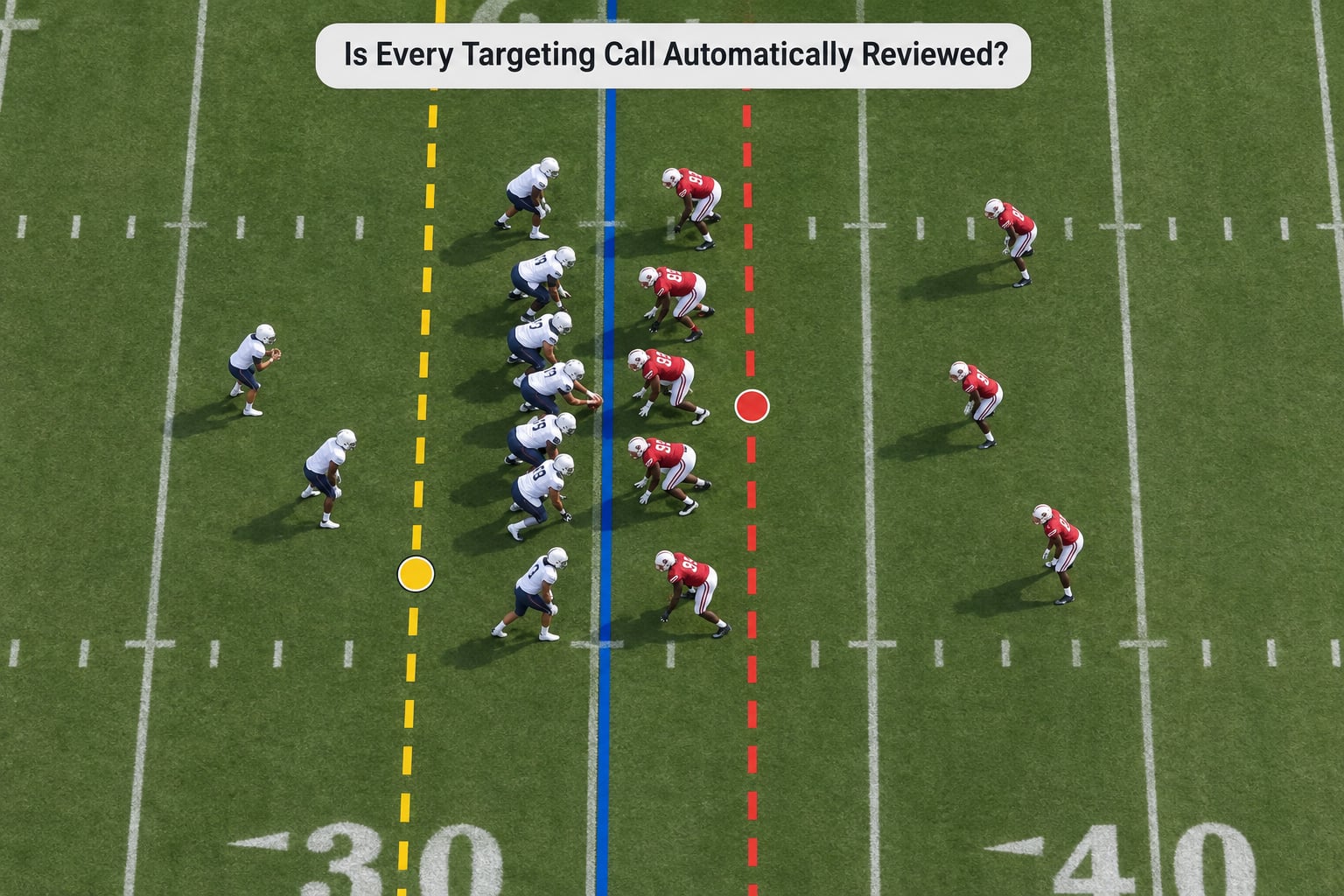
No. A targeting call is eligible for instant replay under the NCAA review criteria, but it is not the automatic-review category it once was, and the standard of what gets sent to the monitor changes with the situation.
When a call goes up, the video judge looks at the angle that shows the act, with the central zone official and a second video official working in the booth. A coach’s challenge is not a route to a targeting call either, since challenges are limited to specific categories that do not cover personal fouls of this kind.
One thing to keep in mind: replay does not apply a stricter or looser rule than the field official did. It applies the same standard, with better angles.
How Does Review Change or Confirm a Targeting Call?
The review runs in a fixed order, and it is short enough that you can follow the reasoning if you know what the booth is checking.
- Identify the relevant angle. The officials pick the view that shows the body position at the moment of contact, usually the end-zone or sideline camera.
- Decide defenseless or vulnerable. They look at what the player being hit was doing: his position, his balance, and whether he had the ability to defend himself.
- Examine the point of contact. The question is where the contact started and whether the tackler drove into the head or neck area, with the ball as a supporting check.
- Apply the standard. Forcible contact against the head or neck area of a defenseless player, or a launch with the crown of the helmet, is targeting. The rulebook’s own language settles borderline cases: when in question, it is a foul.
- Communicate the ruling. The decision comes back to the field as a confirmed or changed call.
When the call does not hold, the penalty and the ejection both come off. There is no partial outcome where a player is ejected but the 15 yards disappear, and the replay official cannot keep the yardage while reversing the ejection.
What video does targeting replay review use?
Typically the end-zone angle or the sideline angle that shows the full body position at the moment of contact, with a second camera as a backup if the first is obstructed. The booth looks for a clear view of where the hands, shoulders and helmet are at the instant of contact. If no angle gives a clean look, the on-field ruling generally stands.
How Do Targeting Penalties Affect Offensive and Defensive Strategy?
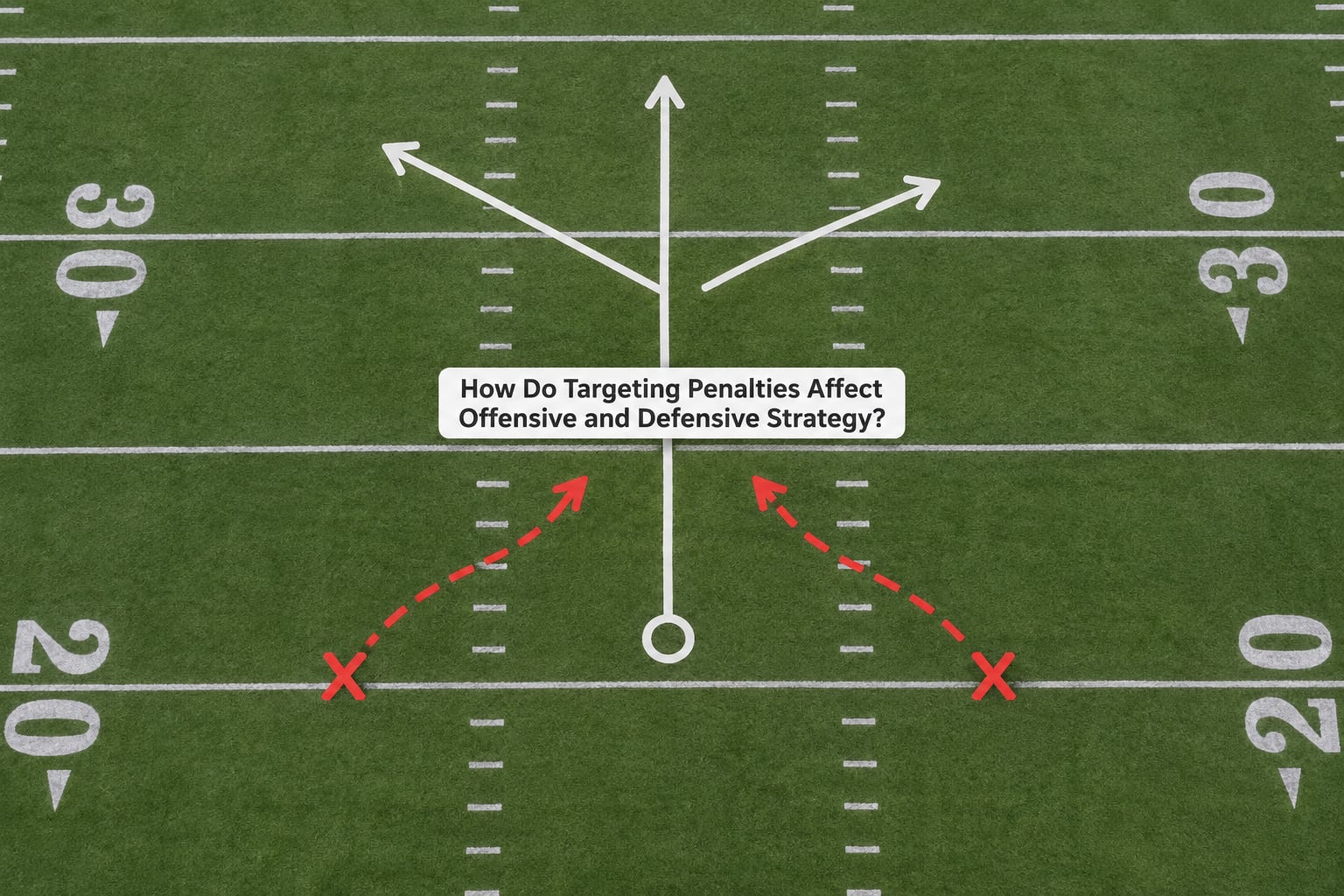
Coaches build a whole season around avoiding these calls, because the yardage is the smaller problem. A defender who takes a bad angle on a deep route is not giving up 15 yards, he is out for the night and possibly for a quarter of the next one.
Defensively, the adjustments are visible. Safeties take shallower angles and finish from a lower base, closing out underneath rather than arriving through the receiver’s head. Linebackers are coached to roll off the crown, and defensive backs are told that a legal hit to the torso, taken at speed and under control, is worth far more than a shot at the head that gets flagged. Some programs drill a wrap-and-drive finish specifically to build a habit that survives contact.
Offensively, the answer is movement. More pre-snap motion, shifts and formation variation make it harder for a safety to guess an arriving angle, and route designers start avoiding the static seam curl that invites a downhill hit. A quarterback who catches a pass after a change of possession is defenseless in the act of throwing, so post-play contact there is treated strictly, and punt and kick coverage gets the same instruction around the kicking motion.
The yardage itself is rarely what changes a game. The ejection is what moves field position, because a defense that loses a starting safety for the rest of the half is playing a different game than the one it scouted, and the offense gets a fresh set of downs with that advantage already banked.
how targeting penalties work in college football strategy
Seen from the sideline, the rule is an insurance policy that both teams buy. Defenses take a little yardage out of play to avoid a much larger loss, and offenses lose a little explosive-option appeal to keep the protection they have. The tactical effect is a league that punts and plays field position more than it used to, and a rule that shapes weeks of practice for a penalty most weeks never see.
Why fans and defenders keep arguing about this rule
The loudest complaint in college football forums is an asymmetry that is real and built into the rulebook. A ball carrier may legally lower his helmet and lead with the crown, because he is not the one making a tackle. A defender who lowers his head into a runner in the same position is ejected. On message boards this comes up in nearly every targeting discussion, and defenders describe being ejected for contact they did not intend, with no way to argue it on the field.
Kirk Herbstreit has made the same case in public, and his proposed fix borrows from college basketball: a severity-graded flagrant 1 and flagrant 2 system instead of automatic ejection. Fans generally accept the safety goal and object to the punishment being identical whether the hit was a launch or a graze, which is exactly what the progressive structure was built to address.
The second complaint is consistency. Fans see near-identical hits flagged one week and waved through the next, and they read that as the replay booth being unpredictable rather than the rule being unclear. Officials see a standard that resolves close cases toward the defender by design, because when in question, it is a foul.
Targeting Rules in College Football vs. the NFL
The NFL has no targeting penalty at all, which is the fastest way to clear up most confusion between the two rule sets. There is no crown-of-the-helmet foul, no 15-yard targeting penalty, and no automatic ejection. An NFL official cannot send a player to the locker room for a hit to the head area, which is why a play that draws a flag in a college game produces nothing at all on Sundays.
The NFL handles dangerous contact through flagrant fouls, which can bring a personal foul, a loss of down, and a first-down repeat for a flagrant 1, while a flagrant 2 adds an automatic ejection. Repeat offenders are handled through the league’s escalating personal foul structure rather than a targeting-specific suspension track. Reviews are also different: the NFL does not review first-half and second-half targeting-style calls the way the NCAA does, and the automatic-review list is built around scoring plays and turnovers.
Everything above in this guide follows the NCAA Football Rules Book for the 2026 season. Conferences can be stricter in how they police contact, and the rulebook is amended every offseason, so check the current edition and your conference’s game notes before treating any specific call as settled.
Frequently Asked Questions
Is contact to the head always a targeting penalty in college football?
No. Contact to the head area is a foul only when it meets the targeting standard: forcible contact against the head or neck area of a defenseless opponent, or a launch using the crown of the helmet, defined as the area within a 6 inches of the apex. A hard but legal wrap-up, incidental contact during a tackle, or contact after the ball moves is not targeting. It may still be a personal foul, which carries the same 15 yards but no ejection.
How is college football targeting different from roughing the passer?
Roughing the passer is a separate foul for contact with an eligible passer after the snap, inside the pocket or downfield, and it carries 15 yards with no automatic ejection. Targeting applies to any opponent in one of the defenseless situations, not only quarterbacks, and it always ends with an ejection. A hit on a quarterback can be one or the other, or both, depending on where the contact lands and whether the passer was still in passing posture.
Can another penalty offset a confirmed targeting foul?
No. Once a targeting foul is confirmed, the 15-yard penalty and the ejection stand, and nothing offsets them. There is no offset, no accepted penalty that cancels the yardage, and no way to trade it back with a flag on the other side. The spot of the foul is where the contact occurred, the play is a no-gain situation, and the offense receives a new series with a first down.
What is the standard for reversing a targeting call during replay review?
Replay officials use the same standard the field official used, applied to a clearer angle. They check the position of the player being hit, whether he was defenseless, where the contact was initiated, and whether the tackler launched or used forcible contact against the head or neck. A call that does not meet the standard comes off entirely, penalty and ejection together. When it remains in doubt, the rulebook language says it is a foul.
Does a targeting penalty automatically give the offense a first down?
It creates a new series, so the offense gets a first down, but the first down is the result of the 15-yard penalty and the no-gain ruling rather than a penalty that treats the play as a first down. A confirmed call is enforced at the spot of the foul, which means the ball is spotted where the foul happened, not advanced to the penalty spot.
Conclusion
Two questions decide almost every targeting call. Was the player who got hit actually defenseless, and did the tackler make forcible contact with the head or neck area, or launch with the crown of the helmet.
If the first answer is yes and the second is yes, the result is 15 yards and an automatic ejection, with a progressive suspension that now starts at the second offense of the season rather than the second half of a game. Knowing how targeting penalties work in college football comes down to those two checks, and to the rulebook language that says when in doubt, it is a foul. Check the current NCAA Football Rules Book and the official ruling from the game in question when a call looks wrong, because the interpretation shifts as the rulebook is amended.