College football clock rules come down to three devices: a 60-minute game clock, a 40-second play clock, and a limited timeout count per half. The game clock runs almost continuously and only stops for specific reasons, then restarts either when the ball is snapped or when the referee gives a signal, depending on the stoppage.
The confusing part for most fans is that a first down almost never stops the game clock, so the last four minutes of a game often run differently from the first fifty-six. This guide covers how college football clock rules work on every clock on screen, when each one starts and stops, and why officials make some of the calls they do.
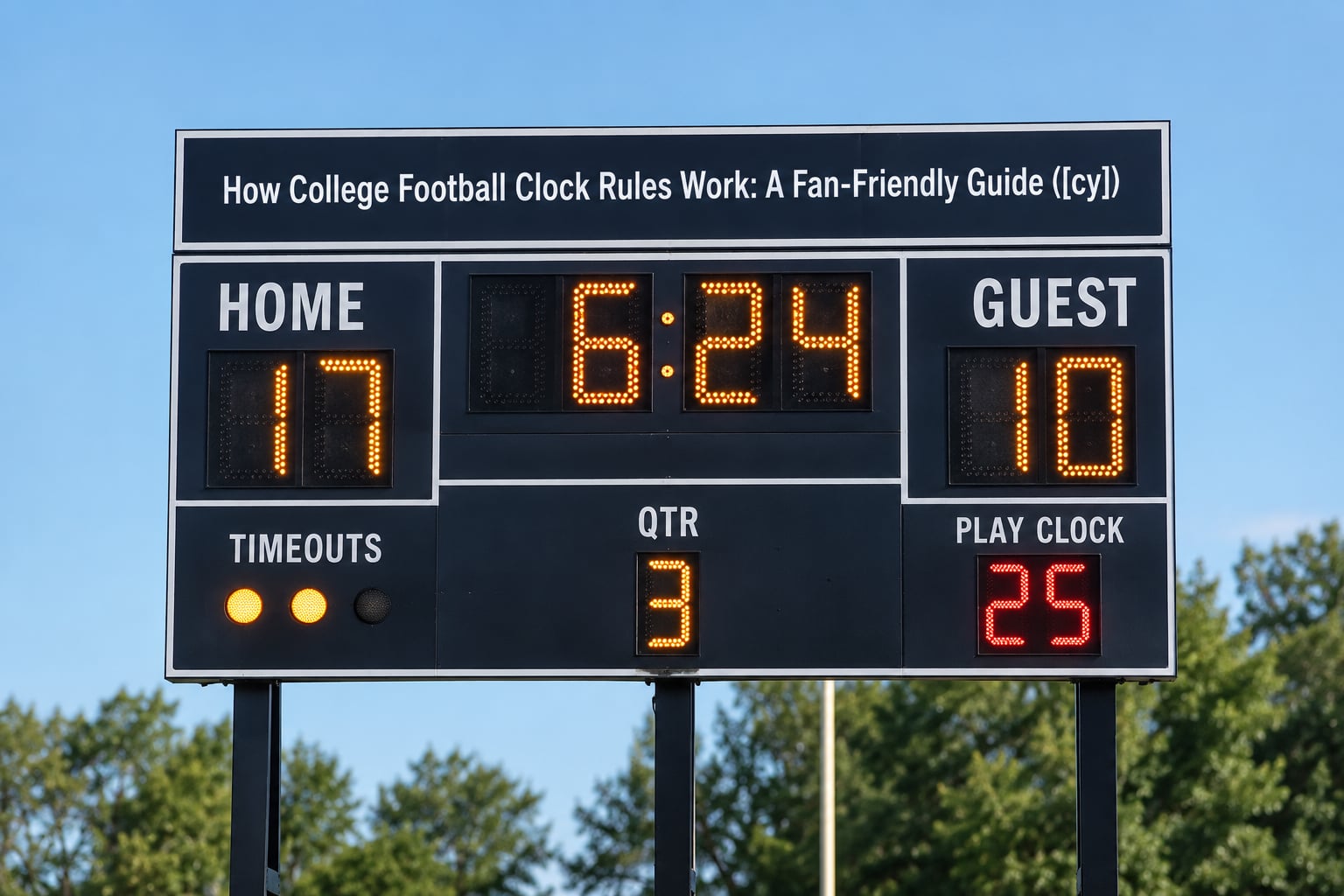
Table of Contents
- What Are the Three Clocks in College Football?
- How Does the Game Clock Start and Stop?
- How Does the Play Clock Affect an Offense?
- How Do Timeouts and Quarter Breaks Work?
- What Happens to the Clock During Penalties?
- How Does the Clock Work in Overtime?
- How Do Officials Signal Clock Changes?
- Example: Following the Clocks Through One Possession
- Frequently Asked Questions
- What is the difference between the game clock and the play clock in college football?
- When does the college football play clock reset to 40 seconds?
- Does the game clock stop after every tackle in college football?
- How long are NCAA football quarter breaks?
- What happens if the play clock expires before the ball is snapped?
- Key Takeaways
What Are the Three Clocks in College Football?
The game clock counts the 60 minutes of a regulation game. It runs during live plays and, since the 2023 rule change, keeps running after a first down too, which is the single biggest adjustment for anyone raised on the NFL.
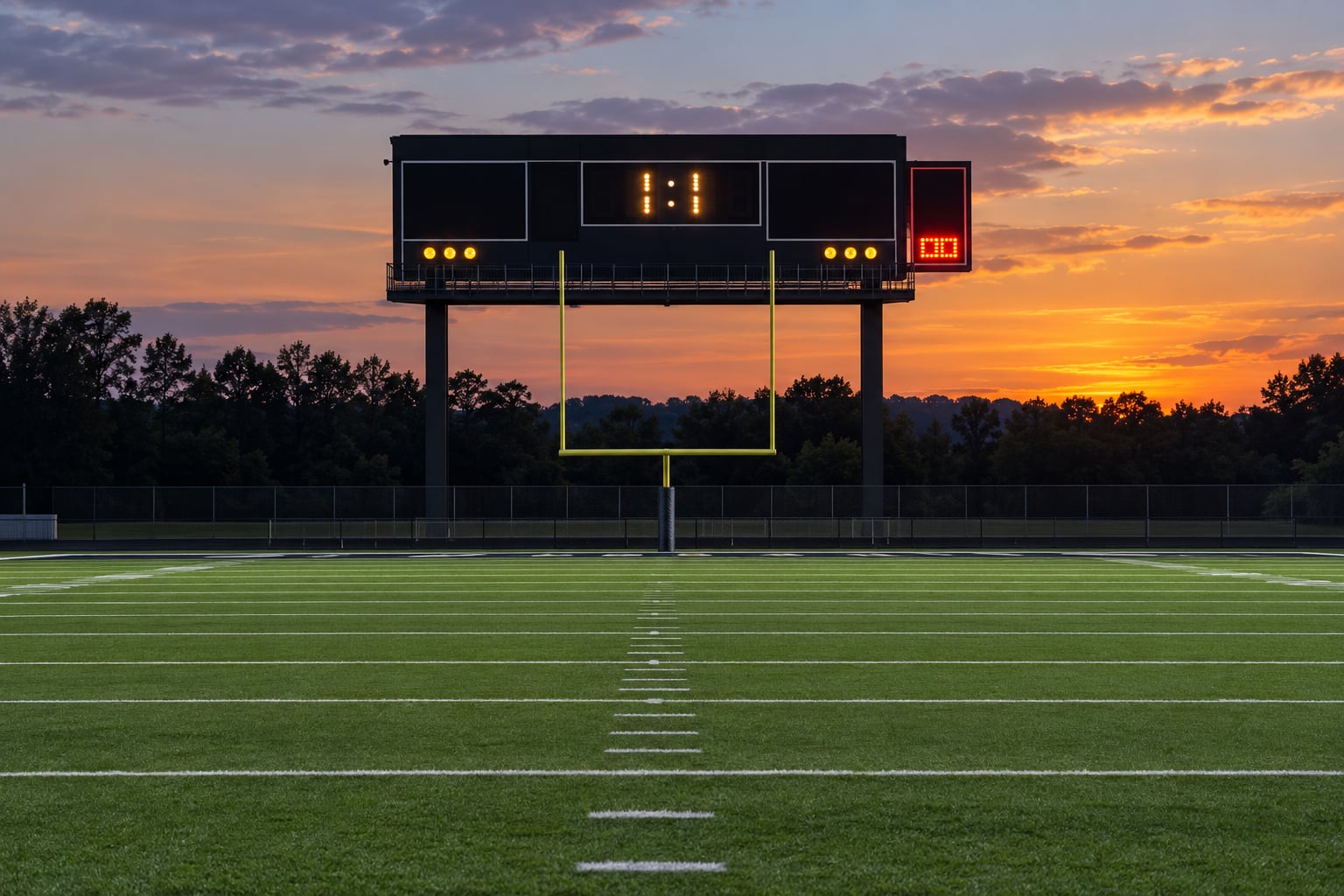
The play clock is the shorter countdown sitting beside it, with a red display over each end zone. It gives the offense a set window to put the ball in motion after the previous play ends.
The third “clock” is not a clock at all. It is the timeout count each side carries, plus the television timeout structure that decides when commercials land in each quarter.
| Device | What it controls | Who operates it | Typical value |
|---|---|---|---|
| Game clock | Time remaining in the period and the game | Clock operator, on the referee’s signal | 60 minutes total, 15 per quarter |
| Play clock | How long the offense has to snap the ball | Dedicated play clock operator | 40 seconds, or 25 in some situations |
| Timeouts | Stoppages a team may use | Each coaching staff | Three per half, plus television timeouts |
How Does the Game Clock Start and Stop?
NCAA Rule 3-3-2 lists the conditions that stop the game clock, and then divides the restart into two groups. That division is where nearly all fan confusion lives.
Starts on the snap. When a play ends with the ball out of bounds, when an incomplete pass hits the ground, or when a player goes down after a catch, the clock restarts the moment the ball is legally snapped. Nobody has to do anything. That is why you see the clock start on a first down: a new down begins with a snap, and snaps start the clock.
Starts on the referee’s signal. When a timeout is called, when a penalty is enforced, when a team changes possessions after a punt or turnover, or when officials stop play for injury or an equipment issue, the referee gives a visible signal and the clock operator starts the count from there. The clock does not run on its own in those cases.
The tiebreaker rule matters in close situations. If the referee’s signal and the snap happen nearly together, the snap supersedes the signal, and the game clock is treated as having started on the snap. That single detail is how college football clock rules work in the final seconds of a half: officials wait, watch the snap, and let the clock run only once the ball is clearly in play.
How College Football Clock Rules Work at Each Snap
Here is the sequence that produces almost every confusing moment in a game.
- The previous play ends and the ball is dead.
- If the ruling is an out-of-bounds play or a completed pass with the runner down, the play clock is set and the game clock is marked stopped, pending the referee’s signal.
- Officials spot the ball, and the offense sets its formation while the play clock counts down.
- The ball is snapped. Because the game clock was waiting on a snap condition, it starts on that snap.
- The play ends. Officials mark the ball dead, signal the clock operator, and the next cycle begins.
The part that trips people up is step two and step four happening in reverse order on penalties. After a defensive holding call the clock is already stopped, so the reset comes from the referee’s signal, not from the snap.
How Does the Play Clock Affect an Offense?
The play clock is set to 40 seconds in most situations under Rule 3-2-4. The exceptions matter, so here is the full picture.
| Play clock value | When it applies |
|---|---|
| 40 seconds | Default value after the ball is snapped and put in play, and after a change of possession, punt, or kickoff |
| 25 seconds | After an incomplete pass, after the offense is penalized for delay of game, false start, or illegal substitution before the ball is in play, and after certain change-of-possession situations |
| 25-second minimum | If the play clock is running down toward zero and an offense cannot snap, officials reset it to 25 rather than allow a play |
| Off | Inside the final 40 seconds of a quarter, and in the final two minutes of the second quarter or final four minutes of a fourth quarter under current protocol |
That 25-second floor is the reset-to-40 issue fans ask about constantly. If the play clock drops below 25 seconds, officials reset it to 25 and the offense gets a fresh, shorter count rather than being handed a dead ball.
Two more details from the same rule. The play clock never displays tenths of a second, so the last second shown stays on screen for a full second and the final count snaps to zero all at once. That is why an entire second can appear to vanish on the last play of a quarter.
Coordinating teams also watch the reset. When the play clock is set to 40, defensive substitutions are restricted during the first stretch of the count, which compresses the substitution window late in a game. The same restriction does not apply in the same way when the clock is set to 25.
How Do Timeouts and Quarter Breaks Work?
Each team gets three timeouts per half, plus one timeout per half that is designated for television and does not count against the three.
A team cannot use timeouts on consecutive plays, so coaches spread them across a quarter instead of burning two on a single dead ball. Unused timeouts do not roll over either: whatever is left in a half expires at halftime, which is why the fourth-quarter count always starts fresh.
Timeouts can be recalled. A coach who signals a timeout and changes his mind before the ball is snapped can take that timeout back.
Quarter breaks run 15 minutes, halftime is 20 minutes after the second quarter. The game clock does not run during any of them.
The Two-Minute Timeout replaces the old two-minute warning model inside each half. Inside the final two minutes of the second quarter and the final four minutes of the fourth quarter, the game clock stops after every first down, the play clock is not required, and coaches may use timeouts freely within their remaining count. That window is where most late comebacks are built.
What Happens to the Clock During Penalties?
The pattern is simple. When the stoppage is caused by a penalty or an administrative issue, the game clock does not start on the snap. It waits for the referee’s signal.
Certain violations also cost the offense a 10-second runoff, meaning the ball is snapped and the clock starts with ten seconds subtracted. The big offenders are false starts, delay of game, illegal substitution, and illegal blocking before the snap. There is one exception worth remembering: no runoff happens inside the final minute of a quarter, so a first-and-10 at 0:47 stays first-and-10 with the clock at 0:47.
An untimed down is a snap taken with the game clock stopped, most often after a first down in the Two-Minute Timeout window, after a change of possession, or before a penalty administration. If a penalty leaves the ball short of the line to gain at the end of a quarter, that quarter is extended with an untimed down so the offense can pick up the first down.
An inadvertent whistle stops the clock, but the play usually still counts if the ball was live and the snap happened before the whistle. Officials do not stop the game for a whistle once the ball is dead by rule.
How Does the Clock Work in Overtime?
College football overtime uses periods of eight minutes, with only the final two minutes of the last period treated as a Two-Minute Timeout window. The game clock follows the standard rules otherwise, including running after the first down.
Each period is a full possession unless a team scores on its first snap, in which case the period ends right there. The play clock works the same way, at 40 seconds or 25, and timeouts are limited rather than eliminated, so a team cannot simply burn the period with repeated stoppages.
How Do Officials Signal Clock Changes?
Watch three things and you will never be surprised by a clock change again.
- The referee’s arm. A raised arm with a clenched fist is the visible signal to start the clock. A crossed arm is the stop signal. When the referee drops an arm toward the ground, the clock starts on the snap.
- The play clock operator. A reset to 40, then a drop to 25 for an incomplete pass or a pre-snap offense penalty, is almost always visible before the offense knows it.
- The sideline. A timeout signal from the coaching staff, followed by a substitution of the timeout marker on the scoreboard, confirms a charge.
One more official’s habit is worth knowing. Because the play clock shows no tenths of a second, a clock operator will not start the game clock until the snap is clearly complete. In tight end-of-half situations that hesitation is why a play sometimes appears to have started late.
Example: Following the Clocks Through One Possession
A team trails by four with 6:20 remaining in the fourth quarter and the ball at its own 20.
First down, a run for four. The clock keeps running because it is outside the Two-Minute Timeout window, dropping to 6:12 on the snap. The play clock resets to 40 after the run.
Second down, an incomplete pass. The play clock drops to 25, the game clock stops, and the offense burns a timeout. The clock now waits on the referee’s signal.
Third down, a completion and a tackle in bounds. The game clock restarts on the snap, so the offense gains roughly 12 seconds of field position per play, which is why teams in this situation attack the sideline and force the defense to spend timeouts.
At 2:05 the trailing team crosses into the Two-Minute Timeout window. Now the game clock stops after the first down, the play clock is optional, and the offense controls exactly how much time each snap consumes. The leading team’s answer is to spend its remaining timeouts immediately and force long-yardage situations.
At 0:37, a first down after a penalty, no runoff is applied because the offense is inside the final minute. The clock sits at 0:37 on every scoreboard in the building until the snap.
Frequently Asked Questions
What is the difference between the game clock and the play clock in college football?
The game clock counts the 60 minutes of a game and runs during plays and, since 2023, after most first downs. The play clock is a separate 40-second countdown that the offense must beat to snap the ball. A possession can end with plenty of time still on the game clock because the play clock expired first.
When does the college football play clock reset to 40 seconds?
The play clock resets to 40 seconds after the ball is snapped and put in play, and after a change of possession, punt, or kickoff. It is set to 25 seconds after an incomplete pass or a pre-snap offensive penalty such as false start or delay of game. If the count falls below 25, officials reset it to 25 rather than let it expire.
Does the game clock stop after every tackle in college football?
Not usually. Since the 2023 rule change the game clock keeps running after a first down and after a completed pass, so it stops mainly on out-of-bounds plays, incomplete passes, and stoppages by official ruling. The exceptions are the final two minutes of the second quarter and the final four minutes of the fourth quarter, where the clock stops after every first down.
How long are NCAA football quarter breaks?
Quarter breaks last 15 minutes and halftime lasts 20 minutes. The game clock is stopped for the entire intermission, as it is for any injury or administrative stoppage, so no game time is lost during a break. Television timeouts are taken during these windows and are separate from the three team timeouts available in each half.
What happens if the play clock expires before the ball is snapped?
The ball is ruled dead and the offense takes a loss of downs, with the play clock resetting to 25 seconds. If the offense already had a first down, it gives up the new set of downs. The game clock is stopped at that moment and does not restart on the next snap without a referee signal, since the stoppage was caused by an offensive failure.
Key Takeaways
The game clock keeps running after a first down, which is why possessions last seconds instead of minutes. Play clock resets of 40 and 25 follow specific situations, and the 25-second floor explains resets that otherwise look random.
Watch four things and the rules stop being mysterious: the snap, the play clock operator’s signal, the referee’s raised arm, and the timeout count on the scoreboard. Everything else follows from those.