If you have ever wondered how college football rankings are decided each week, the short version is that three independent groups do it separately and rarely land on the same order. Sportswriters vote for the AP Poll, FBS head coaches vote for the Coaches Poll, and a 13-member committee ranks teams during the postseason for the College Football Playoff. Computer models like NET, FPI and SP+ publish their own numbers too. Every one of them updates on its own schedule, which is why your team can climb on Sunday and fall in the CFP rankings two weeks later.
Table of Contents
- What Determines the College Football Rankings Each Week?
- The Major College Football Rankings at a Glance
- How AP Poll Voters Rank Teams
- How the Coaches Poll Is Different
- How Computer Rankings Turn Games Into Ratings
- What Does NET Mean in College Football Rankings?
- Why Does Strength of Schedule Matter So Much?
- What Happens During Selection Committee Reordering?
- How Each Week Can Change a Team’s Ranking
- Do Rankings Decide Who Makes the College Football Playoff?
- Can Rankings Change After the Season Ends?
- Frequently Asked Questions
- Conclusion
What Determines the College Football Rankings Each Week?
College football rankings are decided weekly by ballots, formulas and committee judgment. The AP Poll and Coaches Poll each collect private rankings of 25 teams from their voters and convert them into points. The College Football Playoff committee ranks teams itself in meetings, and computer models recalculate after every game using wins, opponent quality and scoring efficiency.
The confusion fans run into usually starts with the count. There are five systems people are calling “the rankings,” and they do different jobs:
- AP Poll — 61 national media voters, published every Sunday during the season.
- Coaches Poll — a panel of FBS head coaches run by the American Football Coaches Association.
- CFP committee rankings — a 13-member committee’s ranking of the top 25, revealed on Tuesday nights in November and December.
- NET — the NCAA’s multi-factor evaluation tool, published by the NCAA.
- Play-by-play models — FPI, SP+, Sagarin, Massey-Peabody, Fremeau and others, each with its own formula and its own publisher.
None of them votes on the others. A team can be No. 3 in one and No. 12 in another on the same Sunday afternoon.
The Major College Football Rankings at a Glance
| System | Who produces it | What it measures | Updates | Playoff role |
|---|---|---|---|---|
| AP Top 25 | National media voters | Points from 61 private ballots, 25 down to 1 | Weekly on Sundays | One input among many for the committee |
| Coaches Poll | FBS head coaches (AFCA) | Points from coach ballots with the same 25-to-1 scale | Preseason, weekly, and a final poll | Another committee input; carries prestige |
| CFP rankings | 13-member selection committee | Group judgment on team quality and field ordering | Tuesdays in November and December | Determines seeding and, in practice, field access |
| NET | NCAA | Six inputs combined into a single index | Weekly | An access index for the committee, not a ranking |
| FPI / SP+ / Sagarin | ESPN / ESPN+ / publishers | Play-by-play expected points, win probability, transitive comparisons | Continuously, and after each game | Research material the committee reviews |
How AP Poll Voters Rank Teams

The AP Poll is the cleanest mechanism in college football. Each of the 61 voters submits a private ordered list of 25 teams, and each ranking is worth points: 25 points for a voter’s No. 1 team, 24 for No. 2, all the way down to 1 point for No. 25.
How a weekly AP ballot actually works
Voters rank teams before they know the totals, which keeps the count honest. After the order is locked in, each voter converts it into numbers, the AP adds up every ballot, and teams are sorted by total points. A team that gets first-place votes but sits low on most other ballots can still land outside the top 25. A team ranked 25th by a single voter appears in the poll on the strength of one ballot plus first-place votes, which is why newcomers tend to jump in at No. 24 or No. 25 rather than No. 12.
AP also applies a bookkeeping convention: a ranked team is treated as beating an unranked team for the purpose of records voters consider. Beat a team ranked above you and that counts much more than beating a team with no ranking at all. That single rule explains a lot of weeks that look strange to newcomers.
How the Coaches Poll Is Different
The Coaches Poll asks FBS head coaches to fill out the same 25-to-1 points ballot, which makes the arithmetic identical and the judgment different. Coaches are barred from voting for their own team, and the panel also decides the preseason poll weeks before anyone plays a game.
The Coaches Poll runs three times a year as a formal ranked poll: a preseason edition, a weekly edition through the regular season, and a final poll after the season ends. Voters are coaches, so the tendencies skew differently than the media poll. Conference bias is the complaint fans raise most often, and it is a structural feature rather than a scandal: coaches watch the same opponents, play the same teams and argue for the same recruits, so an undefeated conference doormat can sit high on the Coaches Poll while a two-loss power conference team sits below it.
That disagreement is why people say a team rose on Sunday. It rose on one poll and fell on the other, and both ballots were counted correctly.
How Computer Rankings Turn Games Into Ratings
Computer rankings skip voters entirely. They start with play-by-play data, estimate what each team would have scored in a given situation, and treat the schedule as evidence rather than as a list of names.
Most models share four ingredients: expected win probability against each opponent, the quality of those opponents, scoring margin adjusted so that running up the score on a weak team counts less than beating a good one, and a home field adjustment. On top of that sit transitive comparisons, which is the part fans find abstract. If team A beats team B and team B beats team C, a least-squares style model will conclude that A is probably stronger than C, whether or not those two ever played.
Different models disagree because they weight those ingredients differently. Some lean hard on margin, some on efficiency per play, some on recency. None of them publishes the others’ numbers, and none of them is the official ranking of anything.
What Does NET Mean in College Football Rankings?
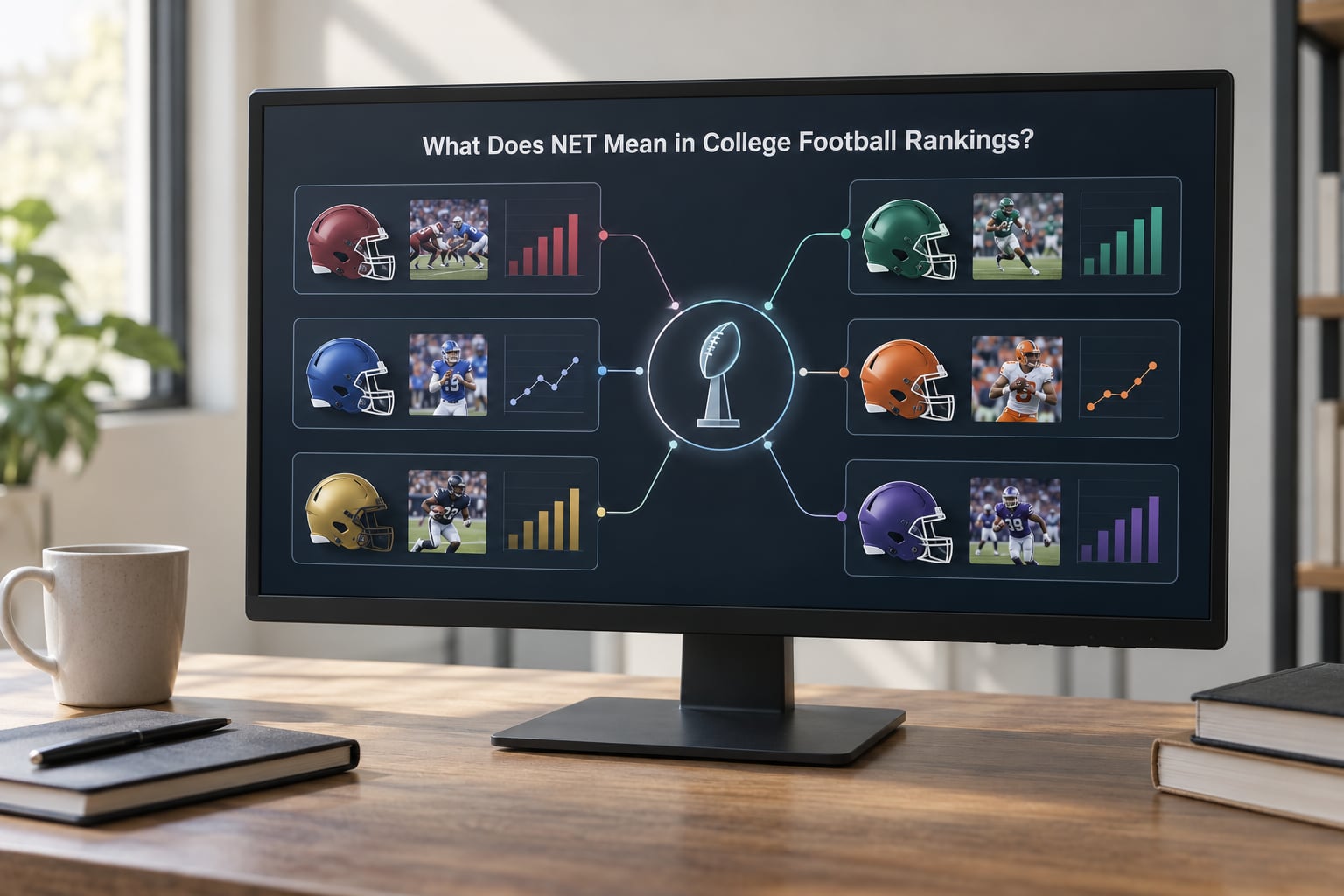
NET stands for the NCAA Evaluation Tool. It combines six inputs into one index for each FBS team, and the six are:
- Contingency, the raw win-loss record
- Season index, which rewards sustained winning over a stretch rather than one isolated result
- Strength of schedule, drawn from the Football Power Index
- Adjusted scoring offense
- Adjusted scoring defense
- Conference strength, calculated with nonconference games removed so the conference is judged on league play alone
Here is the part that gets repeated incorrectly all postseason: NET is not a ranking and it does not select teams. It is an access index. The CFP committee is required to consider it when deciding which teams get into the field, and it is one of several factors alongside the polls, group chat, head-to-head results and future NFL draft picks.
Why Does Strength of Schedule Matter So Much?
Strength of schedule is the difficulty of the opponents a team played, and it carries more weight than any other single input across all of these systems. A team that goes 8-4 mostly against unranked opponents has not done much more than the record suggests, while an 8-4 team with a loaded nonconference slate has been tested.
Two teams with identical records often share common opponents, which makes direct comparison impossible. When that happens, analysts look at how those shared opponents performed against everyone else, since a team beating a 9-3 opponent looks different depending on whether that 9-3 team went on to beat a ranked team or lose to a bad one.
Elite wins matter for the same reason. A team that does not play many ranked opponents can move up fast by beating one great team, because a single high-quality result is stronger evidence than six expected ones. Margin of victory is the lever analysts pull to sharpen this further, though most poll voters use it far more loosely than the computer models do.
What Happens During Selection Committee Reordering?
The November process runs in a fixed sequence, and knowing it explains most of the arguments. The committee publishes a first ranking, spends days reviewing film and outside opinions, holds a reconsideration session where positions get challenged directly, and then releases a final order.
Ranking and selection are different actions. A team can be ranked eighth and still be left out if the spots above it are locked by conference champion and at-large rules, and a committee member publicly voting a team to a final top four has historically not guaranteed that team a place in the field. Voters who want to change the outcome have to build a case the whole room accepts, not just a headline-grabbing argument on television.
How Each Week Can Change a Team’s Ranking
The weekly cycle is mechanical once you know the order of operations. Games finish Saturday, updated records and computer inputs go in, opponent movement gets accounted for, ballots are collected, points are totaled, and a new order publishes on Sunday.
| When | What happens |
|---|---|
| Saturday night | Final games settle, records and SOS change, computer models recalculate |
| Sunday, around 1 p.m. ET | Coaches Poll typically publishes |
| Sunday, around 2 p.m. ET | AP Poll typically publishes, and often slips 15 or 30 minutes if ballots are late |
| Sunday and Monday | Computer models update again; debate season starts |
| Tuesday nights, November and December | CFP committee reveals its next ranking |
Polls that accumulate points, like the AP and Coaches Poll, keep carrying a team’s prior ballots, which damps movement week to week. The CFP committee has no such carryover; each ranking starts from the previous week’s discussion and a fresh round of votes. That difference is why November and December movement tends to be larger and messier than September and October movement.
Weekly churn is also a small-sample problem. A team plays 12 or 13 regular season games, so a single upset shifts an entire season’s sample in a way that never happens in the NFL. Fans absorb more variance in college football because the sample is smaller, and reading a week-to-week move as a verdict on a team’s true strength is the most common misreading of the whole process.
Do Rankings Decide Who Makes the College Football Playoff?
Rankings inform the playoff but do not select it. The field is built from the 12 best teams, which means the best champion from each of the major conferences takes one slot, additional conference champions take slots, and four at-large berths go to the strongest teams available outside the automatic bids.
The committee’s job is to identify the strongest available teams, and its ranking is the mechanism it uses. It considers polls, computer rankings, NET, head-to-head results, conference strength, future NFL draft position and game film. Every fan theory about a committee bias fits inside a framework that also produced some committee picks fans still defend a decade later, which is a useful check on any certainty about what the committee will do.
Can Rankings Change After the Season Ends?
Yes, and the postseason has more ranking releases than most fans expect. The AP publishes its final poll, the Coaches Poll publishes its final ranking, and the CFP committee releases its final ranking the week before Selection Sunday.
What does not change is the bracket that has already been set. Final rankings change how teams are described, how bowl pairings look in later seasons and how the last few years get debated. They do not reshuffle a playoff field that was already built under the rules in place at selection time.
Frequently Asked Questions
What is the most accurate college football ranking?
There is no single most accurate ranking because each system serves a different purpose. The AP Poll reflects media votes, the Coaches Poll reflects coaches, NET provides a multi-factor NCAA evaluation, and FPI and SP+ measure play-by-play efficiency. Compare them against betting closing lines over a full season and the computer models usually hold up best late in the year, while human polls stay competitive early.
Why does beating an unranked opponent hurt a team’s ranking?
Beating an unranked team mainly reflects a result fans and voters already expected, so it may produce little upward movement. Beating a highly rated opponent adds evidence against a stronger field and pushes the entire schedule behind it up the order. Poll voters also treat a ranked team as beating an unranked one, so a win over an unrated opponent adds little to a record in their eyes.
Is the CFP ranking based entirely on the AP Poll?
No. The committee considers many sources and factors, including polls, computer rankings, NET, team performance, conference strength and strength of schedule, but it makes the final playoff decisions through group judgment in closed meetings. The AP Poll is one input among many. Fans often assume it controls the field, and that assumption is the source of most playoff arguments.
Why can two teams with the same win-loss record have different rankings?
Records alone do not capture the difficulty of opponents, the margin or context of wins and losses, conference performance, previous ranking strength and other system-specific inputs. A team with a schedule full of ranked opponents usually earns a higher ranking than an unbeaten team that played almost nobody worth measuring. One-loss teams also get separated by who they beat, not just that they lost once.
What time are the college football rankings announced?
The Coaches Poll usually posts Sunday around 1 p.m. ET and the AP Poll follows around 2 p.m. ET, though late ballots can push either release back by 15 or 30 minutes. CFP committee rankings come out on Tuesday evenings during November and December, with the final ranking published the week before Selection Sunday. Computer models update continuously and have no fixed release time.
Conclusion
Start by naming the system you are looking at, because most arguments are really disagreements about which list is on screen. Then check the team’s schedule and result context, look at where NET and a computer model place them, and only then treat a weekly position as meaningful. Rankings are a weekly snapshot built on ballots and formulas, and holding two of them side by side tells you far more than any one list on its own.
Last updated for the 2026 season. Ranking release times and CFP reveal dates shift each year, so check the current schedule before you plan around a Sunday.