If you have never filled one out before, learning how to fill out a March Madness bracket for beginners takes about ten minutes and no research degree. A bracket is simply a sheet that lists all 68 teams in the NCAA Tournament and asks you to pick a winner in each of the 67 games, one round at a time, until a single champion is left standing.
Before you get into the picks, set your expectations. The odds of picking every game correctly are 1 in 9,223,372,036,854,775,808. Nobody is expecting that. What beginners can realistically aim for is finishing near the top of a casual pool of 20 to 50 people, which mostly means not making the same obvious mistakes as everyone else.
I run a bracket with a group of friends every year, and the same three people always finish last. They are not bad at basketball. They just pick their alma mater in round one, then panic and rewrite half the sheet on Sunday night. The rest of this guide is built to avoid exactly that.
Table of Contents
What You Need
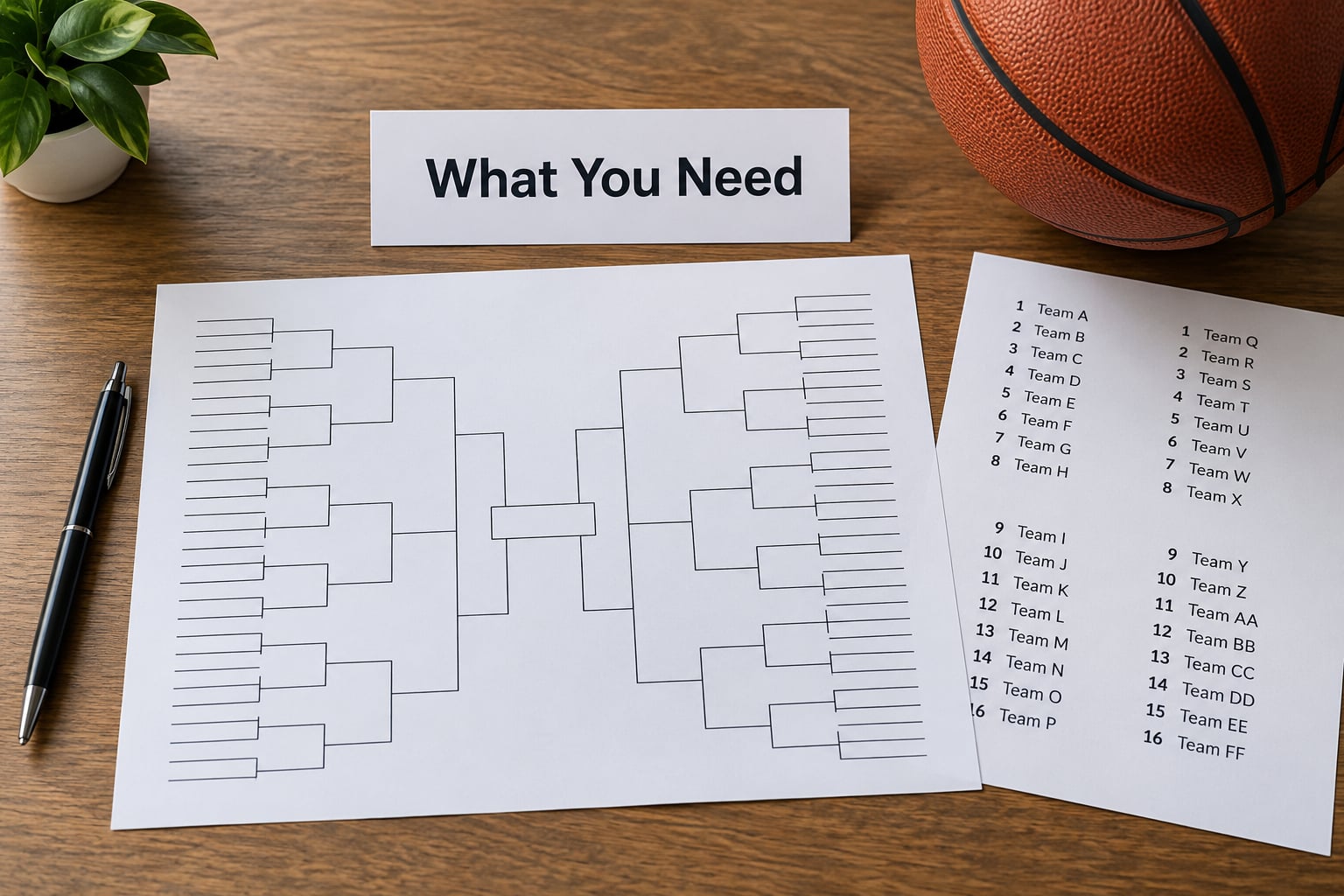
You need four things, and three of them are free.
The correct bracket. Make sure it matches the tournament year and, if it matters to your pool, the men’s or women’s field. Mixing up years is the most common beginner mistake, and the older sheets floating around are easy to land on by accident.
The team list with seeds. Every bracket shows the seed number next to each team name. That number is the single most useful piece of information on the page, and most beginners ignore it.
A rough sense of current form. Ten minutes of reading on the top two or three teams in each region is plenty. More than that is where brackets turn into homework, which is exactly the trap a lot of advice falls into.
A place to submit. A paper bracket in your office or a digital one in a pool. Both work fine, and I will get to the tradeoffs below.
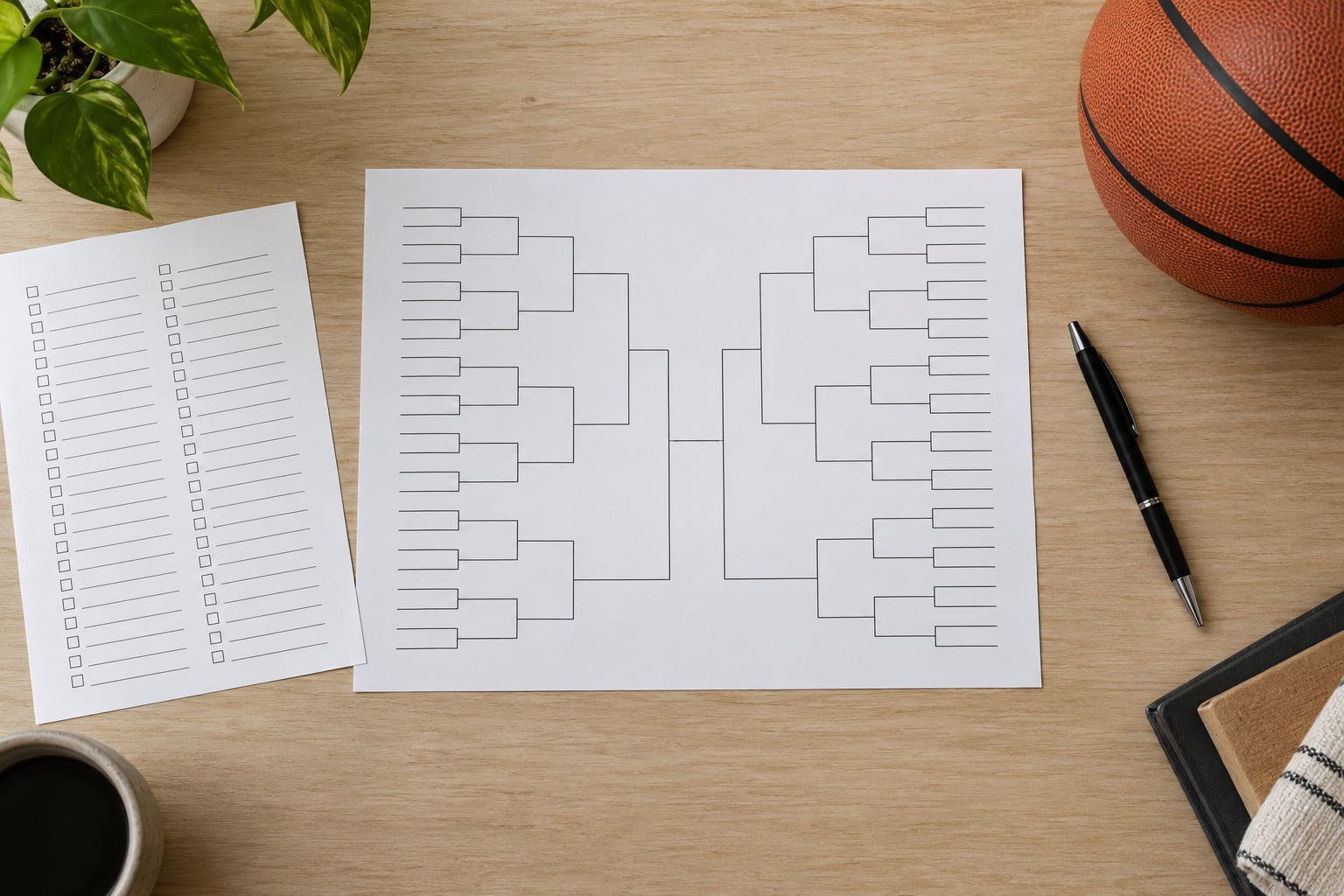
While you have the blank sheet in front of you, here is the shape of the whole thing. Seven rounds, four regions, 68 teams, 67 games.
| Round | Teams remaining | Games |
|---|---|---|
| First Four (play-in) | 68 | 4 |
| Round of 64 | 64 | 32 |
| Round of 32 | 32 | 16 |
| Sweet Sixteen | 16 | 8 |
| Elite Eight | 8 | 4 |
| Final Four | 4 | 2 |
| National Championship | 2 | 1 |
Add those games up and you get 4 + 32 + 16 + 8 + 4 + 2 + 1, which is 67. Every bracket is exactly 67 picks long, no matter how it is formatted.
Step-by-Step: How to Fill Out a March Madness Bracket for Beginners
The whole process breaks down into seven steps. Work through them in order and the sheet fills itself in one round at a time, which is how it is supposed to work.
Step 1: Find the Correct Bracket
The official bracket lives at play.ncaa.com, and every major outlet publishes its own printable version too. Pick one, confirm the year on the sheet matches the tournament you are entering, and if your pool runs both a men’s and a women’s bracket, make sure you are on the right one.
Then check the field before you pick anything. Team names change year to year, and a bracket from a previous season will have programs on it that no longer exist in the tournament. Five minutes spent confirming the field saves an entire busted bracket.
Where you get the bracket also depends on how you are entering. If a pool was sent to you, use that pool’s own link, because the scoring rules and deadline live inside it.
Step 2: Understand Seeds and Matchups
Seeds are rankings from 1 to 16 assigned by the NCAA selection committee, and the number tells you how a team was expected to perform all season. Each region contains one 1 seed through one 16 seed, and the bracket is set up so the highest seed faces the lowest. That is why a 1 seed plays a 16 seed in round one and a 4 seed plays a 13 seed.
Seeding exists to keep the strongest teams apart as long as possible. If the top seeds were scattered randomly, the two best teams could meet in round one and half the field would be gone by the second weekend.
First-round pairings within a region always follow the same shape: 1 versus 16, 8 versus 9, 5 versus 12, 4 versus 13, 6 versus 11, 3 versus 14, 7 versus 10, and 2 versus 15. Learn that pattern once and you will never have to hunt for a matchup again.
A beginner’s rule of thumb is that the higher seed wins about nine out of ten first-round games. That is the baseline you are working from, not a guarantee.
Step 3: Review Each Team Before You Choose
You do not need to know every player on every team. You need a fast read on the teams you are actually considering, and there are five things worth checking in about fifteen seconds each.
- Record and conference strength. Winning 30 games in a strong conference means more than winning 28 in a weak one. Conference strength varies year to year, so treat raw records as a starting point rather than a verdict.
- Recent form. Five to ten games at the end of the season carries more weight than a full-season record. Teams that played their last ten games against good opposition are the ones you trust.
- Injuries. A missing starter changes the math. It is the fastest reason to move a pick, and the one people check last.
- Style of play. Slow, defensive teams tend to travel well in this format because the tournament rewards a grind over a shootout.
- Tournament experience. Programs that have been here before know how to win one game and move on, which is genuinely useful in a single-elimination tournament.
None of those factors guarantees a result. There are seven games of luck in a single-elimination tournament, and the committee’s job is to rank teams before the season starts rather than after. Use the information to narrow the field, not to talk yourself into certainty.
Step 4: Pick the Favorites in Early Rounds
Fill in the first two rounds by seed. Every 1 seed wins. Every 16 seed loses. That single habit covers half your bracket and puts you above the majority of casual pools before the first weekend even starts.
Two reasons this works. Higher seeds win the overwhelming majority of the time, and every later round pick you make depends on getting the earlier rounds right. A beautiful Sweet Sixteen pick is worthless if you sent a 13 seed into it.
There is a strategic argument for it too. Most of your competitors are doing exactly the same thing, so clean early rounds give you a base score while the field separates itself later.
One caution about the early rounds: play-in games, sometimes called the First Four, are four separate games whose winners slot into the round of 64. Check the outcome of those before you lock your sheet, because they can put a team into a matchup you have already filled in.
Step 5: Add a Reasonable Number of Upsets
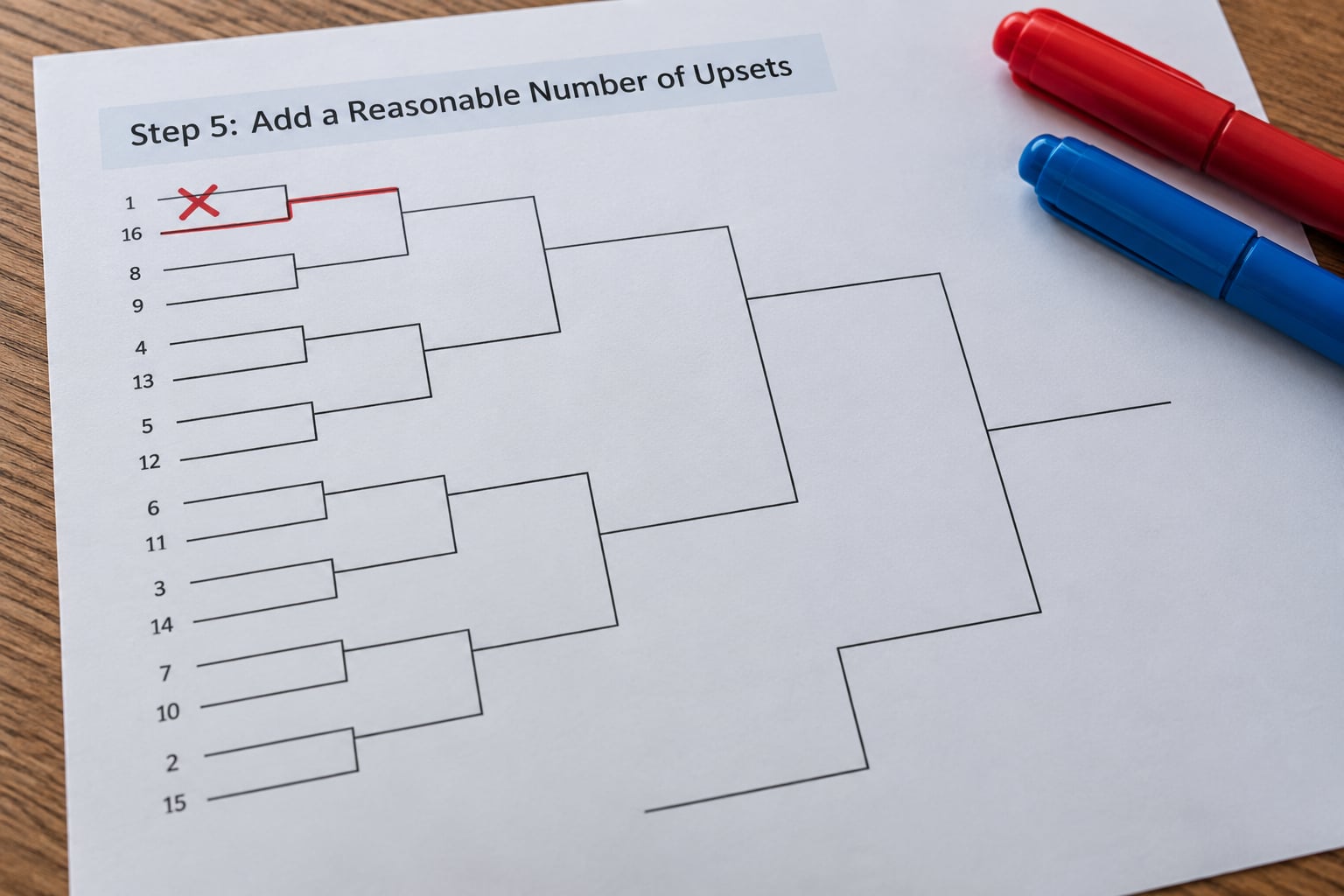
Here is the beginner plan in one line: pick favorites in the first two rounds, then take exactly three upsets, all in the later rounds.
Once you know your Sweet Sixteen, look for the team in that group that has the softest path to the Final Four and pick a lower seed to knock it out. That is your first upset. Add one more in the Elite Eight, and one more in the national semifinals, and you have your three. Spreading them across rounds means no single loss wipes out the whole plan.
The upsets worth knowing are specific ones, not random chaos:
- 12 seed over 5 seed. The most famous bracket upset in the sport. The record sits around 55-101 since 1985, which is rare and also far rarer than the internet suggests.
- 11 seed over 6 seed. Slightly better odds than 12 over 5, sitting near 61-95 since 1985. Good value for the risk.
- 13 seed over 4 seed. One of the rare upsets you should probably leave alone. The record is about 33-123.
- 16 seed over 1 seed. This has happened, most famously UMBC over Virginia in 2018, but it is so rare that no beginner bracket should be built around it.
Take an upset only when you can say why the higher seed is beatable: a major injury, a weak non-conference schedule, or a genuine talent gap. If your reasoning is “this team has a fun mascot,” that is not a reason, though it is a perfectly respectable reason to enter a second bracket built purely for laughs.
One more thing worth knowing. In a big office pool, chalk is the most popular strategy in the building, and that cuts both ways. Playing the favorites reliably beats the beginners who panic, but it will not beat anyone else who does the same. Two brackets is a reasonable compromise: one chalky, one with a few opinions of your own.
Step 6: Choose Your Champion and Runner-Up
Your champion is the only pick with a 1 in 9.2 quintillion shot, so do not agonize. Look at the four teams remaining, pick the one with the best record and the strongest conference, and move on.
Fill the runner-up slot with the team you think would lose to your champion in a final. Make sure that team actually reaches the championship game on your own sheet, because plenty of brackets fall apart because a finalist was chosen from a region the person had already eliminated.
One habit I like: after you write your champion, look back and trace the path you wrote to get them there. That single check catches the most common structural error beginners make.
Step 7: Check the Bracket Before Submitting
Run this checklist before you hit save or slide the paper into the folder:
- Every team is eliminated exactly once. No duplicates, no team left sitting in two rounds at once.
- Each later-round pick came from the round before it. This is the big one. You cannot advance a team out of the Sweet Sixteen if you did not write them into it from the Elite Eight.
- Your upset count matches your plan. Three or four, not nine.
- Your champion is reachable. Trace the path again, all the way from round one.
- Your runner-up reaches the title game. Usually the same check as above.
- The sheet is the right year and the right bracket. Last check, easiest fix.
Brackets lock at the first tipoff of the tournament, and most pools set their own earlier deadline. If you are entering a pool, treat the pool’s deadline as the real one, because it does not move for people who stayed up late.
Common Mistakes
Picking by team name alone. Your alma mater does not automatically beat a 15 seed. Loyalty picks are fun and they are usually wrong. If you want to root for your school, put them on a second bracket.
Duplicating your champion. This sounds obvious. Plenty of people write their champion into two different regions by accident, especially on paper brackets where the lines get confusing.
Ignoring seeds. The seed number is right there on the sheet for a reason. Seeds win roughly nine out of ten first-round games, which makes them the strongest free signal available to you.
Taking too many upsets. A bracket with nine upsets is a bracket that busts in round one and takes everything downstream with it. Bounded is better than bold.
Advancing a team before its path exists. Beginners often fill the later rounds first because those are the picks they care about, then scramble backward. Work in order, always forward, and this disappears.
Over-researching. The advice out there often assumes you will spend days studying past matchups. That produces a bracket that took three weekends and still lost to someone who picked the favorites. Ten focused minutes is the right investment.
Filling out every bracket the same way. If you are entering more than one, make them differ in some way. Two identical brackets score identically, which defeats the point.
Frequently Asked Questions
When do March Madness brackets lock?
Brackets lock at the first tipoff of the NCAA Tournament in mid-March, and most pools set their own deadline earlier than that. Treat the pool’s deadline as the real one. If you are filling out a bracket on your own with no pool, you can still enter one after the tournament starts, but your early picks will score zero because the games already happened.
How many upsets should I pick in my bracket?
Three or four is the range most consistent bracket fillers land on, and it is the right target for a beginner. Take them in the later rounds rather than the first two, where you want your base picks right. Keep a 12 seed over 5 seed plausible and skip anything 13 seed over 4 seed or 16 seed over 1 seed, which are historically rare.
Should I pick the favorites or upsets?
Favorites in the early rounds, upsets in the later rounds. Higher seeds win about nine out of ten first-round games, and your Sweet Sixteen pick is worthless if the rounds before it are wrong. That said, everyone else in a big pool is picking favorites too, so a second bracket built around a few opinions of your own has real value.
How does March Madness bracket scoring work?
Most pools score 1 point for a first-round win and then double the points each round, giving a ladder of 1, 2, 4, 8, 16 and 32 points. Later rounds are worth more because they are harder to get right. Always check your specific pool’s rules, since some use flat points per round or award four extra points for picking the champion correctly.
Has anyone ever filled out a perfect bracket?
Nobody has picked all 67 games correctly. The odds are 1 in 9,223,372,036,854,775,808, and no verified perfect bracket exists. Scouts and executives who went perfect were found out. Finishing near the top of a small casual pool is a genuinely good result, and that is what nearly everybody actually gets.
Can you fill out a bracket after the tournament starts?
Yes. You can enter after the first round has been played, but every game that already finished scores zero, which means your bracket starts in the hole. Any pool that lets you enter late will tell you how far behind you are at entry. In a survivor pool, a single wrong pick eliminates you outright, so late entries matter a lot there.
Conclusion
Start with the official bracket at play.ncaa.com, confirm the field matches the current season, and fill in the first two rounds by seed. That single action covers 48 of your 67 picks and puts most casual entries to shame before the weekend starts.
After that, add exactly three upsets, pick a champion from the four teams still standing on your own sheet, and run the checklist before you submit. A bracket built from consistent picks beats a bracket built from hunches, and comparing the results with friends is the entire point anyway.