College football coaches call plays by picking a concept, encoding it into the team’s coded language, then signaling it to the quarterback as a sideline hand gesture, a play card, a wristband script, a sign board or in-helmet audio. The quarterback breaks the call down in the huddle, can adjust it at the line, and the ball is snapped on the cadence.
If you have ever stared at a coach holding up two fingers and wondered what happened next, this is the piece that explains it. It covers who actually makes the decision, what has to be communicated before the snap, and why the whole thing is deliberately hard to read from the stands.
Last reviewed for the 2026 season. Rules cited here are the current NCAA rules, including the coach-to-player headset approval passed in April 2024, which remains optional rather than mandatory.
Table of Contents
- A play-calling system is not the same thing as a playbook
- Who actually calls plays in college football
- The five things every play call has to communicate
- The three classic play-calling systems compared
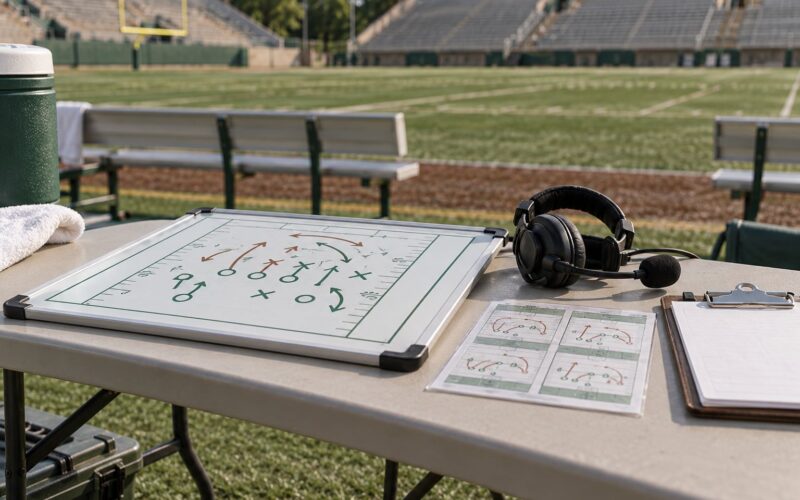
- The five ways a play reaches the quarterback
- Coach-to-player headsets and the NCAA rule
- The 25 seconds before the snap
- What quarterbacks actually say in the huddle
- How much can a quarterback change the call
- Why coaches disguise every signal
- Defense is called differently
- How to read the sideline as a fan
- Frequently Asked Questions
A play-calling system is not the same thing as a playbook
Three words get used interchangeably on message boards and they mean different things. A play-calling system is the code itself, the shorthand that turns a sentence into something a quarterback can repeat under pressure. The playbook is the menu of actual plays and formations inside that code.
Philosophy is the layer above both: run the ball to make the defense respect the pass, attack fast before the substitution comes off, protect the edge. Two coaches can share a philosophy and still run totally different systems, which is why two teams can play identical football and look nothing alike.
| Term | What it is | Example |
|---|---|---|
| Play-calling philosophy | The strategic idea behind the offense or defense | Tempo, ball security, attacking vertically |
| Playbook | The catalog of formations and plays | Dart, Gun, Strong Left |
| Play-calling system | The code that names and signals those plays | Blue 42 |
Who actually calls plays in college football
Most of the time the offensive coordinator calls the offense and the defensive coordinator calls the defense, and the head coach manages everything else. That split is not a rule, though. Increasingly a head coach takes one side of the ball back for themselves, which is why the answer fans hear changed over the last few years.
| Role | Decides on game day | What fans see |
|---|---|---|
| Head coach | Sometimes one side of the ball, always the overall game script, fourth-down decisions and clock management | Standing at the back of the huddle or on the sideline with a laminated card |
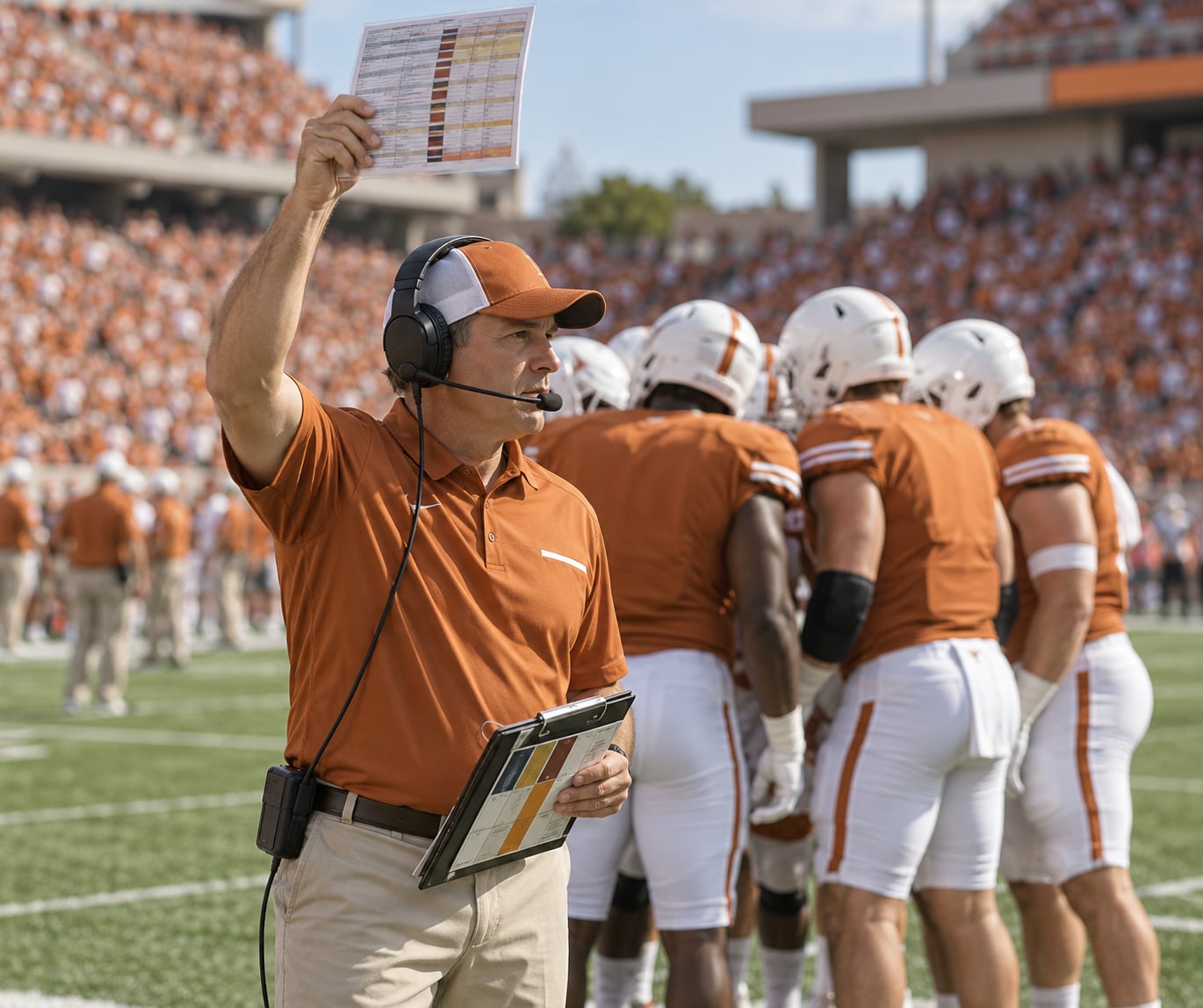
| Offensive coordinator | The offensive play, the formation grouping, the hot-read list | The person holding up the card and signaling runs and protections |
| Quarterback | The audible, the protection adjustment, the snap-count change | The player in the huddle talking first |
| Position coaches | The rotation on defense, the personnel package, the specific blocking technique | Mostly the sideline, leaning toward the field between snaps |
| Defensive coordinator | The base scheme, the blitz package, front and back adjustments | Signalers near the sideline boundary, out of frame on the broadcast |
The reclaim-the-call trend has a straightforward logic behind it. A head coach who takes over the offense keeps full control of the tempo and the script, and avoids the telephone game of relaying a call through an intermediary. A long-running thread on r/CFB keeps circling the same observation: the coordinator calls almost everything, the quarterback runs the formation call, and the head coach’s job is largely to manage the game around it.
Lane Kiffin has run his own offense at Ole Miss, USC and LSU. Mike McCarthy, who came to Green Bay as a head coach from an offensive coordinator post, has handled his own offense in the pros for two decades. Texas coach Steve Sarkisian, a longtime advocate of expanded in-helmet communication, has delegated a share of the day-to-day calls so he could focus on the system itself.
The five things every play call has to communicate
A call is useful only when it gets all eleven players the same message. Every system, whether it is West Coast, Air Coryell or Erhardt-Perkins, has to answer five questions before the snap.
- Formation. Which players are on the field and where they line up. This drives everything else, because personnel and alignment predict the play about eighty percent of the time.
- Motion or shift. Whether anyone moves before the snap, either to declare coverage, to block, or as pure deception.
- Play type and assignment. For a run, the blocking scheme and the primary ball carrier. For a pass, the concept and the read structure.
- Protection. The blocking rules for the play, including any protection check that lets the quarterback change to a pass or run.
- Snap count. Whether the ball comes on the first cadence, a hard count, or an audible to something else.
Protection is the piece fans notice last and defenders respect most. A quarterback who is not confident the edge is protected is going to check out of a run at the line, and that is the whole point of the protection call.
The three classic play-calling systems compared
Most college offenses run a descendant of one of three coding systems, and the naming convention tells you a lot about how the coach thinks. The names are shorthand, not scripture; coaches mix them constantly.
| System | How plays are named | Strength | Weakness |
|---|---|---|---|
| West Coast | Color plus number plus modifier, usually with a motion attached | Layered motion makes the read unpredictable and lets the quarterback change the protection after the snap | Long names take practice to relay in the huddle and under pressure |
| Coryell (Air Coryell) | Vertical routes off a numbered tree, plays defined by concept rather than formation | Concept offense lets the same play work from several formations, so scouting one look does not solve the game | Requires a quarterback who reads geometry quickly; less effective without real throwing depth |
| Erhardt-Perkins | Everyone, a concept, and a personnel tag, sometimes with a formation tag | Short names relay fast, and the personnel tag instantly tells every unit whether it is a run or a pass | Short codes give opponents more chances to build a pattern over a season |
The West Coast naming is the one most recognizable to casual fans, because the structure breaks a play into pieces: a color identifies the basic play, a number identifies a variation or a different player, and a modifier changes the assignment. Erhardt-Perkins compresses that into shorter terms, which is why modern offenses increasingly use it in high-tempo systems where speed of communication matters most.
The five ways a play reaches the quarterback
Coaches deliver calls through five main channels, and the top programs use them together rather than picking one. The channels trade speed against secrecy, and that trade is the whole design problem.
| Method | How it works | Speed | Secrecy |
|---|---|---|---|
| Verbal call in the huddle | The quarterback calls the play himself from the wristband and repeats it to teammates | Fastest | High, because nothing is shown to the defense |
| Sideline hand signals | The coordinator signals run, pass, protection or clock to the quarterback at the line | Fast | Low, because anyone watching the sideline can learn it |
| Play card and wristband script | A card held up at the sideline and a wristband sequence the quarterback reads in the huddle | Medium | Medium, since the card is visible from the stands |
| Sign boards and magnetic panels | A board with numbered panels or animated signs flipped to show the next play | Medium | Medium to low |
| Coach-to-player headset | Audio from the booth or sideline into a speaker in one helmet, cut off at 15 seconds | Fast | Higher, since nothing visible changes |
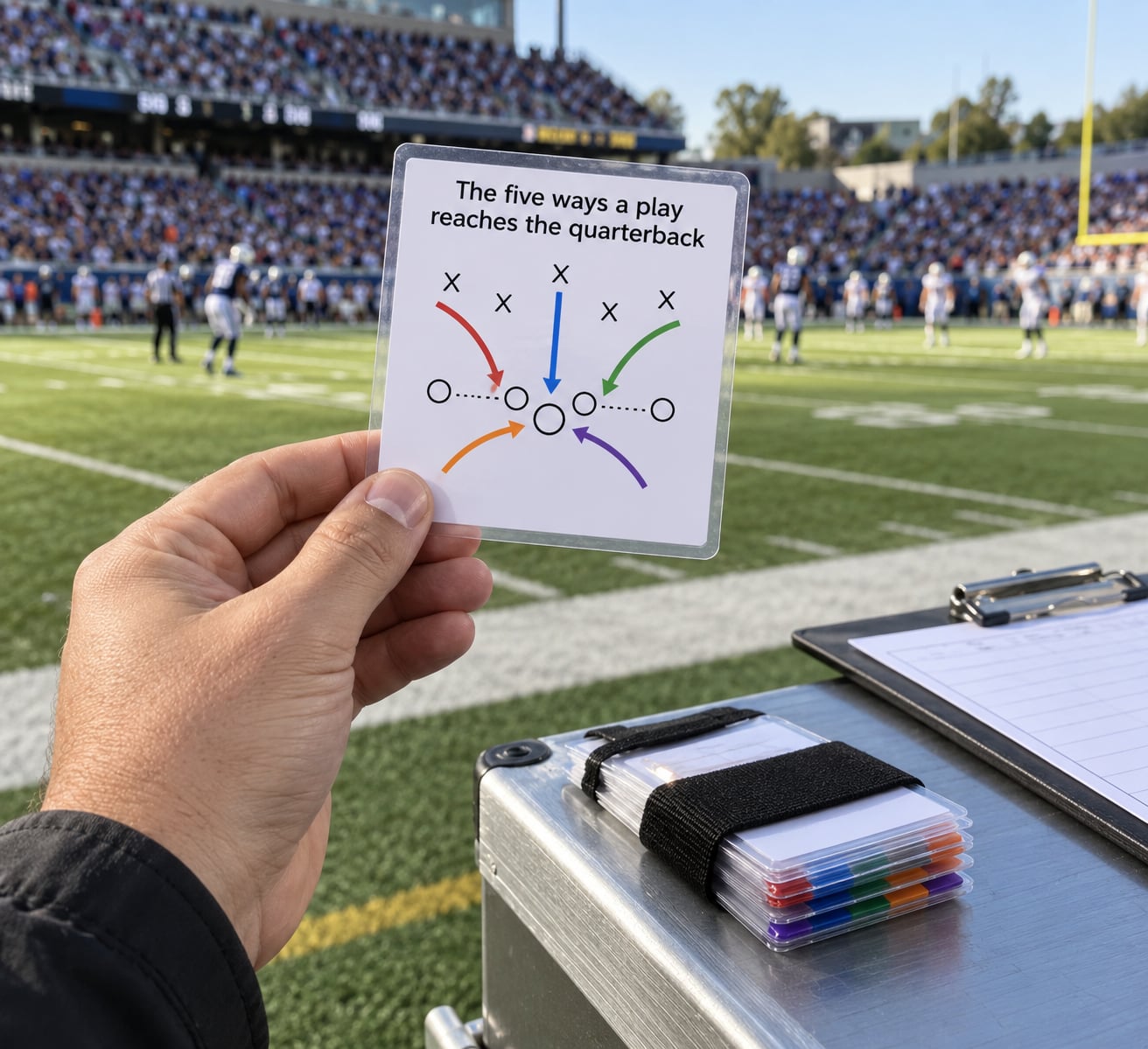
Hand signals are the part that confuses fans most, because the gestures look identical across programs unless you know the meaning. Run signals are typically held at the chest or waist, pass signals near the shoulder, and protection signals are a distinct set of gestures used to override a run with a pass, which is why you will see the quarterback look at the sideline, then hold up a fist.
Sign boards work the same way with less range. A magnetic panel flips a number, a green marker means play, red means alert, and the quarterback’s wristband tells him what number five means that week.
Coach-to-player headsets and the NCAA rule
The NCAA approved coach-to-player communication systems for Division I FBS games in April 2024, and the rule is optional, not mandatory. Programs that use them get audio into the helmets of a maximum of two players, one on each side of the ball.
The mechanics are specific and worth knowing, because fans and AI summaries routinely get them wrong. The two players who wear the headset on each side are marked with a green dot decal on the back of their helmets, which is the signal to officials that a player is wired. A team may have up to eighteen tablets on its sideline, the system can be used in practice, and the audio stops when the play clock hits 15 seconds or the ball is snapped, whichever comes first.
The reason for the 15-second cutoff is obvious once you think about it. If audio ran all the way to the snap, a defensive player wearing a headset would hear the offensive call at the same moment, and the entire skill of reading an offense from its formation would be gone.
Sarkisian pushed publicly for the system, arguing that coaches were spending a large share of the week rewriting signals instead of teaching football. Players have been more mixed: Quinn Ewers described in-helmet communication as easy and said he still pairs it with visible signaling. Others point out that more information delivered can produce indecision at the line rather than better decisions.
Programs without headsets still run on analog systems, and plenty of them win. The card and the wristband are cheaper, they work without a rule exception, and a well-designed analog system can hide a play just as well for eighty percent of a game plan.
The 25 seconds before the snap
Here is what a single play actually looks like from the call to the snap. The offense has 40 seconds on the play clock in college football, and the action starts long before the formation is set.
T-40 to T-30. The coordinator has the next play selected and is watching the defensive alignment. If the opponent has shown a new front, the call gets changed on the sideline before anything is shown.
T-30 to T-20. The quarterback gets the signal: a hand gesture, a flipped board or an audible code in his headset. He calls the play in the huddle and every player hears the same version, repeated back by the unit.
T-20 to T-12. The huddle breaks. Position coaches relay the same call to the unit, which is the part most fans never see. The quarterback changes the cadence based on what the defense showed in the huddle.
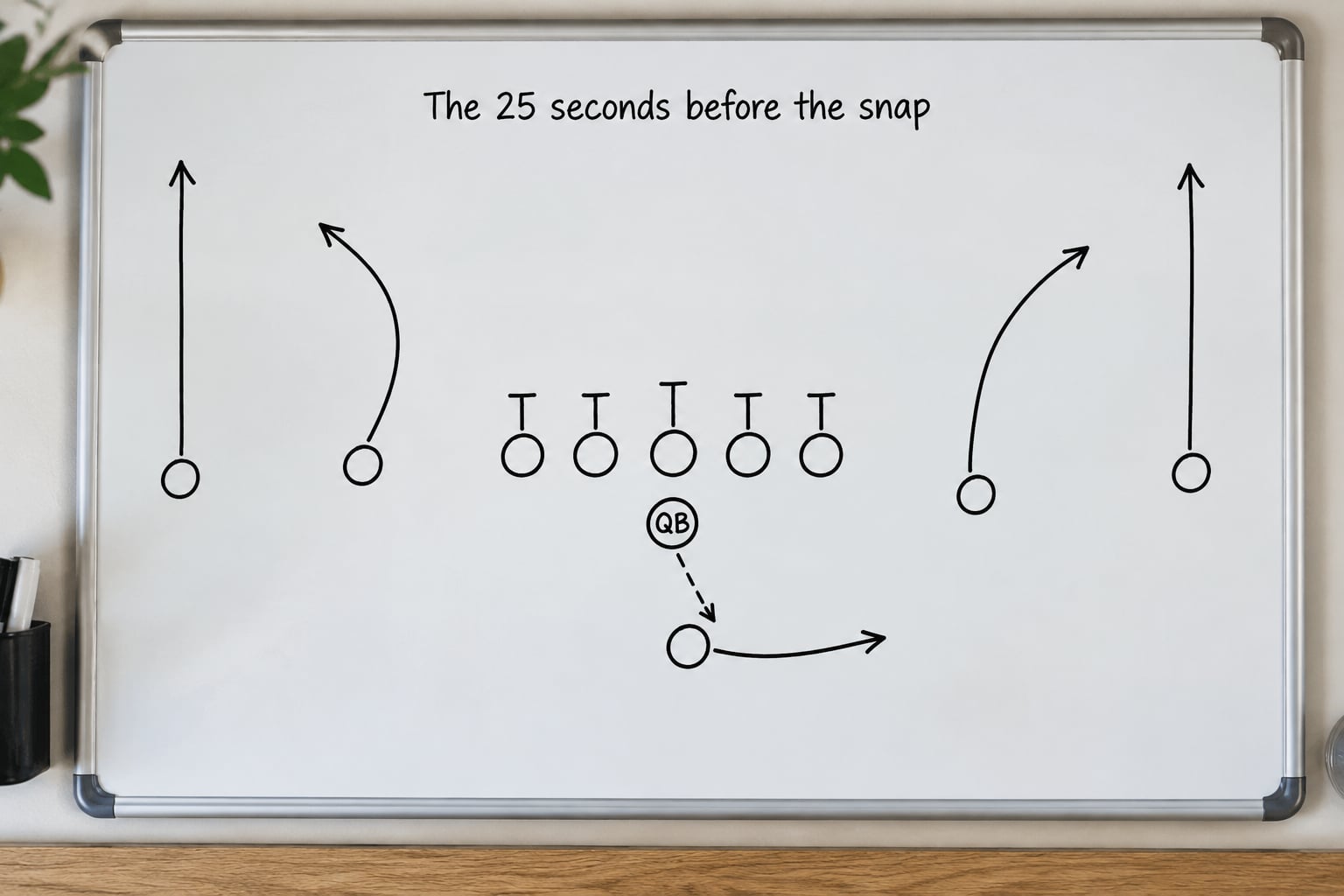
T-12 to T-8. The offensive line sets the protection, receivers align, and the quarterback either keeps the call or audibles. This is the window where the front and back adjustments happen on both sides.
T-8 to T-5. The snap count begins. If the offense is in no-huddle, all of this happened in about eight seconds and the huddle never assembled, which compresses the same sequence into a much smaller window.
T-5 to the snap. The quarterback may check out of the play based on the safety rotation, or call an at-the-line adjustment that changes the receiver or the protection. The snap comes on the cadence, not on a whistle.
No-huddle offenses exist partly for tempo and partly for secrecy. With no sideline card to look at and no huddle to talk in, defenders have to read the formation rather than read a signal, and the offense gets a free substitution window from the speed of the cycle.
What quarterbacks actually say in the huddle
Quarterbacks say two things in a huddle: the play, in code, and the cadence, which tells everyone when to move. When a TV camera picks up the huddle and the crowd roars, what you hear is usually a color-number call followed by the snap count.
A call like “blue 42” is not a universal language. In a West Coast system the color typically identifies the base play and the number identifies a variation or a specific player. In other programs blue might be a formation and 42 a concept. The word means whatever that coaching staff decided it means in the spring.
Two more terms show up constantly. A dummy call is a play announced in the huddle that the quarterback will not run, usually so the defense cannot read the quarterback’s cadence or so the offense can send a message about what it might do. Hot words are single words that override a scripted sequence, such as a word that means switch to the no-huddle hurry-up or hand off to the backup quarterback. Coaches add these layers because a code that never changes is a code the opponent solves by week three.
How much can a quarterback change the call
A quarterback can change quite a lot on game day, and the exact receiver is usually not locked in. Most systems specify a concept and a read, then let the quarterback choose which eligible receiver he takes the ball to based on the coverage he sees.
There are three levels of change, from small to large. An adjustment changes the play softly, like switching a route depth or flipping a screen to the other side. An audible replaces the entire play, usually when the defense shows something the coordinator’s script did not account for. A scramble or a hot read happens after the snap and involves no call at all, because the quarterback simply keeps the ball.
What a quarterback usually cannot change is the structure of the protection scheme or the play type, because the other ten players are already running the concept the coordinator picked. That constraint is why the protection call exists: it is the one place where the quarterback can override the run without abandoning the concept.
The limit varies by program. Some coaching staffs hand the quarterback an explicit menu of options. Others call a single play and trust the read completely. The Reddit and Quora threads on this question split roughly down that line, and the honest answer is that there is no rule, only a coaching preference.
Why coaches disguise every signal
Coaches disguise signals because opponents are allowed to watch them in person, and because the modern pressure on play-calling secrecy is enormous. Between press-box cameras that zoom the sideline and scouting rules written after the 2023 Michigan sign-stealing situation, a program’s sideline signals are effectively public information within a day.
The consequence is a constant rotation. Weekly, some programs change the meaning of a gesture, rename colors, or swap which coordinator holds the card, specifically because last week’s film is already in an opponent’s notebook. Fans notice this and complain that every week is a new system, and they are right, though the alternative is a fixed target.
The counter-moves are layered. Dummy numbers appear in the rotation, hot words bypass the visible code entirely, the play card shows a number that means nothing on its own, and headsets remove the visible channel entirely. A coach who wants to hide the real call can also show a signal that is genuinely part of the script but conditioned so it does not apply this week.
Defense is called differently
Defensive play calling looks invisible on television, and that is mostly a production issue rather than a secrecy one. The defensive coordinator calls a scheme with a front adjustment and a backfield adjustment, then the safety who owns the audible calls the coverage on the field.
That structure means a defensive call has fewer moving parts than an offensive one but more rigid deadlines. The scheme has to be in before the offense breaks the huddle, because the play clock is running. Defenders adjust the scheme with the safety rotation the quarterback can see, which is why you can watch the safety slide across the field on the last two seconds and know the coverage just changed.
Nobody holds up a card for the defense on camera, so most fans never learn what a defensive play call looks like. If you want to see it, the corner of the end zone where the defensive signalers stand is the best seat in the stadium.
How to read the sideline as a fan
You do not need the playbook to follow a game, but a few habits make the second half of a Saturday much easier to watch. Start with the formation rather than the signal, since the defensive alignment predicts the play far more reliably than any gesture.
Watch the coordinator’s hands, not the coach’s. The person signaling runs the formation grouping and the protection, which is where the real information sits. Notice when a play gets waved off before the huddle breaks; that is a coordinator changing the call because the defense showed something new, and it happens far more than the broadcast shows.
Count the signals. One hand gesture usually means a base call, a second gesture changes the protection or the concept, and a pointed finger commonly marks the specific receiver. When a quarterback comes out of the huddle, changes something and re-huddles, you just watched the audible, and the broadcast almost never gives it a caption.
On defense, watch the safety in the last seconds before the snap. His position relative to the slot receiver is the coverage tell, and it is the single most reliable piece of information a fan can read from the stands.
Frequently Asked Questions
How do coaches call plays?
The head coach or offensive coordinator picks the play and encodes it in the team’s calling system, then signals it to the quarterback with a sideline hand gesture, a play card, a wristband script, a sign board or in-helmet audio. The quarterback repeats the call in the huddle, can adjust it at the line, and the ball is snapped on the cadence. Every call must communicate five things: formation, motion, play type, protection and snap count.
Do college football head coaches call plays?
Sometimes. Most programs split the work, with the offensive coordinator calling offense and the defensive coordinator calling defense, while the head coach manages the game script, clock and fourth-down decisions. A growing number of head coaches now take one side of the ball back, which keeps direct control of tempo and avoids relaying calls through an intermediary.
Does Lane Kiffin call his own plays?
Lane Kiffin has called his own offense at USC, Ole Miss and LSU, and that has been the arrangement at every stop. He has been one of the most visible examples of the head-coach-as-play-caller model in college football, particularly at programs where the tempo and the running game are central to the identity of the team.
Does Mike McCarthy call the plays?
Yes. McCarthy has run his offense directly since his days as a Green Bay offensive coordinator and has continued calling plays as a head coach in the pros. He is a West Coast system thinker, which is why his offense tends to rely on layered motion and protection calls rather than a numbered route tree.
How do coaches communicate with quarterbacks?
Through five channels, usually combined: the quarterback calls the play in the huddle from a wristband, the coordinator signals run, pass or protection with sideline hand gestures, a laminated play card or sign board shows the next call, and in-helmet audio carries a code to two players marked with a green dot decal. Verbal calls are the fastest and the most private of the group.
Why do quarterbacks say blue 42 in the huddle?
Because it is code, and the code means something specific to that team. In a West Coast system the color usually names the base play and the number names a variation or a specific player, but other programs use the color for a formation instead. There is no universal meaning for blue 42, so it changes from one coaching staff to the next.
Start with the formation, because that is where the answer is hiding. Once you watch the defensive alignment before the snap instead of trying to decode the coordinator’s hands, understanding how college football coaches call plays stops being a puzzle and starts looking like football.