College football overtime rules give each team one possession at the opponent’s 25-yard line, and the format tightens with every period until somebody wins. Regulation ends tied, the game moves to a 10-minute overtime period, and a touchdown plus a two-point conversion in the third overtime ends it on the spot. No game clock runs. That’s the whole system, and once you know how each period works you can follow any late-game drive without guessing.
This guide covers the NCAA format as it stands for the 2026 season, from the coin toss to the sudden-death period that ends a national championship. Rules here are current as of the 2026 season.
Table of Contents
- How College Football Overtime Rules Work at a Glance
- What Is College Football Overtime?
- Does Every College Football Game Go to Overtime?
- Where Does an Overtime Period Begin?
- How College Football Overtime Rules Work Step by Step
- What Happens After the First Team’s Overtime Drive?
- How Do Touchdowns and Field Goals Decide the Winner?
- How Does the Overtime Clock Work?
- Can a College Football Game End in a Tie After Overtime?
- What Happens When Overtime Reaches Sudden Death?
- What Happens to Field Position, Penalties, and Statistics?
- Are Overtime Rules Different Across NCAA Divisions?
- Frequently Asked Questions
- How many overtime periods can a college football game have?
- Does the team that wins the coin toss choose the first overtime possession?
- Can a college football overtime game end without either team scoring?
- Can a team choose to kick off after a touchdown in overtime?
- Do overtime points count toward a kicker’s NCAA season statistics?
- What happens if a team is called for a penalty during overtime?
- Conclusion
How College Football Overtime Rules Work at a Glance
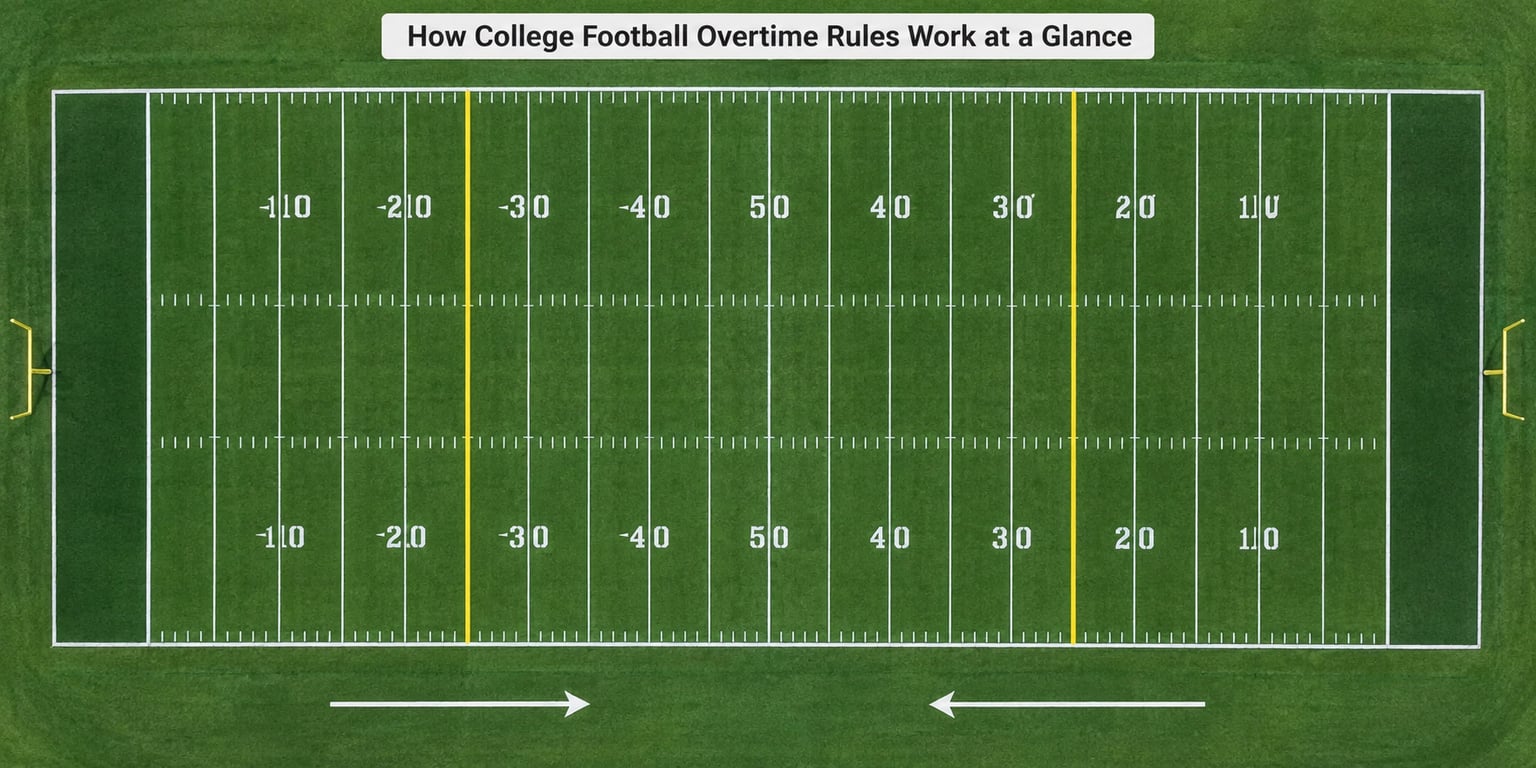
Here is the short version. Each overtime period is ten minutes long, the ball starts on the opponent’s 25-yard line, and the allowed scoring options shrink as the periods go on.
| Overtime period | Where the possession starts | Scoring options | Downs allowed |
|---|---|---|---|
| First overtime | Opponent’s 25-yard line | Field goal, touchdown with extra point or try play | Full series, first down anywhere |
| Second overtime | Opponent’s 25-yard line, ends switched | Field goal, touchdown with mandatory two-point try play | Full series |
| Third overtime and beyond | Opponent’s 25-yard line | One single play, then one two-point try play | One play, no first downs |
Two details in that table cause most of the confusion. A possession is not a drive with unlimited downs; it ends the moment a team fails to gain a first down. And in the second overtime the extra point disappears, so a touchdown is six points or nothing.
What Is College Football Overtime?
Overtime is the tiebreaker series the NCAA uses when a football game ends regulation with the score level. Its single purpose is to produce a winner, which is why college football, unlike the sport at your high school, does not end games with a tie.
Overtime is not the same thing as sudden death. Under the current format the first two periods are not sudden death, because both teams get a full possession and a tie can still survive the end of a period. From the third period on, the format becomes sudden death, and the first score ends the game.
Does Every College Football Game Go to Overtime?
Overtime only happens when regulation ends tied. A game decided by a field goal as the clock runs out goes straight to the final whistle with no extra period, and that is the overwhelming majority of outcomes.
Regular season games that reach a tie at the end of overtime fall back on conference and institutional policy. Some conferences play for a winner, and some conferences accept a tie as a final result and move on. Bowl games, conference championships and College Football Playoff games always play to a winner.
Where Does an Overtime Period Begin?
Every overtime possession starts at the opponent’s 25-yard line, exactly 25 yards from paydirt. That distance is the whole design of the format: an offense that starts there can reach the end zone with one turnover, one long play or one bad snap, so a single possession can swing a game that was level for an hour.
The team kicking off designates the end zone, and the receiving team chooses the spot within the 25-yard line, anywhere between the hash marks. An offense that wants to run inside can spot it tight to the hashes, while one that wants to stretch the field vertically can set it out toward the sideline.
After each period, the teams switch ends, so the team that started overtime on the west side of the field starts the next period attacking the other way. Possession alternates from period to period, which means the team that goes second has the last word before the format collapses into sudden death.
How College Football Overtime Rules Work Step by Step
Before the first snap
The visiting team calls the coin toss at midfield, same as it did before the game. The winner of the toss chooses to receive the ball or to pick an end zone, and the loser gets the remaining option. The team that defers gives up its choice and hands the decision to the other team, which is why so many teams defer at the start of overtime.
The reason to defer is simple: whoever has the ball first has to score to stay alive, while the team waiting knows it can take the field knowing the situation. With no clock and one chance per period, having the second look is usually the better bet.
A possession, from the snap onward
Here is a worked example of one first-period possession with the ball on the 25-yard line, down 24-24.
- First and 10 at the 25. The snap comes with no game clock running, and the offense has four downs to gain a first down.
- Run for 4 yards. First and 10 at the 21, one down used.
- Pass incomplete. Second and 10 at the 21.
- Run for 6 yards. Third and 4 at the 21, and the offense now chooses: punt away from the end zone, try a fourth-down run, or try a fourth-down pass.
- Incomplete on fourth down. The possession ends there and then. There is no second chance, no first-down guarantee and no extra series. The ball goes to the opponent at the 25-yard line with the score still 24-24.
That last line is the rule fans argue about most, and it is worth repeating: in the first two overtimes a team gets a real series with real downs, but it does not get a new set of downs after failing to convert.
What ends a possession
Any of these five things close a series before the period ends:
- A score. Touchdown, field goal, or a defensive score by the offense-turned-defense.
- Turnover on downs. Failing on fourth down, or failing anywhere else with the down reached that ends the series.
- A turnover. Interception, fumble lost, or a snap out of bounds into the end zone for the defense.
- A safety. Two points to the defense, which matters far more than it sounds.
- The period running out. The offense runs out of time with the ball still in its hands.
What Happens After the First Team’s Overtime Drive?
When an offense comes away empty, the other team takes over with fresh field position and a fresh set of downs, starting again from the opponent’s 25-yard line. Nothing about the previous possession carries over except the score.
That creates the scenarios that decide games. The team that goes first has to score to survive, so if it punts, fails on fourth down, or throws an interception, the opponent is now one possession away from winning. If the first team kicks a field goal to go up 27-24, it has handed the other team a shot at a touchdown plus a try play to win it.
How Do Touchdowns and Field Goals Decide the Winner?
A touchdown is worth six points and a field goal three, but in overtime the try play decides far more often than the points do. In the first period the offense chooses between a one-point extra point and a two-point conversion. From the second overtime on, going for two is mandatory.
The reason to force it is arithmetic. Once the try play is worth two, only an even score can settle an overtime. If the team going second answers a field goal with a touchdown but misses the try play, the score is 27-27 and the game moves on to another period instead of ending.
A defensive touchdown ends things instantly, no try play required, because the points are already counted. A fumble recovered and returned for a score in either direction is the fastest possible way to finish a tied game.
How Does the Overtime Clock Work?
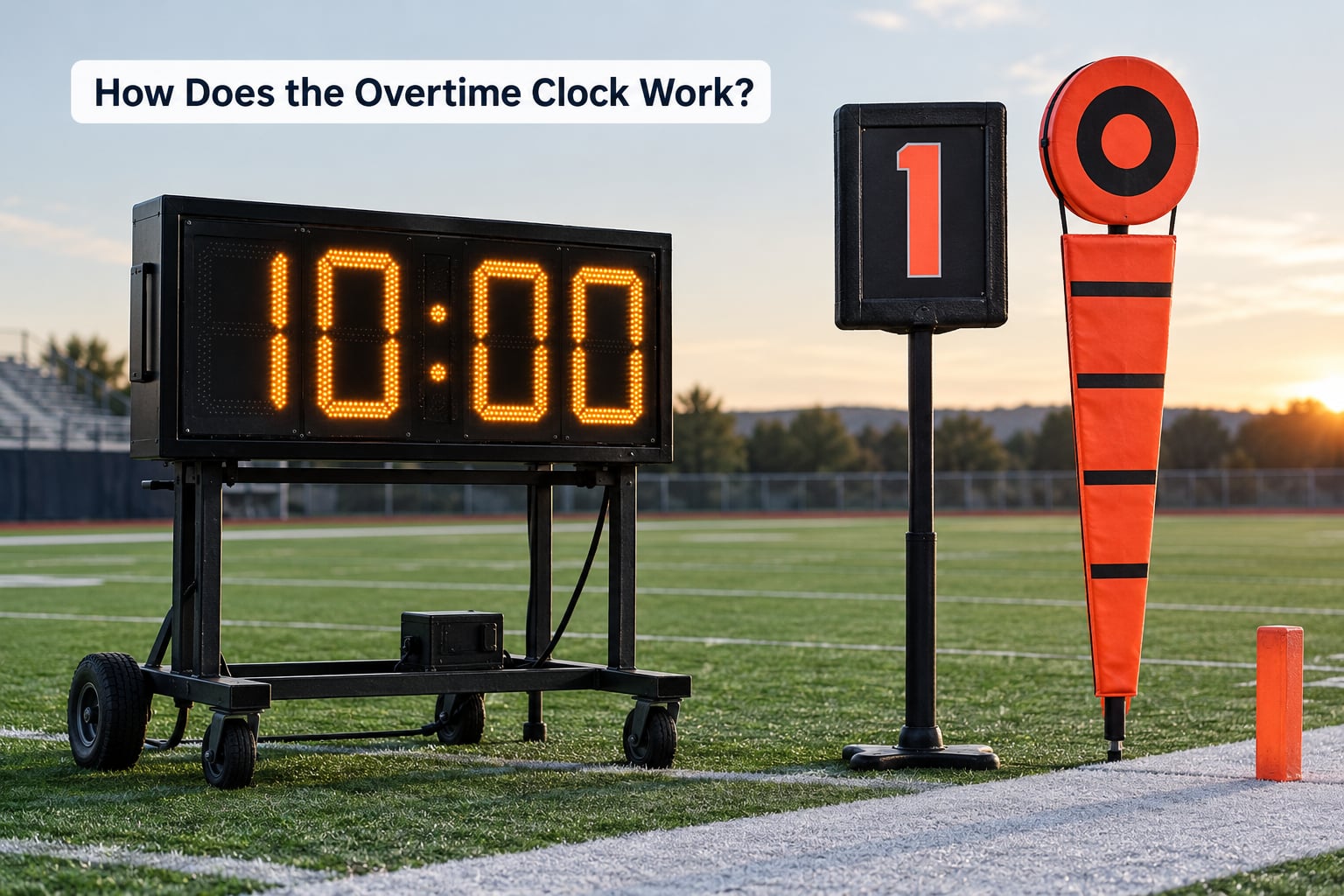
Once the coin toss is over, the game clock is stopped for the duration. Overtime periods are ten minutes long, but that clock is not a game clock in any meaningful sense, because it is not running while plays are happening. It exists so a period has an end point if a team chooses to milk the remaining time and prevent a score.
The clock starts running only on a kickoff following a touchback, and officials stop it at the end of every play. Sitting on the ball for eight of the ten minutes is legal, and it is a real tactic when a team would rather not hand the opponent a shot at a touchdown.
Timeouts are tight in overtime. Each team gets one timeout per overtime period, and unused timeouts do not carry into the next period. When the ten minutes expire without a score, the period ends and the next one begins, with sides switched and the clock reset.
Can a College Football Game End in a Tie After Overtime?
Yes, for a full period it can. Two teams can go through an entire overtime period without scoring, and the game continues into the next period rather than ending 0-0. Because both teams get a possession in the first two periods, a scoreless period is a real possibility, not a theoretical edge case.
The NCAA objective is always a winner, so a game continues until somebody scores. The tie only survives as a final result in regular season games where conference policy accepts a tie. In a bowl game or a College Football Playoff game, a tie after overtime is not an option.
What Happens When Overtime Reaches Sudden Death?
The third overtime is sudden death, and everything gets simpler. Each team gets one play from the 25-yard line. If the play is a touchdown, the game is over and no try play is run. If the play is not a touchdown, the period is over and possession alternates.
There are no downs and no first downs in sudden death, which is why a single snap can decide a national championship. If the play goes up for a try play, two points end the game immediately. Missing the try play does not end anything; it just means the game moves to the fourth period.
Possession alternates in later periods the same way, and there is no cap on how many periods can be played. Games have gone to nine overtime periods and beyond, which is a genuinely unpleasant thing to watch and a great reason to pay attention to the coin toss.
What Happens to Field Position, Penalties, and Statistics?
In the first two periods the kicking team must kick off after a touchdown. From the third overtime on, there are no kickoffs at all; the ball is spotted where the previous play ended. That is a meaningful difference, because kickoff touchbacks are a large part of why college offenses are conservative at the start of a possession.
Penalties are enforced exactly as they are in regulation. A foul carries the usual 5, 10 or 15 yards, and if the foul occurs during a try play, the penalty is carried over to the spot where the next possession would start. Review works the same way too, so a close fourth-down spot or a fumble ruling can still be challenged and overturned.
Overtime points are not part of official NCAA season statistics. A kicker’s field goals, a quarterback’s touchdowns and a receiver’s catches from overtime do not count toward official records or statistical rankings, which is one of the quieter reasons coaches approach a tie with as much caution as they do.
Are Overtime Rules Different Across NCAA Divisions?
The mechanics are the same everywhere in NCAA football. FBS, FCS and Division III all use the same 25-yard line start, the same 10-minute periods, the same mandatory two-point try play in the second overtime and the same single-play sudden death after that.
What changes is policy around the edges. Regular season tie rules come from the conference or the institution, so two teams in the same division can have different rules for what happens when a game ends level. Postseason games do not have that flexibility. Bowls, conference championships and the College Football Playoff all require a winner, which is why the national championship is decided in sudden death rather than ending in a tie.
Frequently Asked Questions
How many overtime periods can a college football game have?
There is no maximum. Periods continue until a team scores under the rules that apply to that period, and because the first two periods allow full possessions on both sides, a game can stay level for several periods. Illinois once needed nine overtimes against Penn State to settle it, and multi-overtime games now happen more often because later periods are decided by a single play.
Does the team that wins the coin toss choose the first overtime possession?
The visiting team calls the coin toss, and the winner chooses between receiving the ball and picking an end zone, exactly as it did before kickoff. The team that wins the toss can defer, which hands the choice to the other team. Most teams defer in overtime because having the second possession means you know the situation when your turn arrives.
Can a college football overtime game end without either team scoring?
It can stay scoreless for a period, but not for the game. In the first two overtimes both teams get a full possession, so a period can end 0-0 and the game simply moves to the next period with sides switched. From the third overtime on, a scoreless period is all but impossible because each team gets one play from the 25-yard line.
Can a team choose to kick off after a touchdown in overtime?
In the first two overtime periods the kicking team must kick off, so there is no choice to make. From the third overtime on, kickoffs disappear entirely and the ball is spotted where the previous play ended. That is a big deal strategically, since a team can no longer expect to start its single overtime play from its own 25-yard line after a touchback.
Do overtime points count toward a kicker’s NCAA season statistics?
No. Points scored in overtime are not counted in official NCAA season statistics, so a field goal or touchdown in overtime does not appear in a kicker’s or receiver’s official totals. Coaches and the media often mention those numbers informally, but they are kept separate from anything the NCAA publishes as an official record.
What happens if a team is called for a penalty during overtime?
The penalty is enforced the same way it is in regulation, with the usual yardage and the same spot rules for the next snap. If the foul happens during a try play, the penalty is assessed and carried to the spot where the next possession would begin. Replay review also applies, so a spot or turnover ruling can be challenged in overtime as it can anywhere else.
Conclusion
If you remember four things about how college football overtime rules work, they are the 25-yard line every possession starts from, the 10-minute period with no game clock running, the alternating possession that gives one team the last word before sudden death, and the fact that from the second overtime on a touchdown means a two-point conversion. Everything else follows from those.
Once a game reaches the third period, one snap decides it, and that is a startling contrast to the sixty minutes that came before. Watch the coin toss and the spot of the ball, and the rest of the format explains itself.