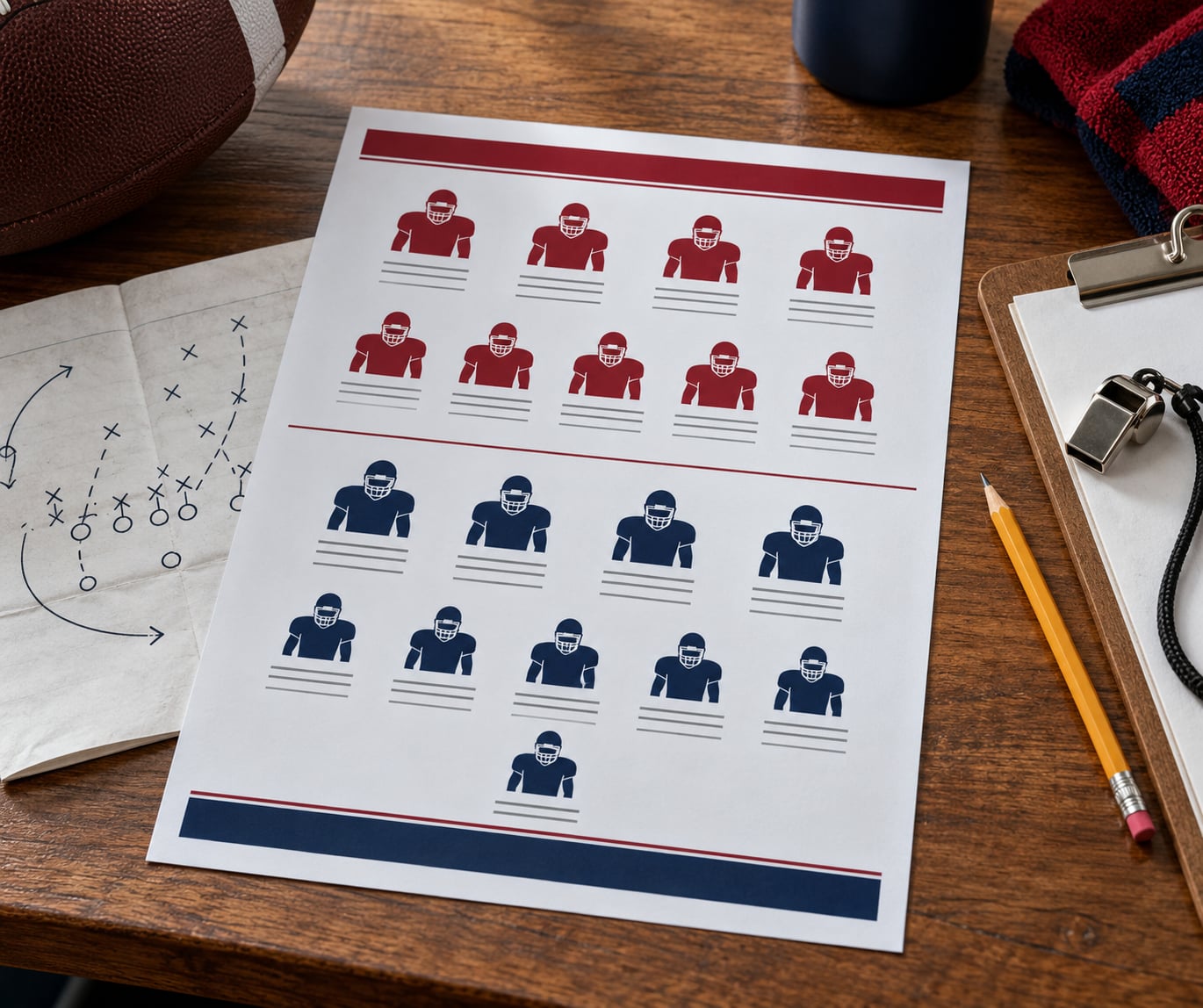
Learning how to read a college football depth chart takes about five minutes once you know what the labels mean. A depth chart ranks every player at each position, starting with the projected starter and working down to the last name who will see game time. Before kickoff, fans use it to answer one question: who is in uniform, and who is the next man up if somebody gets hurt.
One quick note before we start. This is the real chart a program publishes in its media guide, not the roster screen inside the EA Sports College Football video game. Plenty of searches for this topic land on gaming content, which is not what this guide is about.
Every school lays the chart out differently, so there is no single format to memorize. What follows is the reading method that works across all of them, plus a legend for the abbreviations that trip up first-time fans.
Table of Contents
- What You Need
- How to Read a College Football Depth Chart: Step by Step
- Step 1: Check the Team, the Date, and What Kind of Chart It Is
- Step 2: Find the Position Groups
- Step 3: Identify the First-Listed Player at Each Position
- Step 4: Read the Backups in Order
- Step 5: Decode Position Abbreviations and Class Year Codes
- Step 6: Look for Position Flexibility
- Step 7: Cross-Check the College Football Depth Chart With News and Game Notes
- Common Mistakes
- Frequently Asked Questions
- What does 2 deep mean in football?
- What does it mean when a quarterback is listed as or?
- How do I read a college football depth chart in the middle of the season?
- Are college football depth charts accurate?
- Why does my team not release an official depth chart?
- What is the difference between a depth chart and a starting lineup?
- Conclusion
What You Need
You need very little to read a depth chart. A team’s athletics website, the current roster, and ten quiet minutes will do it.
Four things are worth having open side by side, because no single one of them is reliable on its own:
- The chart itself, with the date it was published or last updated printed on it somewhere.
- The roster page, which tells you class years, jersey numbers, hometown and position changes.
- The weekly injury designations, where availability is spelled out in words rather than letters.
- Last week’s box score or play-by-play, which shows how many snaps each player actually took.
That last one matters more than people expect. Fans on r/CFB have long complained that teams are inconsistent about publishing charts at all, and practice reports routinely contradict the printed version. Cross-checking against snaps settles most of that noise.
Not every chart carries the same weight. This is the difference fans keep asking about:
| Chart type | Where it comes from | How much to trust it |
|---|---|---|
| Official media guide chart | The program, usually published before the season | Strong on names and positions, weaker once the season starts because programs often stop updating it |
| Official weekly chart | The program, released around game week | The best public source, but only a handful of schools publish one every week |
| Projected or unofficial chart | Scouting services and aggregators such as 247Sports, On3, OurLads and TheTwoDeep | A coach’s earlier public comments turned into a guess. Useful in the offseason, unreliable as a final word |
| Scraped PDF mirrors | Third-party copies of a program’s chart | Fine for notation, but often dated and stripped of the footnotes that explain the symbols |
The pattern fans describe is that schools like Alabama hand the press box a real depth chart while most programs release one media guide page and then go dark. If a chart carries no date, treat it as an offseason guess.
How to Read a College Football Depth Chart: Step by Step
Read it top to bottom, in this order. Seven steps, about five minutes.
Step 1: Check the Team, the Date, and What Kind of Chart It Is
Start with the boring part. Confirm the school, confirm when the chart was published, and figure out whether it is official or projected. A September media guide chart and an official week-eleven chart can name different starters at the same position.
If the chart is projected, treat every name on it as a hypothesis. If it is official and recent, it is the closest thing to a public answer.
Step 2: Find the Position Groups
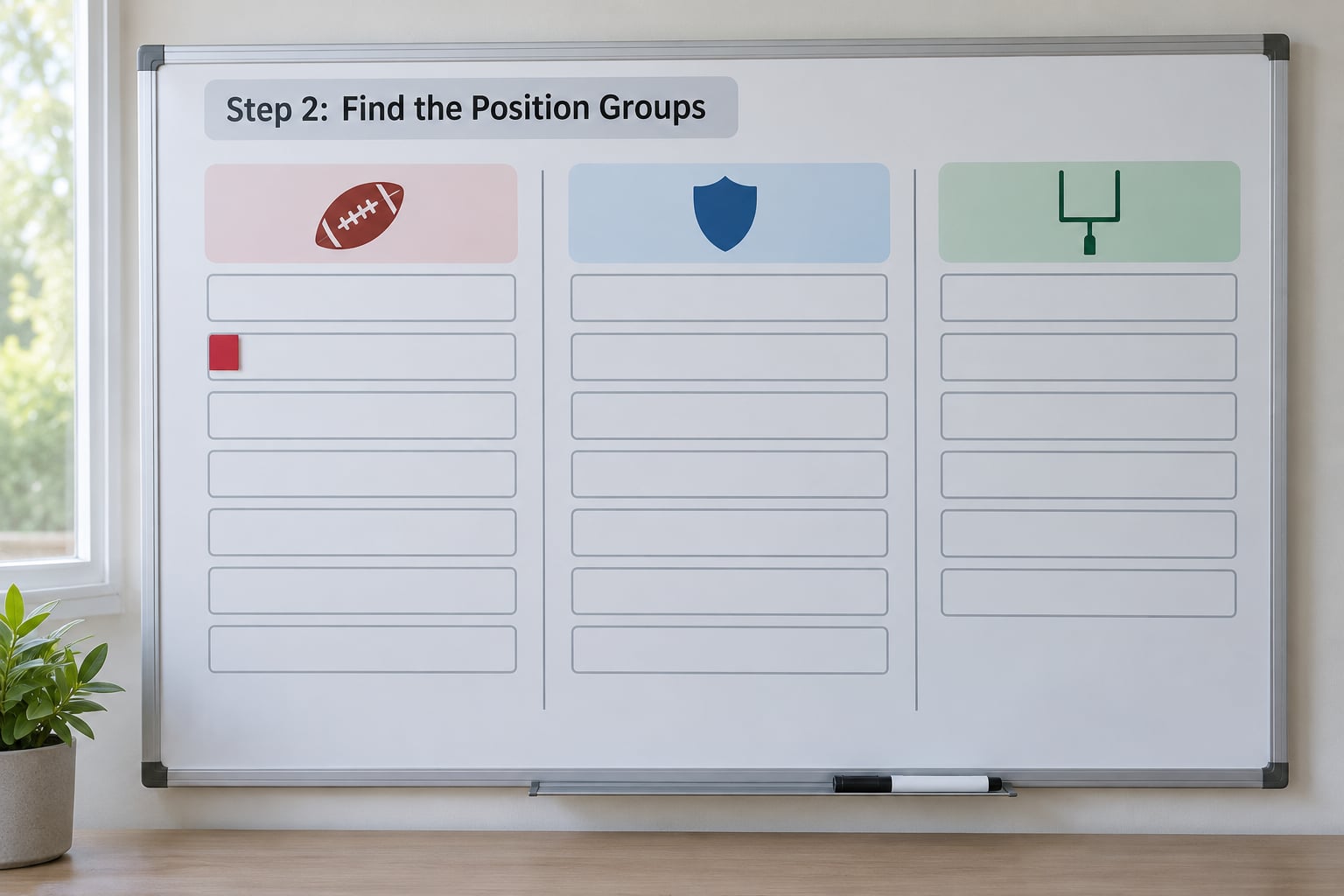
Separate the chart into its three blocks: offense, defense, special teams. Offense runs quarterback, running back, receivers, tight end and the offensive line. Defense runs defensive line, linebackers and the secondary. Special teams covers kicking, punting and returns.
Then go one level deeper. Inside receivers you will often see X, Z and SLOT listed separately rather than one generic WR group. On defense, watch for defensive ends versus defensive tackles, outside versus inside linebackers, and safeties split into strong and free.
Some charts are built around the eleven positions of a base formation. Others are organized by personnel package, meaning the nickel or dime positions appear as their own groups. Neither is wrong, but you cannot compare the two directly until you know which one you are holding.
Step 3: Identify the First-Listed Player at Each Position
The top name at a position is the projected starter. That is the entire meaning of top billing on a chart.
Watch for the trap of two names joined by the word “or.” That is the most misread notation in football. It usually means the coach is not ready to name one player, sometimes because a true competition is running, more often because he wants both quarterbacks to prepare as if they are playing. It is not a coin flip.
And an inactive or out player listed at the top of a position is still printed there. The chart records the depth order; it does not update itself the minute someone gets hurt.
Step 4: Read the Backups in Order
The second name listed is the backup, the third is what fans call the third string, and the fourth is emergency depth. Higher means more likely to play, not more talented in any absolute sense.
Comparing order across positions tells you a lot about a roster. A chart with five running backs and two tight ends is telling you the run game is the plan and tight end is a blocking position. Two tight ends with real depth usually means the offense wants to play with two of them on the field.
You will also see the same player listed at two positions. That is a cross-trained player, not a mistake, and it is usually a good sign for the depth behind them.
Step 5: Decode Position Abbreviations and Class Year Codes
This is where most beginners stall. Here is the legend for the offense.
| Label | Position | What the role actually does |
|---|---|---|
| QB | Quarterback | Calls the offense, handles the snap, throws or hands off |
| RB / HB | Running back, halfback | Carries the ball, blocks, catches out of the backfield |
| FB | Fullback | Lead blocker who also carries on short runs |
| X | Wide receiver, flanker | The wide receiver on the side away from the slot |
| Z | Wide receiver, split end | The wide receiver on the side the slot is not on |
| SLOT | Slot receiver | Lines up between the tackles, motion and screens a lot |
| TE | Tight end | Lines up next to the tackle, blocks first and catches second |
| LT / RT | Offensive tackle | The two bookends of the offensive line, pass-block and run-block |
| LG / RG | Offensive guard | The interior linemen on either side of the center |
| C | Center | Snaps the ball and protects the quarterback’s blind side from the middle |
| OL | Offensive line | Sometimes used as a single grouped entry instead of five slots |
Defense gets its own set of labels, and the split between outside and inside linebackers is the one that matters most.
| Label | Position | What the role actually does |
|---|---|---|
| DE / DLE / DTE | Defensive end, edge rusher | Lines up outside the tackles and rushes the passer |
| DT / NT | Defensive tackle, nose tackle | Holds the interior, occupies blockers so the linebackers can read |
| OLB | Outside linebacker | Edge defender, sometimes dropped into coverage |
| ILB / MLB | Inside linebacker, middle linebacker | Runs downhill, reads the run, takes the lead on blitzes |
| STAR | Strong safety or hybrid backer | The safety-sized defender who plays downhill in run defense |
| OTB | Outside backer | A defensive back who plays the slot receiver in coverage |
| CB | Cornerback | Covers the receivers, usually man to man |
| S / SS / FS | Safety, strong safety, free safety | Last line of defense, deep coverage and run support |
| NB | Nickel back | The extra defensive back who comes on in five-defensive-back packages |
| DB | Defensive back | A generic label covering corners and safeties |
Special teams labels are short enough to memorize in one pass.
| Label | Position | What the role actually does |
|---|---|---|
| K / PK | Kicker, placekicker | Kicks field goals, extra points and most touchbacks |
| P | Punter | Kicks punts and usually handles the onside kicks |
| LS | Long snapper | Snaps on field goals, punts and extra points |
| KR / PR | Kick returner, punt returner | Takes the returns after kickoffs and punts |
The letters after a player’s name are class years, and they tell you about eligibility, not ability.
| Code | Meaning | Why you care |
|---|---|---|
| FR | Freshman | First year, usually the least experienced name on the chart |
| SO | Sophomore | Second year of eligibility |
| JR | Junior | Third year, when most players first compete for a starting job |
| SR | Senior | Fourth and final year of eligibility |
| RS | Redshirt | Sitting out a year of playing time while practicing with the team |
| GR | Graduate | Finished degree requirements early and is playing an extra year |
| TR | Transfer | Arrived from another school, with eligibility left to work with |
Schools are not consistent about these, and you will see lower-case and hyphenated variants. The meaning rarely changes.
Step 6: Look for Position Flexibility
A player printed at two positions is cross-trained, which usually means a real rotation when healthy and a faster substitution when somebody is banged up. Multiple entries across the offensive line are a good example: it tells you the coach has a replacement ready at more than one spot.
Also watch for position conversions. A wide receiver who moves to running back in the spring may be listed at both spots for a few weeks, and that is a genuine headline, not noise.
Step 7: Cross-Check the College Football Depth Chart With News and Game Notes
Finish by confirming the chart against what the program said this week. Read the availability report, which uses written designations instead of symbols, and check the game notes published before kickoff, which often confirm the starting lineup hours ahead of the game.
Then compare against snaps. If the chart says somebody is second at running back and he took 30 snaps last week, the chart is wrong or the rotation changed. Either way, you now know something the printed chart did not tell you.
Symbols are worth decoding before you trust any of it. Unofficial data sites use single letters that are not explained anywhere on the page.
| Symbol | What it means | How to react |
|---|---|---|
| O | Out | Ignore the chart order for this player and find the next healthy name |
| Q | Questionable | Wait for the game-day update; he may play limited snaps |
| D | Doubtful | Plan around him being unavailable |
| I | Injury or inactive | Treat as out until the school says otherwise |
| or | Two players share the job | Often a managed competition, not a genuine 50/50 split |
| * | Footnote marker | Find the note at the bottom, which is usually about eligibility or injury |
| N/A or dash | No player listed | That spot is empty or undecided, and it is worth watching |
| NEW STARTER | Tag showing a change from the prior chart | The most useful label on the page, because it tells you what moved |
Common Mistakes
Almost every confusing moment with a depth chart comes down to one of these six errors.
- Reading the top name as a guarantee. A projected starter can lose the job on Tuesday. Treat top billing as the best available guess, not a promise.
- Treating a projected chart as official. Offseason charts are built from press conference comments. If the page does not come from the school, it is a guess with a logo on it.
- Ignoring the date. The single most common error. A chart from early August and one from week ten are not the same document, and the earlier one is worthless in October.
- Assuming depth order equals playing time. The name listed second can take more snaps than the name listed first. Coaches rotate for reasons the chart never records, and snap counts from the box score settle it.
- Overlooking special teams. Kickers, punters and returners decide games, and their entries change often. Returners in particular are worth checking every week.
- Reading “or” as a tie. Two names joined by “or” is a coach declining to commit. It says almost nothing about who takes the first snap.
One more that trips up people coming from the video game: personnel packages are not the same thing as positions. A nickel or dime formation on defense, or a twelve-personnel group on offense, changes which players are actually on the field. The chart lists positions, and the box score tells you the package.
Depth charts also feed everything else. Fantasy players use them to project roles before lineup locks, bettors use them to size up an opponent’s bench, and recruiting watchers use them to track portal losses. The same reading method works for all three, as long as you weigh the chart by how official and how recent it is.
Frequently Asked Questions
What does 2 deep mean in football?
Two deep means the chart lists two players at a position: the starter and the backup. It is the minimum a program can publish and tells you nothing about the third option. Three-team charts add a third name and four-team charts go further, so you can see where a game would turn if two players at one position were unavailable.
What does it mean when a quarterback is listed as or?
The word or between two quarterbacks means the coach has not picked one, not that the job is a coin flip. It often signals a managed competition where both players take reps, or a preferred starter the staff wants to keep honest with a caveat attached. Actual starter splits show up in the box score, not on the chart.
How do I read a college football depth chart in the middle of the season?
Check the date first, then find the position groups and read down from the top name at each spot. Cross-check the result against the weekly injury designations and last week’s snap counts, because the printed order often lags behind what coaches actually did. Weekly official charts beat the media guide version once the season starts.
Are college football depth charts accurate?
Official charts are directionally right and frequently stale, since most programs update them a handful of times a year. Unofficial projections are honest guesses built from public comments and are weakest in the offseason. Fans in places like r/Gamecocks complain that offseason projections are often flatly wrong, so treat them as a starting point rather than a source.
Why does my team not release an official depth chart?
Most programs publish one chart in the season media guide and then stop, because a public depth order creates recruiting and game-plan risk. A small number of schools do publish weekly charts. If yours does not, use the media guide version plus injury reports and last week’s snap counts as your substitute.
What is the difference between a depth chart and a starting lineup?
A depth chart is a ranked list published in advance, showing the starter, the backups and everyone behind them. A starting lineup is the official eleven revealed shortly before kickoff on game day. The lineup is the answer; the chart is the prediction the program published earlier.
Conclusion
Start with the date, because an undated chart is worse than no chart. Find the offense, defense and special teams blocks, read down from the top name at each position, then decode the abbreviations and class year codes using the tables above. Before you make any prediction, check the injury designations and last week’s snap counts, because that is where the printed chart usually goes wrong.
Nothing on the page is permanent. Depth charts shift weekly once the season starts, so the copy you saved in September is already out of date. Treat the lineup announced on game day as the answer and everything before it as an educated read.