Home field advantage in college football is the extra win probability a team picks up simply by playing at its own stadium. How college football home field advantage works comes down to six things that stack on each other: crowd noise, officiating tilt, travel, venue familiarity, routine, and schedule context. Historically home teams won about 59% of games, worth roughly 4.1 to 4.7 points on a spread, depending on the study you read.
That is a real edge and it is also a modest one. Nothing in the research says the home team is guaranteed to win, and a good chunk of the headline numbers are tangled up with selection bias. This guide breaks the mechanism apart, then tells you which parts actually move a line.
Updated for the 2026 college football season.
Table of Contents
- What Is College Football Home Field Advantage?
- Why Home Crowds Can Help
- How Travel Requirements Affect Teams
- Why Familiarity With the Field Matters
- Do Officiating and Home-Team Rules Create an Advantage?
- Which Teams Benefit Most From Home Field Advantage?
- How Large Is the Typical Home-Field Edge?
- Why Do Some Home-Team Comebacks Look So Memorable?
- Can Visiting Teams or Coaches Eliminate Home Field Advantage?
- Frequently Asked Questions
- Does home field advantage guarantee a college football team will win?
- How many points is college football home field advantage worth?
- Does a home crowd really affect football officials?
- Which college football conference has the strongest home-field advantage?
- Can a visiting team overcome home field advantage?
- Conclusion
What Is College Football Home Field Advantage?
Home field advantage is the measurable performance edge a team shows when it plays at home rather than on the road. In college football that shows up three ways: home teams win more often, they outscore opponents by a wider margin, and betting markets price them as the favorite.
It is an average, not a promise. A 59% home win rate means that in a large sample of games, the home side won a bit more than half the time. It does not mean the next game at Arizona Stadium is a lock, and it does not mean a home team playing a much better opponent will win.
It also matters to separate two ideas that get mixed together. The first is a team’s genuine home edge, which depends on the stadium, the crowd, and the team’s habits. The second is the value of being listed as the home team, which is mostly a scheduling and officiating designation. A team playing a designated home game in the other conference’s stadium has the designation without the substance.
How College Football Home Field Advantage Is Created
The framework underneath the phrase comes down to six channels, and it helps to rank them.
- Crowd noise and psychology. Loud, engaged stands make it harder for a visiting offense to relay a play call, and they feed the home team’s energy.
- Officiating. Officials are not considered biased, but the calls are not random either, and small margins land disproportionately on one side.
- Travel and logistics. Bus rides, flights, time zone changes, altitude, and back-to-back weeks cost visiting teams energy before kickoff.
- Venue familiarity. Home players know the surface, the sight lines, the wind, and the noise floor of their own stadium.
- Routine and recovery. Pregame, sleep, meals, and treatment happen at home, on a schedule the team controls.
- Schedule context. Opponent quality, altitude, weather, and the conference schedule the team sits in all shape how big the edge looks in any given season.
No single channel explains the whole thing, and the honest answer is that the measurable portion is smaller than the folklore. The framework is still useful because it tells you what a program can actually control.
Why Home Crowds Can Help
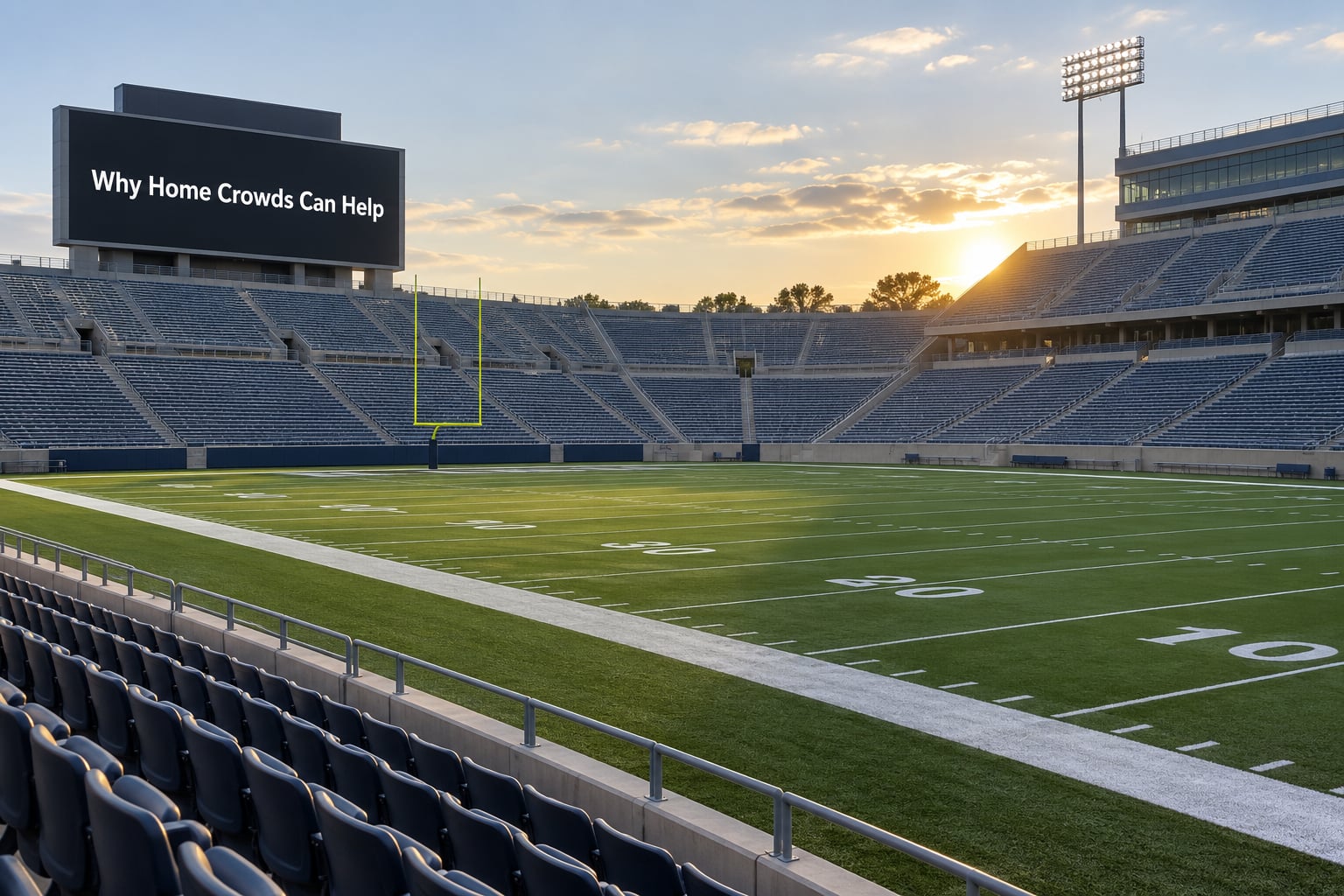
A crowd helps mainly because it degrades communication. A visiting offense calling an audible at the line has to be heard over an entire bowl, and the home sideline can hear the call too. Forum threads on r/CFB keep landing on the same detail: visitors describe losing composure specifically on communication reads, not on individual physical plays. That is the noise mechanism working exactly where you’d expect it.
Crowd noise is measured in decibels, but raw volume is not the variable that matters. A 95,000-seat stadium with a thin, disengaged student section can be quieter in practice than a smaller one where the student band is packed behind the end zone. That is why fans on operations forums and Quora threads argue about student section size far more than about raw capacity.
The second effect is penalties. False starts, illegal procedure, delay of game: all of them are more likely when an offense cannot get the snap count and the sideline signal straight. Officials also operate in an environment where a stadium is loudly disagreeing with them, and research in other sports has found that social pressure on referees shifts borderline calls toward the home team without anyone intending it.
Third, there is emotional energy. Home players get a lift from a standing start, and third downs in a loud building tend to end more often than not. It is hard to quantify and easy to feel, which is exactly why it gets over-credited.
How Travel Requirements Affect Teams
Travel matters, but the effect is smaller and more team-specific than most schedules assume. A 90-minute bus ride is not comparable to a redeye followed by a time zone change, and a team that travels with its own bus, its own food, and a routine it has run a dozen times absorbs far less than a team flying commercial after a bad week.
A Dartmouth sports analytics study on FBS point differential found that travel distance has a statistically significant effect, while also noting the effect has lessened in recent seasons. The practical read is that travel still matters, and it matters more in September and late in a season than it does in the middle of October.
Time zone is the piece fans argue about most after conference realignment. The rebuilt Big 12 stretches across three time zones, which means some trips are short flights with a three-hour clock change, and that is a genuine physiological cost on top of the travel itself. The same conversation plays out in the SEC and the Big Ten, where the footprint grew after expansion.
Altitude is a real but narrow factor. Only a handful of programs play high enough for it to matter, and the effect is measurable in the first quarter and largely gone by the second.
Back-to-back weeks compound all of it. A visiting team that played three hours of football five days earlier arrives tired before the travel even starts, and the home team usually has a lighter load.
Why Familiarity With the Field Matters
Familiarity helps because it removes a layer of small decisions. Home players know how the field cuts on a cut, where the ball moves in the wind, which way the noise bounces off the roof, and how the surface behaves after fifty plays. None of that is dramatic on its own, and all of it compounds over four quarters.
Practice access is part of the same thing. Programs that play and practice in their own stadium get the full week in the building. A visiting team gets maybe one walkthrough, and its quarterback is hearing the acoustics for the first time in game conditions.
Local weather knowledge is underrated. A team that plays in the desert in September knows when the wind picks up and how to adjust its offensive calls, and it knows what the stadium feels like at three in the afternoon. The Wildcats play one of the most punishing late-season home schedules in the sport, and visiting teams routinely show up having practiced in morning fog and then play in full afternoon sun.
Familiarity can also go the wrong way. Relocation studies in professional sports found that teams played noticeably worse in a new venue for a period, then reverted once the building became routine. So a brand new stadium is not automatically a home field advantage upgrade, and some of the loudest venues in football took decades of tradition before they felt like anything.
Do Officiating and Home-Team Rules Create an Advantage?
Partly, and it is worth being precise about how. The best-known work here is Scorecasting, the analysis by Tobias Moskowitz and John Wertheim, which found that referee decisions explain a meaningful share of the measurable home advantage in basketball, football, and baseball. Football had the weakest referee effect of the sports they studied, but it was not zero.
The translation to points is simple. A penalty that sets a team back seven yards, a spot call that adds a first down, a borderline holding call that goes against the visitor: each one is small, and the margin college football produces is also small, so a handful of them decides the score. Officials are not generally regarded as favoring home teams, and crews rotate through home and road assignments all season. The mechanism is pressure and noise, not preference.
On rules, college football overtime is structured specifically to avoid the extra-possession imbalance that once favored one team. Each half of overtime has an equal number of possessions, so the format itself does not hand the home team an edge. What remains in overtime is who wins the coin toss and who has the better drive, which is a much thinner version of the same problem the crowd created over four quarters.
The one structural quirk that matters more is playoff hosting. Under College Football Playoff rules, ticket revenue from a first-round home game goes to the playoff rather than the school, schools keep parking and concessions, and the visiting school receives an allotment of roughly 3,500 tickets. Front Office Sports has documented how that setup changes the feel of a host game, and visiting teams now arrive with their own hype video that plays over the home stadium PA before kickoff.
Net result: a playoff host keeps the building and loses some of the economics and some of the exclusivity. That is a real reason a first-round home playoff game does not feel like a September home game.
Which Teams Benefit Most From Home Field Advantage?
Programs with a deep, engaged student section and a bowl-shaped building built for noise get the biggest edge, not programs with the largest raw capacity. Phil Steele’s multi-part atmosphere series is the reference fans treat as authoritative for this reason, because it ranks on measurable details instead of reputations.
| Factor | Associated with a larger edge | Associated with a smaller edge |
|---|---|---|
| Student section size | Large, loud, organized band and student block | Small enrollment or disengaged student section |
| Stadium geometry | Steep bowl that funnels sound onto the field | Upper deck pulled back from the sideline |
| Travel distance to visitor | Cross-country or multi-time-zone trip | Short bus run down the road |
| Altitude and weather | Host used to the conditions, visitor is not | Neutral conditions for both teams |
| Schedule context | Favorable home slate against weaker opponents | Home slate stacked with ranked teams |
| Tradition and routine | Decades of the same gameday script | New stadium, unsettled routine |
Venues that show up on the list for consistent, explainable reasons rather than reputation: Death Valley at Clemson for its steep bowl and student section, Michigan Stadium for sheer volume and the tunnel tradition, Kyle Field at Texas A&M for a dense student band in a tight bowl, Neyland Stadium for sheer concentrated noise, and Beaver Stadium and Doak Campbell for the same bowl-and-student-section reasons.
The reverse case matters too. An 8,000-undergrad school with a thin student section can field a strong football team and still play at home in a building that gives it very little. Capacity and home field advantage correlate only loosely.
How Large Is the Typical Home-Field Edge?
Most published estimates land in the same neighborhood: a home team is worth roughly three to five points, and wins a little over half of its games. The spread between figures you see online usually comes from era and methodology, not from disagreement about whether the effect is real.
| What the number describes | Typical value | Where it comes from |
|---|---|---|
| College football home win rate, 1971 season | About 59% | Schwartz and Barsky, The Home Advantage (1977) |
| College football point-spread estimate | 4.1 to 4.7 points | Fair and Oster, College Football Rankings and Market Efficiency (2007) |
| Regular season home win rate, modern sample | About 54% | Aurora University analysis of 2000-2017 data |
| Expected differential, same sample | About +4% | Aurora University analysis |
| Straight-up read | Home team favored in roughly six of ten comparable matchups | Derived from the win-rate figures above |
| Betting market read | Typical spread favors the home side by about the same margin | Market pricing tracks the point-spread estimate |
Expected differential is the number to keep in mind. It asks what a team would have scored against an average opponent, and it strips out the fact that good teams happen to win at home more often. On that measure, the college football edge sits around four percent, which sounds small until you realize it is the gap between a coin flip and a real lean.
Now the skeptic’s case, because it is the strongest objection. Teams earn home playoff games by being good, so playoff data where home teams dominate proves almost nothing. Bill James put it bluntly: an undefeated team has a home field advantage of zip. The selection effect is real, and it is why the honest estimate comes from regular-season data across thousands of games rather than from highlight reels of hosts going undefeated at home.
Kevin Krieger’s peer-reviewed work on fan impact is useful here too, because it separates the physical presence of supporters from the expectation of supporters. The expectation alone produces much of the effect, which explains why playoff games with restricted away allotments still feel different.
Why Do Some Home-Team Comebacks Look So Memorable?
Because we keep the good ones and forget the rest, mostly. A team that comes back from 17 down in a building at full volume becomes the clip everyone shares, and the four hundred times the home team did not come back do not. It is survivorship bias doing the storytelling.
That said, the recurring patterns in those games map cleanly onto the six channels. Early crowd energy inflates the home offense before the visitor has settled into its calls. Adjusted offensive communication, usually a switch to a simplified or hand-sign system, is the most commonly described turning point in road-game write-ups. Reduced travel fatigue shows up as fourth-quarter tackling and special teams effort that look inexplicably worse for the visitors.
Late-game execution is the least romantic part of the list and probably the most important. Home teams know their routine: the timeout that means something specific, the cadence on the final drive, which staffer handles the sideline. A visiting team is improvising all of it at 11-to-1 under a clock.
None of that makes the comeback causal proof. It makes it consistent with the mechanism, which is the strongest claim the data supports.
Can Visiting Teams or Coaches Eliminate Home Field Advantage?
They can shrink it. They cannot delete it, and the difference is worth being clear about.
Communication systems are the biggest lever. A visiting team that expects noise will have a silent or simplified system built in during the week, with hand signals and a backup cadence for when nothing gets through. That takes away the largest crowd effect without a single word spoken on the field.
Preparation matters in the same way. Teams that treat a hostile road game as a normal game, with the same meals and the same sleep, lose less than teams that treat it as an event. Hosting the play calling against noise in practice is another one; quarterbacks who have called plays in stadium noise during the week are noticeably calmer than ones hearing it for the first time.
Experience compounds. Programs that play hostile road games every year, and that have lost on them before, treat the noise as background rather than as a problem to solve. Programs that rarely leave home treat it as an emergency.
Tactical adaptability is the fourth lever, and it has hard limits. A coach can change the offense to a run game that needs no communication, and it can slow the tempo to lower the number of decisions per quarter. It cannot manufacture a stadium, remove the altitude, or hand its players back the three hours of rest the travel took.
The floor, then, is roughly the non-crowd portion of the edge. Visits shrink the crowd component to near zero and can blunt the officiating component through discipline. Travel and familiarity stay exactly where they were.
Frequently Asked Questions
Does home field advantage guarantee a college football team will win?
No. Home field advantage raises the odds, not the outcome. A home win rate near 59% historically means home teams won more often than not across thousands of games, not that any particular home game is likely to be won. Expected differential of about four percent is the cleaner way to read it: the home team plays roughly as well as it would against an average opponent, with a modest bump on top.
How many points is college football home field advantage worth?
Roughly three to five points. Fair and Oster’s 2007 study of college football rankings and market efficiency estimated 4.1 to 4.7 points, and modern samples put regular season expected differential at about four percent. Treat it as a range rather than a fixed number, because the edge moves with stadium, opponent, travel, and weather.
Does a home crowd really affect football officials?
Mostly through pressure and side effects, not preference. Research in other sports found that referees shift borderline calls toward the home team under crowd pressure. In football the indirect effect may matter more: noise causes false starts and illegal procedure calls that officials have no choice about, and those pre-snap penalties add up over a game.
Which college football conference has the strongest home-field advantage?
No conference owns it outright, because the edge tracks stadium design, student section size, and travel burden rather than league membership. Programs with steep, packed bowls in the Deep South and Big Ten tend to rate highest, and conference schedules that span three time zones make travel bite harder in the rebuilt Big 12 than in the SEC or ACC.
Can a visiting team overcome home field advantage?
Yes, and it happens every season. Building a silent or simplified communication system, preparing for hostile noise during practice, and keeping normal pregame routines can remove most of the crowd component. What a visitor cannot remove is travel, altitude, and unfamiliarity with the venue, so the realistic goal is cutting the edge rather than erasing it.
Conclusion
Here is the short version of how college football home field advantage works: a loud, engaged home crowd degrades the visiting offense’s communication and generates extra penalties, officials shift a small number of borderline calls toward the home side, and travel, altitude, and venue unfamiliarity quietly take points off the visitor. Measured across thousands of games, that combination is worth about three to five points and roughly four percent of expected differential.
Start there when you evaluate a game. Check the travel burden and the stadium before you check the hype, and treat any claim that home field advantage explains a specific result as a hypothesis to test rather than a fact. The edge is real, it is modest, and the teams that build it deliberately get more out of it than the teams that assume it is free.