College football tailgating is a pregame gathering in the parking lots, lawns and paved areas around a stadium where fans set up shade, cook food, play lawn games and talk before kickoff. For most schools it runs three to five hours, and for a first-timer it is the easiest part of game day to walk into, even if you have never been to a college football game.
Most first-timers overthink this. There is no ticket scanner at the mouth of the lot, no dress code, and nobody is going to hand you a clipboard. You find a space, put up a canopy, cook something, and talk to whoever wanders over.
What actually trips people up is parking, and the rules schools publish about what you can do inside your own space. Get those two things right and the rest of how college football tailgating works for first timers is mostly common sense. Below is the whole picture, from picking a game to clearing your spot at the end of it.
Last updated: October 2026. Stadium policies change every season, so confirm the current game-day guide on your school’s athletics site before you drive out.
Table of Contents
- What College Football Tailgating Is
- How College Football Tailgating Works for First Timers
- How to Choose the Right Tailgate for Your First Game
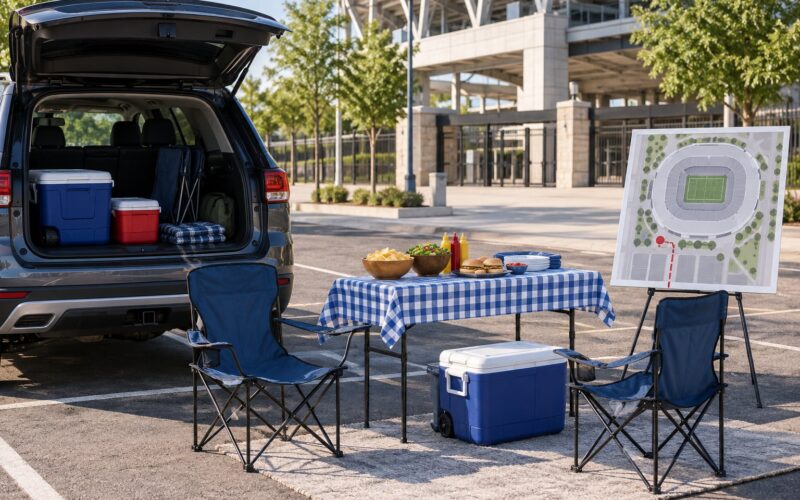
- What to Bring and How to Set Up
- How Food and Drinks Fit Into the Experience
- What Tailgate Etiquette First Timers Should Know
- How to Move from the Tailgate to the Stadium
- What to Do If the Weather Changes
- How to Leave the Tailgate Responsibly
- Frequently Asked Questions
- Do you need football tickets to attend a college football tailgate?
- How early should first-time tailgaters arrive?
- What should I wear to my first college football tailgate?
- Can families and younger children attend a college football tailgate?
- What if my school or ticket-holder group does not have an assigned tailgate?
- What to Do First
What College Football Tailgating Is
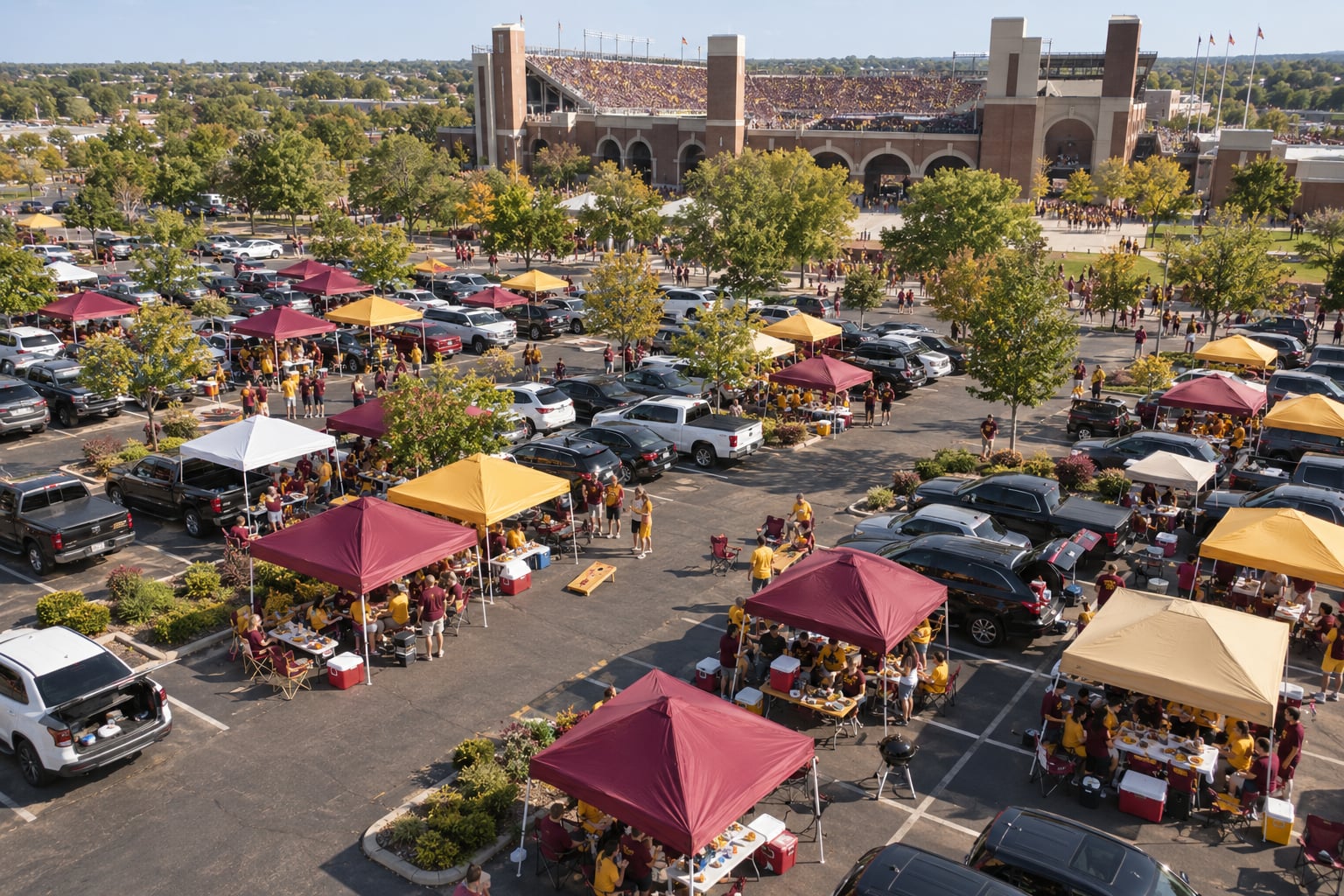
A college football tailgate is a party held outdoors near the stadium before a game, where a group of fans gathers around a vehicle, tent or canopy to eat, drink, play music and socialize. It is not a formal event. It is a block party that happens to share a parking lot with the stadium.
Two things are worth separating right away. First, tailgating is almost never run by the university. It is usually a group of season ticket holders, alumni or students who own or rent a space and invite whoever they like. Second, an official fan fest is a different thing entirely: a ticketed or registration-based event with entertainment, a step-and-repeat and restrooms, run by the athletic department or a booster club.
Everything else varies by school, by opponent, and by who holds the parking pass. Some schools are strict about your assigned space and where a grill can sit. Others barely police anything. A September game against a regional opponent is calm. A homecoming game with a ranked opponent is a different universe.
How College Football Tailgating Works for First Timers
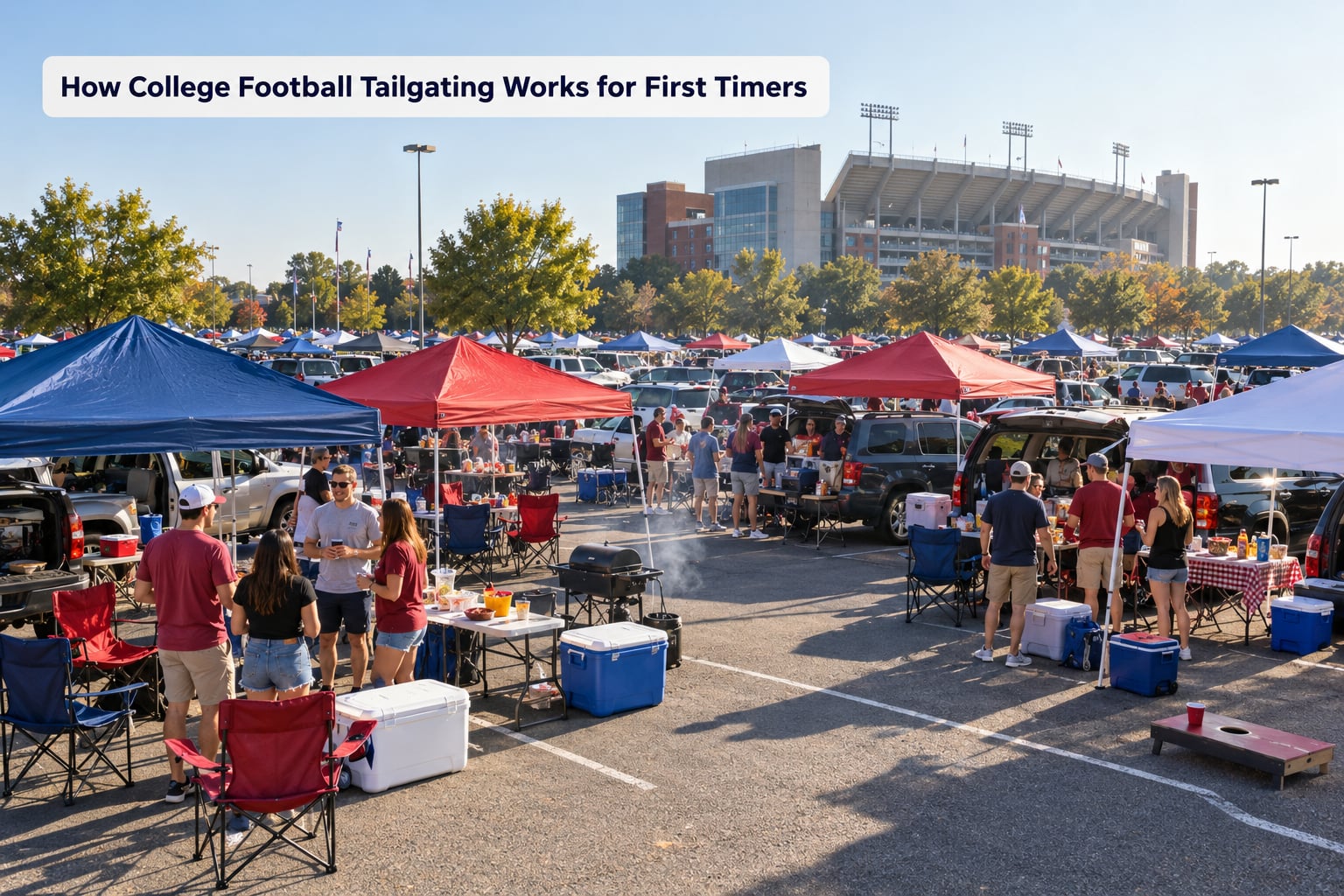
Six steps cover it. Work through them in order and your first game day goes the way it is supposed to.
- Choose the game and the gathering. Pick a home game that fits your calendar, then decide whether you are joining an existing tailgate or setting up your own. You do not need to have the game in hand before step two, but you do need tickets before kickoff.
- Confirm the location and the rules. Get the exact lot, your space or the section of the lot that is open to you, the time gates and lots open, and the school’s tailgating policy. This is the step people skip and the one that causes the problems.
- Arrive three to four hours before kickoff. Earlier if you care about your spot, later if you do not. Noon kickoffs need an earlier start than night games.
- Set up inside your footprint. Canopy, table, chairs, cooler, grill. Ten minutes of setup turns an empty patch of asphalt into somewhere you want to stand for three hours.
- Cook, eat and talk to people. This is the actual point of it. Bring something to share and you will be fed by strangers within the hour.
- Break down, clean up and walk to the stadium. Leave an hour early if you are sitting far out, less if you are close. Know your gate and your bag rules before you go.
That is the whole process. What follows is the detail behind each step.
How College Football Tailgating Works at a Typical Game
A night kickoff means the morning belongs to setup, and the tailgate itself starts around lunch. Times below assume a 7:00 p.m. kickoff, which is what a lot of programs use for September and October home games.
| Time | What happens |
|---|---|
| 9:00 a.m. – 11:00 a.m. | Lots open and passholders park. Early groups claim prime rows near the stadium and set up canopies while it is still cool. |
| 11:00 a.m. – 12:30 p.m. | Food goes on the grill. Music starts. Strangers begin wandering over to see what you are cooking. |
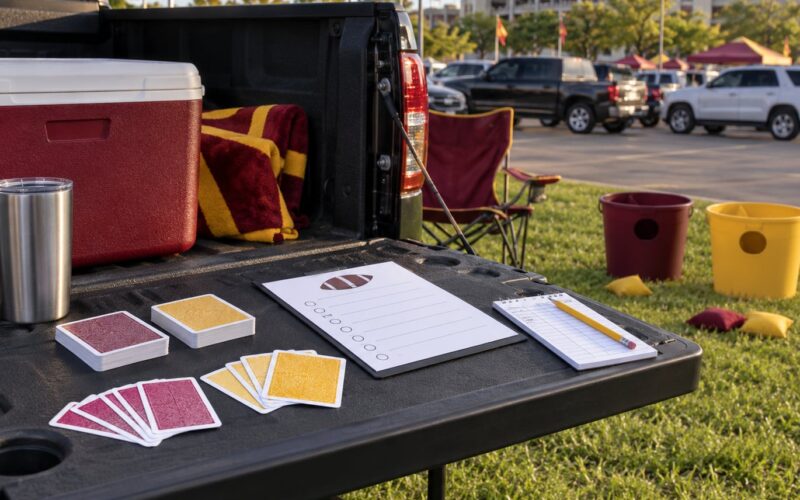
| 12:30 p.m. – 3:00 p.m. | The peak. Cornhole, music, other games on a portable TV, the group photo somebody’s phone takes whether you like it or not. |
| 3:00 p.m. – 4:30 p.m. | Groups start splitting up. People carrying coolers toward the stadium, folding tables, loading the car. |
| 4:30 p.m. – 6:00 p.m. | The walk. This includes the pregame entrance, the senior walk, the band, and whatever your school does before kickoff. |
| 6:00 p.m. – kickoff | Security lines and seating. Bag check at the gate. |
| Postgame | Some groups go straight to the car. Others head back to the lot, where the same tent and the same cooler are still waiting. |
For a noon kickoff, move the whole thing up by five or six hours. Game day is already in progress when most tailgates get going, and the sun is the main adversary. r/Tulane regulars put it simply: go a few hours early to secure a spot, and expect the school to have trash cans and portable restrooms out for everyone.
The Friday night setup is the part almost nobody outside the tradition knows about. People camp overnight in RVs, set up tents the evening before, and cook a Friday dinner that turns into a Saturday breakfast. On r/wsu, one poster described the makeshift RV park the night before as the best tailgating experience there is, because alumni end up talking to current students. That is a real thing about college football that has nothing to do with the scoreboard.
How to Choose the Right Tailgate for Your First Game
Four setups cover almost every first game, and they are not equally beginner-friendly. Here is what each one actually involves.
An official or alumni tailgate
Run by the booster club, an alumni chapter or the athletic department, usually with registration in advance. You get a defined space, a spot in line for food, portable restrooms and sometimes a speaker or a caterer. This is the most organized option and the least spontaneous.
Confirm the registration deadline, what a spot includes, whether you are buying in advance or at the gate, and whether tickets to the game are bundled or separate.
A ticket-holder or season ticket holder tailgate
The classic. One group, one space, one canopy, and an open invitation. This is where you meet people. Most insiders in the SI guide said the same thing in different words: find a group that already has a spot and tag along, because they will show you how the day runs.
Ask the host three things before you go: which lot and row, what time to arrive, and whether you need to bring anything. Then show up fifteen minutes early.
Setting up your own parking-lot tailgate
You need a legitimate space. A parking pass, an RV spot or a lot that allows walk-in setup. This gives you full control over food and music, and it is the option most likely to run into a rule you did not read.
Before you commit, check the school’s tailgating policy for grill type, open flame, alcohol, generators and when you must be gone. Some schools allow alcohol in the lot; others restrict it to beer and wine, ban kegs and common sources, or prohibit it entirely outside a designated area.
No tailgate at all
Completely legitimate, and underrated. You park, you walk in, you watch the game, you leave. Some people bring a cooler and a blanket and eat by the tailpipe, which is a tailgate in every way that matters.
This is the option to pick for a big rivalry game where parking is scarce, or for a night kickoff when you would rather not haul a tent around. You still get the walk and the pregame, which is the part most worth seeing.
What to Bring and How to Set Up
Bring less than you think for the first time. The single most common first-timer mistake is arriving with a truckload of equipment and no plan for where to put it.
- Food and a way to cook it. Burgers, brats, a rotisserie, whatever your group does. Bring raw meat cold and keep it cold until it hits the grill.
- Ice. More than you estimate. Buy it on the way; every parking structure near a stadium sells it at a markup and the local grocery store will not.
- A cooler. Separate drink cooler from food cooler if you can. Nobody wants warm hot dogs.
- A canopy or pop-up tent. Anchored properly. Most schools require weights or stakes rather than stakes alone in paved lots, and an unweighted canopy in wind is a flying object.
- Folding chairs and a folding table. Two chairs and a table is the standard kit for four people.
- Trash bags and a small shovel or dustpan. Bring more bags than you need. Cleanup is part of the deal.
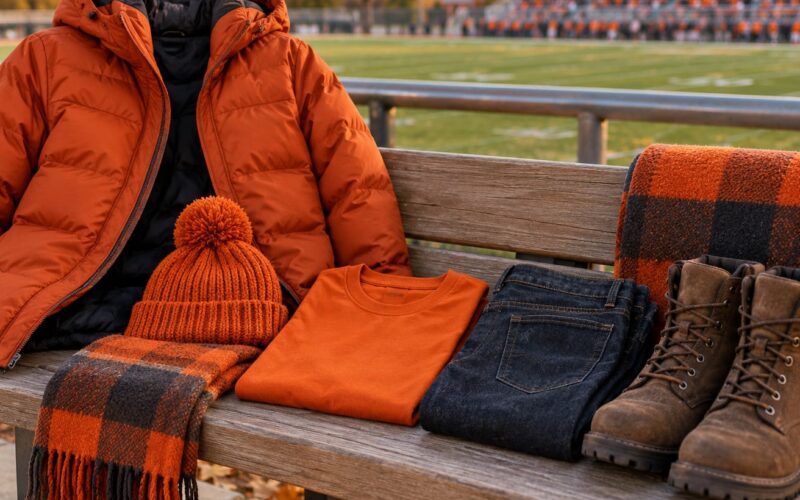
- Weather gear. Sunscreen, a hat, a poncho, or a jacket and hand warmers depending on the region. Check the forecast the morning of.
- Your ID, your tickets, and a portable phone charger. Most stadium entry now runs off a mobile credential, which means your phone needs to stay alive. On r/USC, one of the recurring pieces of advice was simply to keep a battery pack in the cooler.
- Cash for the lot. Some lots and shuttles still take cash or a scan of a paper pass. Have both.
On grills and open flame: many schools restrict cooking to propane only, and some limit grills to a specific level of a decked structure. Charcoal, which is the default in most people’s minds, is the one that gets people turned away. The r/fsusports first-season thread is full of people wondering whether to bother with a charcoal grill at all. Read your school’s policy, and do not light anything before you have confirmed you are allowed to.
How Food and Drinks Fit Into the Experience
Food is the social lubricant. Bringing something to contribute is the fastest way into a group you did not arrive with, and it is the expectation inside most established tailgates. Show up with nothing and you are fine as a guest, but you will be on the outside of the circle.
Most groups coordinate by text thread in the week before the game. Somebody claims the main course, somebody else brings a side, somebody says they are bringing a cooler and not a dish. If you are joining a tailgate you were invited to, ask where the gap is rather than showing up with the same thing as everybody else.
A few practical points on food. Coordinate dietary needs in the thread, not at the grill, because someone always has a serious allergy or is bringing small children. Serve in batches so food sits out for less time. Keep perishable items in a cooler at or below 40 degrees and get them back into cold storage before you leave; for poultry, cook to 165 degrees, ground meat to 160, and whole cuts and fish to 145.
On drinks, there is a real divide between schools. At many programs you can drink openly in your own parking space with no fuss, which is why r/UMD regulars say the same about their own lot. At others, alcohol is restricted to specific lots, limited to beer and wine, or banned outside a licensed area. Sun Devil football’s published policy, for example, allows beer and wine only inside your assigned space, with no kegs and no common sources.
Whatever the rule is, plan for it. Decide who is not drinking before you arrive rather than in the parking lot at 6 p.m. Put a designated driver in the group chat on Thursday. And keep drinking water ahead of the game, because most gamedays start early and alcohol plus dehydration plus three hours of sun is how a good day turns into a bad one.
What Tailgate Etiquette First Timers Should Know
The rules nobody writes down are the ones that actually matter socially. None of them are complicated.
- Arrive when you said you would. Early is fine. Forty-five minutes late to a setup that starts at 11 is not, because people are waiting on you to hold down the corner.
- Do not save extra spaces. Taping off an empty spot next to yours for friends who are not here yet is the fastest way to make an enemy in a parking lot.
- Stay inside your footprint. Your space, your canopy footprint, your fire. Lanes have to stay clear for emergency vehicles, and attendants will enforce it.
- Introduce yourself and bring food. The people next to you did not invite you. Saying hello and offering a burger does more than any amount of quiet sitting.
- Ask before joining a group you did not arrive with. The fear of crashing a stranger’s tailgate is the biggest thing keeping first-timers in their car. It is mostly unfounded. The same SI insiders who recommended joining a group also said they have never seen a stranger turned away, even someone cheering for the other team. Still, ask.
- Cheer for your team, not against theirs. Rivalry is part of it. Hostility is not. Keep the trash talk aimed at the players, never at the people in the next space.
- Respect the staff. Parking attendants, police, porters and restock crews work that day. Tip them if they help you, and do not argue about a tow.
- Leave the space cleaner than you found it. Bag your trash, and if the school separates recycling, separate it. Not every lot has bins, which means yours goes with you.
How to Move from the Tailgate to the Stadium
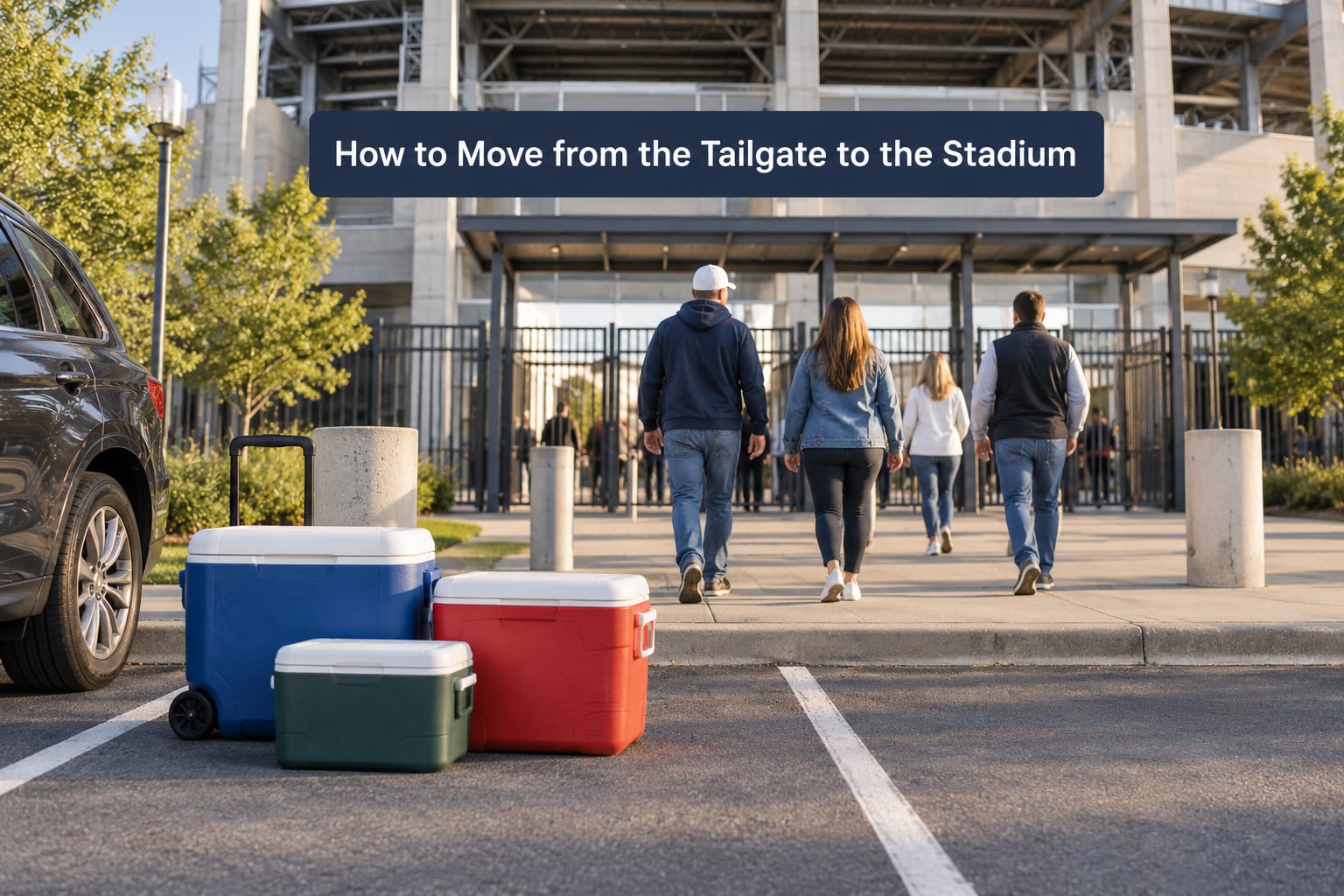
The move from the lot to the stadium is where first-timers lose time, because it is a handoff between two separate events with their own entry rules.
Know the bag policy before you leave the tailgate. A growing number of stadiums use a clear bag policy, typically a clear tote no larger than about 12 by 6 by 6 inches, with small clutches allowed separately. Sunscreen, a phone and a wallet go in a separate pouch that may not have to be the same size as your main bag. If you do not know the dimensions, check before kickoff, not in the security line.
Tickets are usually a mobile credential in your wallet app or a screenshot, and screenshots of live tickets sometimes stop working. Download or activate yours before you drive out, and make sure it works on the phone you are actually carrying.
Budget the walk. Thirty minutes of parking-garage-to-seat is normal at a large stadium, and it happens in a crowd moving in one direction with everyone else. Most groups leave the tailgate 60 to 90 minutes before kickoff, earlier for a big game, later for a night kickoff where you can dawdle.
Agree on a meeting point before you split up, and inside the stadium pick one landmark rather than relying on “near the band.” If you plan to leave early, check whether your ticket allows re-entry. If you plan to stay through the end, confirm the alcohol cutoff and the bag rules for the trip out, because a clear bag policy works in both directions.
Before you walk away from the tailgate, secure anything left in the car. Coolers with open lids, a grill still cooling, food sitting out in the sun and an unlocked bag in an open car are all the kinds of thing that turn a good day into an insurance claim.
What to Do If the Weather Changes
Weather is the single biggest variable in a parking lot, and it changes by region. A September noon kickoff in Tempe or the Southeast is a heat problem. A November game in the Pacific Northwest or the Midwest is a cold and wet one.
Heat. Arrive early enough to have shade before the sun is overhead, because most tents do not block it well. Drink water on a schedule rather than when you feel thirsty, use sunscreen, and rotate between the sun and the cooler. If someone in your group is showing signs of heat illness, get them out of the sun and cool them down immediately. Anyone with mobility limits should know before the day where the closest portable restroom is.
Rain. A canopy handles light rain and blocks almost nothing when rain comes sideways. Footprint or wide-foot tents hold up better. Save one dry layer for the walk to the stadium, because that walk is longer than it looks and you will be sitting in wet seats if you are wrong.
Wind. Weight the canopy legs on all four corners, following whatever rule your school requires. If you have a pop-up, practice putting it up once at home. An unweighted tent in a gust is a liability to everyone around it.
Cold. Dress in layers you can add and remove, bring a blanket, and pack hand warmers in the cooler. Metal chairs get cold fast. Most groups end up around a grill for warmth, which is a decent argument for cooking something.
Lightning. Do not shelter under a canopy, a tree or an open structure during a storm. Stop grilling, get into a hard-topped car, and follow the school’s or public safety authority’s guidance, not your group’s instinct to wait it out.
Poor ground. Lots that were parking in September can be a mud pit in November, especially after weeks of rain. Wear shoes you do not care about, and be gentle with the grass where other people had to stand.
How to Leave the Tailgate Responsibly
Cleanup is the part most first-timers think of last and most veterans care about most. A parking lot that is left wrecked is how a school starts restricting tailgating, which is how you lose the thing you came for.
Run a sweep of your footprint before you close the trunk. Common misses are bottle caps under the cooler, a bag of ice melted into the grass, the charcoal chimney, and whatever your kid dropped between the seats.
Bag everything, and separate recycling if the school asks for it, because mixed bags at a stadium often end up in a landfill. If the lot has no bins, the trash comes with you.
Extinguish the grill properly and let it cool before it goes in the car. A propane burner turned off with the cylinder still warm and a charcoal chimney full of embers are the two fire-department calls that end tailgates early.
Do one lap around your area for lost phones, sunglasses and house keys. Check the spot behind the cooler and the area your car is not covering. It is a fifteen-second habit that has saved a lot of people a two-hour drive.
For the drive home, leave before the game ends if you can. Everyone leaves in the same fifteen minutes after the final whistle, and the lot adjacent to a large stadium can take an hour to empty. If you want to stay for the postgame scene, plan a slow exit rather than a fast one, and know your route before you need it.
Frequently Asked Questions
Do you need football tickets to attend a college football tailgate?
Usually not. Most parking-lot tailgates are private gatherings held by season ticket holders or alumni, and they have their own guest list, so you need their invitation more than you need a stadium ticket. Official alumni or booster club tailgates sometimes require registration and sometimes bundle a game ticket with your spot. A Talker Research survey of more than 2,000 adults found roughly 25 percent have tailgated without tickets at all. You will need a ticket for the game itself if you plan to go inside.
How early should first-time tailgaters arrive?
Three to four hours before kickoff is the standard rule of thumb, and earlier if you care about your spot or have a canopy to raise. For a night kickoff, showing up at 11 a.m. for a 7:00 p.m. game puts you in the middle of the setup crowd. For a noon kickoff in September, aim for 7:00 or 8:00 a.m. to get shade before the sun is high. If you are joining someone else’s group, arrive fifteen minutes before the group’s start time so you are not the reason setup stalls.
What should I wear to my first college football tailgate?
School colors if you have them, and otherwise whatever you would wear to a cookout. You will stand in a parking lot, not a bar, so layers beat style. A team shirt makes strangers friendly, but nobody checks a gate for a logo. Footwear matters more than the shirt: you will be on pavement, grass and mud, often for four hours, so wear shoes you do not mind ruining. Bring a hat and sunscreen even in September, and something warm for the walk into the stadium at a night game.
Can families and younger children attend a college football tailgate?
Yes, and a lot of first-timers bring kids. Many established groups are family setups, and official fan fests are specifically built for families with activities, restrooms and food vendors. The practical concerns are shade, food and noise. Bring ear protection for young children near a speaker, keep them away from a hot grill, and check your school’s alcohol policy, since some lots restrict drinking to areas away from families. If you want a guaranteed kid-friendly option, choose the official fan fest over an adult tailgate.
What if my school or ticket-holder group does not have an assigned tailgate?
Plenty of schools have no formal tailgate program at all, and you are not left out. Options include tailgating in any space that permits setup, joining a booster club or alumni event if one is running, going to an official fan fest, or simply parking and eating by your car. Check the athletic department website and the ticket office, since some schools list both passholder and general lot rules. On game day, walking through the lot before you commit is normal, and joining a friendly group is usually as easy as asking.
What to Do First
Your first college football game day comes down to five things, in this order. Confirm who is hosting and exactly which lot you are in, because a tailgate with the wrong address does not happen. Read your school’s game-day and tailgating policy for grill type, alcohol, bags and end times, since those are the rules that get people turned away. Ask what time gates open and when your group wants you there, then work backward from kickoff.
Pack inside what your vehicle holds comfortably, not what the packing list suggests. Arrive with an hour of slack, because parking is harder than you expect and the walk to your seat takes longer than the map claims. And decide before you go what your group is throwing away and who carries it out, so the last twenty minutes are not spent on the ground picking up bottle caps.
Everything else you can figure out standing in a parking lot holding a burger.