Knowing how to keep tailgate food warm for hours comes down to one insulated hot box: foil pans wrapped in towels inside a cooler, loaded with food that is already hot and warmed with hot bricks or a heating pad. Add a chafing dish or a slow cooker on low if your lot allows flame or you can run a power station, and keep everything at or above 140F until the last serving.
That matters more than it sounds, because a game with a noon start and a 6 pm finish is a five-hour hold. Most lukewarm tailgate food fails for the same reason: the heat was never trapped, so it leaked out through an open lid, a thin tray, or too many trips to the table. Here is the setup that fixes it, whether you are cooking for twelve people outside the stadium or feeding forty in a backyard on a cold night.
Table of Contents
- What You Need
- Step-by-Step: How to Keep Tailgate Food Warm for Hours
- Common Mistakes
- Frequently Asked Questions
- How long can food be kept warm in a chafing dish?
- Is it safe to use the warm setting on a slow cooker all day?
- How do you keep food warm outdoors without electricity or a flame?
- What is the 2 2 2 rule for food?
- What foods hold heat best at a tailgate?
- How long can tailgate food sit out before it goes bad?
- Conclusion: The Gameday Order of Operations
What You Need
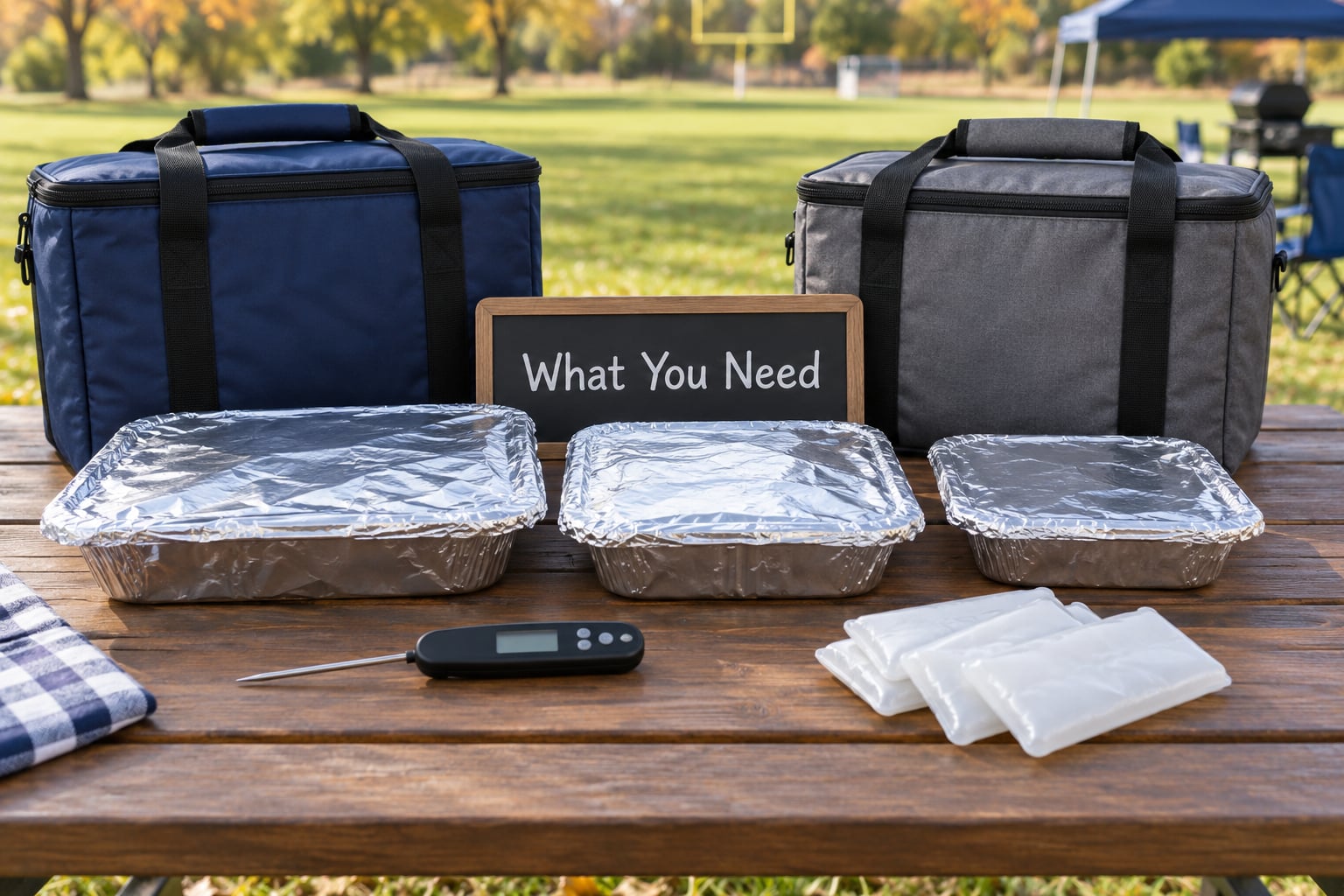
Start with insulation, because a good cooler or insulated tote does more per dollar than any powered option. A 48-quart cooler with a tight-fitting lid works as a hot box as happily as it works for drinks, so nothing is wasted if you only use it a few times a year.
Then add the small things:
- Foil pans with tight lids, in two sizes. Full hotel pans for casseroles and chili, half pans for sides and smaller portions. Cardboard trays from takeout soak through and collapse, so skip them.
- Two old towels per pan. Wrap the pan, then the towels go in the cooler around it. Towels cut the airflow that steals heat and they buffer a pan that is still hot enough to be uncomfortable to grab.
- A warming source: bricks or river rocks, a wrapped heating pad, or a Sterno-style fuel can for a chafing unit. Warm bricks at 200F for 20 minutes and wrap them in foil before they go near food.
- A chafing dish with a water pan if flames are allowed where you are parked. Many stadium lots ban open flame and even embers, so check the rules before you pack one.
- A slow cooker on low as a holding pot rather than a cooking pot. It is the easiest way to keep one dish at temperature for four hours, as long as you check it.
- An instant-read thermometer with a probe. This is the item people leave behind and then guess. A probe thermometer is what turns a guess into a decision.
- Food-safe storage containers and serving utensils, so nothing goes back into the pan that sat on a picnic table for an hour.
That is the whole kit. Everything else is technique.
Step-by-Step: How to Keep Tailgate Food Warm for Hours
Choose Foods That Stay Hot
Chili, saucy tacos, pulled pork, sloppy joes, stews, and casseroles hold heat for hours because they are wet, dense, and fatty. Moisture is the insulating material, so a dish with sauce in it loses heat far more slowly than an equivalent dish with none.
Dry and thin foods are the opposite problem. Brats on a bare bun, a plate of chips, cold sandwiches, and raw vegetable trays hit ambient temperature in well under an hour, and no amount of equipment rescues them. If you want that on the menu, treat it as a cold side and pack it separately.
One more choice pays off: hot food stays hot longer in a wide, shallow pan than in a deep one. A casserole dish has more surface area exposed to the air than a deep stockpot holding the same volume, so it sheds heat faster even before you wrap it.
Wrap the Food for Maximum Insulation
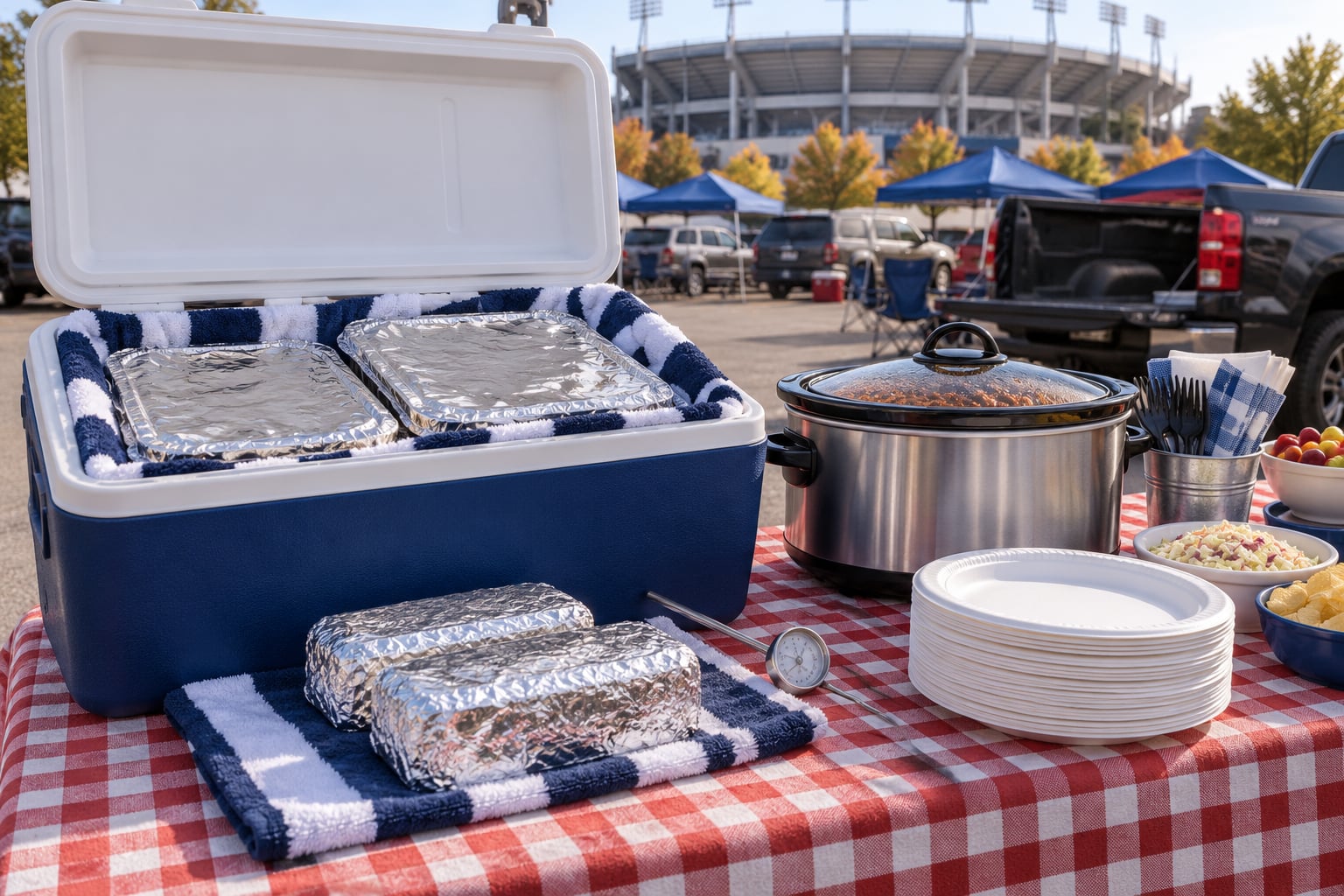
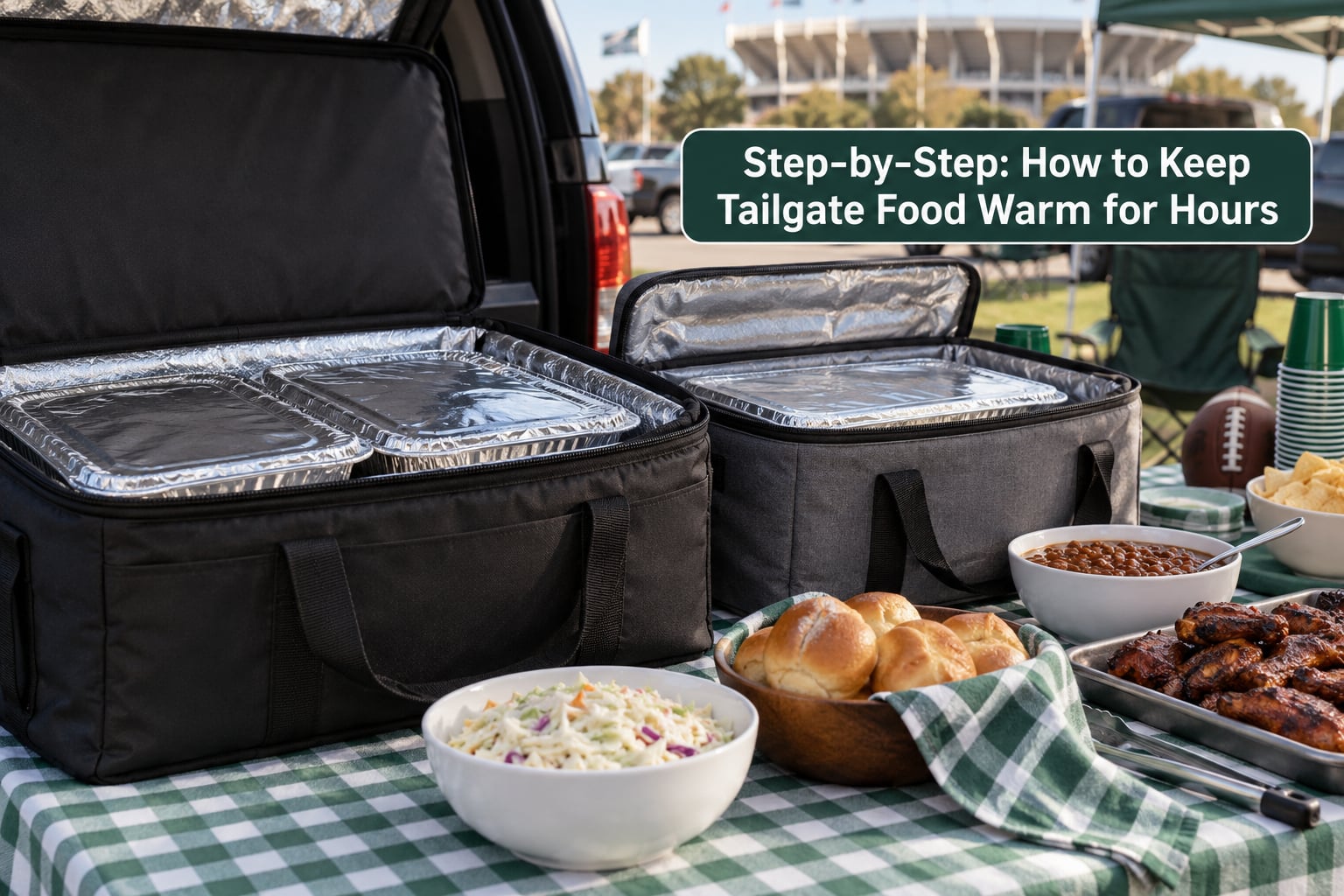
Seal first, wrap second, insulate third. Put the hot food in an oven-safe container, press a foil lid or a fitted plastic lid on it, and cover the seams with foil tape or a tight rubber band so steam cannot escape.
Then wrap the whole pan in a towel or a layer of newspaper, leaving a small vent open at the corner if you are worried about pressure. Set the wrapped pan inside the cooler on a bed of towels, and pack the space around it tightly so nothing shifts. Empty air inside a cooler is a heat leak; packed towels are not.
Never put a steaming-hot pan straight into a cooler with cold food or cold drinks. The thermal shock can warp plastic, and the temperature swing wastes heat that your food needed. Use a separate cooler, or let the pan cool for ten minutes under a loose foil tent first.
Keep the Container Closed Between Servings
Every time you open the lid, you let out the air that holds the heat. A hot box that opens four times can lose an hour of holding time, which is why people end up reheating at halftime.
Portion for the crowd in rounds instead. Bring the first pan out, serve it down, put the remainder in a second pan on a preheated tray, and close the cooler again. Warming the serving pan with a hot towel under it for a minute or two keeps the second round hot without touching the main container.
The same logic applies to lids during transport. Wrap the cooler in a blanket or a beach towel, strap the lid down, and put the whole thing in the trunk rather than the back seat, where sun hits the lid all the way to the stadium.
Use a Safe Warming Source
There are three practical options outdoors, and which ones you can use depends on your parking lot.
Warm bricks and towels. Heat bricks or river rocks to 200F, wrap them in foil and a towel, and set them under and around your foil pans inside a towel-lined cooler. This is the most-shared DIY method in cooking and tailgating forums, and it reliably buys two to three hours. The catch: it works by slowing heat loss, so the food has to go in already hot.
Fuel-burning warming units. A chafing dish or a small warmer with Sterno-style cans gives you a genuine heat source that keeps food above 140F indefinitely while the fuel lasts. Light two cans for a four-hour window and keep a spare, because one can runs out faster than people expect. Follow the manufacturer’s instructions exactly, set the unit on a stable non-flammable surface, and never leave it unattended. A water pan under the food pan is worth the extra minute: it evens out the heat and stops scorch marks.
Hot water around a sealed container. Fill a large stockpot or tub with water heated to about 140F, set your sealed pan in it, and cover. It is gentle, needs no flame once the water is made, and is easy to top up. It will not heat food from cold, so this is a holding method only.
Electricity is the fourth option when you have it. A portable power station with a few hundred watts of continuous output will run a slow cooker for most of a game, which is how people in tailgating forums cover multiple dishes. A warming mat handles shallow pans well but creates hot spots underneath, so food on one needs a stir at some point.
Check the Temperature Before Serving
Hot holding is a temperature problem, not a clock problem. Food is safe to serve when it is at 140F or above, and the number that matters is the one in the pan, not the one in your head.
Take a reading in the thickest part of the dish before service, then again an hour in. USDA guidance for the cook stage is 165F for poultry, 160F for ground meat, and 145F for whole cuts of meat and fish. Once cooked, hold at 140F or above.
If a reading lands between 40F and 140F, you are in the danger zone. Food that sits there for more than two hours, or one hour when the outdoor temperature is above 90F, has to be discarded. That rule is the reason to check rather than sniff, and it applies to a slow cooker on warm: owners report that setting dropping below safe temperatures over a long hold, so the crockpot needs the same thermometer check as everything else.
Here is what each method realistically holds, so you can size the kit to your kickoff time.
| Method | Holds hot for | Power or flame needed | Best for |
|---|---|---|---|
| Insulated hot box with warm bricks | 2-3 hours | Neither | Transport plus a moderate hold with no rules to check |
| Cooler-style hot box, loaded hot and packed tight | 3-4 hours | Neither | Long holds in cold weather with no gear to buy |
| Chafing dish with fuel cans | 4 hours plus, while fuel lasts | Open flame | Lots of food, repeat service, lots where flame is allowed |
| Slow cooker on low | 4-6 hours | Electricity or a power station | One stew or chili held for the whole game |
| Oven at 170-200F | 2-3 hours before drying out | Electricity | At home, finishing a dish before you load the cooler |
| Insulated tote or catering bag | 1-2 hours | Neither | The drive over, not the hold |
Read that last row carefully. Transport containers are built for the drive, not the game. People who expect an insulated tote to hold a dish through a three-hour tailgate find it lukewarm by the second quarter, which is why a hard-sided cooler makes a better hot box.
Common Mistakes
Opening the cooler too often. Each opening vents the warm air that took an hour to build. Serve in rounds from a separate pan and keep the insulated container shut.
Dropping a steaming pan into an empty cooler. Warping, cracked plastic, and a wasted temperature swing. Let it sit ten minutes, or use a second cooler.
Skipping the towels and the foil. Air gaps inside the cooler are the leak. Packing towels tight around the pan, and wrapping bricks in foil, is the difference between two hours and four.
Serving from a container that sits open on the table. A pan in the sun and wind cools in minutes, no matter what you did to transport it. Put out the portion you need, keep the rest covered, and bring out the next pan when the first is gone.
Reheating everything at once at halftime. Crowded pans reheat unevenly and the middle stays cold. Reheat in smaller pans, check the center, and give it a few extra minutes.
Trusting a warm container. The outside of a pan tells you nothing. Push the probe into the thickest part and read it, or you are just checking the towel.
Two habits fix most of the rest. Cook the night before and reheat to 165F in the morning, then load the hot box and leave it alone. And put the thermometer in the same bag as the foil, so it is actually in your hands when the decision comes.
Frequently Asked Questions
How long can food be kept warm in a chafing dish?
A chafing dish holds food above 140F for as long as its fuel burns, and most Sterno-style cans last about four hours. Use two cans when you expect a full game, and keep a spare in the car. A water pan under the food pan spreads the heat and prevents scorch marks, which matters most for chili and casseroles held for a long time.
Is it safe to use the warm setting on a slow cooker all day?
Only if you check it. Slow cooker owners report that the warm setting drifts below safe temperatures over a long hold, and cooking forums repeatedly flag it as unreliable for eight to twelve hours. For a game day, set it to low instead, and confirm the food is at 140F or above with a probe thermometer before serving.
How do you keep food warm outdoors without electricity or a flame?
Use a passive hot box. Heat bricks to 200F, wrap them in foil and a towel, line a cooler with more towels, and set your sealed foil pan on top. Loaded with food that is already hot, this method holds for two to three hours and works in any parking lot, which makes it the default when flame rules or missing outlets rule out the alternatives.
What is the 2 2 2 rule for food?
It is a memory aid for outdoor cooking: two hours in the danger zone, two hours to get leftovers into a refrigerator, and two inches of clearance between a heat source and anything that can scorch. For hot holding the practical part is simple: keep food at 140F or above, or chill it within two hours.
What foods hold heat best at a tailgate?
Wet, fatty, dense dishes hold heat best: chili, saucy tacos, pulled pork, sloppy joes, stews, and casseroles. Moisture traps heat inside the food, which is why a stew stays serving hot far longer than a dry dish of the same size. Dry and thin items such as brats on a bun, chips, and sandwiches cool quickly, so plan them as cold sides instead.
How long can tailgate food sit out before it goes bad?
Keep hot food at 140F or above and you can serve it for the length of the event. Once it drops into the danger zone between 40F and 140F, the limit is two hours, or one hour when the outdoor temperature is above 90F. Food past that limit gets discarded, no matter how long the game still has left to run.
Conclusion: The Gameday Order of Operations
Cook the night before, reheat to 165F in the morning, and load food into sealed, foil-wrapped pans packed tight in a towel-lined cooler with hot bricks under them. Bring a probe thermometer and read the thickest part of the dish before you serve it.
Everything else on this list is a variation on that. If your lot allows flame, add a chafing dish and you have bought yourself a full game. If a friend has a power station, run one slow cooker on low. The difference between great tailgate food and lukewarm tailgate food is rarely the recipe, and almost always the packing.