Learning how to plan a tailgate for a large group comes down to three numbers: how many people are coming, how long you have to set up, and how many hands you have on the gear. Get those right and the rest is a checklist you can finish in an evening. Get them wrong and you end up with 30 people, one cooler, and a game already starting while you look for napkins.
Twenty-plus guests changes the math on everything. A small tailgate runs on improvisation. A large one runs on assignments, written deadlines and gear staged before anyone leaves home.
This guide walks through the whole process in eight steps, from setting the headcount to the final trash sweep, with the food quantities, budget categories and equipment lists scaled for 20, 50 and 100 people.
Table of Contents
- What You Need
- Step-by-Step: How to Plan a Tailgate for a Large Group
- 1. Set the headcount, date, and location
- 2. Create the budget and assign responsibilities
- 3. Plan the menu and drinks
- 4. Reserve or confirm parking and arrival
- 5. Gather the setup and serving equipment
- 6. Set up the layout and serving stations
- 7. Share the plan and prepare a weather backup
- 8. Finish with serving and cleanup logistics
- Common Mistakes
- Frequently Asked Questions
- How early should you arrive for a large group tailgate?
- How much food do you need for 50 people at a tailgate?
- What should you not bring to a stadium tailgate?
- How do you keep food safe at a large outdoor tailgate?
- What is the etiquette for setting up near other tailgates?
- How do you organize cleanup after a big tailgate?
- Conclusion
What You Need
Before you plan anything, gather these items. If you are missing two or three of them, your plan has holes in it.
- A confirmed headcount, plus a realistic estimate and an RSVP deadline several weeks out.
- The date, kickoff time and location, including which lot or tailgate zone you are aiming for.
- A working budget broken into food, drinks, equipment or rentals, parking, decorations and a contingency fund.
- Two or three co-hosts who each own a slice of the plan.
- Food and drink assignments, either a potluck signup or a fixed list of categories.
- Parking details, including passes, fees, tailgating hours and unloading access.
- A weather backup for heat, rain or cold.
- An equipment checklist that someone owns and checks off.
- Cleanup supplies, including heavy-duty trash bags, a recycling option and a named cleanup crew.
- One shared timeline everyone can see, with dates attached to each task.
The single most useful item on that list is the shared timeline. One spreadsheet or group chat post that everyone can read beats four separate plans held in four different heads.
Step-by-Step: How to Plan a Tailgate for a Large Group
Work through these steps in order, and do not start the next one until the current one is finished. The order matters because each step depends on the answer produced by the one before it: quantities need a headcount, the layout needs a menu, and the guest message needs a parking plan.
1. Set the headcount, date, and location
Pick the game first, then work backward. Choose the tailgate window, confirm the site or parking area, and estimate how many people will actually show up.
Most experienced organizers estimate two to three guests per confirmed yes, because invites are social and no-shows are normal. Set an RSVP deadline at least three weeks out and a final count one week out, then plan against the final number rather than the optimistic one.
This step is done when you have a specific meeting location, a specific arrival window and a number you are actually buying food for. Everything after this gets easier.
2. Create the budget and assign responsibilities
Break the budget into categories so you can see where the money is going before you spend any of it. For a large group, food and drinks usually dominate, rentals are the second big swing factor, and parking passes are the easiest line to forget.
| Budget category | What drives the cost | How to control it |
|---|---|---|
| Food | Guest count and how many courses you serve | Stick to one or two mains, use sides people can serve themselves, and buy in bulk from a club or warehouse store |
| Drinks | Non-alcoholic volume, alcohol type, whether guests bring their own | Pre-fill a party bus or ask each guest to bring a case; put water and one signature drink in your own supply |
| Equipment and rentals | Canopies, tables, chairs, portable restrooms, hand-washing stations | Check what the group already owns before renting anything; a canopy shared across two tailgates cuts the cost in half |
| Parking | Lot fees, number of vehicles, pass requirements | Compare lots, carpool or rent one vehicle for a group of ten, confirm passes are transferable |
| Decorations and games | Team flags, cornhole, sound | Assign categories so each guest brings one item instead of the group buying fifteen of the same thing |
| Contingency | Weather, extra guests, forgotten supplies | Hold back roughly a tenth of the budget unspent until the day before |
Then assign responsibilities. A workable split for 20 to 50 people is five roles: setup crew, food lead, drinks lead, guest contact and cleanup lead. Give each role a name, not a job title, and write down what done looks like.
The setup crew handles gear, canopies and the layout. The food lead owns quantities, dietary needs and cooking logistics. The drinks lead stocks coolers and handles ice and any alcohol rules. The guest contact is the single point of contact for arrival questions and last-minute changes. The cleanup lead recruits the crew and runs the post-game sweep.
No task should depend on one person. If your only grill is on your neighbor’s tailgate and they leave at halftime, your food stops too.
3. Plan the menu and drinks
Choose food that is easy to serve in groups. Finger foods and one-dish meals beat anything that needs a plate, a knife and attention, because guests at a large tailgate eat standing up, moving around and half the time.
Five popular tailgating foods cover almost any group: burgers and hot dogs off a grill, pulled pork or chili in bread bowls, a large tray of nachos with toppings in separate bowls, a pasta or taco tray kept warm in a chafing dish, and a tray of sandwiches or wraps cut into quarters. Add one cold option, usually a salad or a fruit tray, and one dessert.
Handle dietary restrictions by asking on the RSVP rather than guessing. Collect allergies, vegetarian and vegan counts, and gluten-free needs, then make sure the menu has something for each one. Buying a labeled shelf-stable option for a handful of guests is cheaper than improvising on site, and it keeps someone from going without.
Size your quantities for the final headcount with a small buffer of about ten percent, then round up rather than trim. Plan quantities like this:
| Item | Per adult | 20 guests | 50 guests | 100 guests |
|---|---|---|---|---|
| Main protein (burgers, dogs, chicken) | 2 to 3 servings | 50 to 60 | 125 to 150 | 250 to 300 |
| Side dish | 1 to 1.5 servings | 25 to 30 | 60 to 75 | 120 to 150 |
| Chips, crackers, snack trays | About 1 cup | 5 to 6 bags | 12 to 14 bags | 25 to 30 bags |
| Water | 1 to 2 liters | 6 to 8 cases | 15 to 20 cases | 30 to 40 cases |
| Ice | 1 to 2 pounds per adult | 30 to 40 pounds | 75 to 100 pounds | 150 to 200 pounds |
| Paper plates, cups and napkins | 2 each per adult, plus 25% | 50 each | 125 each | 250 each |
A grill that handles 15 burgers an hour will take nearly three hours to feed 50 people from a standing start. Many large-group organizers plan two grills, or cook the long items like chili the night before in a slow cooker.
Decide the drink situation early because it shapes everything else. Plenty of stadiums restrict outside alcohol, so check the rules before you plan around a cooler of beer. Have water and a signature drink in your own supply regardless, because dehydration ends a tailgate before the second half.
Confirm the menu and the supply list before anyone buys anything, then send one message with the final list.
4. Reserve or confirm parking and arrival
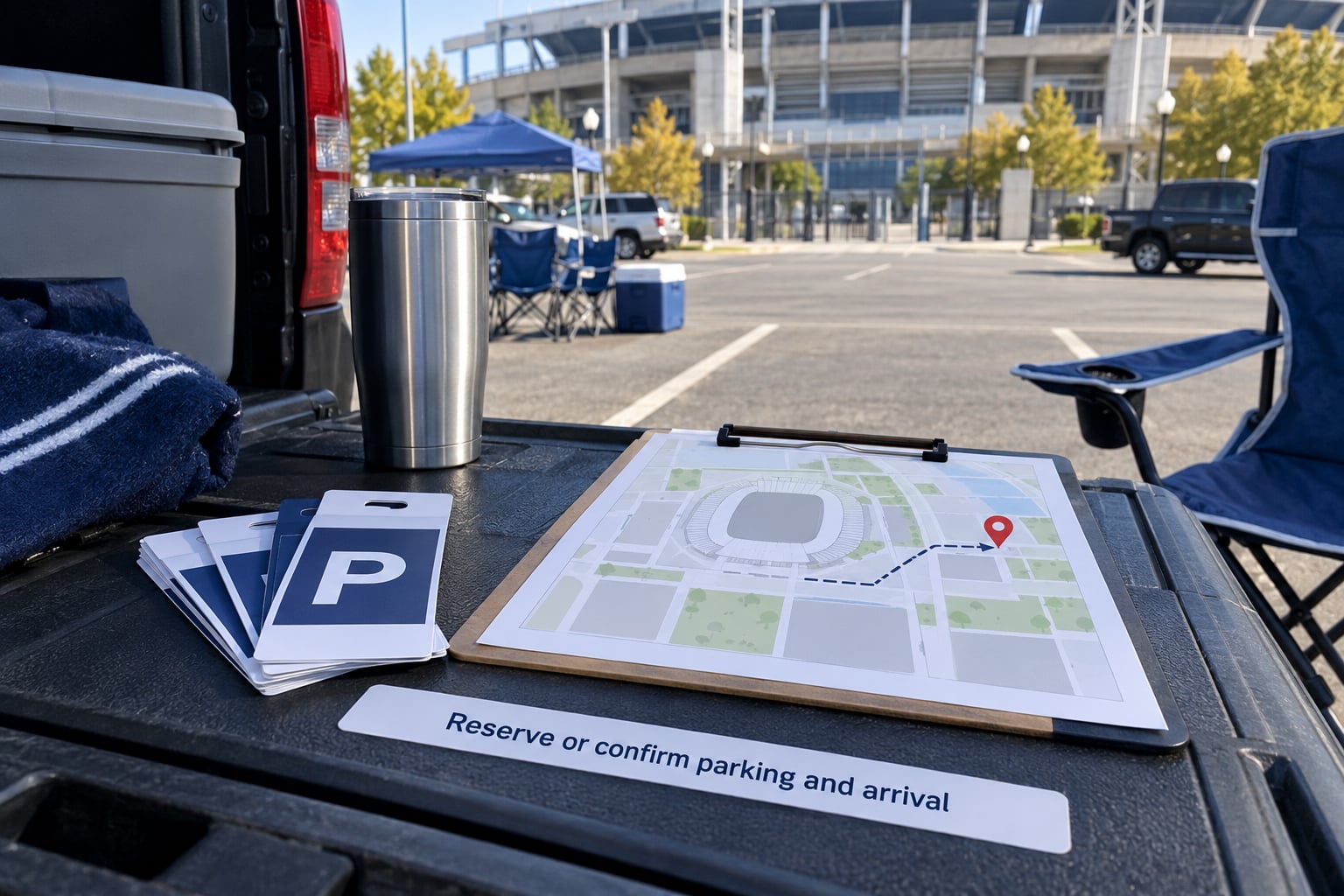
Parking is where large-group plans fail most often, because stadium rules vary widely and are scattered across a dozen pages of a website. Verify the lot capacity, the fee structure, whether passes are sold in advance, the hours tailgating is allowed, and whether you can park near your setup area for unloading.
Then plan for multiple vehicles. If ten cars are coming to a lot that expects standard parking spaces, you will end up in the far section where nobody can walk back for the second half. Options that work: rent a shuttle or minibus for the group, designate a drop-off point where gear comes from, or pick a lot where tailgating is allowed across several rows.
Always have a backup lot identified, with the name written down. Lots close, fill up early, and change rules without much notice, and the version of the map you saved at home may not match the signs on game day.
Decide the arrival timeline too. Experienced tailgaters arrive four to five hours before kickoff for the best spots, and three hours is a reasonable floor for a group that has to unload a truck’s worth of gear. Build backward from kickoff, not forward from breakfast.
Share arrival instructions, a contact number and one clear meeting point. A group that scatters across three rows wastes its first half in walking.
5. Gather the setup and serving equipment
Build one master equipment list and scale it to the headcount. Write it as a checklist with an owner, and inspect the important gear a week early rather than loading it the morning of the game.
| Equipment | 20 guests | 50 guests | 100 guests |
|---|---|---|---|
| Pop-up canopies (10 by 10) | 2 | 4 to 5 | 9 to 10 |
| 6-foot folding tables | 3 | 7 | 14 |
| Folding chairs | 20 | 45 | 80 plus a few spares |
| Grills | 2 | 3 | 5 or more |
| Coolers | 3 | 6 | 12 |
| Heavy-duty trash bags | 1 roll | 3 rolls | 6 rolls |
The rest of the list rarely changes: serving trays and utensils, plates, cups, napkins, a cutting board, tongs and spatulas, a first-aid kit, ice, water, sunscreen, a portable speaker, a water bottle per guest, trash bags, a broom, and extension cords if you plan to bring power.
Two items get forgotten more than anything else at this size. The first is shade: canopies need weights, not stakes, because most parking lots will not allow digging. The second is lighting, because a late kickoff in fall means you are packing up in the dark. A couple of battery lanterns solve it without asking anyone to run cords across an aisle.
If you plan to cook far from your parking spot, remember that grills and propane tanks are subject to venue rules. Some stadiums prohibit open flame entirely and some restrict it to certain lot areas. Check before you buy fuel.
Food safety matters more at scale because one person getting sick affects the whole group. Keep hot food at 140 degrees Fahrenheit or above and cold food at 40 or below. Cook poultry to 165 degrees, ground meat to 160, and whole cuts of meat and fish to 145. Use a thermometer rather than guessing, and treat the danger zone between 40 and 140 as somewhere food should pass through quickly, not somewhere it should sit.
The two-hour rule is the one people forget: food left out for more than two hours goes in the trash, and the limit drops to one hour once the outdoor temperature passes 90 degrees.
6. Set up the layout and serving stations
Plan the layout on paper before you arrive, then follow it on site. A large tailgate that has been arranged well keeps traffic out of the cooking area and lets new arrivals figure out the layout without an escort.
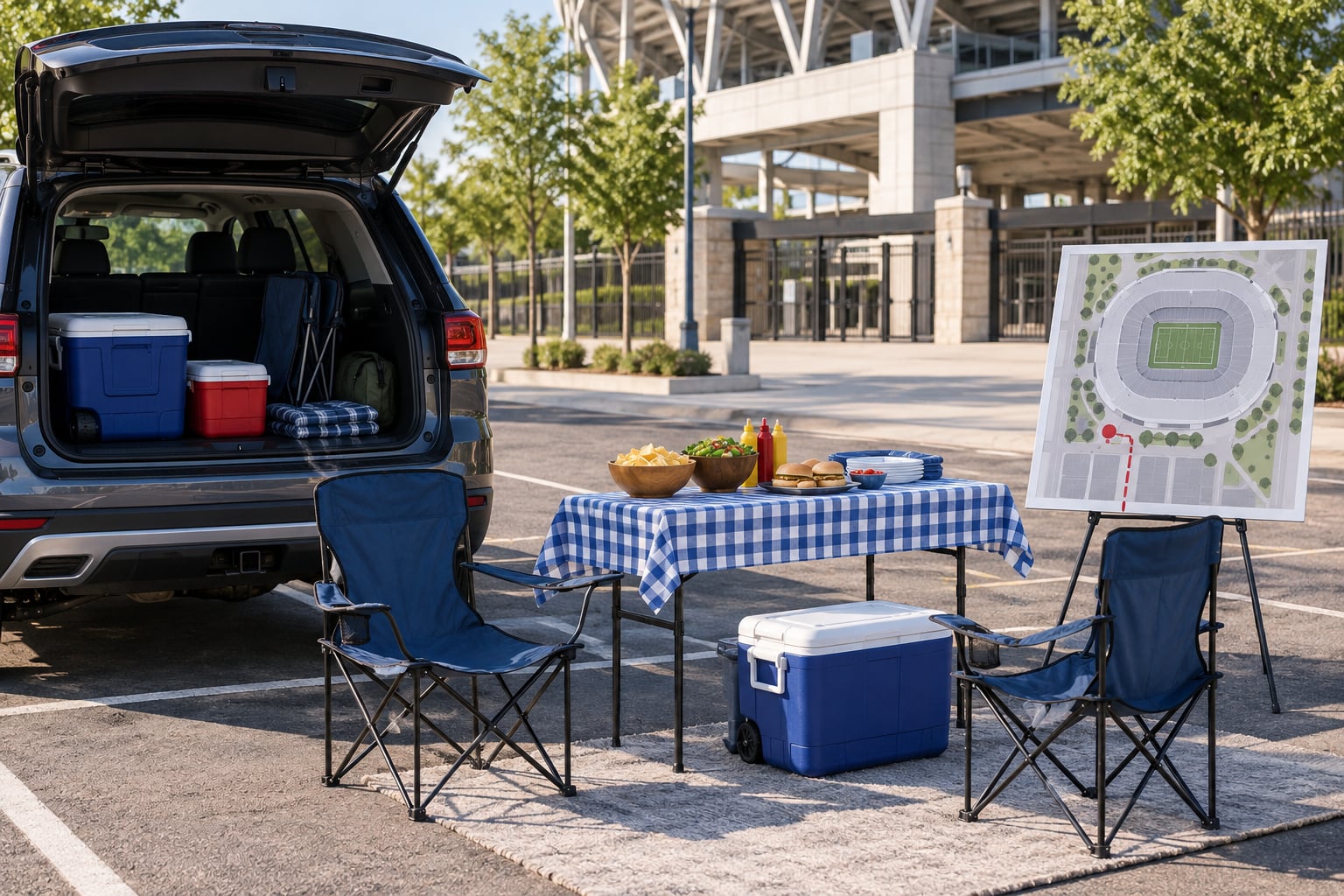
Anchor the layout around four stations. Put cooking and hot food at the back, where smoke and grease do not blow across the seating. Put cold food, drinks and ice near the front so nobody has to cross the whole space for a water. Put one trash and recycling point at each end, because a single bin in the middle means people walk past it rather than use it. Keep a supply area near the entrance for anything guests are supposed to bring.
Leave a walking lane between stations. Once twenty people are standing in the food line, the space you saved in the plan gets used whether you planned for it or not.
Put serving items within reach, name them, and label them. A color-coded bin system works well at this size: one color for food, one for tools and gear, one for trash. It cuts setup time because nobody has to sort through everything to find the tongs.
Keep hot and cold items separate with their own utensils so nobody crosses a raw chicken tray with a serving spoon. If you serve from a cooler, set a station so people open it less often.
7. Share the plan and prepare a weather backup
Send guests one message with everything. The date, the location with the lot name, parking instructions, the arrival time, what to bring, the RSVP deadline and the weather guidance should all sit in a single message you can copy and paste again closer to game day.
For an away game, add transportation details: who is driving, where the vehicles meet, departure times, and where to park locally. Groups that coordinate transportation in advance avoid the most common away-game headache, which is a group of cars heading to the stadium at different times from different hotels.
Decide what each guest is bringing before the day, not on it. A potluck with assigned categories, one person on mains, one on sides, one on drinks and one on dessert, spreads the work and prevents three people from each bringing the same tray.
Build the weather backup from a forecast check two to three days out, and pick one trigger in advance. If the forecast shows rain, the plan goes to canopies, ponchos packed by the dozen and a decision about whether the setup holds. If temperatures pass the mid-90s, add canopies for shade, extra water, a misting option and a shorter serving window. If it drops below freezing, plan on heated blankets, a warm drink station and keeping hot food in insulated carriers.
Many venues also restrict open flame in dry conditions, so check the rules if rain is in the forecast. A no-burn plan with cold sandwiches and a slow cooker might be all you need.
Communication fails on game day because cell service drops in crowded lots. Agree on a fallback before you go: a group chat, a walkie-talkie or simply a meeting point and a time to reconvene after the game.
8. Finish with serving and cleanup logistics
The plan is not done when the food is ready. Decide when food goes out, who watches the supplies, where extra food is stored and how the tailgate ends.
Set a serving time that works with kickoff, usually food out about an hour before the game. Assign a person to monitor supplies through the day, since ice melts, drinks run out and someone always drops a tray of cups.
Plan for the food that is not eaten. Store it properly, keep hot food hot, and send extras home with named owners rather than leaving it to sit. What stays out too long gets thrown out, and saying so in advance prevents the awkward debate at the end of the day.
Then build the cleanup crew with real roles instead of a general plea. Four named roles work well: the bag team, the dish team, the gear loader and the sweep. The sweep walks the area after the gear leaves and picks up what the others missed, which matters because most tailgates lose tablecloths, cans and cords, not food.
Run the sweep as a scheduled step, not an afterthought. When the crowd disperses, nobody wants to stay, so the crew should clean the area first and pack gear second.
Have one person responsible for the venue rules check on departure. That person confirms you took everything, disposed of charcoal properly and did not leave the spot a mess for the next group.
Common Mistakes
Underestimating food. The most common failure. Plan for two to three servings of the main per adult and keep ten percent above your final headcount. Running out of food at halftime is the story people retell all season.
Ignoring dietary needs. Ask on the RSVP and buy a labeled option for the people who answer. It takes five minutes and it prevents someone from standing at the edge of the tent with a paper plate and nothing to put on it.
Not confirming parking rules early. Lot capacity, fees, tailgating hours, pass requirements and open flame restrictions all vary. Find out a month out, not on the morning of the game when the parking page is down.
Leaving equipment and weather contingencies unresolved. Decide on one trigger for rain, one for heat and one for cold, and name the person who calls it. A backup plan nobody knows about is not a plan.
Arriving without clear instructions. A group text with the lot number, the meeting point and the arrival time prevents the most wasted hour of the day. Say who is carrying the canopy and who is bringing the cooler before everyone leaves home.
Skipping cleanup. Name the crew at the start of the day, not the end. If cleanup is nobody’s job, it does not happen, and the lot and the rental company will both let you know.
Three habits fix most of the rest. Communicate in one place, so every update lands in the same thread instead of five different group chats. Label everything, because color-coded bins and labeled coolers turn a ten-minute search into a two-second one. And run the whole plan through a final checklist the night before, item by item, out loud.
One more: if your group tails more than once a season, write the plan down after the first successful game and reuse it. Most of what you learn on game day one, you will learn again anyway. Save the version that worked.
Frequently Asked Questions
How early should you arrive for a large group tailgate?
Plan to arrive three to four hours before kickoff, and four to five hours if you want a good spot near your setup area or a nearby group. That window covers unloading, raising canopies, lighting the grill and getting food on before the lines form. For away games, add drive time between your lodging and the stadium on top of the tailgate window.
How much food do you need for 50 people at a tailgate?
For 50 adults, buy 125 to 150 servings of your main protein, 60 to 75 servings of one side, and about 25 bags of snacks. Plan on 15 to 20 cases of water, 75 to 100 pounds of ice, and roughly 125 paper plates, cups and napkins each. Round up about ten percent above your final count and keep extra food hot rather than letting it sit out.
What should you not bring to a stadium tailgate?
Check the venue list, but common prohibitions include glass bottles, outside alcohol at many stadiums, large coolers over the size limit, professional cameras without a permit, and fireworks. Open flame and grills are restricted in some lots and banned outright in others. Also leave the valuables in the car: tailgate lots are crowded, and nobody needs a better view of a stolen phone.
How do you keep food safe at a large outdoor tailgate?
Keep hot food at 140 degrees Fahrenheit or above and cold food at 40 or below, using insulated carriers and a food thermometer rather than guesses. Cook poultry to 165 degrees, ground meat to 160, and whole cuts and fish to 145. Food left in the danger zone of 40 to 140 degrees for more than two hours must be discarded, and the limit drops to one hour above 90 degrees outdoors.
What is the etiquette for setting up near other tailgates?
Introduce yourself before you back into a spot next to someone. Stay inside your own space unless invited, keep the aisle between rows clear for people walking to the stadium, and never move a vehicle that is not yours. Most fans are friendly about a shared table or a lighter on their grill, but they expect the same courtesy in return. Chatty neighbors are usually a bonus, not a problem.
How do you organize cleanup after a big tailgate?
Assign named roles before the game: a bag team, a dish team, a gear loader and a sweep. Clean the site first and pack gear second, while the crew still has energy, and hold a final walk of the area to catch cans, cords and tablecloths. Bring more heavy-duty bags than you think you need, and put a recycling container at both ends of the setup so people do not carry trash across the whole space.
Conclusion
To plan a tailgate for a large group, do four things first. Confirm your headcount and lock a final-count date. Choose the location and verify the parking rules before you invite anyone. Assign responsibilities so that setup, food, drinks, guest contact and cleanup each have a name attached. Then build the final food, equipment, parking and weather checklist and put it where everyone can see it.
Everything else on this page hangs off those four steps. Once they are done, the rest is execution: quantities, labels, ice and a scheduled cleanup sweep. Groups that do this properly tend to run the same tailgate every season, because nobody has to reinvent it from scratch in the parking lot.