Learning how to find cheap flights for college football road trips comes down to one thing almost every generic airfare article gets wrong: your dates are not flexible. A Saturday kickoff at a fixed stadium means your only real levers are which airport you fly into, when you leave, which carrier you pick, and when you book. Everything else is a side quest.
The good news is that those four levers are worth real money. Widen the airport search past the one your team shares its name with, price the ground transportation honestly, and compare total trip cost instead of the headline fare. Do those three things well and most fans shave a meaningful chunk off airfare without touching the trip experience.
Table of Contents
- What You Need
- How to Find Cheap Flights for College Football Road Trips: Step-by-Step
- 1. Build the trip around the game schedule
- 2. Check nearby airports and ground transportation
- 3. Search flexible dates and airport combinations
- 4. Compare metasearch results with airline websites
- 5. Compare the total cost, not just the ticket
- 6. Choose the fare that protects the road trip
- 7. Book and confirm every important detail
- Common Mistakes
- Frequently Asked Questions
- How far in advance should I book flights for a college football road trip?
- Is it worth flying a day early for a college football game?
- Can budget airlines be a good choice for college football travel?
- How can I use points and miles to reduce the cost of a road trip?
- What should I do if a flight connection is too tight before kickoff?
- Conclusion
What You Need
Before you open a single search box, get these eight things straight. The whole process takes about 45 minutes and the hard part is the prep, not the searching.
- The game details. Opponent, date, venue, and scheduled kickoff time. Kickoff matters enormously because an 8 pm start in the Mountain time zone and a noon start on the East Coast produce completely different return flights.
- Your arrival window. The latest time you can land and still make the trip comfortably, usually the afternoon before kickoff for a Saturday game.
- Your return window. A game ending at 11:30 pm is not a game you catch a 9 pm flight home from.
- Every airport within driving distance of the stadium. Not one. At least three, including the smaller regional fields.
- Passenger details. Names as they appear on a government ID, correct ages for fare rules, and loyalty program numbers if you have them.
- Baggage needs. A tailgate cooler and a duffel changes the fare calculus more than most people expect.
- A budget ceiling, not just a ticket target. You need to know what you can spend across airfare, hotel, parking, food, and rental car.
- Access to two kinds of tools. One metasearch engine to scan many options at once, and direct access to the airline websites you are likely to book on.
How to Find Cheap Flights for College Football Road Trips: Step-by-Step
Here is the process in order. Each step depends on the one before it, so resist the urge to jump to step four and start typing city names.
1. Build the trip around the game schedule
Write down the venue and kickoff time first, then work backward. If kickoff is at noon and you want to be in the stadium an hour early with time for parking and a walk, you are looking at a Friday evening arrival at best. If kickoff is a night game, a Saturday afternoon flight works fine.
Most first-time fans try to do the whole trip in one long weekend and end up paying for an unplanned extra hotel night. Deciding the return time before you search keeps that from happening.
2. Check nearby airports and ground transportation
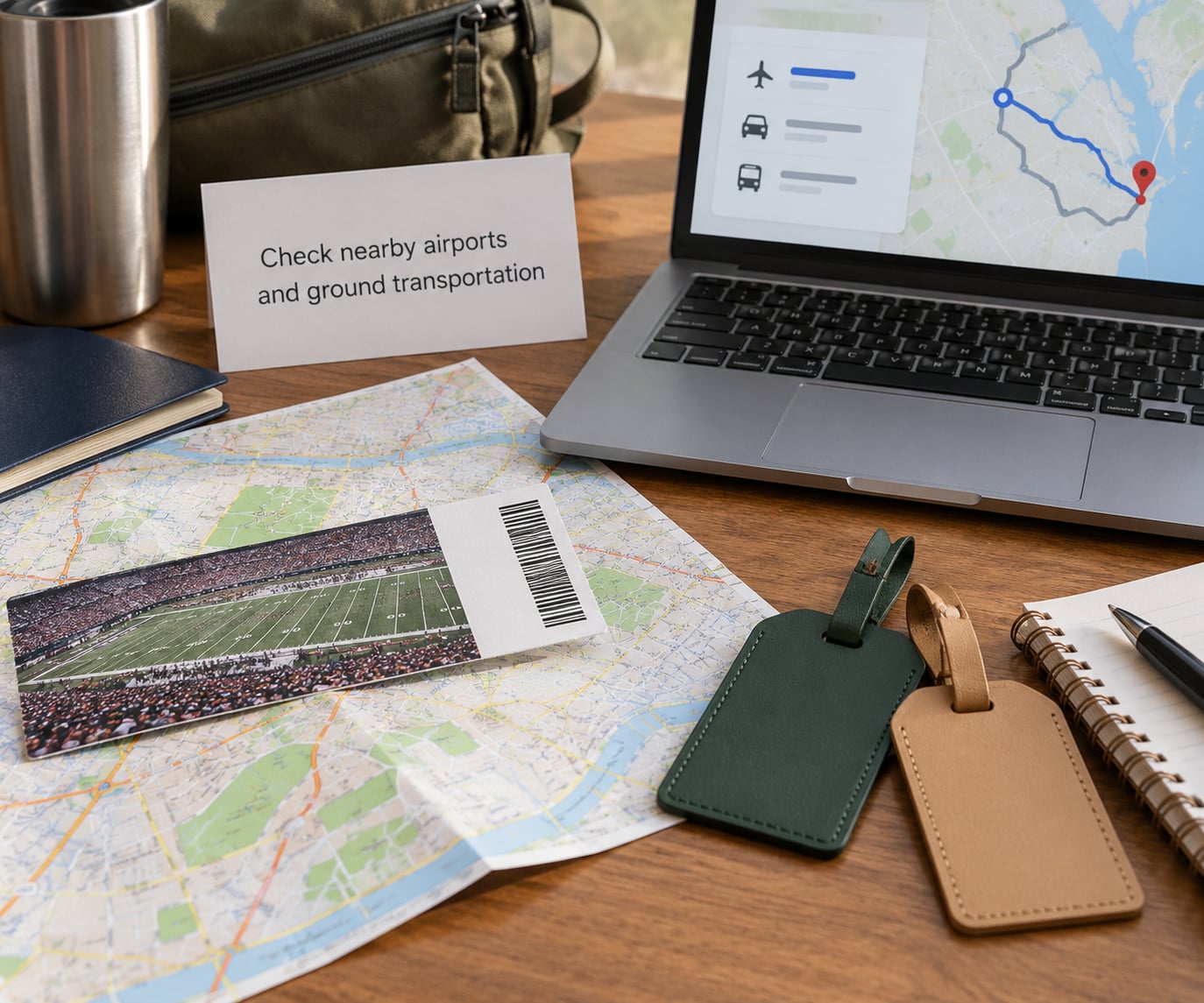
This is the single biggest lever, and it is the one fans skip. College town airports are often dominated by one carrier, so the default search returns whatever that carrier wants to charge. A field two hours away can undercut it substantially, and fans on travel forums describe airport price gaps in the hundreds of dollars as ordinary rather than rare.
Map the stadium to every airport inside about a three-hour drive. A college town might have a small commercial field, a regional field an hour out, and a major hub two hours out that a low-cost carrier serves. Then price the transfer. Add up rental car or mileage and fuel, parking at the stadium, or the rideshare cost from the secondary airport at midnight on a Saturday night, because that is when the surge pricing hits hardest.
A cheaper fare plus a 90-minute drive and two airport parking fees is not a cheaper trip. Run the math before you get excited.
3. Search flexible dates and airport combinations
Even with a Saturday game, you have slack on both ends. Search the game Saturday plus the Friday before and the Sunday after. Departing Friday afternoon instead of Saturday morning often costs more, and departing Sunday afternoon instead of Saturday night sometimes costs less than the night-before option, even with the extra hotel night folded in.
Run the same search across every airport pair on your list. Twelve combinations across three dates takes a few minutes in a metasearch tool and occasionally reveals a fare that is a fraction of what the stadium-city search returned.
4. Compare metasearch results with airline websites
Use metasearch to scan broadly, then go book on the airline itself. The lowest price shown in a comparison grid often disappears once you click through, because the fare it came from sold out or was a partial view of the itinerary.
What metasearch is genuinely good for is seeing the whole market in one screen: which airlines serve your route at all, whether nonstop service exists, and how the fare changes across the three dates you are considering.
5. Compare the total cost, not just the ticket
This is where most fan budgets quietly break. Compare these lines before you commit, on one screen, for your top two or three itineraries.
| Cost line | What to check |
|---|---|
| Base fare | Taxes and carrier-imposed surcharges included in the displayed total |
| Checked bag | Per-bag fee, and whether a cooler or oversized duffel counts |
| Seat selection | Advance purchase fee versus free assignment at check-in |
| Ground transport | Rental car, fuel, mileage, parking, or rideshare to and from the airport |
| Change and cancellation | Whether the fare is refundable or credit-only, and the change fee |
| Extra night | Hotel cost if the return schedule forces an additional night |
| Points value | What an award ticket would cost in miles for the same itinerary |
A fare that is 80 dollars cheaper but adds a checked bag, a rental car, and one hotel night is a more expensive trip. Say the number out loud before you book.
6. Choose the fare that protects the road trip
A nonrefundable basic fare is fine when your dates are fixed, the connection is comfortable, and the forecast is boring. Weather in the Southeast in September or October is not boring, and November games carry real cancellation risk.
Pay for flexibility when a delay means missing kickoff. That means either a flexible fare with a real refund, or a refundable ticket on a carrier whose hubs cover weather diversions well. The premium is worth it once. It is not worth it on all seven segments of a two-game trip.
Also pay attention to connection length on the return. Anything under an hour between flights is a problem when the first flight is late, and your return home does not matter until Monday morning.
7. Book and confirm every important detail
Once the fare enters your target range, book. Waiting for a better number on a fixed-date event itinerary mostly does not pay off, because the seats that cheap are gone.
After booking, confirm the airline and both airport codes in the confirmation email, note your connection times, check whether your fare includes a free carry-on or only a personal item, and put your confirmation number somewhere you will find it on a phone with no signal in a stadium. If the schedule has not been finalized, set a fare alert on the route and a calendar reminder to recheck two weeks out.
Common Mistakes
Searching only one airport. This is the expensive one. Fix: build the list of every airport within a three-hour drive before you search, not after you see a price you dislike.
Booking before you know the kickoff time. A late-afternoon arrival works for a noon game and strands you after an 11:30 pm kickoff. Fix: confirm the schedule on the official athletics site, then set your arrival window.
Ignoring connection risk. A 50-minute connection before a tailgate is a gamble. Fix: build in 90 minutes minimum on the way to the game, since a delay there ruins the trip, and tighten only on the trip home.
Overlooking baggage fees. Coolers and duffels add up fast on a basic economy fare. Fix: check the bag allowance in the fare rules before you pick the itinerary, not at the counter.
Waiting far too long. Fixed-date weekend travel does not follow the usual midweek-flexibility rules that every generic airfare article preaches. If your fare is reasonable, take it.
Comparing airfare instead of trip cost. Fix: build the full total every time, including the transfer and any extra night.
Two smaller habits pay off too. Turn on fare alerts as soon as the schedule is confirmed, because they cost nothing and they tell you when a route genuinely moves. And if you are booking third-party packages, read exactly what is included; fan forums are split on whether bundled flight, hotel, and ticket deals actually cost less than booking each piece yourself.
Frequently Asked Questions
How far in advance should I book flights for a college football road trip?
For fixed Saturday game dates, book once a fare lands inside your target range rather than waiting for a magic drop day. A practical window is roughly two to four months out for a rivalry or bowl trip, when schedules are published and seats are still open. Weekend event inventory does not follow the usual general rule of booking several months ahead for flexible travel. Set a fare alert when the schedule is confirmed and recheck weekly until you book.
Is it worth flying a day early for a college football game?
Usually yes. Arriving the afternoon before costs more than a Saturday morning flight, but it removes the risk of a delay, a missed connection, or a long drive from a secondary airport eating your game day. It also lets you pick up a tailgate spot, find the stadium, and sleep before kickoff. If your fare is nonrefundable and the return is tight, weigh that extra hotel night against the stress of watching a flight board during kickoff hour.
Can budget airlines be a good choice for college football travel?
They can, with caveats. The base fares are often the lowest on a route, and several large budget carriers have hub networks that put a stadium within a short drive of two or three of their bases. The tradeoffs are extra fees for bags and seat assignment, limited seat-back comfort on a red-eye home, and few or no premium options. Add every fee to the base fare before comparing, because a bare fare rarely survives the trip unchanged.
How can I use points and miles to reduce the cost of a road trip?
Award tickets are the strongest tool for fixed-date weekend travel because the dates never move. Search your airline’s own redemption calendar first, since partner sites often show award seats the airline site does not. Watch for short transfer-partner windows and large weekend surcharges on international programs. Transfer points before you search rather than after, and hold a reservation if you are transferring. Confirm whether your card already covers the award ticket fee.
What should I do if a flight connection is too tight before kickoff?
Change it. A connection shorter than 90 minutes on the way to the game is a real risk, because the second flight departs on the first flight’s schedule and baggage has to make it too. Look for an earlier arrival the night before or a different pairing that gets you into the city by early afternoon. If nothing works, ask the airline whether a same-day change is available at no fee rather than gambling at the gate.
Conclusion
Start with the schedule. Confirm the venue and kickoff time, decide the latest arrival and earliest return you can live with, and only then open a search box. Build your airport list before you type anything, run the same three dates across every pair, and compare full trip totals rather than headline fares.
That is how to find cheap flights for college football road trips in practice. The ticket price matters, but it is only one line in a trip that includes a hotel, a transfer, a tailgate, and a stadium seat, and it is the line you have the least control over. Airport choice, booking moment, and honest cost math are where you actually save.