The best tailgate games for college football fans are the ones that absorb a big crowd without equipment, argue about nothing, and reward the loudest table. My picks lead with a two-team football knowledge bowl, a prediction game, and a helmet toss, because those three fill a three-hour pre-kickoff window with almost nothing to haul in. Cornhole still works as a warm-up, but on its own it runs out of steam after twenty minutes with a big alumni tent.
Here is the problem every host hits. Kickoff is three hours away, the food needs another hour, and a lot of people at the tailgate do not care about a beanbag board. They want something to argue about. So the games below all come with rules, scoring, group sizes, and setup times instead of a one-line description.
I built these for a range of settings, from a quiet campus spot with six people to a parking lot row with forty. Each one gives you a way to fill a specific slot: something loud, something quiet, something that scales, and something that works when the kids arrive. All of them suit the 2026 college football season, home or away.
Table of Contents
- Best Tailgate Games for College Football Fans at a Glance
- 1. Two-Team Football Knowledge Bowl
- 2. Prediction Football
- 3. Fantasy Football Draft Board
- 4. Football Helmet Toss
- 5. Beanbag Football Accuracy Challenge
- 6. Two-Minute Drive Relay
- 7. College Football Matching Game
- 8. Fan Chant-Off
- 9. Pass-the-Play Grid
- 10. Rivalry Road-Trip Bingo
- Frequently Asked Questions
- What are the best tailgate games for college football fans with a large group?
- Which tailgate games work well for kids and adults at the same time?
- How do you make a football prediction game more competitive?
- What tailgate games need little or no special equipment?
- How long should a college football tailgate game take?
- How can fans make a tailgate game more Arizona-specific?
- Conclusion
Best Tailgate Games for College Football Fans at a Glance
Read the table first if you have a group in front of you. Group size decides more than preference does, since most published lists are two-player games that collapse once a dozen people show up.
| Game | Best group size | Setting | Difficulty | Equipment | Time to play |
|---|---|---|---|---|---|
| Two-Team Football Knowledge Bowl | 6 to 20 | Table or tent | Easy | Paper and a pencil | 20 to 30 min |
| Prediction Football | 4 to 30 | Anywhere | Easy | Paper and a pencil | Write it in 5 min, settle after the game |
| Fantasy Football Draft Board | 6 to 16 | Table or tent | Easy | Printed or hand-written player list | 20 min |
| Football Helmet Toss | 4 to 12 | Open lawn or end zone | Moderate | Helmet and a ball | 30 min |
| Beanbag Football Accuracy Challenge | 4 to 16 | Any flat surface | Easy | Beanbags and tape | 15 min per round |
| Two-Minute Drive Relay | 4 to 12 | Open ground | Moderate | Cones or shoes | 20 min |
| College Football Matching Game | 3 to 8 | Table or tent | Moderate | Index cards | 15 min |
| Fan Chant-Off | 6 to 25 | Open ground | Easy | A speaker and a scorecard | 10 min per heat |
| Pass-the-Play Grid | 3 to 8 | Table | Easy | Index cards | 10 to 15 min |
| Rivalry Road-Trip Bingo | 2 to 8 | Road trip or tailgate | Easy | One printed card | Ongoing |
Two patterns jump out. The paper games are the cheapest and the most portable, which matters when you are driving four hours to an away game. The physical games need open ground, and a parking lot row between tents rarely gives you that.
1. Two-Team Football Knowledge Bowl
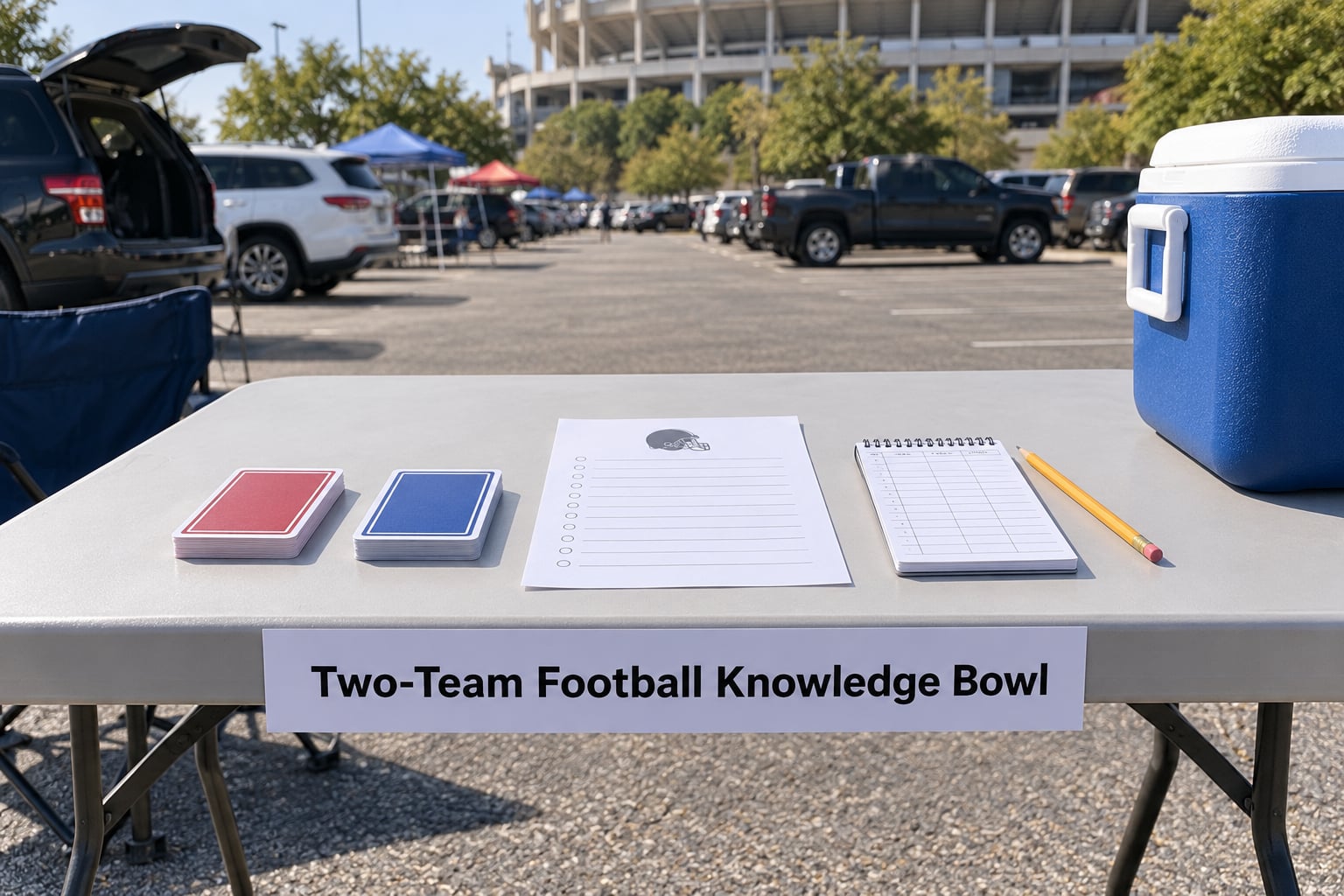
Football trivia beats cornhole for one reason: everyone has an opinion, and this game lets them use it. Split the tailgate into two fixed teams, keep the teams the same all series, and write down a score on a sheet everyone can see. Nobody switches sides, so the arguing stays friendly.
How to play the Two-Team Football Knowledge Bowl in 30 seconds
Write 15 questions on a sheet, one per line. Divide the group into two teams, take turns reading a question aloud, give each side 30 seconds to write an answer, then reveal it. A correct answer is one point, and a question nobody in the group can answer gets removed rather than awarded.
Build the question list from five buckets: current-season games, all-time scores and records, team traditions, rivalries, and the group’s own game-day history. That last bucket is the cheat code. Ask who first wore the jersey or who drove to every away game a decade ago, and the trivia becomes a story session instead of a quiz.
Keep individual questions fast. Anything requiring more than one fact loses the table, and the fun is in the arguing about borderline calls, not the trivia itself.
2. Prediction Football
Prediction Football is the cheapest game on this list and the one that keeps working for four hours, because the scoring happens after kickoff. Hand out a card before anyone has an opinion and the game is done before the food is ready.
How to play Prediction Football in 30 seconds
Each person writes five numbers before the game starts: final score, halftime margin, combined points, which team scores first, and the first touchdown length. Write everything down, initial it, and settle after the final whistle.
A flat 1 point per correct answer flattens the game fast, because the confident and the cautious both get one. Weight it instead. Award 2 points for the winner, 1 for the margin, and 1 for the total, so someone who nails a 27 to 24 upset is separated from someone who guessed the favorite by two points all game.
Add a confidence token. Everyone gets one card worth 5 points and one worth 2. The only rule is that you cannot put both on the same prediction, which forces a real decision instead of doubling down on the safest number in the row.
This is the easiest one of the best tailgate games for college football fans to steal. It costs a sheet of paper, scales to a thirty-person tent, and works in an away bar where there is no grass and no speaker.
3. Fantasy Football Draft Board
A fantasy draft board is fantasy football stripped of logins, subscriptions, and twenty minutes of clicking. Everyone picks from the same printed list at the same time, so nobody is waiting on a loading screen.
How to play the Fantasy Football Draft Board in 30 seconds
Print or hand-write a list of 20 to 30 well-known players with their projected points. Each fan drafts a roster of five: one quarterback, one running back, one receiver, and two flex players. After the game, total the points your five actually scored.
The tiny roster is what makes it a party game. Five picks means you finish in under three minutes and can run three drafts, one per hour, before kickoff. Add a waiver twist between rounds: after the first draft, everyone swaps one pick with the neighbor on their left.
Keep the scoring simple. One point per touchdown, one per 50 receiving yards, and a flat subtraction for turnovers. Anything fancier turns a good-natured argument into a rules dispute, and the rules dispute is the reason people stop playing.
Hand-write the list if you have to. A notebook page with 25 names works fine and travels in a jacket pocket.
4. Football Helmet Toss
Helmet toss is the loudest game here, and it is the one that pulls fans out of neighboring tents. If your group has energy to burn and a flat stretch of grass or the back of an end zone, this is the one.
How to play Football Helmet Toss in 30 seconds
Set a helmet or a bucket on the ground as the target and mark a toss line 10 feet away. Each player gets three throws, and every bag or ball that lands in or on the helmet scores 5 points. First team to 20 wins.
Once the base points stop producing a winner, add distance. Move the line back five feet after every round, so throws become optional and drops cost a round. Bucket football works the same way, and any bucket in team colors works as well as a helmet.
Keep it on grass, never in the lane between parked cars. The best version of this game at a big stadium is the one where someone from the next tent over wanders in to take a turn, which is the entire point of the noise.
5. Beanbag Football Accuracy Challenge
Not every group has a field goal. This is the version that works in a parking lot, on a patio, or in the corridor of a stadium where people will not even let you throw a football.
How to play the Beanbag Football Accuracy Challenge in 30 seconds
Tape three targets on the ground: 5 feet, 10 feet, and 15 feet. Each player throws six beanbags and gets 1 point for the near target, 2 for the middle, and 3 for the far one. Run it head to head, or as an individual round with a written leaderboard.
Give extra points for style, because that is what keeps the line moving. A bag that lands upside down after touching the ground earns a bonus, and a bag thrown from the knee instead of standing earns one. A tiebreaker round throws from the chest, since that separates the throwers from the lucky ones.
The team version works too. Two sides, five bags each, alternating throws, and the side with more points claims a trophy made of whatever is on the table. Beanbags beat footballs here because they do not hurt anyone at close range.
6. Two-Minute Drive Relay
The Two-Minute Drive Relay is the best game when the group has runners and not much patience. It takes the entire shape of a football drive and compresses it into a two-minute clock.
How to play the Two-Minute Drive Relay in 30 seconds
Mark a scoring zone 30 feet from the start, place two cones at the ten-yard and twenty-yard lines, and split the group into two teams. On each play, one player carries a ball marker to a cone while a teammate performs a task: a jump, a spin, or a handoff. Each completed task moves the offense up ten yards, and reaching the scoring zone scores 6 points.
Turnovers are the drama. Any team that drops the marker or runs past the cone loses ten yards and the ball. With a two-minute clock, a single fumble can turn a 14 to 6 lead into a tie, and the group will lose its minds over it in the best way.
Play three drives and total the points. In football a two-minute drive means something specific, and the fact that the clock matches the real thing is what makes fans argue the calls instead of the rules.
7. College Football Matching Game
Matching games work well for groups that want strategy without athleticism. This one also does the educational work of reminding everyone what the conference even is.
How to play the College Football Matching Game in 30 seconds
Make 12 to 20 pairs of index cards, one card per item and one per match. Pair a player with his team, a mascot with its school, a conference with a champion, a rivalry with a trophy name, or a stadium tradition with the school that invented it. Shuffle, lay them face down in rows, and beat the clock.
Keep every pair a single fact. If a card needs two facts to identify it, the group will stall arguing instead of flipping, and the game dies. I have had more success with 12 pairs than with 20, and 12 pairs keeps a round under six minutes.
Later rounds can raise the difficulty by turning over one card at the start. The first person to match everything wins, and the losers owe the winner a plate of food from the grill.
8. Fan Chant-Off
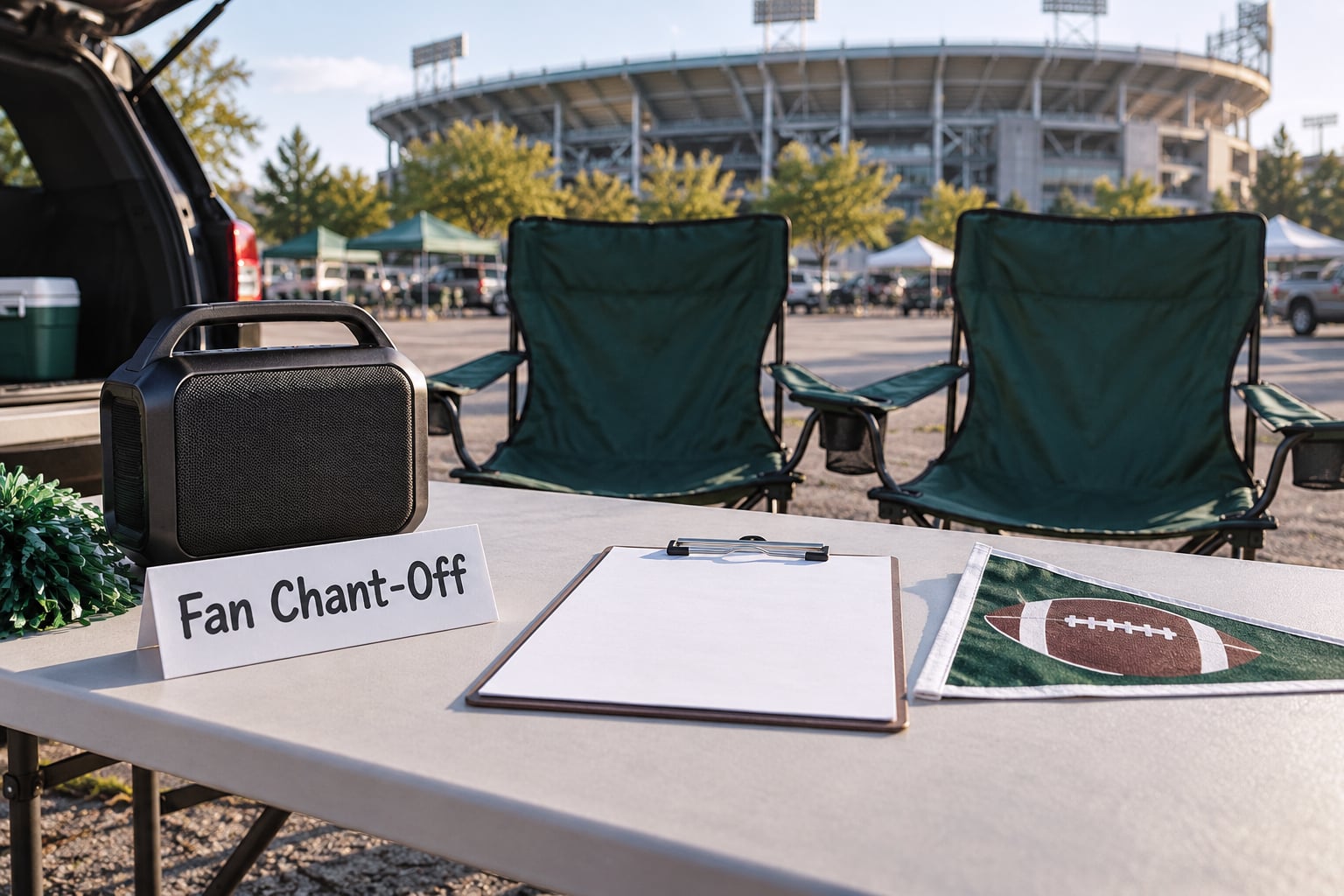
The Fan Chant-Off is the shortest game on the list and the one that produces the most noise. Put the speaker down, pick three judges, and give each team one fight song, one call-and-response, and one original chant.
How to play the Fan Chant-Off in 30 seconds
Split the group into teams of four to six, give each a different piece, and give the whole competition 30 minutes. Judges score volume, originality, timing, and team spirit on a sheet with four columns and a 10 in each.
Volume is the easiest category and the most fun to argue, so weight it. Score it from one to five rather than one to ten and set the judge scores in public, so no one claims the tent next door won by decibel alone. Originality counts for a full point of the total, which means a chant somebody wrote on the drive up beats a fight song everyone already knows.
This works best after the food is out. People sing better when they are not also grilling, and a chant-off at 90 minutes before kickoff tends to settle down on its own.
9. Pass-the-Play Grid
Pass-the-Play Grid is a football-themed card game that uses the same deck for four or eight people. It fills the gap where food is cooking and the TV is still off.
How to play Pass-the-Play Grid in 30 seconds
Make 30 cards: 12 plays worth 1 to 3 yards, 6 worth 4 to 7, 6 worth a first down, 2 worth a touchdown, 2 fumbles worth minus 5 yards, 1 field goal worth 6, and 1 extra point worth 2. Each player draws one card per play and adds the yards to a running total until they cross the 100-yard line.
The line marker moves along a paper field as totals grow, which turns arithmetic into something people can watch. Cross the line, take the extra 7 yards, and reset for the next drive. Fumbles and field goals are what make the deck worth building, since a bad draw hurts more than a good draw helps.
That imbalance is deliberate. Deck games run long without downside, and the downside is the reason this one ends.
10. Rivalry Road-Trip Bingo
Rivalry Road-Trip Bingo is the game for the drive up and the walk in. It costs one printed card, it needs no space, and it works equally well at a tailgate or in a car with six people arguing about the route.
How to play Rivalry Road-Trip Bingo in 30 seconds
Fill a 3×3 or 4×4 grid with game-day observations. Good squares: a fan in a rival’s colors, a scoreboard message you can read from the road, someone wearing a decade-old jersey, a tailgate you have never seen before, a chant overheard at a gas station, a team pun that lands.
Mark a square when you see it, and the first person to complete a row shouts the name of the game out loud. For a four-hour trip, use a 4×4 grid and drop the hardest squares, since the game should still be alive with an hour left.
Make one square specific to your team. The Arizona Wildcats version has a square for a pitchfork reference and one for a game-day sticker older than ten years, and those two squares win more often than anything else on the card.
Frequently Asked Questions
What are the best tailgate games for college football fans with a large group?
For 20 people or more, use games that scale by splitting the group into fixed teams: the two-team football knowledge bowl, prediction football, or the fan chant-off. Avoid anything built for two or four players, since a twenty-person group will splinter within ten minutes. Keep team rosters on a sheet everyone can see and play three rounds max so late arrivals can join without a reshuffle.
Which tailgate games work well for kids and adults at the same time?
The beanbag football accuracy challenge, the college football matching game, and the pass-the-play grid are the safest mix. None of them requires throwing at each other or keeping score for an hour, and all three work on a table or a short patch of pavement. Adults get a real competition out of the beanbag version, and the card games give kids something to do that does not involve adults losing to a ten-year-old.
How do you make a football prediction game more competitive?
Stop scoring every correct answer the same. Award more points for the winner, less for the margin and total, and give each player one 5-point confidence card and one 2-point card that cannot be used on the same prediction. Prohibiting doubles forces a decision instead of doubling down on the safest number, and the margin category keeps a lucky winner from feeling unbeatable.
What tailgate games need little or no special equipment?
Prediction football, the two-team football knowledge bowl, the fan chant-off, and rivalry road-trip bingo need only paper and a pencil, or a phone playing a fight song. The beanbag accuracy challenge needs beanbags and tape you can pull from any kitchen. The pass-the-play grid needs index cards and a marker, which makes it the best option for a rainy tailgate with no table.
How long should a college football tailgate game take?
Twenty to thirty minutes for a paper game, and 15 minutes for the chant-off, which covers most of a three-hour pre-kickoff window when you stack two of them with a break for food. Football Helmet Toss and the Two-Minute Drive Relay run closer to 30 minutes including setup. Hold the last game back for after the grill opens, because a group that wins early stops playing.
How can fans make a tailgate game more Arizona-specific?
Swap the generic names for your own. Make the knowledge bowl questions about Arizona Wildcats history instead of general college football, and give the chant-off extra points for a fight song in the school fight song tradition. Put a pitchfork reference on one bingo square and a decade-old Wildcats jersey on another, and the group plays harder because the squares are theirs.
Conclusion
Pick one game and commit to it. A knowledge bowl or prediction football for a loud group, the helmet toss or drive relay if you have open grass and runners, and the pass-the-play grid when the weather turns and you are all sitting under a canopy.
Whatever you choose, run it once, keep the scores on a sheet everyone can see, and stop before the grill opens. Then bring the same format to the next Arizona Wildcats tailgate, since the format is what people remember, not the game.