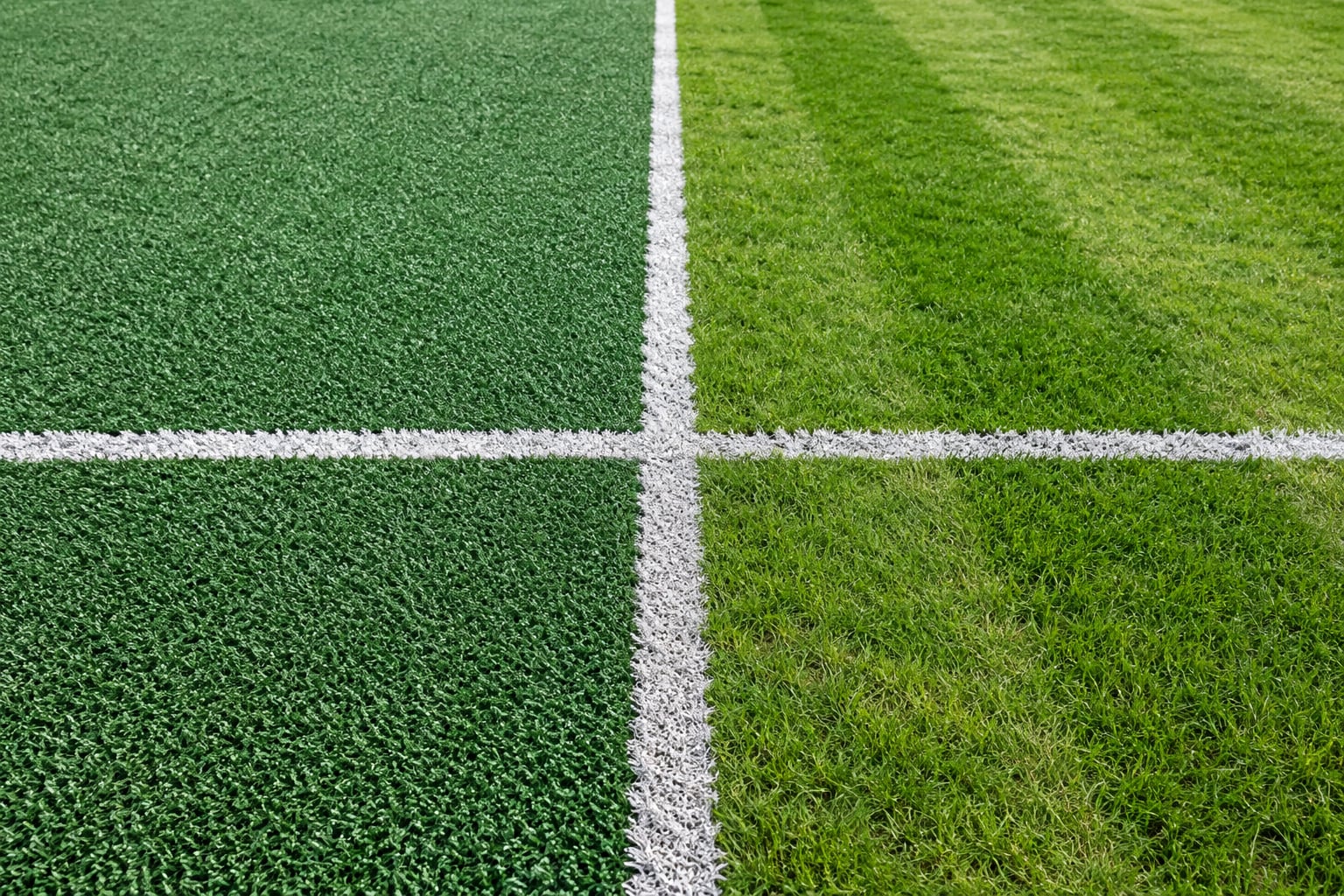
A turf field is a manufactured playing surface: synthetic fibers of polyethylene, polypropylene, or nylon, stretched over a compacted aggregate base and weighted with rubber or sand infill, all built to imitate grass. A natural grass field is living sod grown in soil, which has to be seeded, watered, mown, and fed to stay playable. That single difference explains everything that follows.
For most readers the practical answer is this: turf plays more consistently and stays open in bad weather, while grass feels softer underfoot and keeps changing week to week. If you maintain a field, grass eats your schedule. If you rent or watch the game, turf changes the look and feel of the contest. Here is how the surfaces stack up on the things people actually notice.
Table of Contents
- How Turf Fields Differ From Natural Grass at a Glance
- How Turf Fields and Natural Grass Are Built
- Traction and Player Movement
- Ball Behavior and Field Performance
- Weather, Drainage, and Seasonal Changes
- Maintenance and Day-to-Day Upkeep
- Durability, Lifespan, and Field Availability
- Injury Risk, Comfort, and Surface Choice
- Cost and Environmental Considerations
- Which Should You Choose?
- Frequently Asked Questions
- Is synthetic turf easier to maintain than natural grass?
- Does artificial turf get slippery in the rain?
- Is natural grass softer and safer than synthetic turf?
- Can synthetic turf be used for football and soccer?
- How long does a turf field last compared with natural grass?
- Which surface provides more consistent ball behavior?
- Conclusion
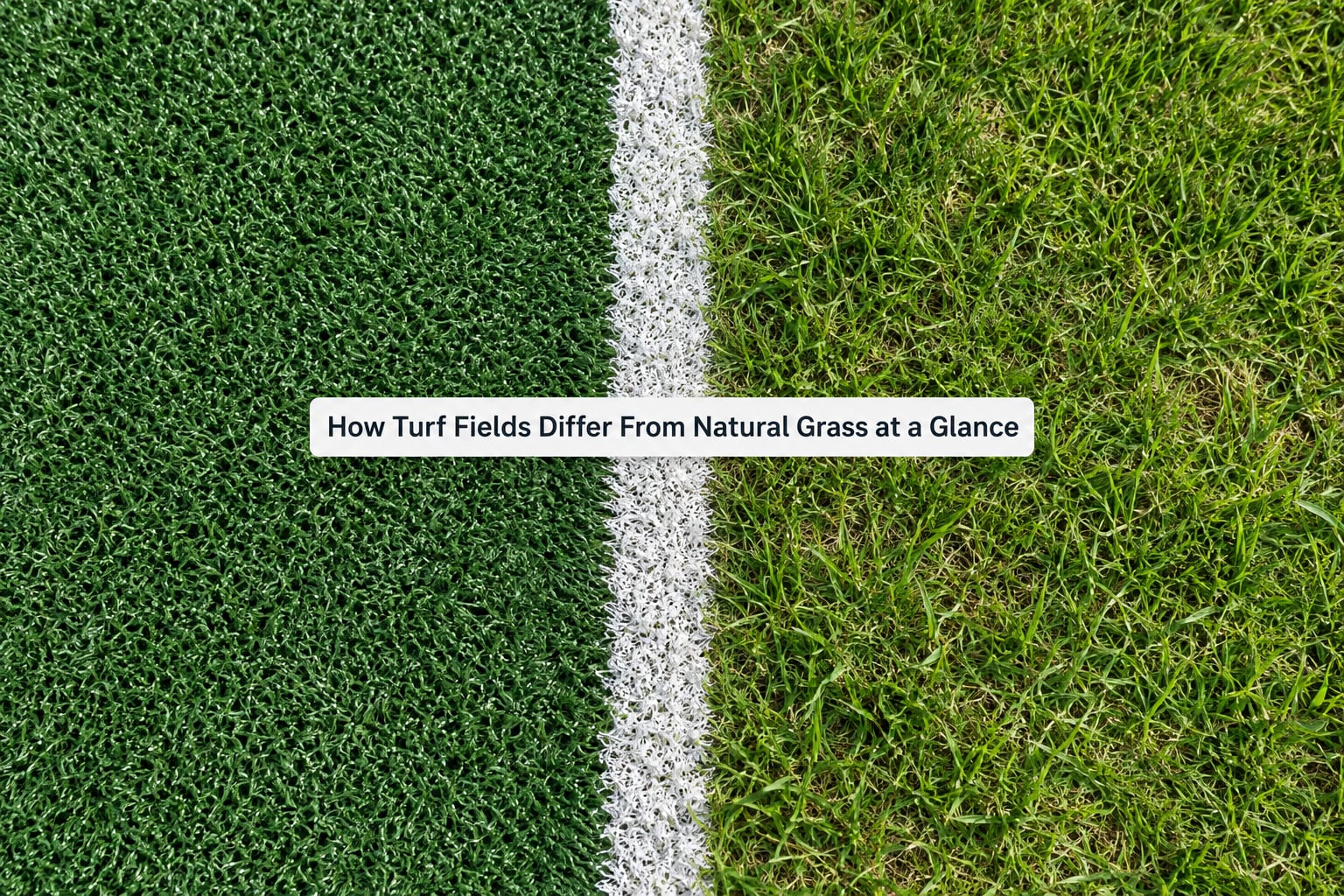
How Turf Fields Differ From Natural Grass at a Glance
| Factor | Synthetic turf field | Natural grass field |
|---|---|---|
| Surface construction | Synthetic fibers over compacted aggregate base with loose infill | Living sod grown in soil and organic matter |
| Traction | Even and predictable, softer and less grippy as infill migrates | Firm when dry, slick when wet, varies with wear and moisture |
| Ball behavior | Faster roll, livelier bounce, consistent flight | Slower roll, softer bounce, changes as the field wears |
| Maintenance | Brushing, decompaction, infill redistribution, seam checks | Mowing, watering, fertilizing, aerating, overseeding, divot repair |
| Rain response | Drains well and stays playable in most conditions | Can go muddy, slick, or shut down entirely |
| Hot weather | Surface runs hot enough to affect footing and comfort | Stays cooler; may brown and go dormant in drought |
| Typical use | Heavy, repeated, multi-sport scheduling | Fewer hours a day, longer recovery between events |
| Cost drivers | Upfront installation and eventual replacement | Ongoing labor, water, fertilizer, and renovation |
| Long-term consideration | Hard to convert back to grass without major excavation | Regrows and repairs itself, at a running cost |
How Turf Fields and Natural Grass Are Built
A synthetic field is a stack of engineered layers. At the bottom sits a compacted sub-base of crushed stone, often over a drainage layer that moves water away from the playing surface. Above that goes an aggregate base, then the carpet itself, whose fibers are tufted into a backing and anchored with stitching or adhesive. Loose infill is worked into the pile to ballast the carpet, hold fibers upright, and add cushion.
Not every field shares that specification. Some newer systems use a shock-absorbing underlayment instead of relying on infill alone, some use sand-rubber blends, and some use organic infill. Field managers on r/Turfmanagement note the same thing from the professional side: specs vary enough that a surface’s feel is tied to its specific build, not to the word “turf.”
A natural grass field has fewer factory layers and more biology. Soil and organic matter hold seed or sod, roots anchor the plants, and a working grass cover absorbs impact by compressing and springing back. That living layer changes constantly, which is both its appeal and its management problem.
Traction and Player Movement
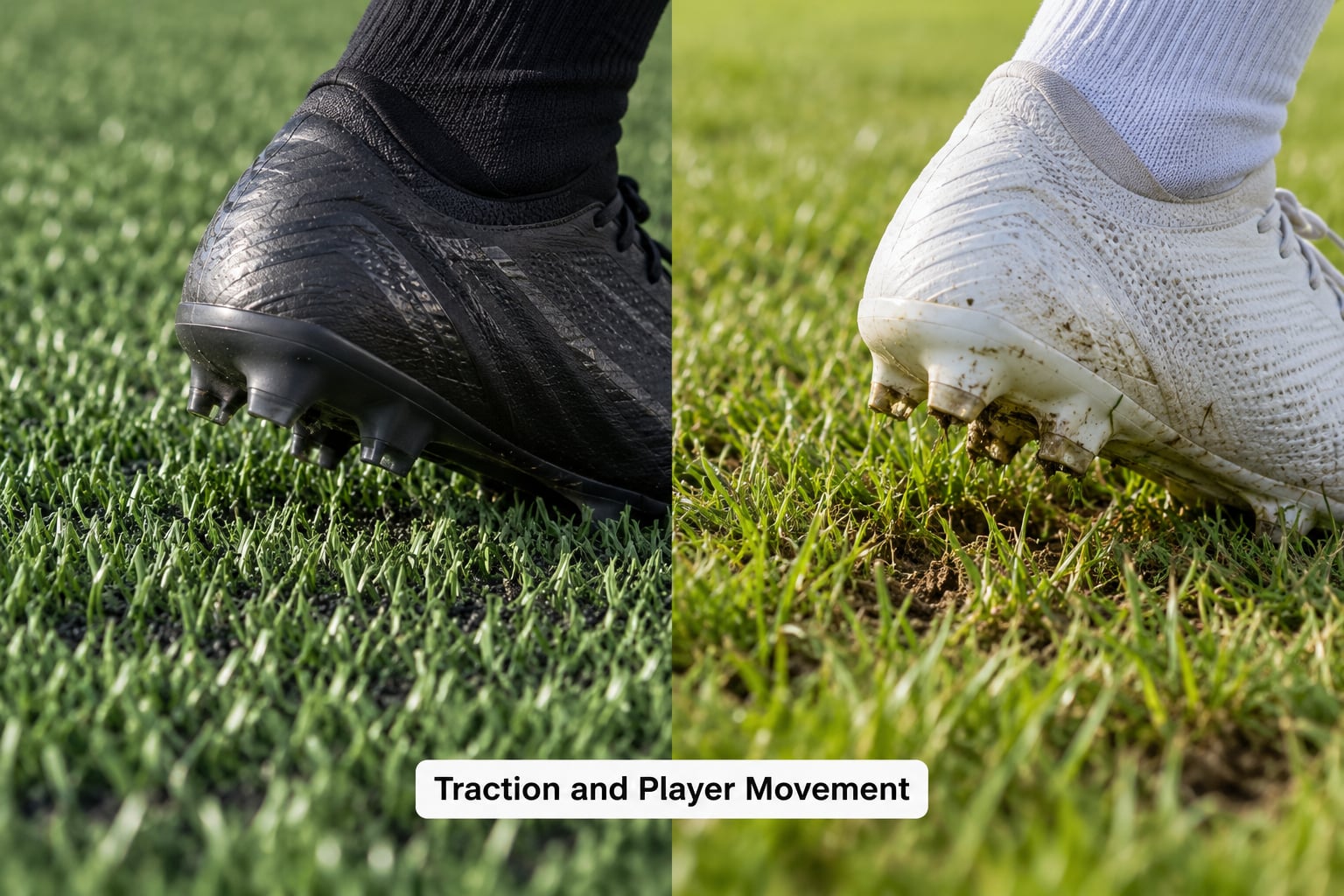
Turf gives roughly the same grip on a January morning as it does in September, and that predictability is why coaches like it. The surface is usually a touch faster underfoot because the fibers sit on a firm base with no mud to absorb into, so acceleration and cutting come sharper.
Grass has more give. Players describe it as cushioning because the blades and soil compress before the knee takes the full load, though the cushion disappears when the field is dry and hard, or when blades have been worn away at the top of the penalty box.
Footwear matters as much as the surface. Molded cleats with many short studs are built for grass and will not bite into loose infill. Shorter, wider studs or turf shoes are the usual answer on synthetic fields, and swapping them mid-program is a common source of confusion for families. Newer turf also grips better than older carpet, whose fibers have flattened and whose infill has compacted into the base over time.
Ball Behavior and Field Performance
The ball tells you the surface before your feet do. On turf, a football skips faster and a soccer ball carries further because the pile is firm and consistent, and a ball with spin bites harder. Passing windows open sooner and wider, which tends to push the tempo of a game up.
On grass the same pass needs a little more pace to travel the same distance, and the ball slows and settles as blades give way under it. Ball roll is shorter and more affected by wind and wear.
Lacrosse players argue about this constantly in threads on r/lacrosse, where the recurring complaint is that some turf fields feel so fast the game becomes a passing drill. Their useful point: field quality and maintenance can matter as much as the surface label. A well-built, freshly decompacted field plays better than a neglected one of either type.
Weather, Drainage, and Seasonal Changes
Rain is where the two diverge most. Turf drains through the aggregate base, so play often resumes shortly after a storm. Grass fields absorb water into soil, so a heavy week leaves them slick, then muddy, then sometimes unfit to host games at all. School administrators treat that lost availability as a budget item.
Heat runs the other way. Because synthetic fibers absorb solar energy, turf surface temperatures can climb well above the air temperature on a hot afternoon, and that heat affects both comfort and grip. Grass stays closer to ambient temperature and shades itself.
Cold and drought change grass more than turf. Short days slow growth, frost makes blades brittle, and a missed irrigation window in July can push a field into dormancy that takes weeks to recover. Turf waits for nobody in February and looks the same in April as it does in August.
Maintenance and Day-to-Day Upkeep
Synthetic upkeep is periodic rather than weekly. Crews brush the pile to keep fibers upright, redistribute infill that has migrated toward the touchlines, decompact high-traffic zones, rinse off debris, and inspect seams where a ball can catch and lift an edge. Small infill top-ups are routine.
Grass is a season-long program: mow several times a week in growth season, irrigate on a schedule, fertilize, aerate to relieve compaction, control weeds and pests, overseed bare areas, and repair divots after games and practices. Wear concentrates in the same places on both surfaces: the goalmouths, the center circle, and the running lanes in front of the bench.
How turf fields differ from natural grass in maintenance demands
The short version is labor. Turf trades a schedule of daily work for periodic skilled work. Grass trades constant work for a skilled crew and a dependable water source.
Neither surface is maintenance-free. A neglected turf field develops compacted infill, flattened pile, and lifted seams, and ball roll suffers. A neglected grass field thins out, dries unevenly, and turns to weeds and mud. The difference is that turf’s problems can wait for a scheduled visit, while a grass field degrades daily and needs someone on site.
Durability, Lifespan, and Field Availability
Expect roughly eight to ten years of service from a well-built synthetic field before its carpet and infill need replacing, though heavier use, intense sun, and a bad base shorten that. Fields that host several sports, camps, and events can wear faster than a stadium that plays a dozen games a year.
Grass has no replacement cycle because it repairs itself, but it needs renovation: aeration, topdressing, overseeding, and periodic deep renovation on a multi-year schedule. Its availability is the weaker point. Weather cancellations and recovery windows limit how many hours a grass field can carry each day and week.
The reverse conversion is worth thinking about early. Putting grass back on a former turf site usually means removing the carpet and infill and rebuilding the base, which is close to starting over.
Injury Risk, Comfort, and Surface Choice
Any honest answer here starts by rejecting the claim that one surface is automatically safer. Research on lower-extremity injuries has run for years with mixed conclusions, and the field quality point keeps surfacing: a bad grass field and a bad turf field both produce bad days.
The mechanism people argue about is stiffness. Grass compresses and returns energy, while a hard synthetic base transfers more load into the joint, particularly during rotation and cutting. In 2022 the NFL Players Association reported a higher rate of non-contact lower-extremity injuries on turf, which is the reference figure most player advocates use. Earlier studies in the 2010s pointed the same direction, though later analyses with different methods have produced less uniform results.
Two other differences show up in training rooms. Abrasions, often called turf burn, occur almost exclusively on synthetic surfaces. And a hard, hot turf surface in July is its own kind of stress on athletes. Against that, a grass field in poor shape with exposed dirt or uneven footing has caused plenty of the same injuries turf gets blamed for.
The practical variables are installation quality, maintenance discipline, footwear, and conditioning. Athletes who load their muscles and knees before high-speed play reduce risk on either surface.
Cost and Environmental Considerations
Both surfaces start with the same base work: excavation, drainage, and aggregate. The difference is the carpet and the years of labor behind it. Turf front-loads the money and shifts it to a replacement cycle; grass spreads the cost across every mowing, watering, fertilizing, and aerating session for as long as the field exists.
Water use is the environmental argument most often raised, and it is real in dry regions where natural fields depend on irrigation. Against that, grass stores carbon in soil and its blades soften heat around the site, while turf displaces perennial plants and eventually becomes a large quantity of mixed synthetic material to dispose of.
So is natural grass chemically clean? Not automatically. An r/Umpire thread put it plainly: the downsides people assign to turf are matched by the fertilizer, weedkiller, and insecticide sprayed on well-maintained grass fields. Hybrid fields, where grass grows over a reinforced or synthetic base, try to split the difference, and turf professionals working in r/Turfmanagement treat them as a real middle option rather than a curiosity.
Which Should You Choose?
Match the surface to how the field will actually be used.
High-volume multipurpose facilities benefit from turf. When a site hosts football, soccer, lacrosse, and community events in the same week, a surface that survives the schedule without closures is worth the installation.
Schools with limited maintenance capacity get predictable upkeep from turf, but should weigh whether they have a reliable irrigation system and grounds staff if they choose grass.
Professional venues already run on a mix, chosen mainly for scheduling reliability, surface testing standards, and revenue from extra events.
Climate-sensitive locations should look hard at rainfall and heat before deciding. Heavy rain favors turf; hot, water-stressed locations favor grass.
Facilities that want a traditional playing experience and can staff the upkeep should choose grass.
Before signing anything, evaluate expected weekly use, climate, drainage, your maintenance capacity, budget over ten years, athlete and community preference, and any local field standards.
Frequently Asked Questions
Is synthetic turf easier to maintain than natural grass?
In day-to-day terms, yes. Turf needs periodic work: brushing the pile, redistributing infill, decompacting heavy zones, and checking seams. Grass needs a near-daily program of mowing, watering, fertilizing, and divot repair. Turf is easier to schedule, though it still needs a trained crew, and a neglected field of either type plays badly.
Does artificial turf get slippery in the rain?
Usually not the way wet grass does. Turf drains through its aggregate base, so water moves off the surface rather than soaking into soil, and play often resumes soon after a storm. Wet grass forms a slick film over soft ground that can end a practice or a game. Loose infill and worn or lifted seams are the situations that do create slipping hazards on turf.
Is natural grass softer and safer than synthetic turf?
Grass is generally softer because the blades and soil compress before load reaches the knee, while a firmer synthetic base transfers more of it. Whether that makes it safer is contested: the NFL Players Association reported higher non-contact lower-extremity injury rates on turf in 2022, but later research has been less uniform. Footwear, maintenance, and field quality move the needle as much as the surface label.
Can synthetic turf be used for football and soccer?
Yes. Most modern systems are built and certified for multi-sport use, including football, soccer, lacrosse, and rugby. Field markings are inlaid or painted per sport, and the surface is engineered with a consistent pile and infill depth so balls roll and bounce predictably. Confirm the specific field’s sport certifications and infill depth before scheduling unusual events.
How long does a turf field last compared with natural grass?
A well-built synthetic field typically gives about eight to ten years before the carpet and infill need replacing, with heavy multi-sport use and strong sun shortening that span. Grass has no replacement cycle because it repairs itself, but it needs recurring renovation such as aeration, topdressing, and overseeding on a multi-year schedule. The real gap is scheduling: grass loses hours to weather and recovery.
Which surface provides more consistent ball behavior?
Synthetic turf. Because the pile height, infill depth, and firmness stay essentially the same, ball roll, bounce, and flight vary little between the first and twelfth game of a season. Grass changes as it grows, wears, dries, and takes wear in goalmouths and along touchlines, which makes it more variable, though many players describe that variability as part of what they prefer.
Conclusion
Turf wins on consistency, drainage, and hours of available play. Grass wins on feel, cooling, and the way it recovers from damage on its own. Neither is automatically safer or cheaper, and the loudest claims on either side usually come from someone who sells the surface.
So assess expected weekly use, climate, drainage, maintenance capacity, ten-year budget, and what athletes in your community actually prefer. Ask to see two fields side by side, one of each, and stand on both.