Last updated: October 2026
How college teams handle heat and hydration comes down to a written heat safety plan with five working parts: a gradual acclimatization period after report, hydration and electrolyte stations within reach on the field or sideline, wet bulb globe temperature monitoring that shortens or cancels practice, cooling equipment like cold water immersion tubs, and a rehearsed emergency action plan. This guide explains what those systems look like during a game, and what fans can do when kickoff lands in triple digits.
One note before we start: this is general information about how college athletics programs operate, not medical advice. If you are an athlete with a health condition, or you feel unwell in the heat, talk to a physician or a certified athletic trainer about what is right for you. For spectators who feel dizzy, confused or ill in the heat, move to shade or air conditioning and contact venue staff or emergency services right away.
Table of Contents
- Why Heat and Hydration Matter in College Sports
- How College Teams Prepare for Hot Game Days
- How College Teams Handle Heat and Hydration During Games
- What Is a Cooling Break and When Does a Team Use One?
- What Do Players Drink During Hot Weather Games?
- How Teams Cool Players Between Plays and After the Game
- How Heat Safety Differs by Sport
- What Signs Prompt Teams to Change Plans?
- What Can Fans Do During Extreme College Game-Day Heat?
- Frequently Asked Questions
- Conclusion: Start With the Venue’s Heat Plan
Why Heat and Hydration Matter in College Sports
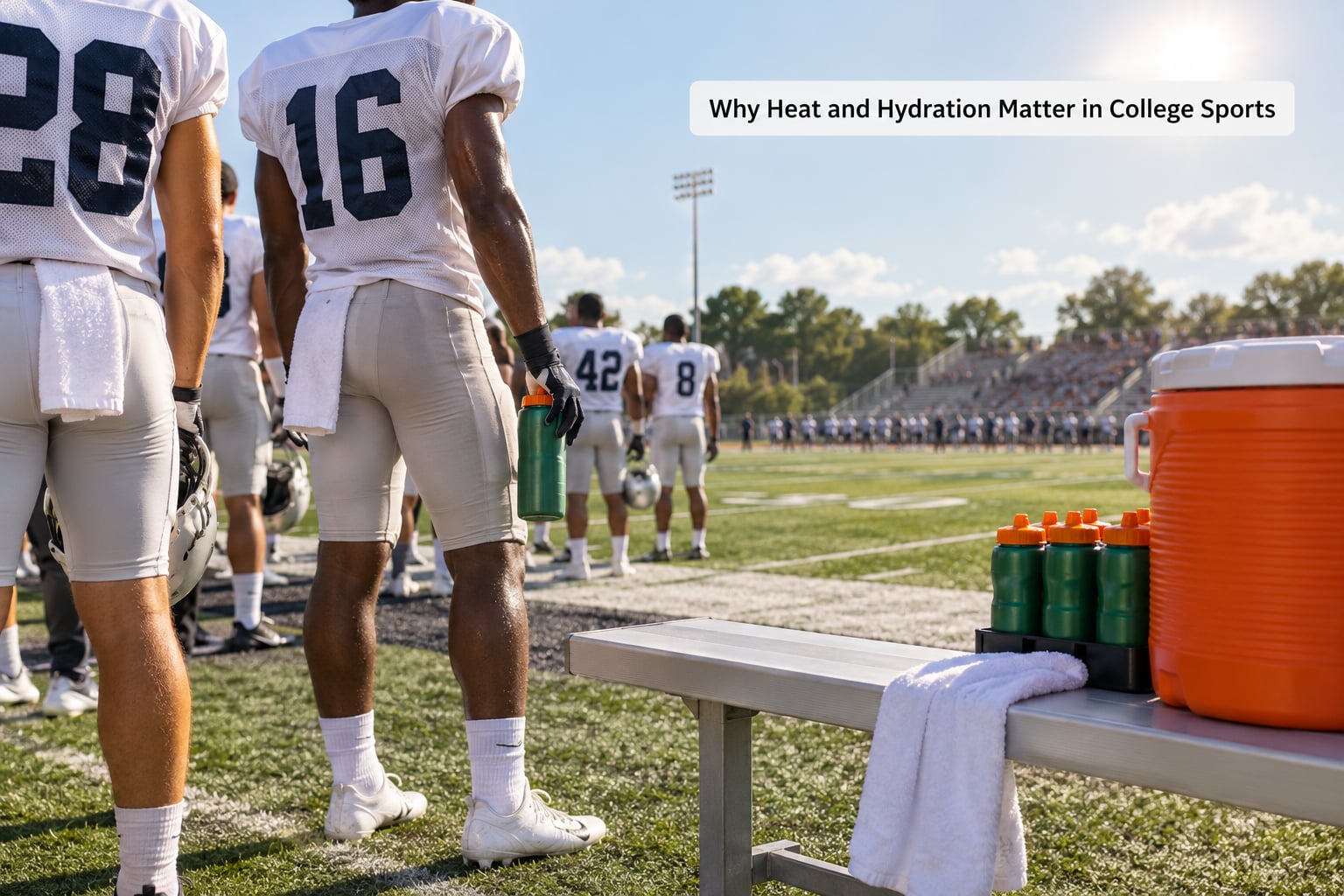
Heat affects players very differently than it affects the person sitting three rows behind them in the shade. A starting safety in full pads generates enormous metabolic heat, wears a uniform that traps it, and has been running for two hours. A spectator walks from the parking lot and stands still. Same temperature, entirely different physiological load.
Several factors stack on top of each other. Humidity is the big one: sweat only cools you when it can evaporate off your skin, so humid air makes the same air temperature far harder to tolerate. Direct sun adds radiant load on top of air temperature. Exertion adds heat the body itself produces, which is why the hardest part of a game is often the third quarter rather than the first.
It helps to separate three ideas that get mashed together. Hydration is replacing the fluid and sodium you lose in sweat. Cooling is actively pulling heat out of the body — shade, fans, cold water. Heat illness prevention is the plan that keeps both of those from being needed in an emergency, through acclimatization, monitoring and workload management.
When a program says it manages heat and hydration, it means all three, and the health and safety rules about it come from the NCAA Sport Science Institute and athletic medicine guidance published through the National Athletic Trainers Association.
How College Teams Prepare for Hot Game Days
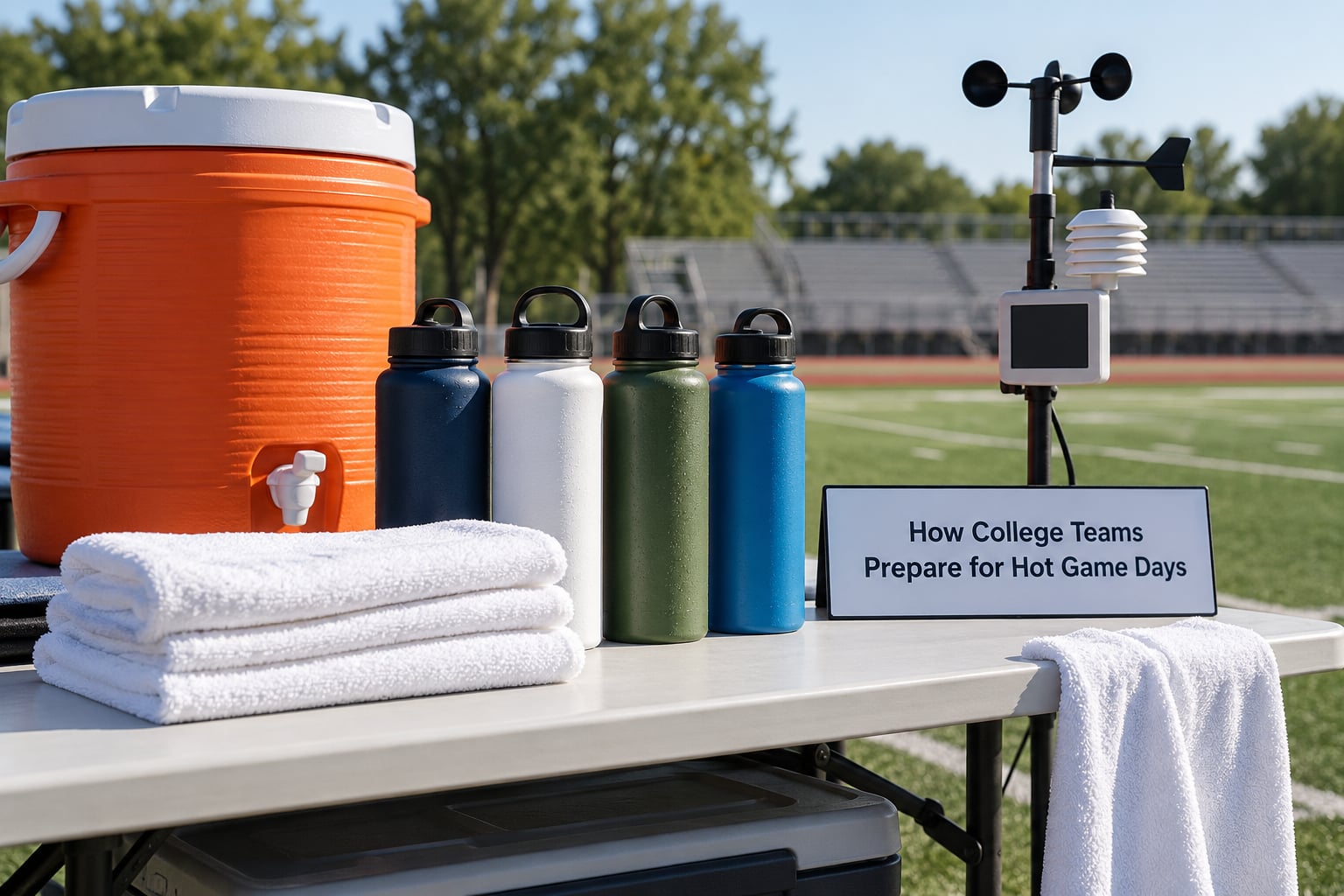
Most of the work happens before anyone takes the field. A college athletic staff starts days ahead, and the pregame routine on a hot day is long and specific.
First, pregame monitoring. Athletes arriving on site may be weighed before practice, since body mass loss across a session is one of the simplest ways to estimate fluid and sodium loss. Athletic trainers also look at urine color, which is crude but useful in a pinch, and track how an individual responds day to day.
Second, weather and field checks. Staff take wet bulb globe temperature readings, which combine air temperature, humidity, sun exposure and wind into a single number that maps to an activity level. The reading gets logged, and the practice or warm-up plan gets adjusted to it.
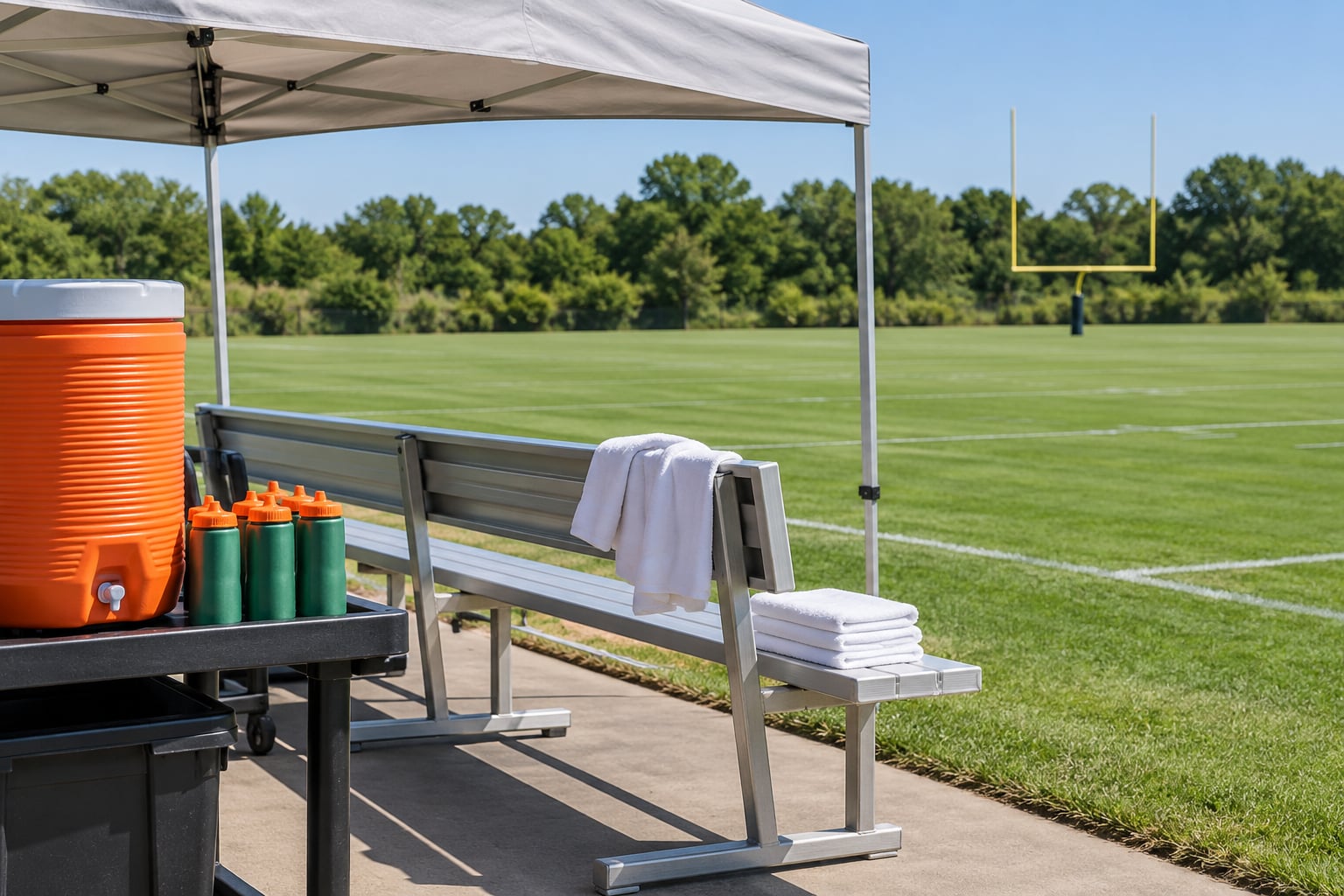
Third, equipment staging. Coolers, insulated water containers, towels, shade tents and recovery equipment get positioned on the sideline before players arrive, not after a problem develops. Fourth, communication: staff and coaches agree in advance who calls for adjustments and who has authority to pull a player.
Procedures differ by school, conference, venue and sport, so do not expect any two programs to run identical routines. The shared framework is the same even when the numbers are not.
How College Teams Handle Heat and Hydration During Games
The direct answer: teams rely on scheduled fluid access, cooling between plays, substitution and clock management, and officials with the authority to stop the game when conditions require it.
How college teams handle heat and hydration between plays
Fluids sit on the sideline rather than being handed out once at the quarter break. During dead balls, players come to the sideline for water or an electrolyte drink, get towels on the neck and upper back, and stand in whatever shade or air conditioning the venue offers. Trainers work the row, talking and looking, watching for the small changes in speech, gait and skin that show up before anything dramatic happens.
Coaches manage exposure. Substitution patterns shift toward fresher players, sun-exposed positions rotate through shade more aggressively, and in the most dangerous conditions teams will shorten warm-ups, add fourth-quarter breaks, or run a clock differently to take touches out of the hottest stretch.
Who can call for extra time
Anybody on the sideline can flag a problem, and the athletic trainer leads the response. In college football, either team can request a timeout, and officials can stop play to let trainers work. Basketball referees control dead-ball time, and coaches routinely ask for extra time so a player can be evaluated. The difference that matters is who counts as qualified to call a return to play.
What Is a Cooling Break and When Does a Team Use One?
A cooling break is a stoppage set up for heat, not for injury or strategy. That distinction is the whole point. Nobody has to be hurt for a coach to ask for one, and the priority is lowering core body temperature, not resetting the down.
Typically a break means players go to the sideline or a shaded area, get fluids, towels and air or fan cooling, and are checked by a trainer before returning. In more severe heat and humidity, breaks get longer and more frequent, and officials may add them without being asked.
There is no single universal temperature that triggers a break. Thresholds come from the sport’s governing rules, the conference, the venue and the athletic department, and they account for whether the playing surface is natural grass, artificial turf or indoor air conditioning. Sport rules committees also allow officials to shorten quarters or add timeouts when conditions are unsafe, which is why the timing of games in hot climates often looks odd.
What Do Players Drink During Hot Weather Games?
Water is the base of nearly every plan. Most long practices and games run on plain water between longer breaks, with electrolyte or carbohydrate drinks appearing when the session runs long enough, the sweat rate is high, or the sport demands fuel rather than just fluid.
For football specifically, yes, players drink sports drinks such as Gatorade, along with water and, for some athletes, plain electrolyte solutions. Published sports-science guidance commonly frames this as pre-hydration of roughly 6 mL per kilogram of body mass every two to three hours before activity, sodium of about 0.5 to 0.6 grams per liter during activity for heavy or salty sweaters, and replacing somewhere around 100 to 150 percent of body mass lost within the hour after.
The catch is that no two athletes are on the same plan. A small lineman who sweats heavily and a quarterback who sweats less need different amounts, and individual sweat rate testing, done by weighing before and after a session, is how a staff sets those numbers. What an individual should drink depends on their own sweat rate, medical history and plan from their own medical staff, which is exactly why individual guidance belongs to a professional rather than a search result.
How Teams Cool Players Between Plays and After the Game
Cold water immersion comes first when it is available. Getting a hot athlete into a tub of cold water and keeping them there is the fastest cooling method most programs have, and the practice fields that have one is the clearest piece of standard equipment in modern athletics.
That standard exists because of Korey Stringer. The Minnesota Vikings offensive lineman collapsed during a preseason practice on July 31, 2001, and died three weeks later of heat stroke. His core body temperature reached 108.8 degrees, and reporters documented a delay of roughly an hour and a half before he reached a hospital. The case changed practice permanently: the response doctrine became cool first, transport second, and cold water immersion tubs went from a nice piece of equipment to a requirement at practice facilities.
Douglas Casa, who has studied more than 85 exertional heat stroke cases as an expert witness and now leads the Korey Stringer Institute at the University of South Carolina, has argued that essentially none of those deaths were unavoidable.
Behind immersion, the second tier is ice towels rotated across the neck, armpits and groin, cooling vests worn during rest periods, shade tents and canopies, electric fans for air movement, and postgame recovery areas where players sit cool before they leave the stadium. Ice slurry, a drinkable mix of ice and water, is another option some staffs use during recovery.
Cooling is not a standalone trick. It is one layer inside a monitoring program that measures core temperature, checks on athletes and is ready to act in minutes rather than hours.
How Heat Safety Differs by Sport
| Sport | Where heat exposure peaks | Primary cooling method | Operational note |
|---|---|---|---|
| Football | August two-a-day and preseason camp; daytime kickoffs later in the season | Cold water immersion tub, ice towels, recovery unit | Heaviest equipment, longest exposure, most players at one depth of heat |
| Basketball | Early non-conference home games; tournament floors in warm cities | Timeouts, ice towels, air-conditioned arena | Cool indoor air usually limits indoor risk; travel and outdoor early games do not |
| Baseball and softball | Afternoon and evening doubleheaders through the summer | Dugout shade, towels, delayed start times | Long stationary exposure in direct sun during innings |
| Soccer | Fall and spring schedules, midday kickoffs in warm regions | Scheduled drink breaks, substituted hydration per rules | Referee-managed breaks under sport rules |
| Track and field | Outdoor meets during the summer months | Shade tents, ice towels, misting where allowed | Small margin for recovery in multi-event competition |
| Cross country and golf | Long-course distance in summer conditions | Race-side stations, carried fluids, event rule changes | Self-paced and self-supplied rather than sideline managed |
Desert programs add a wrinkle that gets missed. Tucson sits above 2,000 feet, which thins the air and makes both heat and recovery slower than at sea level. Phoenix-style dry heat is easier on sweat evaporation than humid heat, but the dry-air version of summer has its own hazard: when relative humidity climbs, evaporation drops without air temperature doing anything dramatic.
Arizona players also train through a July monsoon shift. The same afternoon can move from dry-bulb heat to oppressive combined heat, which means a plan built in June does not automatically fit August.
What Signs Prompt Teams to Change Plans?
Teams change plans for three kinds of reasons: the environment, the field, and what they see in people.
Environmental change is the easiest to measure. Wet bulb globe temperature crossing a threshold, wind dropping, humidity rising, or a forecast shifting trigger adjustments to length, timing and clothing. Field condition matters too. Natural grass and artificial turf do not heat the same way, and a field that held up fine at noon can be at its worst surface temperature during a kickoff.
The third reason is observation. Trainers watch for stumbling, unusual speech, confusion, headache, chills, goosebumps despite heat, and athletes who stop sweating or sweat heavily while acting unaffected. Coaches notice a position group running a step slow or missing snaps in the third quarter.
When those signals line up, the response ladder usually looks like this:
- Mandatory water break, shade, and cooling for the affected athlete.
- Formal evaluation by an athletic trainer, with removal from play if symptoms are present.
- Suspected exertional heat stroke means immediate full-body cold water immersion. No exceptions, no debate, no waiting to see if it passes.
- Emergency services called, with cooling continuing during transport.
- Post-incident documentation and review before anyone returns to participation.
Sports medicine guidance is blunt about the order: cool first, transport second. Anyone who looks wrong in the heat gets cooled and gets watched, even when it turns out to be nothing.
For fans: follow venue instructions and announcements, and treat any spectator who seems confused or unsteady as an emergency. Call for venue staff rather than assuming someone else already has.
What Can Fans Do During Extreme College Game-Day Heat?
The program protects players. Nobody is assigned to protect you, so plan for yourself.
Arrive prepared. Bring your own refillable bottle and do not rely entirely on stadium fountains or vendor cups, which run out. Drink steadily across the hours before you get there rather than trying to catch up once you are in the seat. Wear light clothing and shade-friendly colors.
Sit in shade or air conditioning when you can, and take breaks from the sun rather than trying to endure three straight hours of it. In the desert, the difference between a shaded lower-bowl seat and a sun-exposed upper section is bigger than the temperature reading suggests.
Watch the people around you. Children, older adults and anyone on medication for heart, kidney or blood pressure conditions are the ones most likely to have trouble in the stands. Early signs of heat illness are easy to miss because people often keep talking and keep moving: headache, dizziness, nausea, unusual fatigue, cramping, heavy sweating, weakness.
Know the exits. Before a hot daytime game, find where you entered, where the nearest shaded or indoor space is, and where medical staff are stationed.
If a game is delayed, moved or shortened, follow the venue’s instructions rather than assuming it is cancelled. And if someone near you shows confusion, fainting or loss of coordination, tell staff immediately. Confusion in the heat is a red flag, not a bad day.
Frequently Asked Questions
Why does hydration matter for athletes?
Sweating is how the body sheds heat, and every liter of sweat costs fluid and sodium. Losing that fluid lowers blood volume, so the heart works harder to deliver the same effort and the body sweats more slowly when it needs to cool fastest. College teams track this because the fix is simple and the failure mode is not: replace what goes out on a schedule matched to each athlete’s own sweat rate.
How to stay cool in 100 degree heat?
For athletes, the order is acclimatize gradually, drink on a fixed schedule, use shade and air movement, rotate ice towels across the neck and armpits, and use cold water immersion when it is available. For spectators, arrive with your own water, stay in shaded or indoor seating, take breaks from direct sun, and leave the sun if you feel dizzy or ill. Cooling helps only if it starts before symptoms do.
What are the 7 signs of heat exhaustion?
Common signs of heat exhaustion include heavy sweating, weakness or unusual fatigue, headache, dizziness, nausea, muscle cramps, and cool or clammy pale skin. A fast or weak pulse and a drop in blood pressure often show up too. Recognition matters because exhaustion can progress quickly. Move the person to shade, cool them with water and cool cloths, and get medical help if symptoms do not improve.
Do college football players drink Gatorade?
Yes, along with water and, for some athletes, plain electrolyte solutions. Sports drinks supply fluid, sodium and carbohydrate, which matters over long practices and two-a-day sessions. Most programs use water as the base and add sports drinks for longer work or higher sweat rates. Individual needs vary a lot by body size and sweat rate, so the specific mix comes from each athlete’s medical staff, not from a product label.
What happened to Korey Stringer?
Minnesota Vikings offensive lineman Korey Stringer collapsed during a preseason practice on July 31, 2001, and died about three weeks later from heat stroke. His core body temperature reached roughly 108.8 degrees, and there was a significant delay before he reached a hospital. The case changed how programs train and respond, and it is why cold water immersion tubs are now standard equipment at practice facilities.
What are the heat safety rules in Arizona?
There is no single Arizona college rulebook. Protocols are built from NCAA Sport Science Institute guidance and athletic medicine standards from the National Athletic Trainers Association, then tightened by the school, the conference and the venue. What is universal is that activity is adjusted to wet bulb globe temperature readings, athletes acclimatize gradually, a written emergency action plan exists, and trained athletic staff are present. Specific cutoffs vary by program.
Conclusion: Start With the Venue’s Heat Plan
The short version of how college teams handle heat and hydration is that it is a system, not a sideline cooler. Acclimatize gradually, keep fluids and electrolytes within reach on a schedule, measure the environment and adjust to it, cool aggressively and early, and write down what happens when something goes wrong.
What the crowd should take from it: check the school’s game-day updates and the venue’s own guidance before you travel, bring your own water, plan on shade, and take heat illness seriously in yourself and in the people around you.