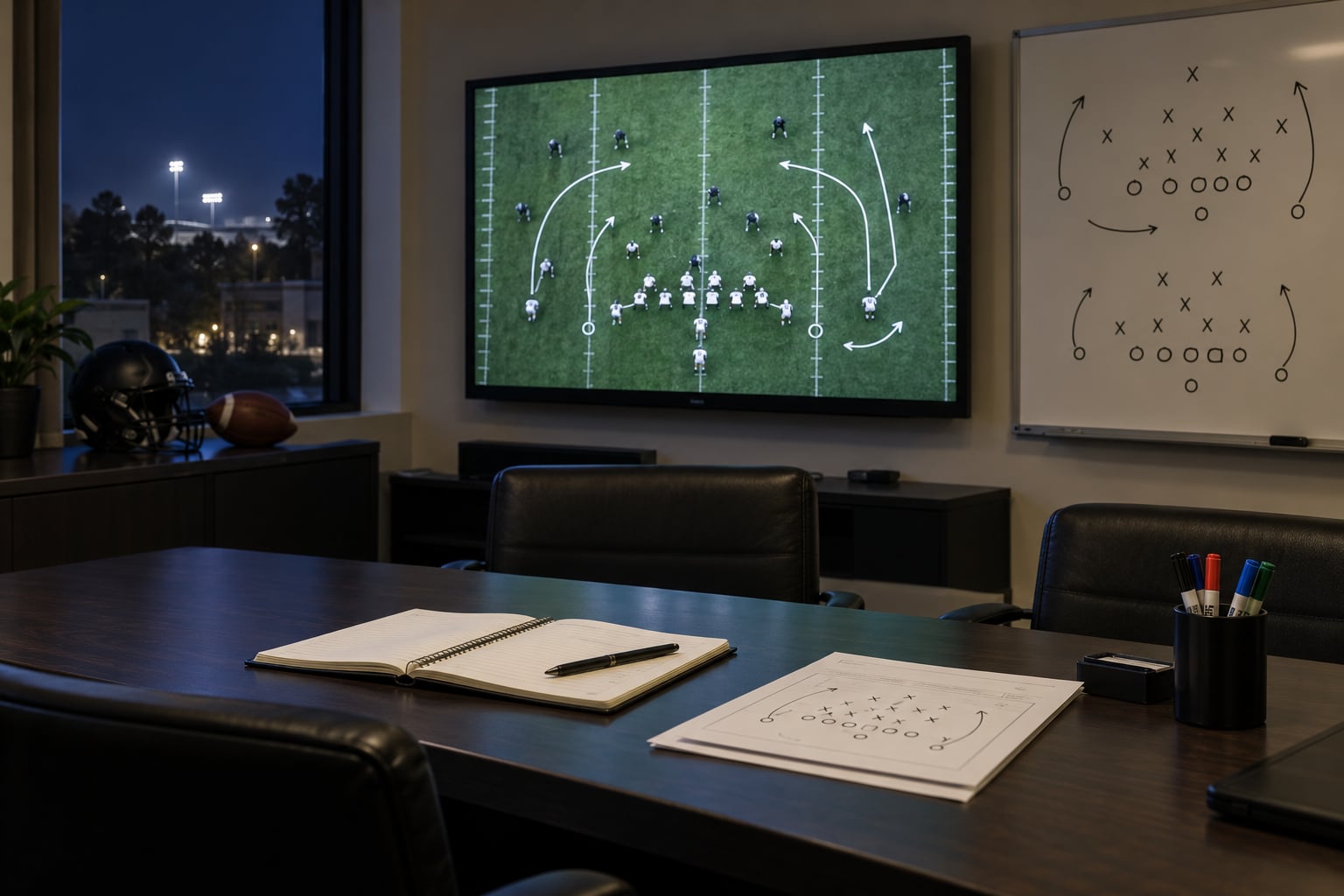
How college teams scout opponents is a weekly job built on film: a staff cuts every game a team played, watches it in passes, charts what recurs by down, formation and personnel, and writes down the handful of things most likely to happen on Saturday. Then coaches turn that report into a game plan. Film study is legal, encouraged and largely automated. Sending scouts to a future opponent’s game in person is not.
What follows is the version of that process a fan rarely sees, from the offseason pre-scout to the twenty minutes of in-game adjusting. It also covers who does the work, what actually gets written down, and where the NCAA rule line sits.
Table of Contents
- What College Teams Scout Opponents For, and How They Do It
- How Do Coaches Research an Opponent Before the Season?
- What Film and Data Do Coaches Study?
- How Do Teams Turn Scouting Reports Into a Game Plan?
- How Does Scouting Differ by Sport and Team?
- How Can Fans Read Scouting Clues During a Game?
- What Are the Limits and Ethics of College Opponent Scouting?
- Frequently Asked Questions
- What does a college scouting report include?
- How long does it take to scout an opponent?
- Who actually does the opponent scouting at a college program?
- How is opponent scouting different from recruiting a player?
- Is it legal for college teams to scout future opponents in person?
- Is stealing signs against the rules in college sports?
- Conclusion
What College Teams Scout Opponents For, and How They Do It
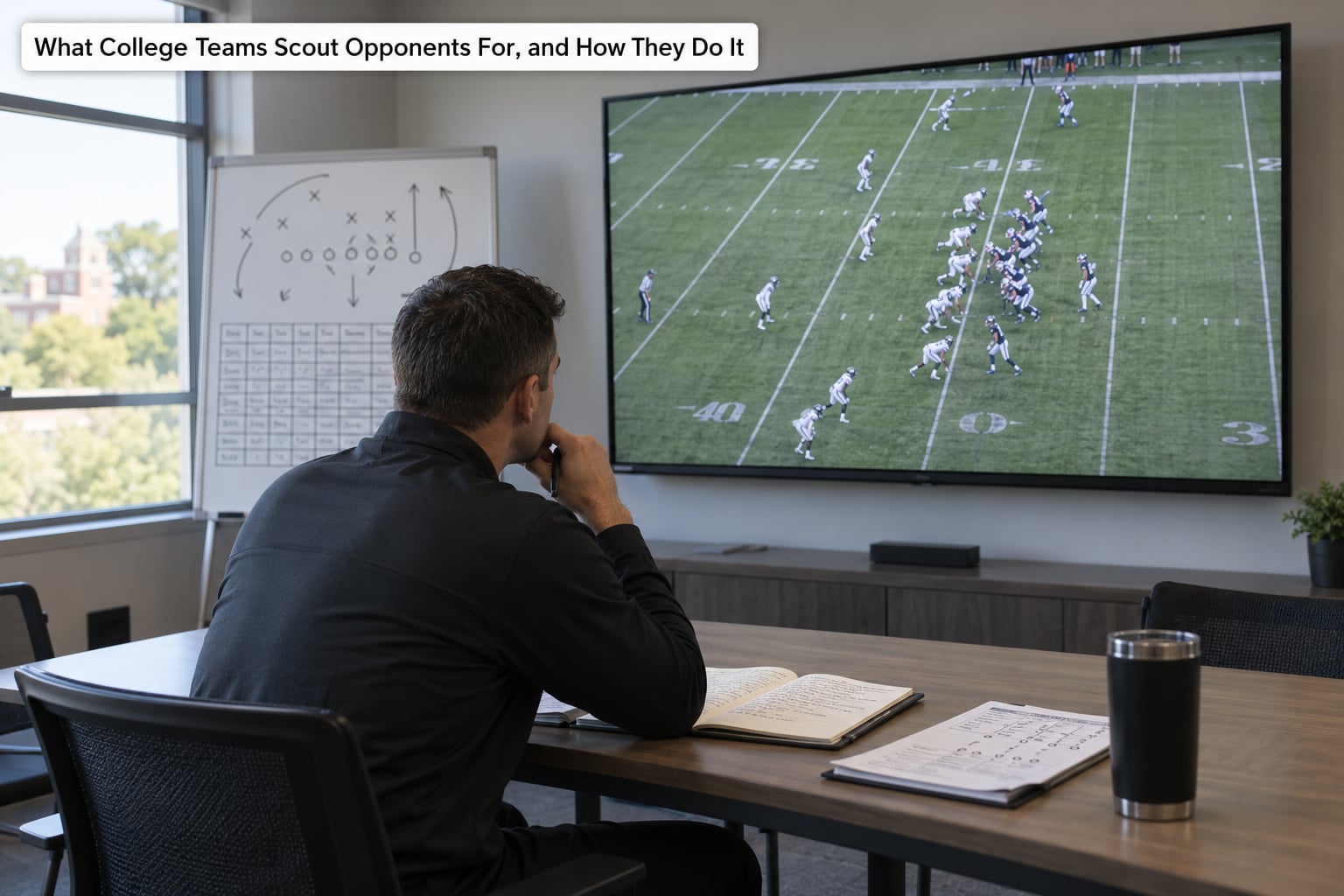
College programs scout an opponent by systematically breaking down game film, charting tendencies and personnel, and turning those findings into a written scouting report that coaches use to build the game plan. The goal is not to predict the opponent. It is to remove surprise.
Three different activities get lumped together under the word scouting, and mixing them up is the most common confusion in search results on this topic.
- Opponent scouting looks at the team you play next. Opponent tendencies, formations, coverages, personnel packages.
- Self-scouting looks at your own team from the opponent’s angle, grading your own execution and finding habits to fix this week.
- Recruiting scouting evaluates individual prospective student-athletes, with composite ratings, film grades and offer decisions. Different metrics, different staff, different purpose.
One thing all three share is film. Everything else is interpretation on top of film.
Who actually does the scouting
Nobody watches 12 games alone. The work is split across a staff, and it changes with resources.
- The head coach sets the standard for the week and reads the final report first.
- Coordinators own their side’s report, usually with a graduate assistant doing most of the tape.
- Graduate assistants are the workhorses: cutting film, logging snaps, building tendency charts, tagging clips.
- Video coordinators manage the archive, edit opponent and self-scout packages, and build player-specific cutups.
- Analysts in the athletic department supply numbers, split reports and opponent shot charts or coverage frequencies.
Coaches on smaller staffs collapse every role into themselves. One common pattern in the coaching forums: a coach grades his own players’ technique on Sunday morning before touching opponent work at all.
How Do Coaches Research an Opponent Before the Season?
Scouting starts long before the first game. A staff maps future opponents in the offseason, while the schedule is still soft and last season’s film is the only film there is.
What gets studied before competition starts
- Personnel and roster — returning starters, new starters at each position, position battles, transfers, injuries.
- Prior-season tendencies — formation frequencies, play types, coverage shells, blitz rates, personnel groupings.
- Coaching and system history — a new coordinator usually brings something recognizable from a previous stop.
- Schedule context — a team that ran a lot last year because it played a weak non-conference slate will look different in August.
- Recruiting footprint — a class heavy at one position usually shows up in the depth chart within a year.
Why personnel turnover wrecks last year’s chart
A tendency chart is only valid for the people on the field. When a coordinator leaves or a starting quarterback changes, most of the pre-season chart becomes historical trivia. The offseason pre-scout is best treated as a set of educated guesses that get thrown away once the first two games of real film exist.
What Film and Data Do Coaches Study?
How college teams scout opponents on film: three passes
The most-cited method among working coaches is deliberately boring. It splits the viewing into three passes rather than trying to catch everything at once.
- First pass, no notes. Watch the game straight through and just form impressions. What does this team look like? What does it want to be?
- Second pass, chart it. Log fronts, stunts, coverages and formations by down, distance and personnel grouping. Build running counts of repeat looks.
- Third pass, personnel. Identify which specific players make the scheme work and which ones opponents have already attacked. Coaches in these communities put it plainly: you are coaching against the kids, not the coach.
The point of three passes is avoiding film overload, the failure mode coaches complain about most. Watch once for feel, then watch again with a specific question.
Tendencies versus habits
A tendency is a play that shows up often enough to matter, usually with a frequency count attached. A habit is something a single player does out of instinct — a stance, a pre-snap gesture, a trigger word. Coaches care about both, but only tendencies can be drawn on a chart.
The numbers that go on the chart
Film supplies the mechanism, analytics supplies the frequency. In basketball the vocabulary is familiar: true shooting percentage, player efficiency rating, usage percentage, assist percentage, steal percentage, win shares, offensive and defensive ratings, and shot charts that show exactly where a guard drives or a forward shoots. In football the splits are situational: third down and long, backed up, facing a two-minute situation, or after a turnover, plus personnel groupings by down.
Video tagging platforms do the repetitive part. Hudl, Sportscode and Instat are the common names, and each lets a staff tag a clip once and then pull every play of a given type, which is why a full breakdown of one game usually lands somewhere between 90 minutes and three hours.
Self-scouting is a different question
The weekly self-scout asks what the opponent just watched on tape of you. It is short, unglamorous, and about your own execution: missed assignments, bad splits, communication failures, third-down sets that reveal a predictable formation.
How Do Teams Turn Scouting Reports Into a Game Plan?
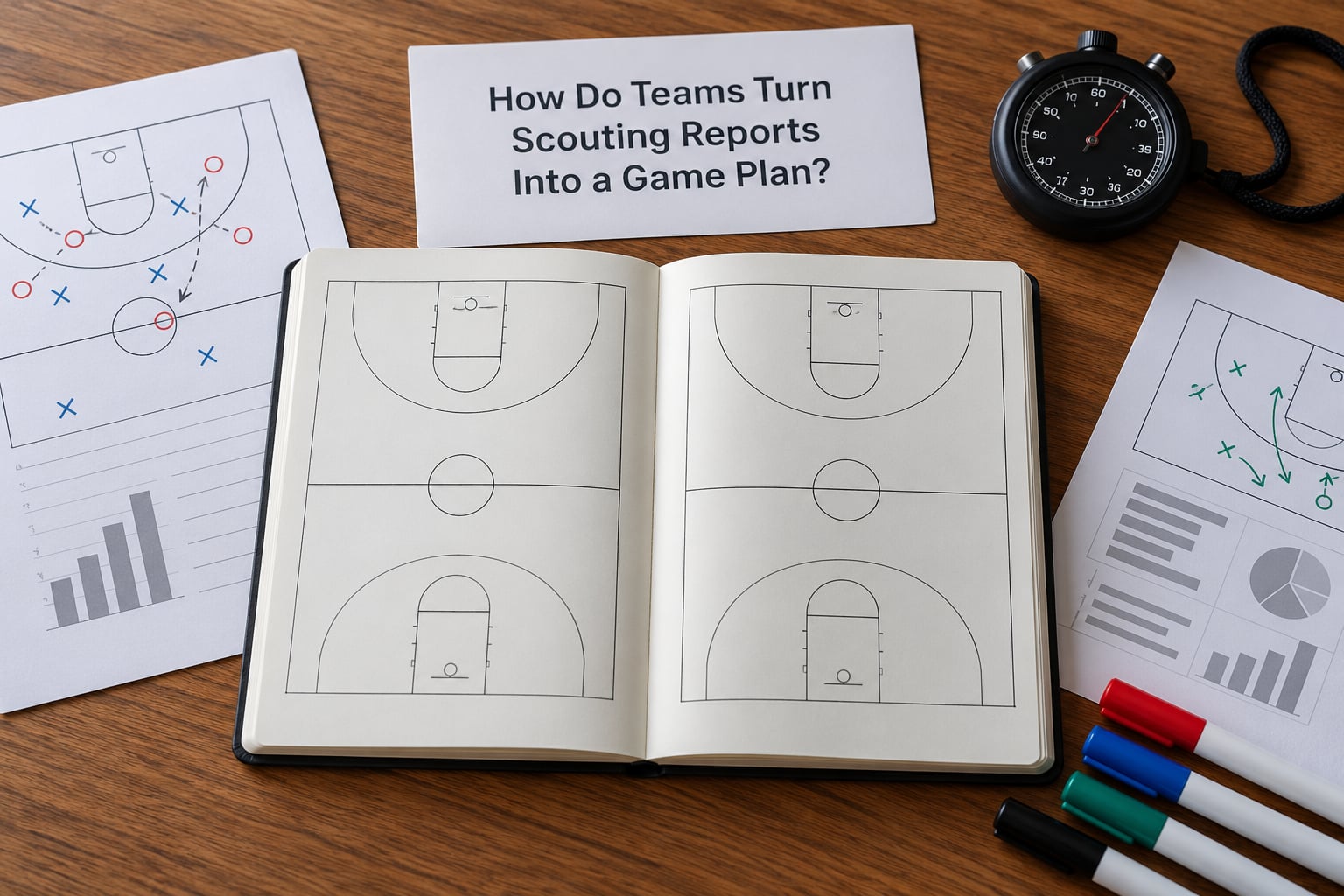
A scouting report that lists every observation is useless. The work of turning one into a plan is mostly deciding what to ignore.
- Rank the opponent’s problems. The staff sorts findings into what hurts them, what helps them and what is neutral.
- Match personnel, not scheme. The plan usually attacks a specific defender’s technique or matchup rather than a coverage concept in the abstract.
- Assign answers to specific players. Each defender or position group gets two or three concrete things to do, not a philosophy.
- Turn findings into practice reps. Scout clips become install items. The practice that matters most is the one built on what the opponent actually does.
- Set adjustment triggers in advance. If they show this front, if they use this motion, here is the switch — decided before the game rather than during it.
How the report reaches players varies by program. Small staffs hand out printed packets. Larger programs push short cutups, and practitioners generally keep player film tight, around 90 seconds, because a long clip does not get watched.
How Does Scouting Differ by Sport and Team?
Football and basketball are both film-first sports, but the unit of analysis differs, and that changes everything downstream.
| Scouting task | Football | Basketball |
|---|---|---|
| Charting unit | Formation, down and distance, personnel grouping, field zone | Action type, screen side, defender position, action number |
| Core question | What front and coverage show up, and from where is the blitz coming | Where do they get their shots and who guards whom |
| Key splits | Third down, backed up, short yardage, four-minute offense | Pick and roll coverage, transition defense, late clock |
| Main metrics | Success rate by down and distance, explosive plays, pressure rate, coverage frequency | Effective field goal percentage, turnover margin, offensive and defensive ratings |
| Typical breakdown time | Roughly 90 minutes to three hours per game | Similar, often trimmed to possessions that matter |
Baseball is built on a batter-pitcher matchup grid rather than formations. Soccer and volleyball tend to be observed live more often than on edited film, because spacing matters more than discrete plays.
Resource level matters as much as sport. A Division I staff with a full analytics department can hand coordinators a finished split report. A D-III or FCS coach with a laptop does the same job, just with fewer games, more self-scout and more Sunday-morning time.
How Can Fans Read Scouting Clues During a Game?
Most of what a coaching staff knows, you can see from the stands if you know where to look.
- Alignment and personnel grouping. Coaches count combinations because frequency predicts what’s coming.
- Pre-snap motion. Shifts, motions and cadence changes are the most honest indicator of the intended play.
- Coverage shell. How many safeties are high, whether the third defender is showing or rotating.
- Substitution patterns. Heavy rotation on offense often signals a specific personnel package that produced something last week.
- Bench and box usage. A defender who gets a rep in a specific alignment is being scouted for a reason.
- Play-call cadence. A long huddle after a previous first down often means the next call depends on what you just did.
Start with formation counts. If a team runs the same look fifteen times in three games and wins with it every time, that is not a secret, it is a chart waiting to be read.
What Are the Limits and Ethics of College Opponent Scouting?
There is a real rule line, and it is narrower than most fans assume.
- Prohibited. NCAA Bylaw 11.6.1 bars sending staff to watch a future opponent’s game in person in the same season. The NCAA investigated Michigan over exactly this in 2023, as CBS Sports reported.
- Prohibited. Using electronics to record or relay another team’s signals during a game.
- Generally permitted. Studying publicly available game film. Programs receive extensive film access ahead of matchups, and using it is encouraged.
- Permitted with constraints. Recruiting-contact rules limit when coaches may observe prospects in person.
Sign-stealing itself is not automatically a violation, which surprises people who assume it must be. The line is in-person observation of a future opponent plus electronics. Keep scouting to film and you stay nowhere near the issue.
Even within the rules, reports are incomplete by nature. They describe what a team did against available opponents, not what it will do against you. Coaches put it better than the charts do: tendencies are probabilities, not promises.
Frequently Asked Questions
What does a college scouting report include?
A college football report usually carries the opponent’s base and secondary fronts, coverage shell, formation frequencies, down-and-distance splits, personnel groupings, blitz origins, run fits and the personnel notes coaches actually build a plan around. Basketball reports lean on action types, shot charts, pick and roll coverage habits and matchup assignments. Both end with a short list of things to do about it.
How long does it take to scout an opponent?
Most breakdowns land between 90 minutes and three hours per game with a full staff and tagging software. Add the early watch, the written report and player cutups, and a single opponent is realistically a week of accumulated time. Smaller programs stretch the same work across more days and cut it down to two or three games a week.
Who actually does the opponent scouting at a college program?
Coordinators own their side’s report, graduate assistants cut and tag the film, video coordinators assemble clips and self-scout packages, and department analysts supply split data and shot charts. The head coach reads the finished report and sets priorities. On a small staff, one coach does all of it, usually starting with grading his own players first.
How is opponent scouting different from recruiting a player?
Opponent scouting examines a whole team: formations, tendencies, personnel packages and scheme. Recruiting evaluation examines individual prospects and produces a rating, a film grade and an offer decision. A coach can scout five opponents a season and recruit three hundred players, and the two reports look nothing alike once written.
Is it legal for college teams to scout future opponents in person?
No. NCAA Bylaw 11.6.1 prohibits off-campus, in-person scouting of future opponents during the same season, which is the rule the NCAA invoked when it investigated Michigan over alleged in-person scouting before a game against a future opponent. Studying game film already obtained is fine. Using electronics to record or relay signals during a game is not.
Is stealing signs against the rules in college sports?
Watching an in-game signal with your own eyes is not prohibited by the NCAA. The problem is the method: sending staff to watch a future opponent in person violates Bylaw 11.6.1, and recording or relaying signals with electronics during a game is separately prohibited. So the act is not the offense, the method usually is.
Conclusion
Scouting is preparation, not prediction. A staff watches film in passes, charts what recurs, cross-references the numbers, filters to what is most likely to happen, and turns that into a written report coaches install during the week.
If you want to read the same clues they do, start with one opponent and three things: their base formation, their most common personnel grouping, and what they do on third down and long. Count the looks across three games. After that, the tendencies write themselves, and the game plan stops looking like guesswork.