A pass rush move is a named, repeatable path a defensive lineman or linebacker takes on a passing down, built from a first step, a hand placement, and a body angle that gets him to the quarterback. Rushers work outside around the tackle, inside through the guard’s shoulder, or straight ahead with power. Every one of them is designed to answer something the blocker just did.
That is the short version, and it is the whole ballgame: a pass rush move is a plan for beating a set. Below is what each piece means, why the protection rules shape everything a rusher can legally do, and how to recognize a move on film the next time you watch a game.
Table of Contents
- What Is a Pass Rush Move?
- Why Protection Rules Matter
- How a Pass Rush Changes the Protection
- Which Positions Are Usually Involved?
- What Are the Most Common Pass Rush Moves?
- How Do Quarterbacks and Blockers Respond?
- How Can You Tell Whether a Pass Rush Is Working?
- How Can Players and Coaches Learn These Movements?
- Frequently Asked Questions
- What does a line drop mean in a pass rush?
- Are stunts and twists the same pass-rush move?
- Why are five defenders allowed in a pass-rush lane?
- Does a pass-rush move require the ball carrier to be involved?
- How do defensive coordinators disguise a blitz?
- Can youth football players safely practice pass-rush moves?
- Conclusion
What Is a Pass Rush Move?
A move is different from raw talent. Talent decides whether a rusher can win his one-on-one; the move decides what he is going to try. A 250-pound defensive end with average quickness still creates real pressure if he has a plan for how to get past a set tackle.
Every pass rush has three goals, in order of usefulness: get a sack, disrupt the quarterback’s timing so the down ends without a completion, and knock down his confidence so later snaps feel slower. Teams that only chase sacks get odd personnel on obvious passing downs and give up easy completions. The rush works when it makes the quarterback’s read wrong before it makes him uncomfortable.
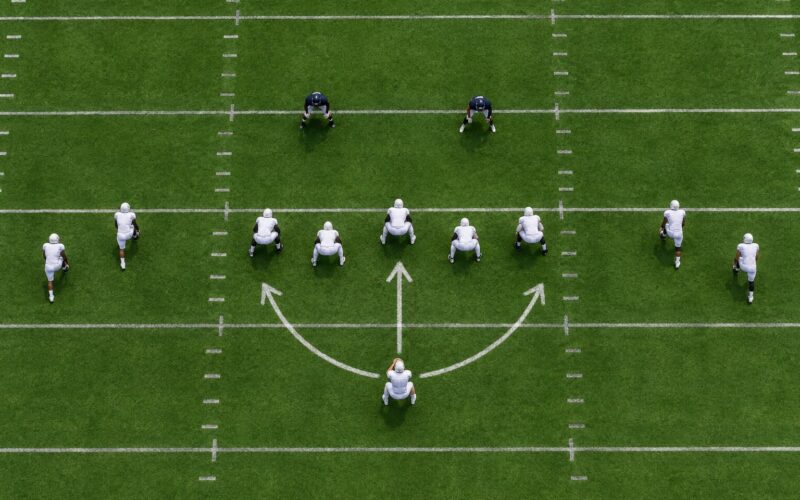
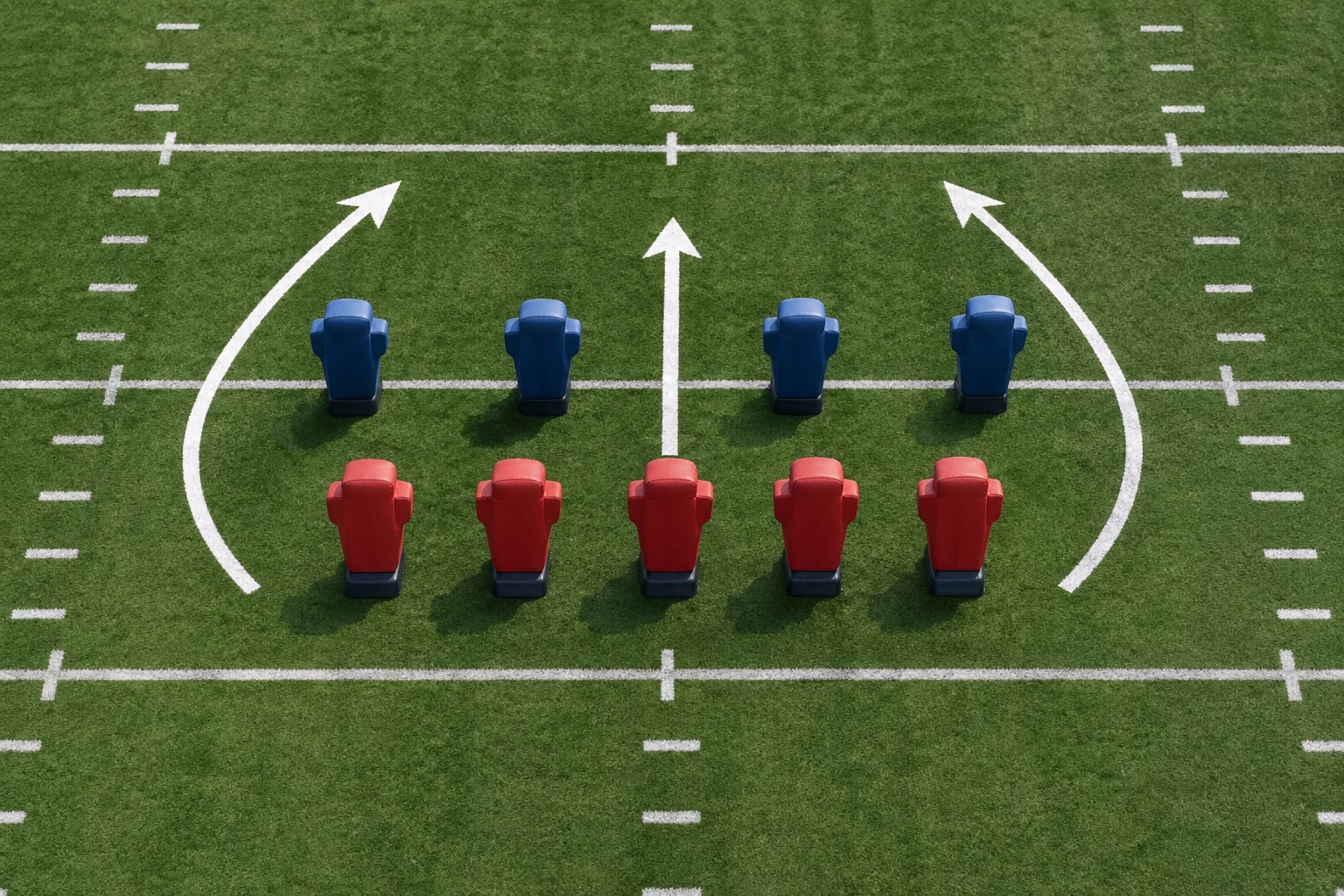
Moves sort into three families, and that split explains almost everything about how a rush plays out:
- Outside moves go around the offensive tackle’s outer shoulder — the speed rush and the contain rush are the clearest examples. They produce the highest speeds and the widest angles around the blocker.
- Inside moves go through the guard or around the tackle’s inside shoulder — the dip, the swim, and the rip all end up in the middle of the pocket.
- Power moves drive straight through the blocker’s chest — the bull rush and the club move. Slower to develop, harder to shed.
The reason the inside family stays slower comes down to geometry. An outside rusher travels around a body, where his length helps him. An inside rusher has to get into the blocker’s body, where he is competing with the other man’s length instead of his own. Analysts who have tried to classify rushes by charting data keep finding the same split: outside rushes finish at higher speeds and wider angles, inside rushes and bull rushes finish slower and tighter.
There is a second way to rush, and it is worth separating from a move. A move-based rusher has a predesignated path. A read-based rusher has no move until he sees the blocker’s set, which is why two-way go and Rex style calls exist. We’ll come back to those.
Why Protection Rules Matter
You cannot fully explain how pass rush moves work in football without the rules that limit them, because the rules decide which lanes are open before a single player moves. Three constraints shape every snap.
The first is the restricted zone. Defenders cannot make contact with an offensive lineman’s back area before the ball is released. No hitting the quarterback’s head area at all. That is why rushers have to win with angle and hand position instead of a running start into the quarterback’s back.
The second is the four-man rush limit. Four defenders can be lined up behind the line of scrimmage in pass-rush positions on a given snap. Anything beyond those four is a blitz, and every extra rusher removes a blocker. A corner pressing a slot receiver is not counted against the four.
The third is the two-hand, five-feet benchmark. A rusher must have his hands on the blocker and contact the blocker within five yards of the line of scrimmage to be a legal rusher and keep rushing. Blow past that distance without hands and the play is a blow-by rusher who has lost the right to continue.
| Rule | What it limits | How it shapes a pass rush move |
|---|---|---|
| Restricted zone | Contact behind the offensive lineman’s back number before the throw | Forces rusher to win with path and hands rather than free pursuit |
| Four-man rush | Defenders behind the line in rush positions | Any fifth man must be a blitz, which buys pressure with a protection risk |
| Two hands, five feet | Rushers who drift without contact | Makes commitment mandatory, so a move is either executed or it is over |
One more constraint shapes the quarterback side: the running back can stay in pass protection and block a rusher, but he must report that he is staying in. That single report is why a defense has to account for an extra body on every snap.
How a Pass Rush Changes the Protection
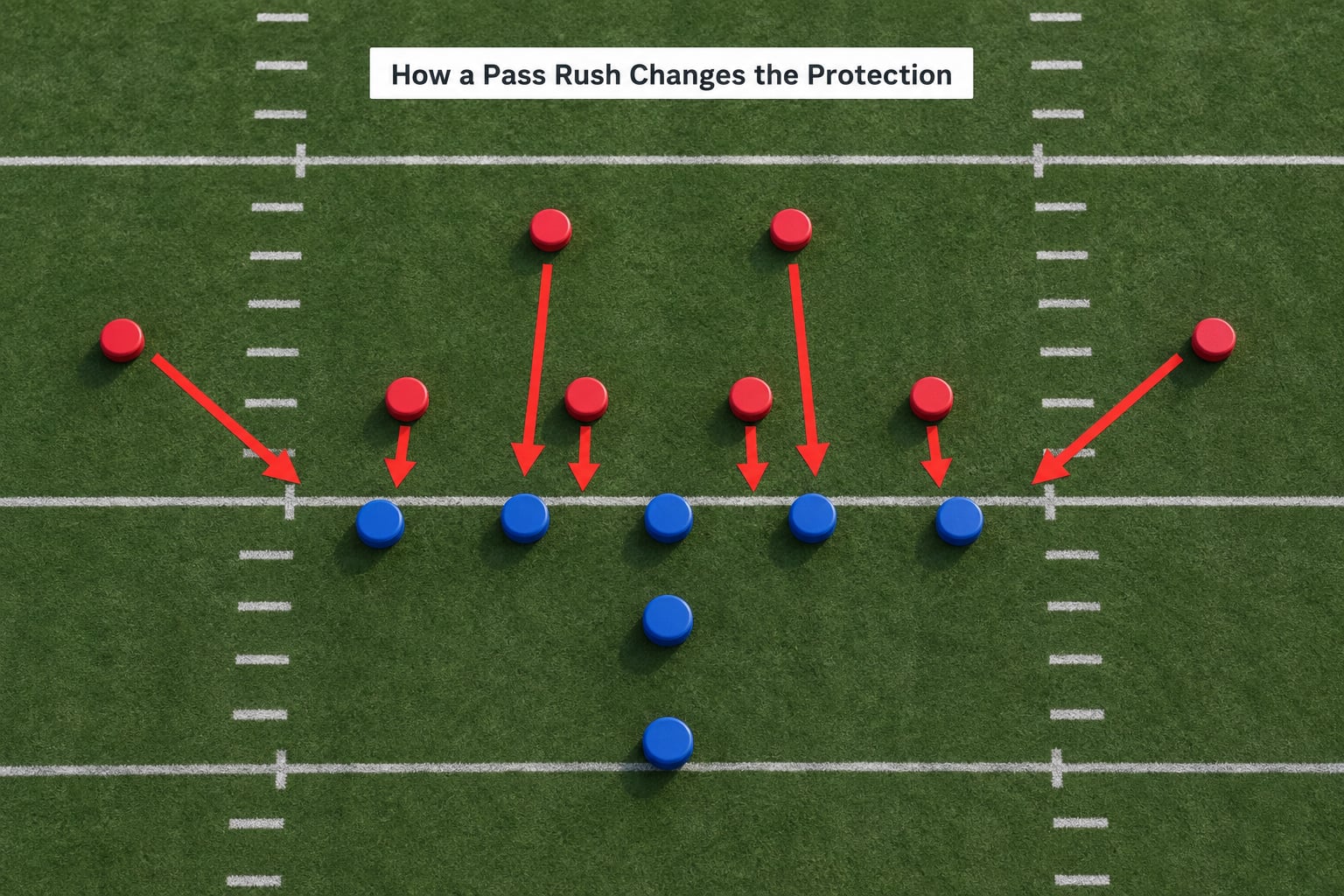
A coordinated rush works because the offense has to answer all of it at once. A move only matters in context of what it does to somebody else’s assignment, so it helps to separate a rush into four phases.
How Pass Rush Moves Work From the Line to the Quarterback
Setup. The formation and the front decide the lanes. An edge rusher aligned wide might have a contain lane if a safety is deep, or a free green grass if that safety is cheating inside. One defender’s alignment can hand a lane to another, which is the entire reason stunts exist.
First action. The first step and the hands tell the blocker which of the three families is coming. A rusher who shows his hands inside is telling the tackle he can set and wait. A rusher who leans his shoulder outside is telling the tackle to over-pursue. This is the moment film readers should study, because the first two steps reveal the move before it finishes.
Second action. The rusher either turns the corner, drives through, or continues reading. A turn-the-corner move ends here. A read-based rusher is still deciding, and that hesitation is the tell the blocker and the quarterback both react to.
Release. The quarterback’s escape, a checkdown, or a completed pass ends the rush. Rushers who are still attached at this point are rarely finishing.
Coordinators who study this footage get the picture quickly: a move is not really about the rusher. It is about pulling a particular blocker’s hands or feet in a direction, which changes what the protection looks like for the three other rushers behind him.
Which Positions Are Usually Involved?
Each position brings a different default move, because each is matched against a different body.
Defensive ends face the offensive tackles, the longest and most technique-oriented blockers on the field. Ends rely on outside speed, the swim over the top, and enough power to bull rush when a tackle sits too wide. Ends also carry the contain responsibility in many schemes, which is a real tension: the same rusher who wants to go outside has to respect the wide lane.
Outside linebackers often get the same matchup but from a different alignment, and they are more likely to be told to execute a designed move rather than read one. In a 3-3-5 or a nickel look, an outside linebacker lined up over the tight end may be sent on an edge rush or a contain-and-return, depending on how the safety is playing.
Inside linebackers work against guards, who are shorter, sturdier, and better suited to the vertical set. Inside linebackers get less angle around a blocker, so their tools are the dip, the stab, and blitzing into gaps. When a guard has to pass off inside pressure, the whole middle of the protection loosens.
Safeties rarely rush as primary pass rushers, but a safety show is a standard disguise. When a safety shows blitz and then drops into coverage, an offensive tackle who respected the show has already lost a step of pursuit.
Nose tackles face the shortest, most powerful blockers on the field and win by working vertically. Their moves are less about angle and more about getting a hand under the chin, staying low, and driving legs. Interior pressure matters because it collapses the pocket and forces throws that a rusher on the edge cannot.
A note on terminology that trips up even experienced fans: a swifter is a defensive back who blitzes and is expected to drop into coverage after the rush. Coaches argue about the naming of swim, dip, and duck under, and a lot of that disagreement is just two coaches describing the same movement differently. When you see the terms in a playbook, read them as path descriptions.
What Are the Most Common Pass Rush Moves?
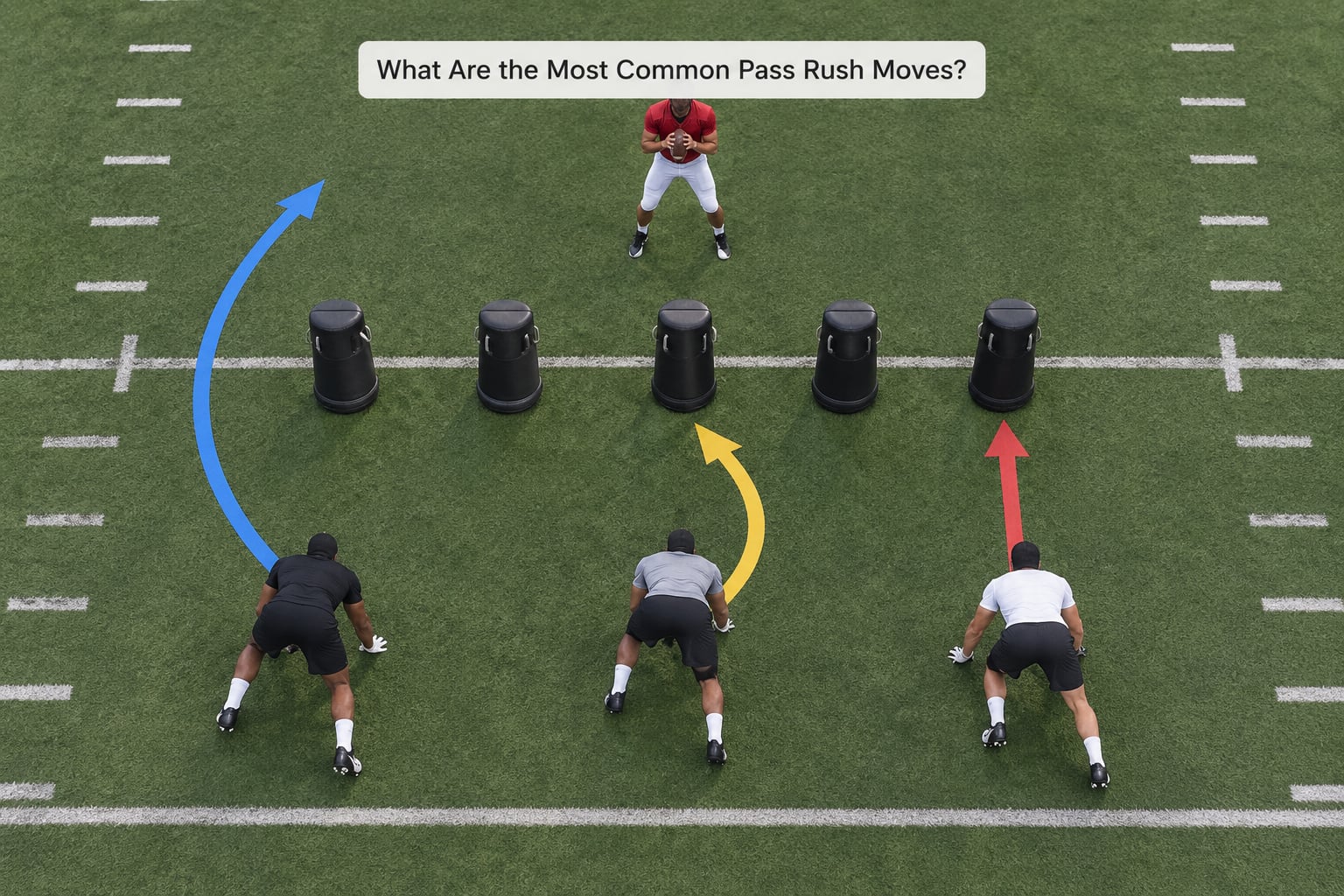
Here is the reference view. The path column tells you where the rusher is trying to end up, and the counter column tells you why a move that worked on one snap fails on the next.
| Move | Path | Primary Skill | Best Against | Difficulty | Typical Counter |
|---|---|---|---|---|---|
| Speed rush | Straight up the outside edge | First-step speed | A tackle who sits and waits | Low | Vertical set with a flat punch |
| Outside contain | Up the edge, then hold | Discipline and lane awareness | Any protection that needs a defender outside | Low | Blocker holds to the inside lane and can seal |
| Bull rush | Straight through the blocker | Low pad level and leg drive | A blocker who is light in the hands | Medium | Anchor with a wide base, shed with hands |
| Swim | Over the top of the blocker | One-arm power, hip turn | A blocker who sets wide | Medium | Hands to the inside, punch under the arm |
| Dip and duck under | Low and inside, under the blocker’s arm | Body control, leverage angle | A long blocker leaning over you | Medium | Hands up, punch the chest, then recover |
| Rip | Under, then explode laterally | Explosion off the low path | A blocker who chases low | Medium | Recover and re-engage with power |
| Club move | Sideways swat, then turn the corner | Hand strength at the shoulder | A blocker waiting on the hands | Medium | Tapered forearms, punch and recover |
| Cross-chop | Hands chop down and across | Grip strength and hand placement | A blocker whose hands are high | Medium | Get hands low and inside first |
| Inside counter | Two steps, then strike inside | Explosion off the second step | A blocker who sets too narrow | Medium | Punch forward, mirror inside |
| Inside stab | Short, direct shot at the blocker’s midsection | Low pad level | A blocker who over-pursues outside | Medium | Square up, anchor and shed |
A few of these deserve the extra sentence. The bull rush versus speed rush debate comes down to the blocker’s hands: the speed rush wins when a tackle’s hands are late, and the bull rush wins when a tackle’s hands are already inside your chest. Rushers who learn to switch between them based on the set get more production than rushers who only own one.
The rip is the move most often taught in isolation and least often explained. It is a dip that ends in an explosion sideways, which is why it punishes a blocker who chases the low path. Its weakness is recovery: if the blocker stays square, the rip has nowhere to go.
The swim is an outside move that finishes inside, which is exactly why it beats a wide set. The blocker has to choose in the first instant between setting outside for the speed rush and getting his hands inside for the swim. Choosing wrong is the whole point.
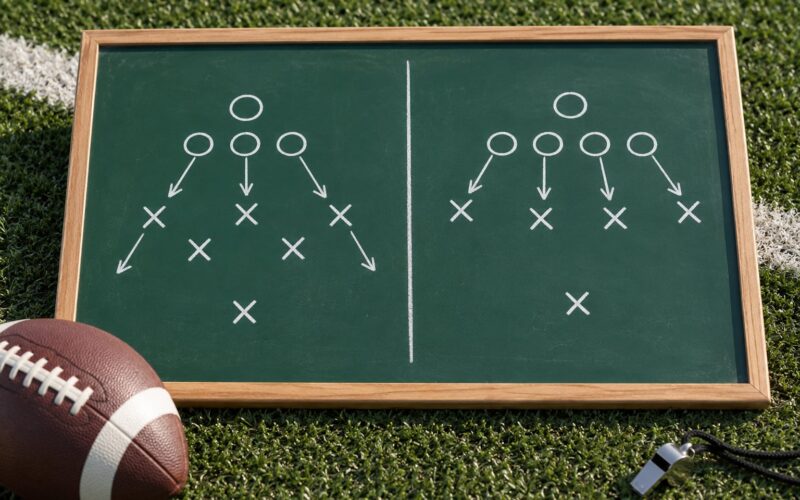
The drop and the line drop are moves rather than individual techniques. A line drop sends a defender backward off the line before the snap so a linebacker can attack an uncovered gap and the dropped defender can fill. A twist sends two defenders on crossing paths, with the second rusher arriving as the first blocker’s hands are displaced. A game simply substitutes one rusher’s assignment for another’s, keeping the protection honest while changing who is actually coming.
How Do Quarterbacks and Blockers Respond?
Blockers counter by making their set look like the move they want to see, then adjusting when it does not arrive. A tackle who shows a vertical set with hands on his knuckles is punishing a speed rush and giving a swimmer nothing to swat. If the rusher comes inside anyway, the tackle meets him square, keeps a wide base, and sheds with the hands rather than the arms.
The quarterback’s response is built into the protection. Slide protection toward a hard outside rush and let the rusher have the edge, then throw inside to the running back in the flat. Hot reads pre-designate a blitzer so the quarterback can throw before pressure arrives. Protect the middle and the quarterback is forced wide, where the rushers already are.
Here is the part that surprises people: a counter does not end the rush. Anchoring and shedding is a reset, not an escape, and most counters put the rusher back in front of the same blocker with the quarterback still standing there. A successful counter wins the first two seconds and hands the second two to somebody else.
How Can You Tell Whether a Pass Rush Is Working?
Sack totals are the worst possible measure, because a good rush often ends with a quarterback who never throws. Watch for these instead:
- The quarterback hesitates before the pocket is full and resets his feet when nobody is near him.
- Pressure arrives up the middle, which collapses passing windows that a wide rush leaves open.
- The protection visibly shifts: linemen widen their sets, a running back stays in, or the quarterback slides away from one side.
- The quarterback releases the ball earlier than the receiver is ready, which shows up as a short throw or a throw away from a hot route.
- The ball comes out on a downgrade, which is pressure doing its job even without a hit.
The pattern to avoid is reading a rush that produced no sacks as a failure. A defense that forces a third-and-long on early downs wins that series on its own terms.
How Can Players and Coaches Learn These Movements?
The gap in most football content is that clips show the move without diagnosing it. Fix that by studying the same way coaches do, and the order matters.
Film study, first. Watch a tackle’s feet on the snap before you watch anything else. A set means both feet are on the ground and his hands are positioned to deliver a punch. A vertical set means he is balanced to block up. Leaning means he has committed to a direction. From that read alone you can usually predict the move a rusher should be running, and when you watch that rusher, you know whether he read it correctly.
Walkthrough. Run the movement at quarter speed with no contact, focusing on where the hips and hands go before power is added. Most failed moves are a hips-and-hands problem long before they are a strength problem.
Controlled reps. Put a hand or a bag against a live blocker. No headgear contact, full supervision, and stop the rep the moment the form breaks. The bag drill teaches the low path of a rip, and the hand-check drill teaches the club.
Full speed last. Only then run the move against a live blocker, and only then add the read. Starting at full speed teaches players to guess.
For youth players, the order most coaches settle on is speed rush, then the two-way go, then the dip, then the rip and the bull rush. Speed and the two-way go build confidence and awareness, the dip teaches an angle, and the rip and bull rush need enough body control to be safe. Holding the inside line and reading blocks before adding moves is the safer progression in my view, because the leverage a young player has is worth more than a move they cannot control.
Drills for a specific look: a hand-clap swim drill against a mirror, a mat work for the dip, a low pad-level drill for the bull rush, and a reaction drill where a coach points left or right and the rusher must convert from whatever move he started. For video game players, the same ideas show up in the artificial intelligence of a simulation, and asking whether the AI handles stunts and twists better than the user rushing is a legitimate way to build the habit of reading a plan rather than mashing a button.
Frequently Asked Questions
What does a line drop mean in a pass rush?
A line drop sends a defensive lineman backward off the line of scrimmage before the snap. It removes him from the immediate rush and creates a running gap that a linebacker can attack, while the dropped player fills behind the rush. It is a way to generate pressure without adding a fifth rusher, and it works best when the front is aligned in a way that leaves a real seam.
Are stunts and twists the same pass-rush move?
No. A stunt sends two rushers in a simple exchange, with one sliding across and the other taking his lane. A twist is a two-man rush where the second rusher passes underneath and arrives as the first rusher’s hands displace the blocker, so the block ends up misaligned. Both are coordinated movement plays rather than individual techniques.
Why are five defenders allowed in a pass-rush lane?
Five defenders can rush the quarterback, but only four can be lined up behind the line of scrimmage in pass-rush positions at the snap. A fifth rusher has to come from somewhere, usually the second level, which makes it a blitz. Each extra rusher forces a protection adjustment, so the quarterback trades blocker help for pressure.
Does a pass-rush move require the ball carrier to be involved?
No. A pass rush move is a body path a rusher takes against a blocker, and the ball carrier has no part in it. What the ball carrier changes is the protection. A running back who stays in to block can remove a rusher or create a chip that resets the rush, but the move itself only involves the rusher and the player blocking him.
How do defensive coordinators disguise a blitz?
The standard method is the show. A linebacker walks up to the line of scrimmage, a safety creeps into the box, or a defensive end widens his stance, and the offense has to adjust its protection and its running back’s assignment. If the coverage holds, the rusher drops back into a zone or underneath route, which makes the show free.
Can youth football players safely practice pass-rush moves?
They can, and they should be taught the safe ones early: speed rush, a two-way go, and the dip. Full-speed contact reps and power moves belong with coaches supervising contact. Watch for a low pad level, keep reps short, and stop as soon as a player is landing with a bad head position or a bent back.
Conclusion
Pass rush moves work through timing, deception, and assignment, not through a secret technique nobody else has. Every move is an answer to a blocker’s set, and every coordinated rush changes the protection for the people behind it.
Learn the protection rules first — the four-man limit, the two-hand benchmark, the restricted zone. Then learn to read a set in the first two steps. Everything else, from the speed rush to the rip, hangs off those two skills, and it will make watching the game a lot more fun in 2026.