If you have ever watched a Navy or Army game and lost track of which back actually had the ball, nothing was hidden from you on purpose. How triple option offenses work comes down to one strange idea: two defenders are deliberately left unblocked, and what those two defenders do decides who carries the ball on every single snap. Once you can see those two players, the rest of the scheme gets much easier to follow.
Below is the version of the explanation I wish I had before my first service-academy game, with the jargon defined the first time it shows up and one full snap walked through from formation to tackle.
Table of Contents
- What Is a Triple Option Offense?
- How Triple Option Offenses Work
- The Three Main Running Options
- What Is the Quarterback’s Read in the Triple Option?
- The Roles of the Quarterback and Running Backs
- How the Blocking Scheme Creates Running Lanes
- How Defenses Defend the Triple Option
- Triple Option Variations Used in College Football
- A Play-by-Preak Example of the Triple Option
- Why the Triple Option Is Difficult to Stop
- Quick Glossary for New Fans
- Frequently Asked Questions
- What are the three options in a triple option offense?
- How does the quarterback read the triple option?
- Why is the triple option hard to defend?
- What is the difference between a triple option and a wishbone offense?
- Can a triple option offense throw the ball?
- What positions are most important in a triple option offense?
What Is a Triple Option Offense?
A triple option offense is a run-first system in which the quarterback reads two unblocked defenders and has three choices on every snap: hand the ball to the dive back, keep it himself, or pitch it to a back coming from the weak side. It is the most popular form of veer offense, and its whole identity comes from reading rather than out-blocking a bigger defense.
The word “triple” counts the decisions, not the runners. Some option systems have one option and one unblocked defender. A double option has two. This one has two unblocked defenders and three possible outcomes, which is why the quarterback’s head is doing most of the work on every play.
How Triple Option Offenses Work
How triple option offenses work in one sentence
Two defenders are left unblocked on every triple option snap. They are called the give key and the pitch key, and together they make up what coaches call the pointe series, the pair of players sitting at the edges of the offensive backfield. Because nobody blocks them, their only job is to remove themselves from the play. That is the whole trick: the offense uses two defenders as its own aiming system.
When the offense commits five blockers to the interior and leaves those two edges alone, the blocking scheme usually creates a numbers advantage. The interior linemen can pick a rule and hit it. Their blocking assignments do not change based on what the defense does, which means they are not being asked to guess.
Meanwhile the defense has committed eight players to stop a run and two players who have been told, essentially, to do nothing but read. If the pitch key sits still and watches the quarterback keep, the keep lane grows. If he closes downhill, the ball goes to the weak-side back. Either way the defense supplied the decision.
Most versions add a fourth layer. The dive back, the quarterback, and the weak-side back all read the give key before reacting, so the backfield moves like a single unit. In game threads on r/CFB and r/NCAAFBseries, fans describe the satisfying part as exactly that: the whole backfield hesitating together, then exploding in the same direction.
The Three Main Running Options
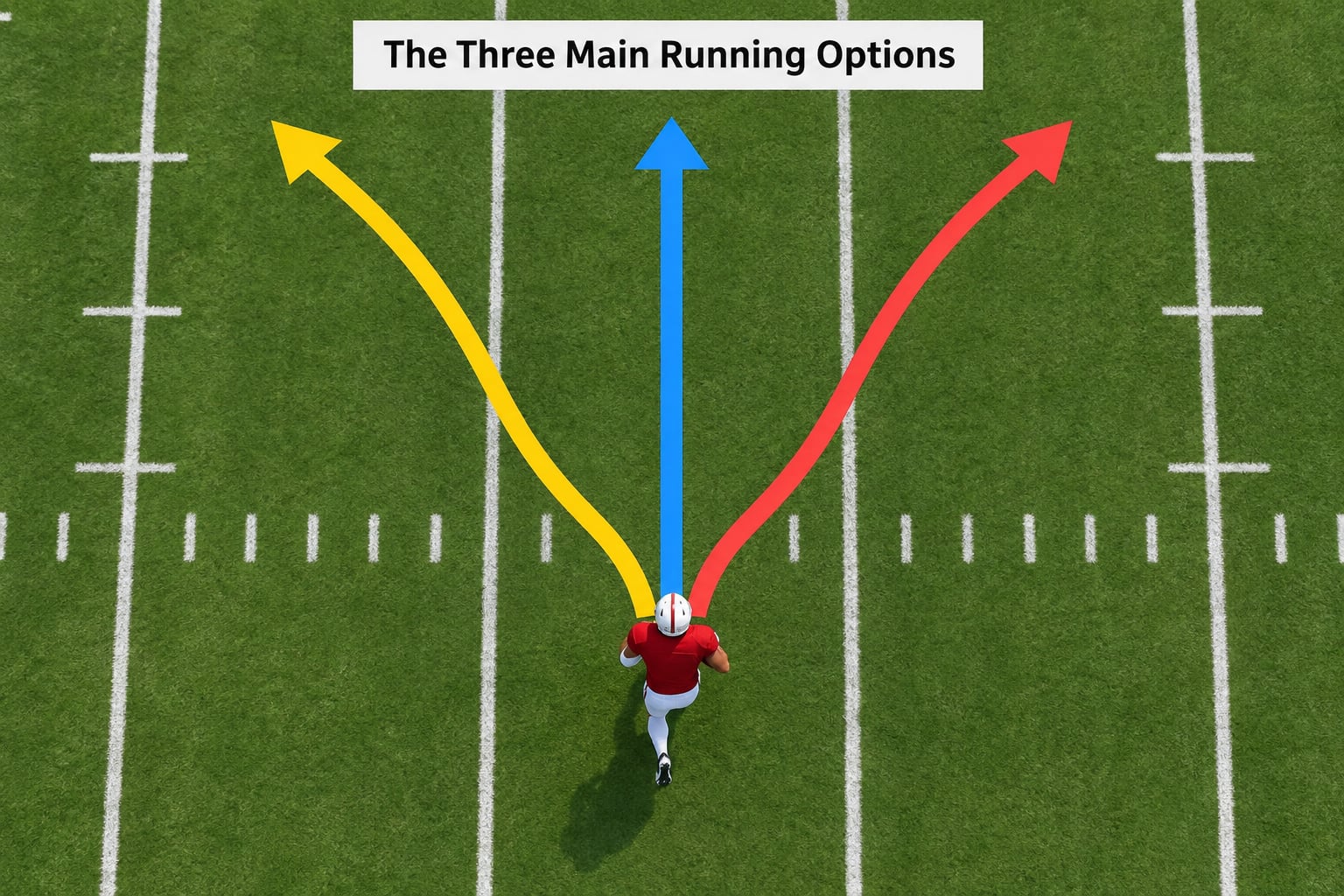
The three options are the dive, the keep, and the pitch. Every triple option play starts with the dive decision, then moves to the keep-or-pitch decision, and the ball carrier in each case has a different job once he has it.
In the table below, “the read” column is the defensive player the quarterback is actually looking at. That is not a detail, because it explains why the defense cannot just chase the runner.
| Read | Ball carrier | What the quarterback reads | Typical result |
|---|---|---|---|
| Dive | Dive back, usually a fullback coming from behind the quarterback | The give key: the defender sitting in or near the dive lane | A few yards, on schedule |
| Keep | The quarterback | The give key again, after the shoulders and hips commit | Off-tackle gains running into open space |
| Pitch | The A-back, arriving from the weak side | The pitch key: the unblocked defender at the edge of the box | The longest run, usually into a thin part of the defense |
A quick note on why three yards matters. Fans regularly ask why a team would celebrate a 3-yard fullback run, and the answer is drive math. If a team gets first down on every third down starting from its own 25, it simply does not hand the ball back. Search forums have this exact confusion, and the phrase coaches use for it is “on schedule”: you are on schedule if your next down is first and 10. Slow, reliable gains are the product, not an afterthought.
What Is the Quarterback’s Read in the Triple Option?
The quarterback reads the give key first, then the pitch key. If the give key commits downhill into the dive lane, the quarterback hands off. If the give key stays flat or turns his shoulders toward the dive back, the quarterback keeps it, because that defender has removed himself from the keep lane. Only after the keep does the pitch key come into play, and only if that second defender is closing on the quarterback.
That second read is why defenses cannot just attack the fullback. Commit to the dive and the quarterback keeps behind you. Keep chasing the quarterback and the pitch runs behind the entire front. Each of the two unblocked defenders can single-handedly open one lane by moving in the wrong direction, which is a genuinely unusual defensive problem.
Watch for the small details that betray the read. A give key who squares his shoulders to the dive back before the quarterback decides has just lost the keep. A pitch key who looks at the quarterback instead of the backfield has lost the pitch. Commentators describe one as “turning his shoulders” and the other as “sitting down,” and those two phrases cover most of what is happening.
The Roles of the Quarterback and Running Backs
The quarterback is the runner who is also the decision maker, so his job is timing and deception rather than power. He takes the snap, gets his eyes in the right order, and either plants the ball into the dive back’s belly, keeps it, or extends it to the pitch back before the pitch key arrives. A late or lazy pitch is how these plays get lost.
The dive back is the reason the quarterback can read anyone at all. He lines up directly behind the quarterback and takes the handoff. If the give key is cheating toward him, the quarterback never gives the ball and the dive back is a decoy and a blocker on the keep.
The A-back is the pitch back. He lines up on the weak side, often behind or beside the tackle, crosses behind the quarterback, and waits for a pitch rather than a handoff. Coaches count the timing of that exchange in tenths of a second, because an A-back who is early runs into his own quarterback and an A-back who is late gets caught from behind.
The H-back is the flexible piece. In the wishbone version he is a fullback in the formation, and in the flexbone version he is often a slotback who can block, carry the ball, or align wide as a receiver. That flexibility is why formations change the reads, which brings up the personnel names.
How the Blocking Scheme Creates Running Lanes
Blockers in this scheme are assigned rules rather than defenders, so they can build a lane without knowing how the defense is playing. The three basic techniques are pull, scoop, and cut blocks. A pull block sends a blocker across the formation toward the play side, a scoop block sends him vertically into an interior defender, and a cut block puts him low in front of a back who runs behind him.
Trap is the inside cousin of the cut block. The backfield thinks it is running one direction, a lineman pulls the other way, and the defense that committed to the first read ends up chasing from behind. Play action, counters, and Rocket Toss all borrow this idea at different speeds.
The two unblocked defenders matter to the blocking plan too, not just to the quarterback’s read. Since the pitch key is unblocked, the offense knows in advance that the weak side is being defended by one man if he crashes. If he does not crash, the offense has an extra blocker available to insert, and the run gains width. Either outcome is planned for, which is what lets the play survive a defensive front the offense has never seen.
How Defenses Defend the Triple Option
Defending the triple option is less about winning individual blocks and more about winning the decisions. The goal is to make one of the three reads a bad idea and force the offense to run it anyway. Here is how the job usually gets done.
- Take away the dive. Crease the give key into the fullback’s path. If the dive is dead, the quarterback keeps more often, and keeps are easier to contain.
- Disciplined give key. Stay out of the give lane unless the ball comes to you. Overcommitting to the dive removes you from the keep, which is the point of the play.
- Disciplined pitch key. Either crash decisively or do not crash at all. Half-committing gives the offense a free lane with no defender in it.
- Pursue downhill. The play’s speed comes from misses, not from blocking. The defense’s job is to make the runner start behind the line.
- Keep the pitch honest. The common belief that a stacked box kills the triple option usually produces a pitch to an uncovered cornerback. The eight who commit to the run should not abandon their leverage.
- Make it a passing down. The most reliable counter is stopping the run, forcing long-yardage situations, and trusting the quarterback to be a passer.
The plan worked in the wake of 1990, when Bill McCartney’s Colorado team defended Air Force’s flexbone. The film-session explanations of that matchup are still the clearest public account of the assignment, and the takeaway is not that the option is unstoppable. It is that a defense can win if every player does one small job correctly.
Triple Option Variations Used in College Football
Modern triple option offenses are hybrids, and the term now covers several different looks. The most common split is by formation, and the second is by where the quarterback snaps the ball.
Wishbone and shotgun versions
Under center, from a traditional wishbone, the offense looks like a 1950s formation and plays one of the hardest reads in the sport. From shotgun, the same backfield rules apply but the quarterback sees the defense a half second sooner, which makes the give key easier to read and increases the quality of the keep.
Flexbone and the modern cousins
Flexbone versions, popularized by Air Force, compress the formation with an H-back in the slot and multiple receivers, which spreads the defense and reduces its ability to load the box. There are also modern cousins worth knowing. Veer and shoot, associated with Houston’s Bill Yeoman, kept the option’s reads and added a genuine vertical passing game. The spread option in today’s game keeps the read idea but usually simplifies it to one or two options, replacing the third read with a pass. Coach Bill Yeoman’s Houston teams of the 1980s are where the triple option became nationally famous, and Bill McCartney’s Colorado built a 1990 national championship team around a wishbone version of it.
Service academies still run it because the roster justifies it. Georgia Southern built decades of success on it under Erk Russell before moving to a passing offense. For fans searching the scheme in a video game, the flexbone sets work about the same way, and players note that pitch timing is the hardest control to learn.
A Play-by-Preak Example of the Triple Option
This is the Inside Veer, the base play most triple option teams run the most. Watch one from the snap.
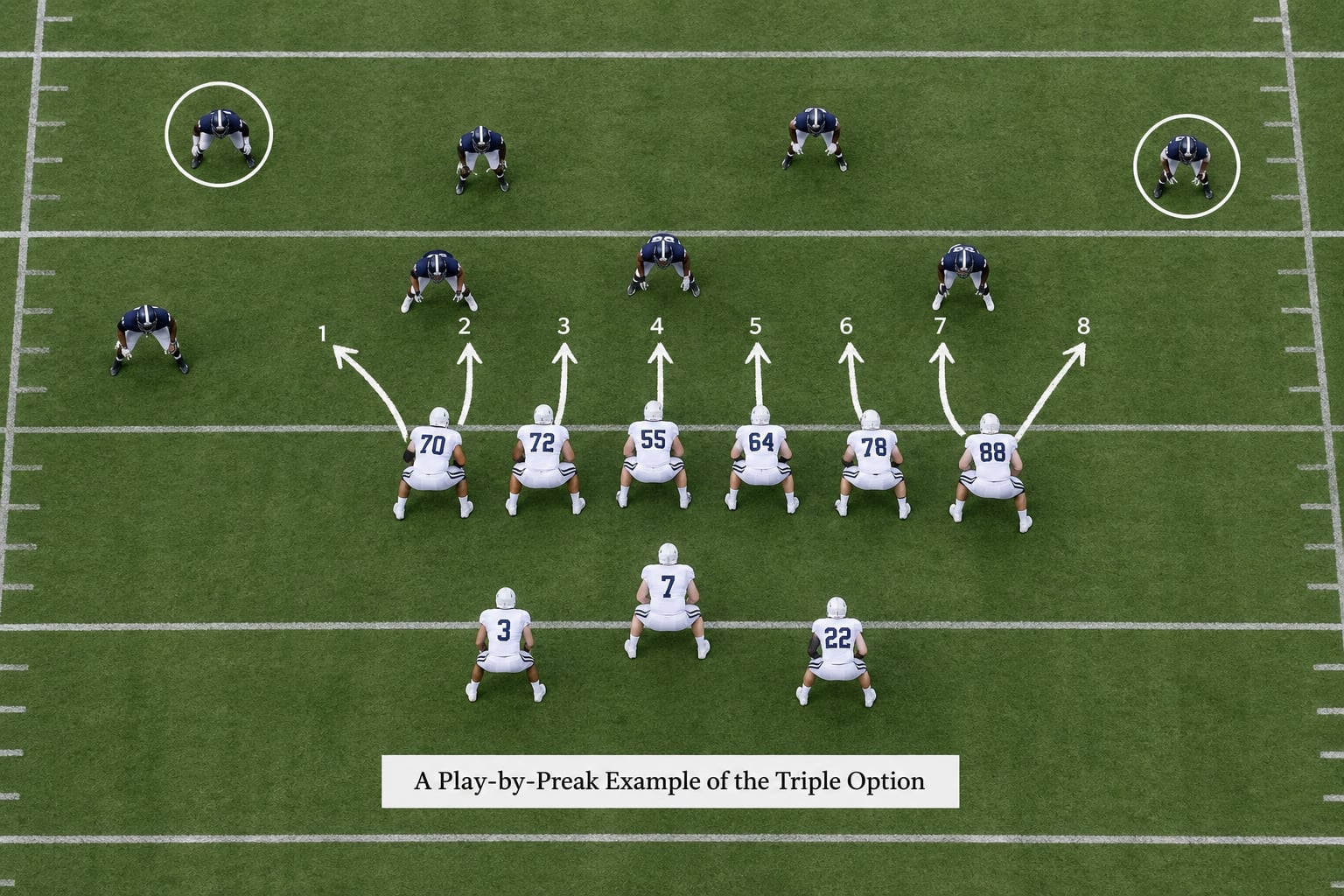
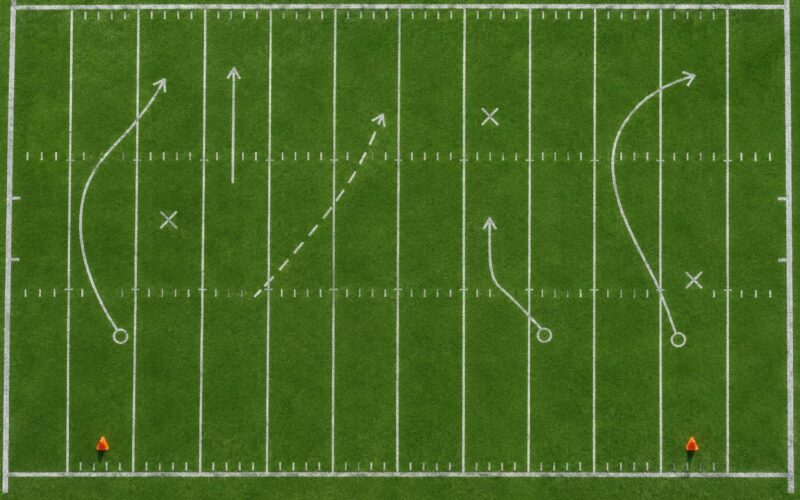
The diagram above shows the blocking rules and the two unblocked defenders marked as open circles.
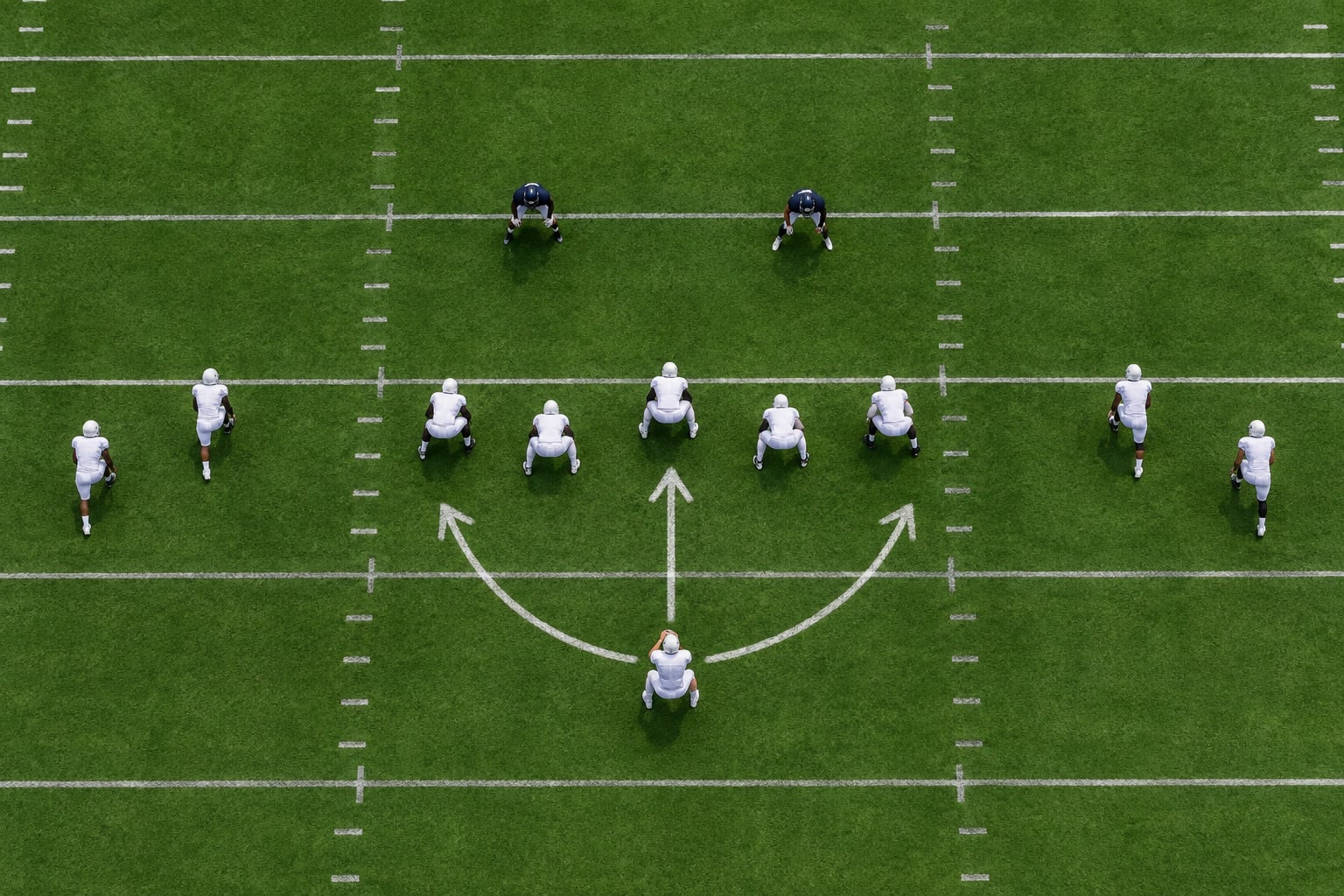
- Formation. Shotgun, three receivers split wide, A-back offset to the weak side, dive back directly behind the quarterback, H-back in the slot.
- Snap. The quarterback takes the snap looking at the weak side of the formation.
- First read. He looks at the give key. The dive back is running downhill at the same defender.
- The decision. If the give key closes on the dive, hand off. If the give key stays out of the dive lane, keep it.
- On the keep. The quarterback turns up the seam that the give key just vacated.
- Second read. He checks the pitch key. If that defender is closing from the edge, the ball goes out.
- The pitch. The A-back crosses behind the quarterback, receives the ball in flight or at the belly, and turns up the sideline.
- The finish. The entire front has either been removed from the play or is chasing it from behind.
That is the entire play. Every version you will see on a game day, whether it comes from a wishbone team or a flexbone team, is that same chain of decisions with different blocking rules attached.
Why the Triple Option Is Difficult to Stop
The scheme is difficult because it makes the defense’s best habits into mistakes. Attacking the dive is correct in isolation and disastrous against this one, because it hands over the keep. Chasing the quarterback is the natural instinct of a good defender and it opens the pitch. A defense that plays its fundamentals perfectly can still end up handing the ball back on third down and lose the game on the scoreboard.
There is also an honesty to it that fans appreciate. Every run really does have three possible endings, decided in front of you, and the offense cannot fake any of them. The quarterback is not reading a defense that has already shown its hand. He is reading one that is committed in real time.
The honest weakness is variance. When the reads are wrong, the quarterback is standing in space with the ball, which is why triple option teams live and die by turnovers and by whether anyone on the defense can actually win their one-on-one matchups. Fans put it more bluntly than the coaching staff would: it is cool, but the risk-to-reward math is all on the risk.
Quick Glossary for New Fans
A few terms come up in every explanation of this scheme, including this one, and they are worth having in plain language before the next game.
| Term | Plain-English meaning |
|---|---|
| Option | A run where the quarterback decides who gets the ball based on what a defender does |
| Veer | The blocking family the triple option belongs to, built on moving blockers instead of drive blocking |
| Triple option | An option with three possible outcomes and two unblocked defenders |
| A-back | The pitch back who runs from the weak side |
| B-back | The dive back who takes the handoff |
| H-back | The fullback or slotback who can block, carry, or split wide |
| Flexbone | A spread formation with an H-back in the slot and receivers split wide |
| Wishbone | A formation with two tight ends and a fullback aligned behind the quarterback |
| Give key | The unblocked defender whose movement decides the dive or the keep |
| Pitch key | The unblocked defender whose movement decides the keep or the pitch |
| Pointe series | The pair of unblocked defenders, named after the pointed tips of the backfield |
| On schedule | Being able to run third down and still get a first down |
One last thing to take into a game: the defense also has a read. Watch the give key before you watch the runner. If that defender squares up early, the quarterback has already made up his mind, and the ball you end up watching was decided two seconds earlier.
Frequently Asked Questions
What are the three options in a triple option offense?
They are the dive, the keep, and the pitch. The quarterback hands the ball to the dive back running at the give key, keeps it when that defender stays out of the dive lane, or pitches to the A-back from the weak side when the pitch key closes on him. Three decisions, two unblocked defenders.
How does the quarterback read the triple option?
He reads the give key first and decides the dive or the keep based on that defender’s movement. If he keeps, he reads the pitch key second and decides whether to pitch to the weak-side back or run it himself. The reads go in that order, and each one is a single defender making a decision in real time.
Why is the triple option hard to defend?
Because the two unblocked defenders decide the play for the offense. Committing to the dive removes you from the keep lane, and chasing the quarterback opens the pitch to an unblocked corner. A defense cannot attack every lane at once, so it has to trust that its discipline holds while the quarterback reads a live front.
What is the difference between a triple option and a wishbone offense?
The wishbone is a formation: two tight ends and a fullback arranged behind the quarterback in a Y shape. The triple option is an offensive system that reads two unblocked defenders. The two are often used together, which is why so many triple option teams line up in wishbone, but you can run the triple option from flexbone or shotgun formations too.
Can a triple option offense throw the ball?
Yes. Most triple option teams pass on a meaningful share of snaps, and a successful run play often creates the best passing look of the game. Systems like Veer and Shoot built the option reads around a real passing game. Passing is usually the counter to a defense that has loaded up to stop the run.
What positions are most important in a triple option offense?
The quarterback, the dive back, and the A-back decide whether the play works, because all three read the give key at the same moment. The H-back gives the offense its formation flexibility. Blocking matters too, but those four players control the timing that everything else depends on.