How the spread offense changed college football is easier to answer than the phrase sounds: it turned a run-first game into a pass-first one, stretched defenses horizontally so one blocker could no longer cover two gaps, and made the quarterback the reader instead of the runner. Almost every offense you watch now, at any level, is descended from it.
That is a blunt summary. The details matter more, because the spread did not arrive as one idea from one coach. It was assembled over decades out of old formations, new passing concepts, and a coaching culture that spent years insisting none of it would work.
Table of Contents
- What Is the Spread Offense?
- Where Did the Spread Offense Come From?
- How the Spread Offense Changed College Football
- How the Spread Changed Quarterbacks and Running Backs
- How the Spread Changed Defensive Strategies
- How the Spread Changed Recruiting and Player Development
- How Tempo and Game Scripts Changed
- Which Teams Helped Popularize the Spread?
- What Limits Are There on the Spread Offense?
- Frequently Asked Questions
- Conclusion
What Is the Spread Offense?
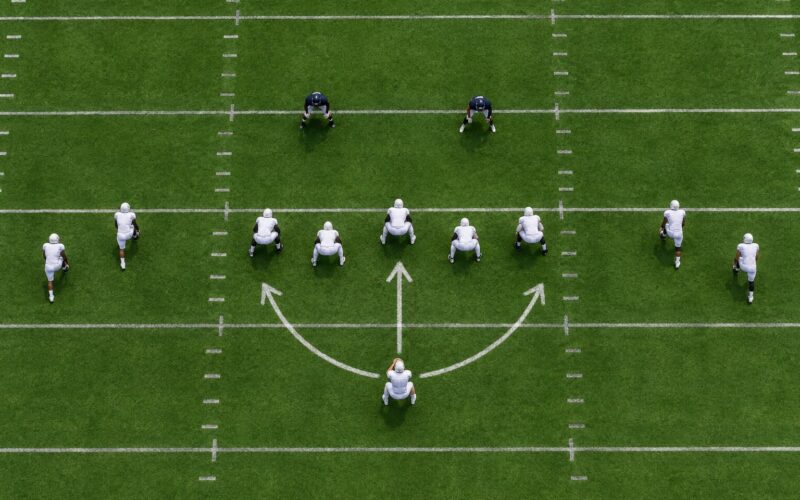
The spread offense is a passing-oriented system that lines up one or two running backs and four or five receivers across the width of the field, usually out of the shotgun, in order to stretch the defense horizontally and create more throwable space than a conventional alignment allows. Spacing matters more than raw numbers: five skill players across the width means each defender can only cover one threat, so the quarterback’s read simplifies and the run lanes widen.
It is not the same as the shotgun formation, which only tells you where the quarterback stands. Nor is it the same as the option offense, where the quarterback or a running back is literally handed the decision to hand the ball off, keep it, or pitch it. Plenty of spread teams run read options and option concepts, but the spread formation is the shell, not the play.
Here is how a spread formation stacks up against the offense that preceded it:
| Element | Conventional offense | Spread offense |
|---|---|---|
| Quarterback alignment | Under center or offset | Shotgun, sometimes pistol, sometimes empty |
| Receivers in base set | Two or three | Four or five |
| Backfield | Two backs plus fullback | One back, sometimes two |
| Typical run lane | Tight, off a blocking scheme | Perimeter, often off a read |
| Quarterback job | Read the coverage, then hit it | Read an unblocked defender and react |
| Tempo | Huddle, substitutions, clock control | Often no-huddle, pace of play set by the offense |
| Tight end usage | Frequent, both as blocker and target | Reduced, sometimes situational |
The tactical core is simple. A defense has eleven players and a fixed amount of ground to cover. Spread formations put six of those eleven players near the line, where they are each responsible for one specific threat, which leaves the remaining defenders spaced thinly across a wider field.
Where Did the Spread Offense Come From?
The spread offense did not start in the 2000s. Its single most important ancestor came from Sid Gillman at Cincinnati in the late 1940s and early 1950s, whose single-wing variations fanned receivers across the line before the concept had a name, and whose playbooks are often described as the Ve system because of its veer-like action. Gillman also coached the Chargers in the AFL, where he spent years building passing attacks years ahead of the NFL’s willingness to use them.
What Gillman did not conceive was the read option, the concept that later made the formation’s spacing convert into a running game. That arrived much later. Bud Wilkinson’s triple-option wishbone, which became a national obsession from the 1960s into the early 1970s, established the other half of the equation: that a quarterback could be put in charge of making the defense react at the line.
Then passing caught up. Sid Gillman’s earlier descendant, June Jones at Houston, built the Air Raid in the 1980s out of a philosophy he inherited from passing coaches like Mouse Davis at Texas El Paso, who learned from Darrell Royal. Jones’s central idea was that the offensive line, not the backfield, should decide where the ball goes. Hal Mumme carried that idea at Houston and then Texas, and Houston’s Run and Shoot system in the late 1980s and early 1990s pushed further, spreading the field until a single safety could not cover both the seam and the sideline.
Jerry Glanville fused the two halves at Georgia Tech in the 1990s. His Veer and Shoot combined the veer’s read action with the Run and Shoot’s spacing, and it is the direct ancestor of most of what people call spread offense today. Mike Leach took Mumme and Jones’s concepts up-tempo at Texas Tech in the 2000s, Dana Holgorsen did the same at Houston and then West Virginia, and Joe Tiller built the most commercially visible version of it at Purdue from 1997 to 2008.
Rich Rodriguez is usually named alongside Leach, and for a reason coaches argue about to this day. Rodriguez tells a story about adapting two-minute drills to open-field running at Salem College in 1988, and he has said the spread was, in effect, worked out in practice before anyone gave it a name. His West Virginia team in 2001 showed the rest of the country what a spread offense with a dynamic runner behind it could do.
How the Spread Offense Changed College Football
The spread offense changed college football in three connected ways. It widened the field every defense had to cover, it multiplied the number of players offenses could involve in a play, and it moved decision-making from the coaching staff to the quarterback. Everything else, from recruiting to how late-game football feels, runs downstream of those three things.
The first change is horizontal spacing. A conventional offense sends one blocker at a gap and asks the runner to hit it. A spread formation can create a seam outside the box, where a linebacker with a fullback in front of him cannot help, and where one defender cannot be in position to make two plays at once. Runners who had been told to get downhill or get tough were instead told to find a lane.
The second is personnel. Expanding a base set from three receivers to five did not require a new rule, but it did require a recruiting class that existed. Programs committed to it built rosters with more athletic wide receivers, more accurate quarterbacks, and fewer traditional tight ends. That in turn changed what high school players were told to look like, which changed what NFL scouts looked for, which changed how college coaches evaluated recruits.
The third is the read. A quarterback in the spread often sees an unblocked linebacker or safety on the edge. That defender has to be respected, which pulls a safety down, which opens the deep passing game. One unblocked player can now move two defenders at once, and that is the whole play-calling argument in a sentence.
The Innovations That Made the Spread Spread
Spacing alone did not take over. Four additions turned a workable formation into the default.
The shotgun as a primary formation. Shotgun existed for decades as a change-up. Once it became the base alignment, the quarterback’s first read changed from a handoff to a pass progression, and offenses could expand plays to five and six options rather than three or four.
The zone read. This is where read option, spread formation, and the run game meet. The quarterback reads the first defender who can be unblocked by a pulling lineman and either hands the ball off or keeps it himself. It arrived in college football in the early 2000s through coaches working from the Rodriguez and Leach families of systems, and it is the single most copied idea in the sport.
Tempo. No-huddle and hurry-up offense compresses the game into fewer minutes but far more snaps. Defenses lose the ability to substitute down, communicate, and settle into a front. In a widely replayed interview with Pat McAfee, Nick Saban put a number on the cost: his view was that a spread offense forces a defense to play roughly ten to fourteen more snaps per game than a conventional one.
Pre-snap motion and modern run-pass options. Shifting receivers, motion, and formations that show empty are now used to move a safety before the snap rather than after it. Run-pass options are built on the same principle. The quarterback’s read produces two or three answers instead of one, so the defense has to defend everything or guess.
How the Spread Changed Quarterbacks and Running Backs
The spread offense changed quarterbacks from passers into decision-makers with the ball. A quarterback in the spread has to recognize an unblocked defender, decide in a fraction of a second whether to keep the ball or pitch it, and then either throw to space or run before a linebacker arrives. Those are different skills from reading a coverage and finding a receiver on a route.
That is why spread quarterbacks tend to look athletic in a specific way. They are not necessarily faster than their predecessors; they are more comfortable improvising, because many plays are built with no predetermined answer. They also accumulate more live reps, since an up-tempo offense runs a lot of plays per game.
Running backs in a spread offense often become receivers first. A back who can catch in space, block a blitzer, and carry the ball on an option exchange is more useful than a bigger back who only runs downhill. Some teams stopped using a traditional featured back almost entirely, and the running-back position became, on many rosters, a multi-position job.
The game-plan effect is just as large. With a full field of throwable options, a coordinator can build an identity around one high-percentage concept, like the mesh or the screen, rather than around a run scheme that a good front can shut down.
How the Spread Changed Defensive Strategies
Defenses answered the spread with spacing of their own. The most common answers were a Cover 2 shell with two safeties, quarters coverage built around quarters-quarterback hooks, and fronts that refused to be pulled out of their gap responsibilities by a fake.
Two-high safety became the most visible answer. With a safety sitting behind the linebacker level, the shallow crossing routes that a spread offense relies on turn into contested catches rather than free ones, and the read-option keeper loses part of its advantage because the defender who would be the read is occupied. The problem is that two-high gives up deep space, so a fast offense with a real vertical threat punishes it quickly.
Contain rules also changed. Defenders learned to read the quarterback’s hips and hand position rather than the back’s movement, which is a completely different discipline from reading a running back’s shoulders in a hole. Defensive linemen started pursuing more freely because the read option could punish them for leaving their gap, and linebackers started having to win one-on-one blocks in space rather than working downhill into traffic.
Personnel went with it. Saban’s argument in that same conversation was that small, fast defenders built to chase a spread offense are not built to take on guards in a power game, and that shift in roster building has been one of the more visible trends of the 2026 season.
How the Spread Changed Recruiting and Player Development
Recruiting priorities inverted once the spread became standard. Wide receiver became a primary position instead of a depth and special-teams job, and athletic testing at that position mattered more. Quarterback recruiting started prioritizing accuracy, decision-making under pressure, and running ability rather than a strong arm alone.
Offensive linemen still had to win their one-on-one blocks, but the way they were asked to do it changed. Spreading the field means more defenders in space, so a tackle is more often asked to reach a linebacker with a full head of steam rather than to punch forward into a nose tackle. Blocking technique for receivers in space and for tight ends in space became coachable skills in their own right.
Development followed suit. Individual receiving work, quarterback film, and situational practice got more emphasis, because more plays are decided by the athlete on the ball rather than by the blocking scheme in front of him. Developmental staff now spend as much time on route precision and pitch mechanics as they once did on footwork drills.
How Tempo and Game Scripts Changed
Tempo changed the feel of a game more than the scoreboard did. Up-tempo teams play more snaps in less wall-clock time, so a fourth quarter feels like it takes ten minutes. The substitution limits stop mattering, the deep roster matters less than the starters, and a single injury is more visible because fewer players get in.
Passing volume rose, and with it the number of explosive plays. A spread offense tries to create a numerical advantage somewhere on the field and take the free yards, so the scoring profile skewed toward big plays rather than a steady grind. The deep passing game became a real weapon rather than a change-of-pace novelty.
Late-game football is where the strategic tension shows. A team protecting a lead in a spread system still has to pass sometimes, because stopping the clock means running and the other side controls it. A team chasing a score in a run-first offense is playing against its own strengths. Coaches now juggle that on every snap, and fans can see it.
Which Teams Helped Popularize the Spread?
No single team invented it, and a ranked list of best spread offenses would mostly measure quarterbacks. The eras below are more useful, since each one left something behind for the next.
| Era | Approximate years | Names attached to it | Defining trait |
|---|---|---|---|
| Ve and early passing concepts | Late 1940s to 1960s | Sid Gillman, Bud Wilkinson | Receivers spread before the formation was named; option football takes shape |
| Wishbone and triple option | 1960s to 1970s | Bud Wilkinson, later adopters at Georgia Tech and Notre Dame | Quarterback decides after the snap; the read idea arrives |
| Air Raid and Run and Shoot | 1980s to early 1990s | June Jones, Hal Mumme, Houston coaching staffs, Mouse Davis | Line decides, spacing becomes the whole point, systems spread nationally |
| Veer and Shoot | 1990s | Jerry Glanville at Georgia Tech | Veer action fused with Run and Shoot spacing |
| The take-over | Late 1990s to late 2000s | Joe Tiller at Purdue, Mike Leach at Texas Tech, Dana Holgorsen at Houston and West Virginia, Rich Rodriguez at West Virginia, Norm Chow and later Chris Nansen-era teams at Hawaii, Art Briles at Baylor | Nearly every program runs a version; the coaching establishment calls it a fad and loses the argument |
| Zone read and modern options | 2000s to 2010s | Coaches working from Rodriguez and Leach systems, including Mike Kliffin at Texas Tech and David Shaw’s Air Raid in the Big Ten | Read option and RPOs become standard vocabulary; tempo becomes a weapon |
| Counter-cycle | 2020s | Power-running programs responding to two-high defenses | Size and physical rushing return as a deliberate counter, not a relic |
By the early 2020s, a widely circulated forum thread about the spread’s rise put the share of college and high school teams running some version of it above ninety percent. That is an informal estimate rather than an official census, but it matches what you see on any given Saturday, including the leagues that have no pro-style alternative at all.
The resistance is worth remembering too. In the mid-2000s, plenty of established coaches dismissed the spread as a gimmick that would fade once the next athletic quarterback graduated. In forums, fans still enjoy recounting that, because the prediction turned out to be wrong in an unusually public way.
What Limits Are There on the Spread Offense?
Honest takes on the spread usually land better than boosterism, so here are the real constraints.
It lives on accuracy. When throws to the perimeter are the first read, a quarterback who cannot complete them has no fallback. Contrast that with an offense that can fall back on a power run, and the risk profile changes completely.
It exposes the quarterback. Every snap is a live decision, and live decisions create turnovers. A quarterback-centered offense also means a team’s ceiling is tied more tightly to one person’s health and mechanics than a run-first offense’s.
Physical fronts can blunt it. A defense built to attack gaps, shed blocks, and rush with four or five players can keep receivers in front of it. Saban’s point about small, fast personnel not being able to take on guards is the sharpest version of that critique, and programs have responded by building toward bigger defensive lines and fullback packages.
Recruiting load is real. Running a spread takes depth at wide receiver and defensive back, and few rosters have it. Coaches who copy the scheme without the roster often end up with a stripped-down offense and a talent gap.
The counter-cycle is underway. The 2020s have seen a deliberate shift back toward power running and 12-personnel groups on offense, driven by two-high defenses and by the roster math that follows them. That shift has not ended the spread, but it has made offensive style a genuine choice again rather than a default.
Frequently Asked Questions
What is the main idea behind the spread offense?
The core idea is horizontal spacing. A spread offense puts four or five receivers across the width of the field, usually in the shotgun, so each defender can cover only one threat. That widens running lanes, shortens the quarterback’s read, and creates more throwable space than a conventional formation allows.
When did the spread offense become popular in college football?
Its roots run back to Sid Gillman in the late 1940s, but it became the dominant structure in the 2000s. Purdue under Joe Tiller, Texas Tech under Mike Leach, Houston under Dana Holgorsen, and West Virginia under Rich Rodriguez made it nationally visible, and by the early 2020s nearly every program ran some version of it.
Is the spread offense the same as the shotgun formation?
No. The shotgun only describes where the quarterback lines up, and coaches have used it as a change-up for decades. The spread describes the whole formation, with receivers spread across the width and one or two backs, so that spacing creates advantages on both the run and the pass.
How did the spread offense change quarterback responsibilities?
Quarterbacks became decision-makers at the line of scrimmage. On read options and run-pass options, they read an unblocked defender and choose to keep the ball or hand it off, often in the same breath. Alongside that, they throw more short passes in space and accumulate far more live snaps per game in up-tempo systems.
What defenses are most effective against the spread offense?
The most common answers are quarters coverage, two-high safety shells, and fronts that refuse to be pulled out of their gap responsibilities by a fake. Defenders also have to read the quarterback rather than the running back, and win one-on-one blocks in space. No defense has solved it outright, which is why offensive style keeps cycling.
Conclusion
How the spread offense changed college football comes down to one idea: it used formation and reads to manufacture space, and that idea rewired offense, defense, recruiting, and what a football game feels like to watch. Coaches who copied it with rosters to match took over the sport; coaches who copied it without the talent got the shell without the advantage.
If you remember one thing, remember the mechanism rather than the era. Spacing creates one-on-one situations, one-on-one situations force defenders to declare themselves, and that is why the scheme survived every counter it has faced.