Punt return coaching is a special-teams process built around one job: give the offense a head start. A special teams coordinator owns the scheme, position coaches handle the individual groups, and the returner makes the call on every ball. Below is how that installs in practice, which rules bind it, and what to watch when you evaluate a unit.
The odd part of punt return is that it is the offense’s first play and the only live-ball play the kicking game hands to the other team. Nothing else on special teams starts with eleven blockers trying to move a ball that has already been struck by a foot from 40 yards away.
Table of Contents
- What Punt Return Teams Do
- How Punt Return Teams Set Their Roles
- How Blocking Schemes Change on Each Return
- How Coaches Practice Punt Returns
- What Changes During a Game
- How Coaches Balance Risk and Field Position
- Frequently Asked Questions
- What is the most important skill for a punt returner?
- How do punt returners decide whether to return the ball?
- Why is the wedge important on a punt return?
- What blocking rules must a punt return team follow?
- How do coaches evaluate punt returners during practice?
- When is it smart for a punt returner to call for a fair catch?
- Conclusion
What Punt Return Teams Do
The punt return unit’s job is simple to state and hard to execute: catch the punt, keep the football, and move the opponent’s field position against their will. Every yard a returner gives back is a gift, and every five yards gained is worth roughly a point and a half of scoring-range value to the offense that never had the ball.
That is the hidden yardage idea, and it is why punt return coaching gets more attention than its one-play-per-game snapshot suggests. Coaches post unit goals in terms of field position rather than yardage. Forum coaches commonly write goals like forcing a touchback or starting the opponent no closer than their own 35, or finishing in plus territory on half their returns.
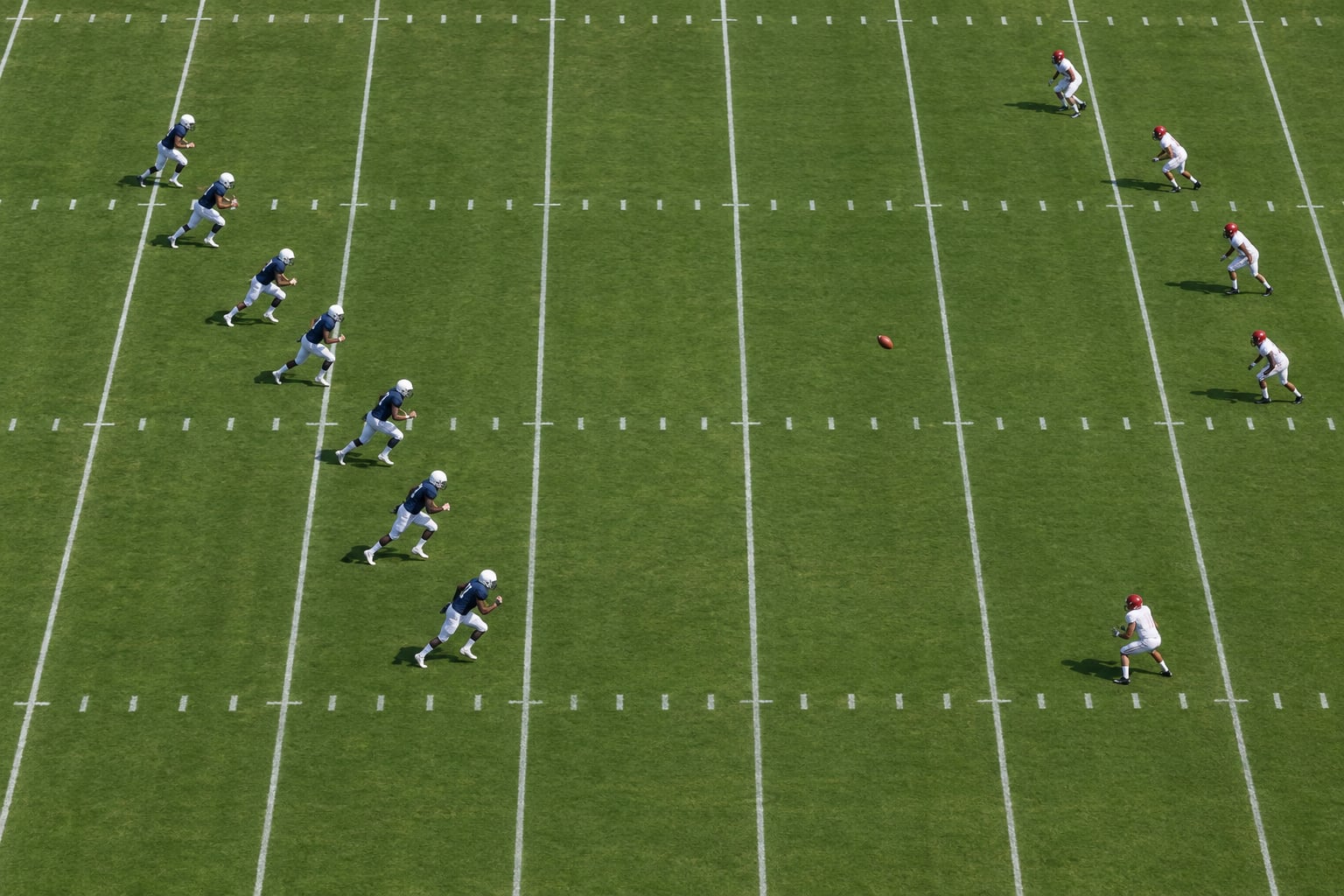
Conditions are unusual too. The returner is catching a ball he did not throw, off a hop that varies with the punt angle, while coverage players are running downhill at full speed from an unbalanced formation. Blocking rules are stricter here than on a kickoff return, and the returner has less room to work than almost any other ball carrier on the field.
Within the unit, the returner owns the catch, the ball security, and the decision. Everyone else owns a specific man or a specific lane. Coaches separate those jobs cleanly, because a returner who is also worrying about his blocking assignment is a returner who will drop a ball.
How Punt Return Teams Set Their Roles
Roles get assigned by skills first and scheme second. The returner is usually a receiver or running back with clean hands and reliable decision-making. Blockers are typically offensive linemen who can sustain a block for five yards without lunging. Edge players come from the defensive front, because they already know how to run a contain path.
Coaches on jcfb.forums.net describe splitting punt return across as many as four position coaches: jammers, returners, edge rushers, and the second group of blockers, with the defensive or wide receivers coach often owning the returners. The special teams coordinator writes the scheme and calls the game plan, but the individual technique belongs to the position coach who works that player every day.
| Role on the unit | Who coaches it | Responsibility on the play |
|---|---|---|
| Punt returner | Wide receivers coach or head coach, with special teams oversight | Catch, ball security, read the punt, call the direction |
| Second returner and support | Same as the primary returner | Communicate the call, provide an outlet, handle the fair catch option |
| Interior blockers (jammers) | Offensive line coach | Set the wedge, sustain contact, own a specific coverage man |
| Edge players | Defensive line or ends coach | Release outside, turn the corner, contain pursuit |
| Wedge players | Special teams coordinator with the line coach | Legal spacing, sprint, cut and release on cue |
| Third-down threat and fake punt defender | Defensive coordinator | Rush the punt, contain the punter, kill the fake |
Assignments get matched to the opponent, not just the roster. When a punting team fields a fast outside gunner, the return team usually double-teams him. When the punter is a drop-back passer who punts from a protected stance, the edge players get a different release trigger because the coverage shell is set later.
Traits matter more than a player’s raw speed. Coaches look for returners who catch on a bounce without flinching, who do not panic after a muff, and who will take a fair catch without arguing. A returner who scrambles for six extra yards because he is embarrassed to let the ball go is a coaching problem coaches spend real practice time fixing.
How Blocking Schemes Change on Each Return
Punt return blocking is built on assigned man blocking rather than a zone, and the techniques change in three stages as the play develops. University of Kentucky coach Dean Hood has laid the sequence out as a hold-up, an arm bar, and a slingshot, with the coaching emphasis on keeping the defender outside and never over the top.
| Technique | When coaches use it | Coaching cue |
|---|---|---|
| Hold-up (rodeo) | First five yards, when the coverage man is still closing | Meet him square, absorb, do not lunge or reach |
| Arm bar | Second five yards, when you need to steer rather than stop | Extend one arm, keep hips away, force the man to the sideline |
| Slingshot | Last five yards, when pursuit arrives from behind | Peel and chase, do not turn your back |
| Spray paint | When you are cut off and the lane is closed | Look for a new defender, or get behind your own block |
| Brush block | Releasing to a second-phase defender near the returner | Short contact, own the man, stay square to the returner |
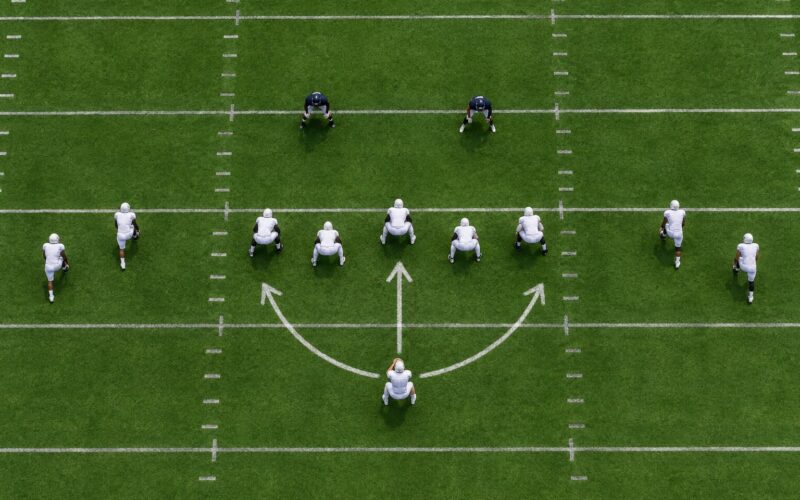
The most common scheme today is a middle or funnel return. Blockers sprint to the punting team, get to heel depth, bail out, and set up once the ball is away, trying to funnel the coverage toward one gap. The downfield wall from the 1970s and 80s has largely disappeared: moving punts hold the front eight too long to let anyone set a wall, and the discipline required to build one rarely survives contact with modern coverage.
Two rules shape everything. Blocking in the back is the single biggest self-inflicted wound on punt return, and coaches call it out constantly because blockers who spray past a defender or run by him get flagged. The wedge is also restricted, since a legal formation cannot form a wedge more than three yards wide between teammates moving together. That spacing rule, not the ban on grouping, is what coaches design around.
Adjustments come from the punt itself. A punt out of bounds near the sideline gets caught with a shortened, safe blocking plan. A punt that draws coverage to one side gets a hard middle return. A high, hanging punt from a punter who is getting rushed gives the return team time to set the wall in space, and that is when a deep return becomes worth attempting.
How Returners Read a Punt and Make Decisions
Returners read direction, speed, and coverage in that order, and they do it without turning their head. The read starts with the punter’s approach and hip position, then confirms with the ball’s flight: which way it is leaning, how high it is coming, and where the coverage shell is spilling. Only then does the returner decide.
The decision set is small. Catch it and signal fair catch. Catch it and call a return to a named side, usually with an audible so the blockers know. Or take the hit, secure the ball against your body, and let the play become improvised. A good returner makes that call in about a second, and coaches build practice reps around that second.
How Coaches Practice Punt Returns
Most programs spend more individual time on punt return than team time, because the technique is fresh and the alignment is simple. Coaches on coaching forums describe roughly 15 to 20 minutes of individual or small-group work per week, then running punt and punt return as a paired group period so the two sides see each other at full speed.
The progression usually runs in five stages. It starts with stance and hand work, then moves to catch reps off a punter with no coverage, then to live punts with an unopposed blocking unit, then to full coverage with decisions, and finally to pressure situations with a hit or a knockdown applied.
Coaching points tighten at each stage. Early reps are about eyes on the ball and hands away from the body. Middle reps are about catching a ball that bounces, because a punt that lands at the 8 and skips to the 3 is a routine catch for a good returner and a turnover for everyone else. Late reps are about the call, the wedge, and finishing the play.
- Hold-up drill. Blockers square up to a coverage man and absorb contact without engaging, building the discipline that keeps them out of the backfield.
- Overload punt. The return unit runs live punts with a static blocking wall to install the calls and communication at full speed.
- Wall set and release. Blockers get to heel depth, bail, and set up on a whistle so the timing works even before the ball is struck.
- Board work. One-on-one blocking in space, so individual technique gets reps that a team period never provides.
- Decision work. Snapped punts from different spots with the returner calling the direction out loud, which makes a wrong read obvious in practice instead of on Saturday.
How much time does punt return actually get?
Less than fans assume, and more than the one play per game suggests. Programs with a coordinated punt coverage and punt return staff can install a simple scheme in a short weekly period because the return is a small group with fixed assignments. Programs trying to install multiple return schemes live punts, and those need far more reps.
The tradeoff is explicit. A two-minute period forces a coach to simplify to something the unit can execute on the first rep, which is why most teams run one or two returns well instead of a full menu.
What Changes During a Game
Coaching adjustments start after the first return or two. The first punt reveals punt hang time, which tells the return unit whether it can set the wall. The second one usually reveals the coverage shell, which tells them which gunner to double and which side to leave alone.
Weather changes the plan more than fans expect. Rain and wind push punters to punt out of bounds or take the safety, which simplifies the return to a catch and a clock. On a dry field with a strong punt, the return team may be told to just field it and take the fair catch because the field position is already good.
Personnel gets involved. A returner who came out limping, or a coverage team that just started sending an extra man over the top, changes the checklist. Coaches on coaching forums track this with a film cut of the opponent’s punting tendencies: hang time distribution, punt location, and which gunners go where on each coverage look.
Field direction matters as much as anything else. A team punting with a leg or into the wind leaves a return team that has practiced catching short punts, and one punting the other way gets a deep, directional punt that punts the ball away from the returner entirely. Everything about the install changes from there.
How Coaches Balance Risk and Field Position
Coaching punt return is a math problem dressed up as a football play. A return that dies at the 30 after a five-yard gain and a tackle is a 15-yard swing against a defense that got a three-and-out. A return taken 40 yards back can flip a field, so the return team is incentivized to take risks that no other special-teams unit takes.
That is why a fair catch is frequently the correct coaching decision, especially inside the 10 or inside the 5. One offensive coordinator’s published punt return philosophy puts it plainly: want the ball, don’t rough the punter, don’t muff the punt, and when in doubt, don’t. A fair catch at the 8 is a fourth-down for the opponent, not a failure.
Muffed punts carry a rule wrinkle worth knowing. Once a punt touches anyone, it becomes a live ball, and the returner may not catch or secure a muffed punt to gain possession. He has to let it come to the ground and then handle it like a kickoff return, which is why coaches drill the awkward hop rather than the clean catch.
Coaches also post accountability systems around this unit. Carryover points toward offensive or defensive playing time, plus a special teams award, exist mostly to stop starters from coasting. One widely repeated unit goal is simple: on punt return, either get at least one block or finish in plus territory half the time.
One last thing. Fans judge special teams by outcomes rather than by decisions. A muff inside the 10 reads as bad coaching, when it is usually a risk the coaching staff accepted with full knowledge of the distribution of punts. Understanding that tradeoff is most of what separates watching football from understanding punt return coaching.
Frequently Asked Questions
What is the most important skill for a punt returner?
Ball security, by a wide margin. A returner who catches it, holds it against his body, and does not panic has value even on a five-yard return. Every other skill, speed and vision included, is worthless if the ball comes out, because a muff inside the 10 often costs more field position than any return gains.
How do punt returners decide whether to return the ball?
They read direction, speed, and coverage before the catch lands. The punter’s approach and the ball’s flight tell them which way it is leaning and how much hang time they have, and the coverage shell tells them where the threats are. From there it is usually a fair catch, a called return to a named side, or take the hit and improvise.
Why is the wedge important on a punt return?
The wedge is the return team’s only real interior protection, and it creates the lane the returner runs through. Coaches build it with two players sprinting to heel depth of the punting team, then bailing out and setting up once the ball is away. Rules limit how closely those players may travel together, so spacing and timing are the whole technique.
What blocking rules must a punt return team follow?
Two get flagged most often. Blocking in the back is the big one, so blockers must keep the defender outside and never turn over the top. Wedge formation is also restricted, because teammates may not move together in a wedge more than three yards wide. Beyond that, blockers own assigned men and hold their blocks long enough to be effective.
How do coaches evaluate punt returners during practice?
They watch the boring parts: catching on a bounce, keeping the ball against the body, calling the return out loud, and taking a fair catch when it is called for. Evaluation usually combines drill performance, live punts against coverage, and a board-work session on blocking technique. Consistency on those details predicts game performance better than a single big return.
When is it smart for a punt returner to call for a fair catch?
Anywhere inside the 10, any time the punt is short enough that returning it costs more than it gains, and any time the coverage shell looks uninviting. A fair catch at the 8 leaves the offense in a fourth-down spot, which is a better outcome than a three-yard return ending in a tackle at the 5. Coaches often set the threshold before the game rather than deciding in the moment.
Conclusion
The sequence behind how punt return teams are coached runs from staff assignment to game-day call. The special teams coordinator writes the scheme and the keys, position coaches install the individual technique in short weekly periods, the unit reps it against live punts, and the returner applies the read on Saturday.
If you want to judge a punt return team for yourself, start with three things: the field position it produces on average, whether it ever flags a block in the back, and how the returner behaves when the punt is short and ugly. Those three tell you most of what a coach has actually installed, and they are all visible from the stands.