Reading a defense is what a quarterback does before and during a snap: naming the front, counting the safeties, measuring the corner depth, spotting the blitz, and then matching the throw, the audible, or the protection call to what he just saw. This guide walks through how quarterbacks read defenses in five clear clues you can learn on Saturday and apply in the film room Monday.
Most fans can name a coverage once the play is over. Learning to name it before the snap is the whole game, and it is a lot simpler than the jargon makes it look.
Table of Contents
- What Does It Mean to Read a Defense?
- The 5 Clocks Every Quarterback Uses
- How Quarterbacks Read Defenses From Alignment and Depth
- How Quarterbacks Read Personnel and Matchups
- How Quarterbacks Read Protection and Pressure
- How Quarterbacks Read Leverage, Spacing, and Motion
- How Quarterbacks Adjust After the Snap
- Common Defensive Looks Quarterbacks See
- A Practical Quarterback Reading Routine
- Frequently Asked Questions
- What is the easiest way for a quarterback to read a defense?
- How can you tell if a defense is playing man or zone?
- Why do quarterbacks look at the safety before the snap?
- Can a quarterback read a blitz?
- What should I study first on game film to read defenses?
- How do coaches help quarterbacks identify defensive looks?
- Conclusion: Start With the Clue in Front of the Quarterback
What Does It Mean to Read a Defense?
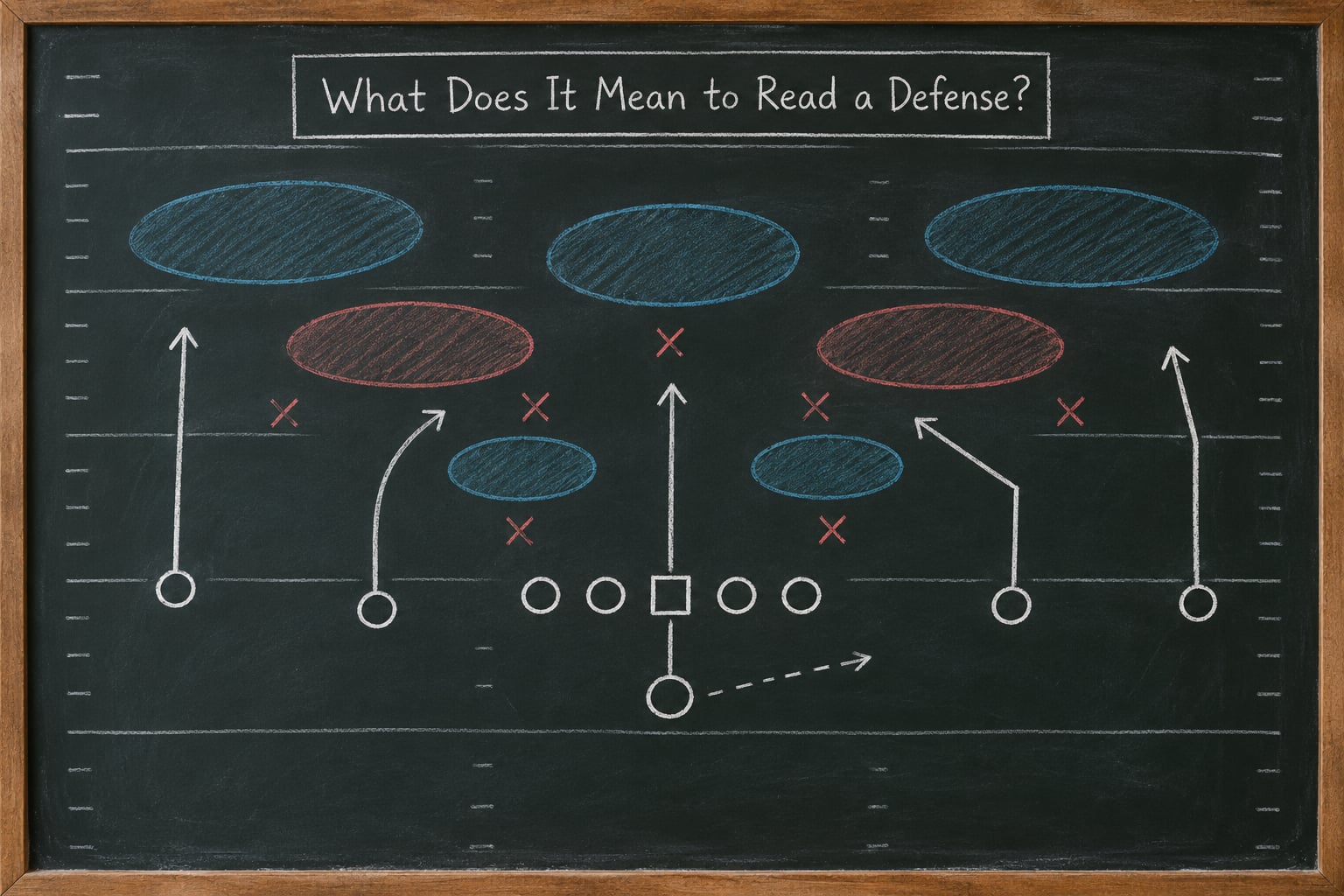
Reading the defense is diagnosis, not memorization. A quarterback who can read well does not need to know a coordinator’s full playbook. He needs to know what he is looking at right now: how many defenders are in the box, how many safeties are deep, where the corners are standing, and who is coming.
There are two halves to the read, and they run at different speeds.
The pre-snap read happens in roughly three seconds, before the ball moves. Its job is identification. The quarterback sorts the alignment into a family of looks so he can predict what is coming, and so he can change the play before he ever touches the ball.
The post-snap read happens after the snap, usually within a second or two. Its job is confirmation and correction. Defenses rotate, disguise, and bluff, so the pre-snap read is a hypothesis and the post-snap read is the test.
Every read comes down to five sources of information: alignment, personnel, protection clues, receiver spacing, and what defenders do once the ball is live. Master those and the rest is vocabulary.
The 5 Clocks Every Quarterback Uses
Quarterbacks talk about reading in terms of clocks, because each source of information arrives on its own timer. Knowing which clock is running tells you how much attention a given clue deserves.
| Clock | When it starts | What you look for | What it decides |
|---|---|---|---|
| Alignment clock | First, roughly two seconds out | Even or odd front, box count, safety depth, corner depth | Which family of coverage is likely |
| Personnel clock | With alignment, then again at the snap | Eleven names on the field, size of the front, number of big bodies | Whether this is a base package or a sub package |
| Protection clock | Blitz clues start pre-snap, finish at the snap | Linebackers at the line, an unaligned edge rusher, a nose in coverage | Which protection or audible to call |
| Spacing clock | As routes develop, post-snap | Defender’s feet, depth on the receiver, gap between zones | Man or zone, and the throw |
| Behavior clock | The first step after the snap | Stems, rotations, drops, jumps, blitzers | Whether the pre-snap read was right or wrong |
Notice that the protection clock and the spacing clock run on opposite ends of the play. One is about surviving the next two seconds, the other about deciding where the ball goes five seconds from now.
How Quarterbacks Read Defenses From Alignment and Depth
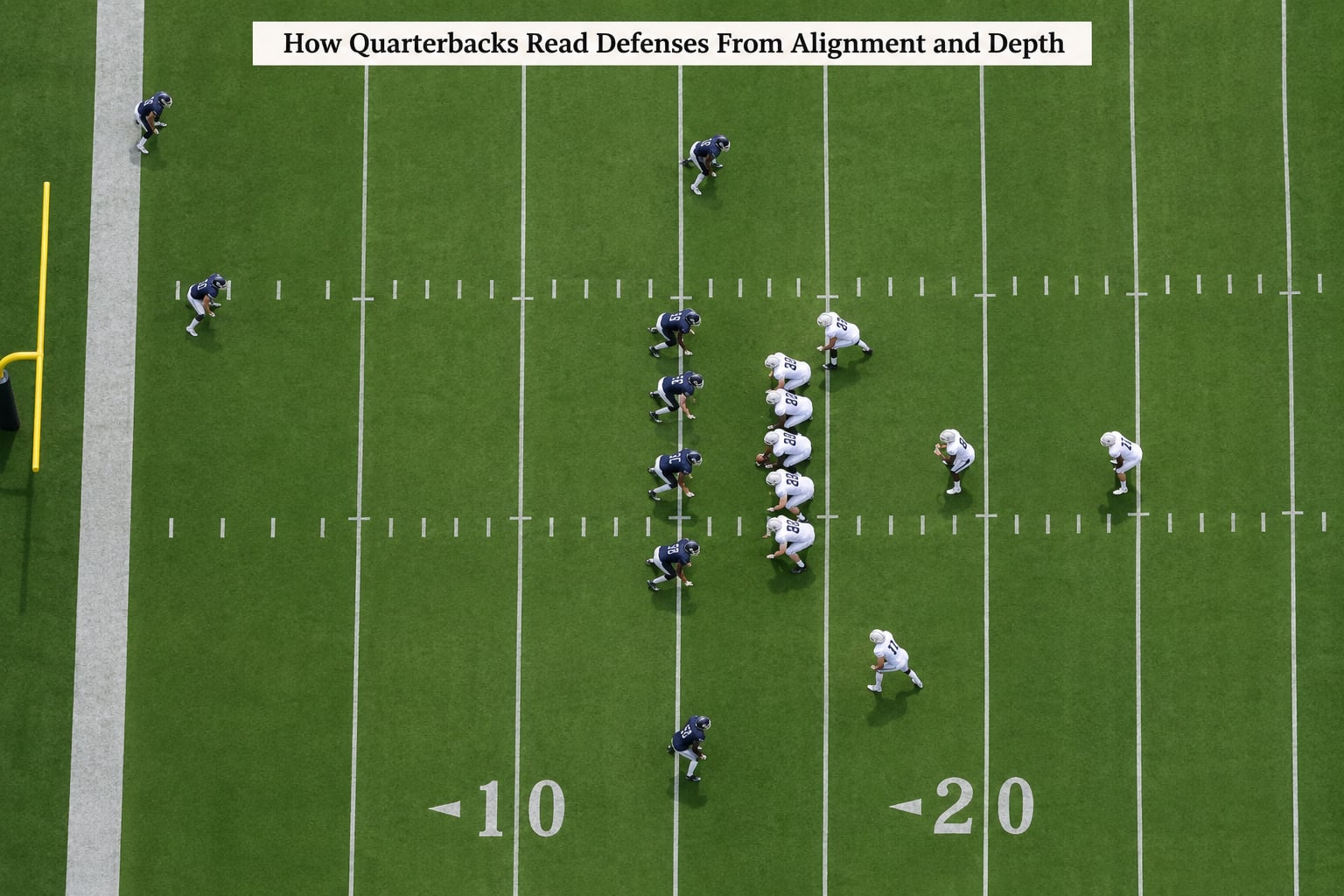
Depth is the fastest tell in football. A defensive back playing five yards off the line is a different player than the same back at twelve yards, and that single number separates most of the coverages you will see.
The count that starts everything is the box count: the number of defenders inside or near the box, roughly six yards off the ball. Seven or more usually means run-heavy personnel and man coverage across the board. Six or fewer usually means an extra defensive back, a four-man front, or a team willing to play zone.
Corner depth does most of the remaining work. Two high safeties sitting eight to twelve yards off the line reads as Cover 2, where the safeties own the deep middle. One safety deep and one corner sitting on the line is Cover 1, man-free, with a single high safety over the top. One safety deep with both corners at five or six yards is Cover 3. One safety deep with corners at twelve and aligned is Cover 4.
Then there are the looks without a number. Man coverage has no deep safety in the classic sense, because the top corner simply follows the receiver. Quarters, sometimes called Cover 3 quarters, splits the deep field into four equal slices with three defensive backs and one safety, and it is the most common base coverage in college and pro football right now.
Tampa 2 is a zone blitz built on Cover 3, where the outside linebacker drops into coverage and a defensive back replaces him on the rush. Quarterbacks learn to spot it by that back sitting at nose level before the snap, right next to the corner.
| Look | Deep safeties | Corner depth | What it tells the quarterback |
|---|---|---|---|
| Cover 0 | None | On the line | Every receiver is man-covered and every route is contested |
| Cover 1 | One | On the line | Man everywhere except one deep safety over the top |
| Cover 2 | Two | Five to eight yards | The middle of the field belongs to the safeties |
| Cover 3 | One | Five to seven yards | Corners own the underneath zones, the safety owns the deep middle |
| Cover 4 | One | Ten to fourteen yards | The middle is open but everything deep is covered |
| Cover 6 | Two | On the line | Both safeties drop underneath, the deep middle is unguarded |
| Quarters | One | Three to six yards | Three deep players split the field, the middle hash is contested by two |
Nobody needs the label to use the information. A quarterback who knows that two high safeties and soft underneath corners mean nobody is home over the middle can still run a crossing route and find open grass.
How Quarterbacks Read Personnel and Matchups
Personnel is the second clock, and it explains the odd things a defense does. A coach who wants to play Cover 2 man will bring on a big safety and a nickel defender. A team that suddenly shows five defensive backs is telling you the run is off the table.
The front matters too. An even front has nobody directly over the center, which usually means a nose tackle who can play a gap technique and drop into coverage. An odd front has someone on the center, which usually means an extra linebacker with pass-rush or coverage responsibility. That nose in coverage is the clue to Tampa 2.
Matchup reading turns all of this into a decision. When a wide receiver lines up against a corner who is six inches shorter and gives up the outside leverage, the quarterback is not looking for open grass, he is looking for a one-on-one win in the end zone. When the only target is a slot receiver bracketed by a linebacker and a safety, the play is a checkdown, not a bomb.
Down and distance finish the argument. A quarterback who has read Cover 3 correctly on third and four is hunting a specific route combination, usually a shallow crossing into the flat that the corners cannot undercut. Same look, fourth down, and now the middle of the field is the only answer.
How Quarterbacks Read Protection and Pressure
Surviving the snap comes before finding the throw. A quarterback who sees pressure late has already lost the play, so the protection read runs in parallel with the coverage read rather than after it.
The four classic clues to a blitz are worth memorizing as a set: a linebacker showing blitz, an unaligned edge rusher, a corner in nickel aligned inside the numbers, and a safety creeping toward the line of scrimmage. One of those could be a player just being aggressive. Two or more together is a blitz until proven otherwise.
Pressure also disguises itself. A defense can show five rushers, bring six, and drop the sixth into coverage after the quarterback commits to a quick throw. That is a disguised blitz, and it is only visible after the snap, which is why quarterbacks are taught to keep their eyes up until the last possible moment.
Twists and games make it harder. Two interior linemen switching assignments mid-snap can leave one rusher with a free lane, and the protection call that looked right on the way to the huddle is wrong by the time the quarterback sets. The instinct to repack the protection comes from a drilled rep, not from reading the play.
MOFO, middle of field open, is the quarterback’s version of the same read. When the two safeties sit at equal depth on either hash, the seam between them is unguarded, so the middle route becomes the primary read rather than the third read.
How Quarterbacks Read Leverage, Spacing, and Motion
Reading leverage before the snap
Reading spacing starts with a defender’s feet, not his hips. A defensive back with his weight on his toes and turned sideways is prepared to drive on the receiver, which usually means man. A back squared up with flat feet and flat hips is reading the quarterback, which usually means he is in a curl or a flat zone and the receiver behind him is free.
Spacing is the gap between defenders rather than the gap to the ball. When two defensive backs drift toward each other on a deep route, the space between them opens up behind the drop, and that is where the ball goes. When defenders stay spread at even depth, the space is on the sideline, where throwing away from the boundary makes the catch easier.
Leverage, the advantage a defender takes by standing in front of the receiver he is covering, works the same way in reverse. A corner with leverage can cut in front of a route on instinct, so the quarterback aims behind him or abandons that receiver entirely. Watch where the defender stands relative to the receiver, not just how far away he is: inside leverage closes the inside window and hands the route to the sideline.
Reading motion
Motion is free information for the offense and expensive information for the defense. When a receiver crosses the formation, the defensive backs who follow have to declare their coverage, either by shuffling with the receiver in zone or by crossing over in man. Either way, the quarterback learns something for free.
The specific clue most quarterbacks watch is the safety. When a receiver motions to one side and the near safety drifts toward that side, the middle of the field is open on the other hash. When the safety stays flat, the middle stays covered.
Jet motion is even better, because the defense is reacting at full speed. Defenses answer jet motion with a substitution, a switch, or a blitz, and each of those answers is a play the quarterback can now hear before he has taken a snap.
How Quarterbacks Adjust After the Snap
Adjusting after the snap is a fixed sequence: confirm the read, find the first option, check the safety, protect the ball, attack the weak part of the coverage. Quarterbacks who skip the confirmation step are the ones who get caught standing still in an open window.
Route conversions are the most visible part of an adjustment. A corner who sits at five yards pre-snap has revealed Cover 3, so a quarterback expecting a hitch converts the route into a corner or a post to find the space behind him. A safety who rotates late into a Cover 2 can turn a crossing route into a crossing route against man coverage, which is a much harder throw.
The language quarterbacks use is worth learning because the broadcasts repeat it and it explains the calls.
Blue 42 is the most famous. It means middle of the field open, plus the 42 safety, the one responsible for the hook, is coming, so go to the route over his head. A quarterback might call it in the huddle, after seeing a two-high alignment, then confirm it at the line with a hand signal.
Hot means the route just entered, meaning the quarterback should throw it now before the defender arrives. Freeze means hold the ball for the next read, usually because the first receiver is covered. Razz is a teammate’s fake route, a draw for a safety or a linebacker to hold. Go is the simplest call there is: the primary receiver is open, take the first read and do not force anything else.
Hot routes work the same way but from the receiver’s side. A running back who sees a free safety declares the route hot before the snap, and the quarterback is now reading the back, not the defense. It is the clearest example of how quarterbacks read defenses and the offense at the same time.
Common Defensive Looks Quarterbacks See
These are the looks that show up on almost every Saturday. The left column is what you see, the right column is what a quarterback does with it.
| What you see | Likely look | The adjustment |
|---|---|---|
| Two safeties at equal depth, corners at five yards | Cover 2 | Attack the corner routes or the short area under the safeties, not the seam |
| One safety deep, one corner on the line | Cover 1 | Run man-beating routes and be ready for a safety rotating over the top |
| One safety deep, both corners at five to seven yards | Cover 3 or quarters | Corners and curl routes into the middle third, or the deep post on the weak side |
| One safety deep, corners at twelve yards and press | Cover 4 | Come underneath with crossing routes, since the deep middle is covered but the middle third is not |
| No safety, corners on the line, linebackers showing blitz | Cover 0 blitz | Hot route to the first man, or a quick throw before the rush arrives |
| Five defensive backs, corners at three yards | Matchup zone | Work the matchup with your best receiver and accept that the volume comes with it |
| Outside linebacker at nose level, safety beside the corner | Tampa 2 | Quick game before the pressure arrives, or a designed run into the replaced defender’s gap |
Two of those rows are worth a second look. Cover 3 and quarters look nearly identical from the sideline, and the difference is whether the middle of the field is split by two deep defenders or held by one. In quarters, a seam route is contested. In Cover 3 proper, the seam belongs to the safety alone, so the seam is the read.
Man and zone also produce different reads, and that is a genuine split among quarterbacks. Man coverage is harder to identify pre-snap but easier to throw against, because the defender’s position depends on the receiver. Zone is easier to read from alignment but harder to attack, because the defender’s position depends on the ball. Most passing attacks live in quarters or matchup zone because it combines both: the deep defenders read the receiver while the underneath defenders read the ball.
A Practical Quarterback Reading Routine
Reading is a habit, not a talent, and habits need a routine. This six-step pre-snap checklist works for a high school quarterback on Friday and a pro quarterback on Sunday.
Count the box. Seven or six and the defense is loaded. Five or fewer and there is a defensive back in the mix.
Name the front. Even or odd, which players are on the line, and how many linebackers are stacked behind it.
Locate the safeties. One high, two high, or MOFO. This single check resolves more coverage questions than any other.
Check the spacing under the receivers. Depth of each corner tells you man, zone, or a hybrid, and it tells you which receiver to target.
Read the protection. Count the rushers, find the unaligned edge, and see if a safety has crept up. Then pick the call.
Set the timing plan. Decide before the snap whether this is a quick game, dropback, or play action, and name the first, second, and third read.
For film work, the routine is simpler: watch five plays of one coverage from the all-22 angle, freeze the frame just before the snap, and write down the safeties and corner depth. Do that for ten looks and the recognition becomes automatic. Watching the all-22 view is the single biggest upgrade, because sideline angles hide exactly the depth cues that matter.
And the same routine works for a spectator. When you sit down on a Saturday, find the deepest defender first, then check the corner depth on both sides, then count the box. Cover 2, Cover 3, and Cover 4 fall out of those three looks in about five seconds, and once you can name the coverage you can predict the throw before the quarterback does.
Frequently Asked Questions
What is the easiest way for a quarterback to read a defense?
Start with the safeties, every time. Counting how many defensive backs are deep, and how deep, tells you the coverage family faster than any other single check. Then add corner depth and the box count. Those three observations, practiced on ten looks a day, build recognition faster than memorizing scheme names.
How can you tell if a defense is playing man or zone?
Look at the defender’s hips and his feet after the snap. A defensive back whose hips turn with the receiver is in man, because his position depends on that receiver. A back whose hips stay square to the quarterback, with flat feet and eyes on the ball, is in a zone, because his position depends on the quarterback.
Why do quarterbacks look at the safety before the snap?
Safeties are the deepest defenders, so their alignment resolves the most coverage questions at once. Two high safeties point to Cover 2. One high safety with a corner on the line points to Cover 1. One high safety with both corners at five yards points to Cover 3. Equal safety depth means the middle of the field is open.
Can a quarterback read a blitz?
Most blitzes, yes. The clues are a linebacker showing blitz, an unaligned edge rusher, a corner in nickel alignment, and a safety creeping toward the line. Two or more clues together mean call a protection or audible to a quick play. Disguised pressure, where the defense shows five rushers and drops the sixth into coverage, can only be confirmed after the snap.
What should I study first on game film to read defenses?
Study the two frames before the snap. Freeze the clip just before the snap, then write down the box count, the front, the safety alignment, and the corner depth on each side. Doing that for ten looks of the same coverage turns recognition into a reflex, and the all-22 angle shows depth cues that a sideline camera hides.
How do coaches help quarterbacks identify defensive looks?
Coaches teach recognition with a fixed vocabulary and a fixed order, so a quarterback learns one routine instead of guessing. They also install a short call system for what he sees, like blue 42 for middle of the field open, plus hot and freeze for the first read. In practice, reps are run against a scripted defense so the same look returns repeatedly.
Conclusion: Start With the Clue in Front of the Quarterback
How quarterbacks read defenses comes down to a short, repeatable order: box count, front, safeties, corner depth, then pressure. The pre-snap read identifies, the snap confirms, and the quarterback attacks the weak part of the coverage.
If you are learning this yourself, study the defensive front, the safety position, the receiver spacing, and the protection before worrying about anyone’s progression. Those four answers feed everything else, and the coverage name is just the receipt.