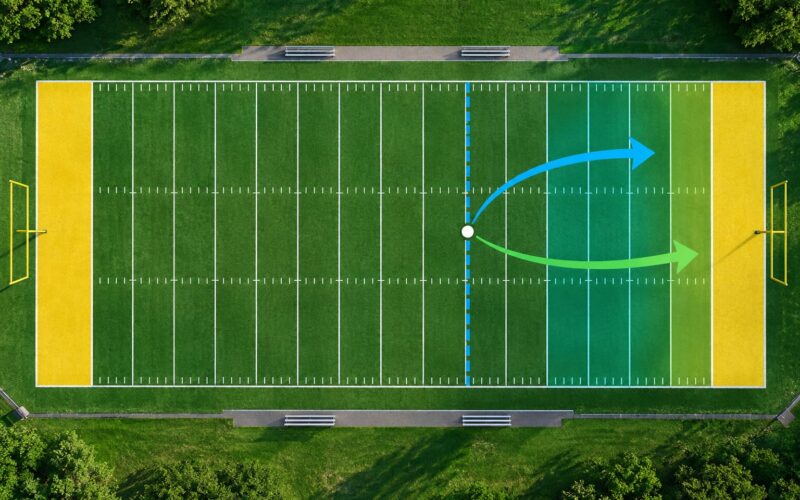
A two-point conversion is a single play from scrimmage run right after a touchdown, in place of the one-point extra point kick. The ball is spotted at the 2-yard line in the NFL, the 3-yard line in college football, and the 1-yard line when a defensive penalty is called on the score; a rush or a pass into the end zone is worth two points, and anything else changes nothing. So how two point conversion decisions are made comes down to a short list of inputs: the score, the time, the timeouts remaining, and how good a shot the specific play in your playbook actually is.
The numbers explain why it is a real decision at all. The extra point is made about 93 to 96 percent of the time in the modern era, and the conversion about 47 to 49 percent. Almost any of the tries a staff has would succeed more often than the one thing kicking gives them.
Table of Contents
- What Factors Go Into a Two-Point Conversion Decision?
- How Does the Scoreboard Change the Decision?
- How Do Time, Field Position, and Down-and-Distance Matter?
- What Personnel and Game Script Are Coaches Considering?
- How Do Coaches Estimate the Chance of Success?
- How Are Expected Points Used to Make the Call?
- When Do Coaches Go for Two Instead of Kicking the Extra Point?
- What Are Common Fourth-Quarter Examples?
- What Can Go Wrong When Coaches Use Conversion Data?
- Frequently Asked Questions
- When should a football coach go for a two-point conversion?
- Is going for two always better after taking a two-point lead?
- What conversion rate should coaches expect on a two-point try?
- Does a team’s overall two-point conversion percentage predict its next attempt?
- How do analytics explain how two point conversion decisions are made?
- What Should You Consider First When Judging a Call?
What Factors Go Into a Two-Point Conversion Decision?
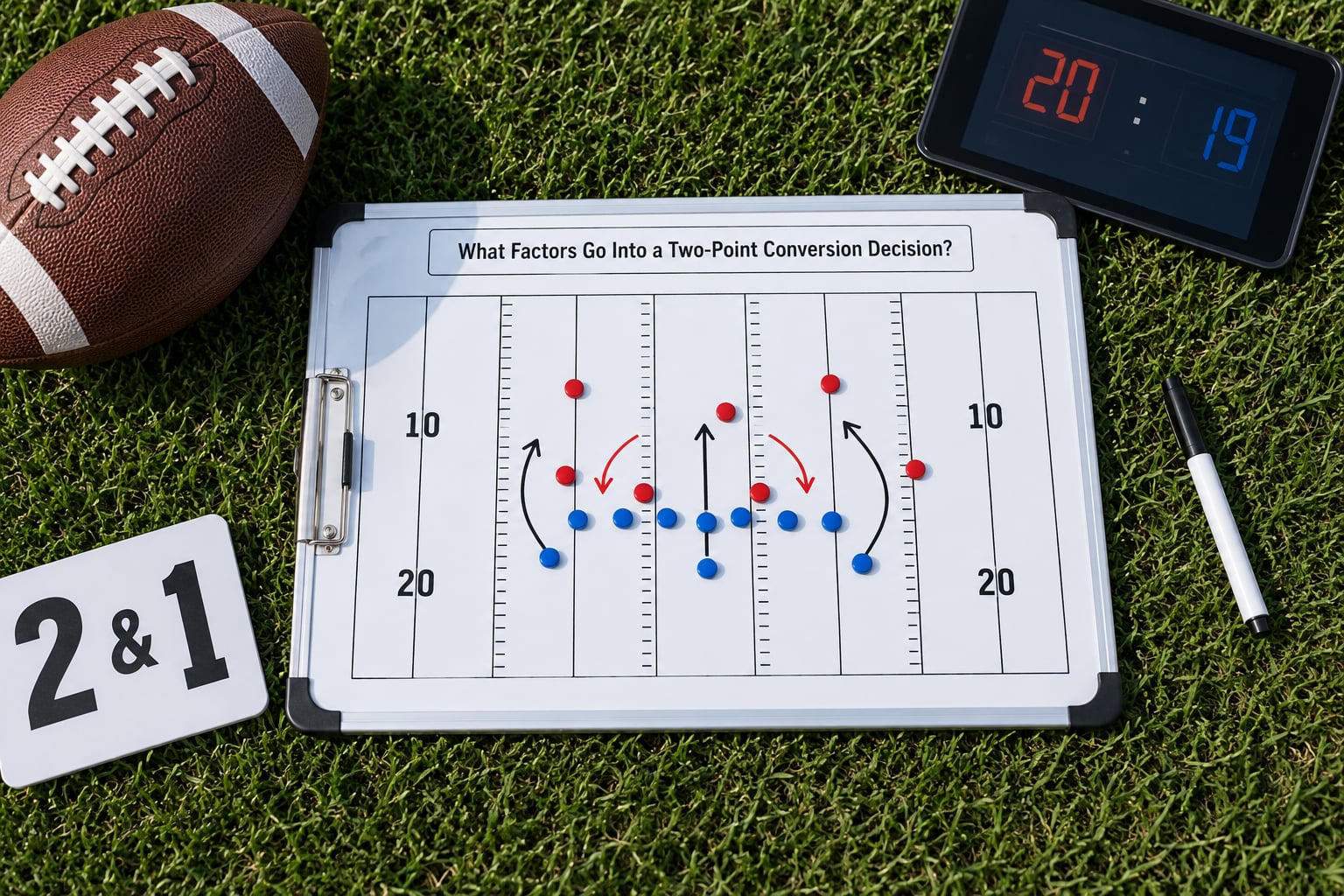
Six inputs go into the call: the score differential at the instant the whistle stops, the time remaining, the timeouts remaining, whether the opponent can realistically answer with a field-goal drive, the success probability of the play you have, and how comfortable your staff is with the downside of a failed try.
The score and the clock do the heaviest lifting because they define how many possessions are left. Timeouts and the opponent’s answering ability adjust it. The play call is what makes two teams in the same score state reach opposite conclusions.
| Input | What a staff actually looks at | When it matters most |
|---|---|---|
| Score differential | Points down or up the second the play ends | Every call; it sets the shape of the choice |
| Time remaining | Seconds left and how many possessions fit in them | The final five minutes versus a second-quarter score |
| Timeouts remaining | Whether the opponent can stop the clock and get a shot | Down one and down four late |
| Opponent’s answering ability | Whether that defense can reach the end zone or kick a field goal | Down eight and down nine |
| Success rate of your play | Run action or pass action from your own package | Any time your rate sits near the break-even line |
| Kicker quality | How much the point after touchdown is worth to you | Poor kicking teams and bad weather |
Three terms carry most of the confusion. The point-after, or PAT, is the one-point kick. A conversion attempt is the generic word for either option. The break-even rate is the success probability your play has to clear before the two-point choice beats the kick.
How Does the Scoreboard Change the Decision?
The same attempt goes from automatic to indefensible depending on the score. Kicking an extra point up one is a three-point lead that no field goal beats, so there is nothing to gain. The identical attempt down one late is the difference between winning in regulation and hoping to tie.
It helps to separate a preferred choice from a last-chance choice. Going for two up nine because you want the free point to create a fourth-down later is one thing. Going for two down sixteen with ninety seconds left because a loss and a tie are both losses is another. Coaches treat the first as a search for value and the second as a way to keep the game alive.
Overtime makes the rules, not the math, run the decision. In the NFL a team kicks on the first overtime possession and goes for two on the second and every one after it, in the regular season and the playoffs alike. College football follows the same first-possession kick, and the two-point try is mandatory on the second overtime possession and beyond.
| Rule | NFL | College football |
|---|---|---|
| Spot for the try | 2-yard line | 3-yard line |
| After a defensive penalty on the score | 1-yard line | 1-yard line |
| Overtime, first possession | Kick | Kick |
| Overtime, second possession and beyond | Two-point try | Mandatory two-point try |
One more piece of the rules work in the fourth quarter. When a conversion succeeds with under two minutes left in a quarter, the clock stops for the change of possession, which means a team that trails by one can bank the lead and bleed the remaining time.
How Do Time, Field Position, and Down-and-Distance Matter?
Time decides how many chances remain to fix a mistake, and field position decides how expensive the miss is. Kicking hands the ball back near your own 25-yard line. A failed two-point try hands it back on the opponent’s 2 or 3, which is why the failure case looks so much worse than the success case looks good.
Timeouts are the part almost nobody quantifies. With three timeouts in the bank and a defense that struggles to get a stop, down one late becomes survivable after a kick, because the kickoff plus three stops can run four minutes. Burn those timeouts earlier in the half and the same score state becomes a coin flip.
| Score right after the touchdown | More than five minutes left | Final five minutes |
|---|---|---|
| Down 14 or more | Kick | Kick; one score will not do it |
| Down 9 or 8 | Kick | Either; converting removes the opponent’s field-goal answer |
| Down 7 | Kick | Either; a tie is worth less than a three-point lead |
| Down 6 or 5 | Either | Kick; a converted try loses to one field goal |
| Down 4 | Kick | Either; a five-point lead with the ball beats a three-point lead without it |
| Down 3 | Kick to tie | Kick; a four-point lead still answers one field goal |
| Down 2 | Kick | Either |
| Down 1 | Go for two; a one-point lead cannot be field-goed | Either; kicking ties and hands them a real chance in regulation |
| Up 1 | Either | Either |
| Up 7 | Either; the tie you get by kicking is better than the one you already have | Either |
| Up 9 | Either; the coin-flip game is worth taking | Either |
Read that table as a set of thresholds rather than orders. Coaches routinely go against a row when their play clears the break-even rate for the situation, which is why the same staff can be right going for two down seven in the third quarter and wrong doing it in the fourth.
What Personnel and Game Script Are Coaches Considering?
Play type matters more than most fans expect. Run attempts convert around 61.7 percent and passes around 43.4 percent, so a goal-line package built around a short-yardage runner changes the arithmetic without changing the scoreboard.
Then there is who is actually on the field. A kicker who has missed two of four short attempts in the second half drags the value of the extra point down. So does a quarterback who throws well and a running back who does not block, which is why some teams run their best pass blocker into the formation instead of their best runner.
Game script filters all of it. A team that runs to protect a one-score lead will take the kick almost every time. A team that expects to need touchdowns to answer will accept the risk of a failed try, because a failed try ends the drive on the opponent’s two-yard line and their next drive starts in their own end.
How Do Coaches Estimate the Chance of Success?
Stands estimate the probability from the specific play, the opponent’s goal-line defense and recent attempts in similar scripts, then set it against the kicker’s number. Season percentages are a starting guess, not an answer, because a season figure mixes routine third-quarter tries with fourth-quarter goal-line stands.
How two point conversion decisions are made on the sideline, in about thirty seconds
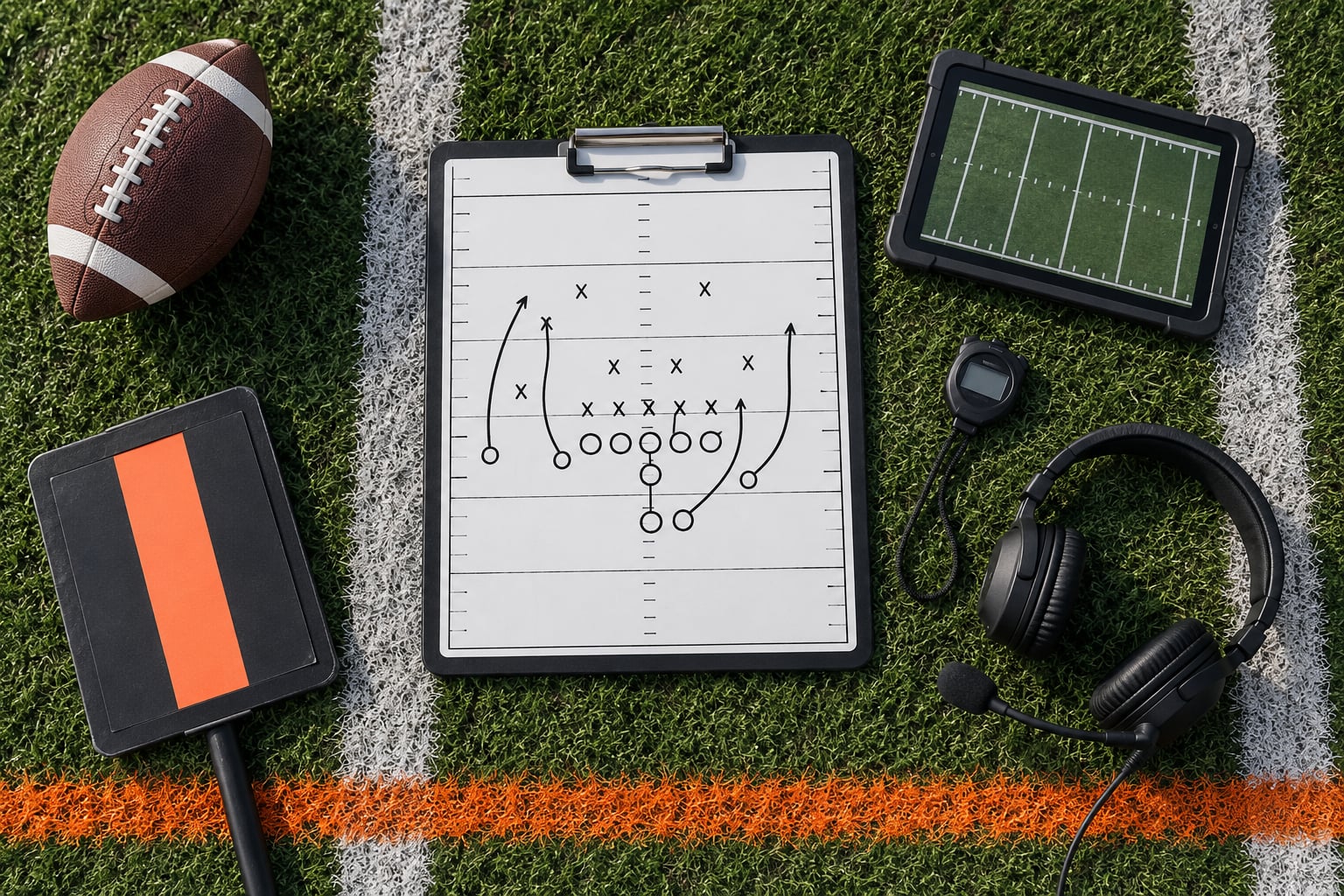
The head coach owns the call. In practice the chain runs from the head coach to the offensive and special teams coordinators, with the quarterback weighing in on what protection he can count on, and an analyst in the booth with a tablet showing the win-probability comparison.
Everything happens between the whistle and the snap, which is roughly thirty seconds of real time including substitutions. The coach signals the formation from the sideline, the play call travels through the headset, and a run action protects the call from a loud stadium in a way a pass does not. A failed conversion is also a turnover in the most literal sense: the ball is dead and the opponent takes over at the spot.
| What the model weighs | What only the staff can weigh |
|---|---|
| Score, time, timeouts, field position | How the quarterback feels in the pocket right now |
| League conversion rates by play type | Whether this defense has given up a try on the same goal line |
| Whether the opponent can answer | Injuries, weather, and a kicker having a bad night |
| Expected win probability for each option | Trust in the play the coordinator wants to call |
The broadcast decision guide fans see on television is the same comparison, made in public. Coaches rarely complain that a call was wrong by the numbers, because the numbers are usually right, and they complain instead that the other factors were heavier that night.
How Are Expected Points Used to Make the Call?
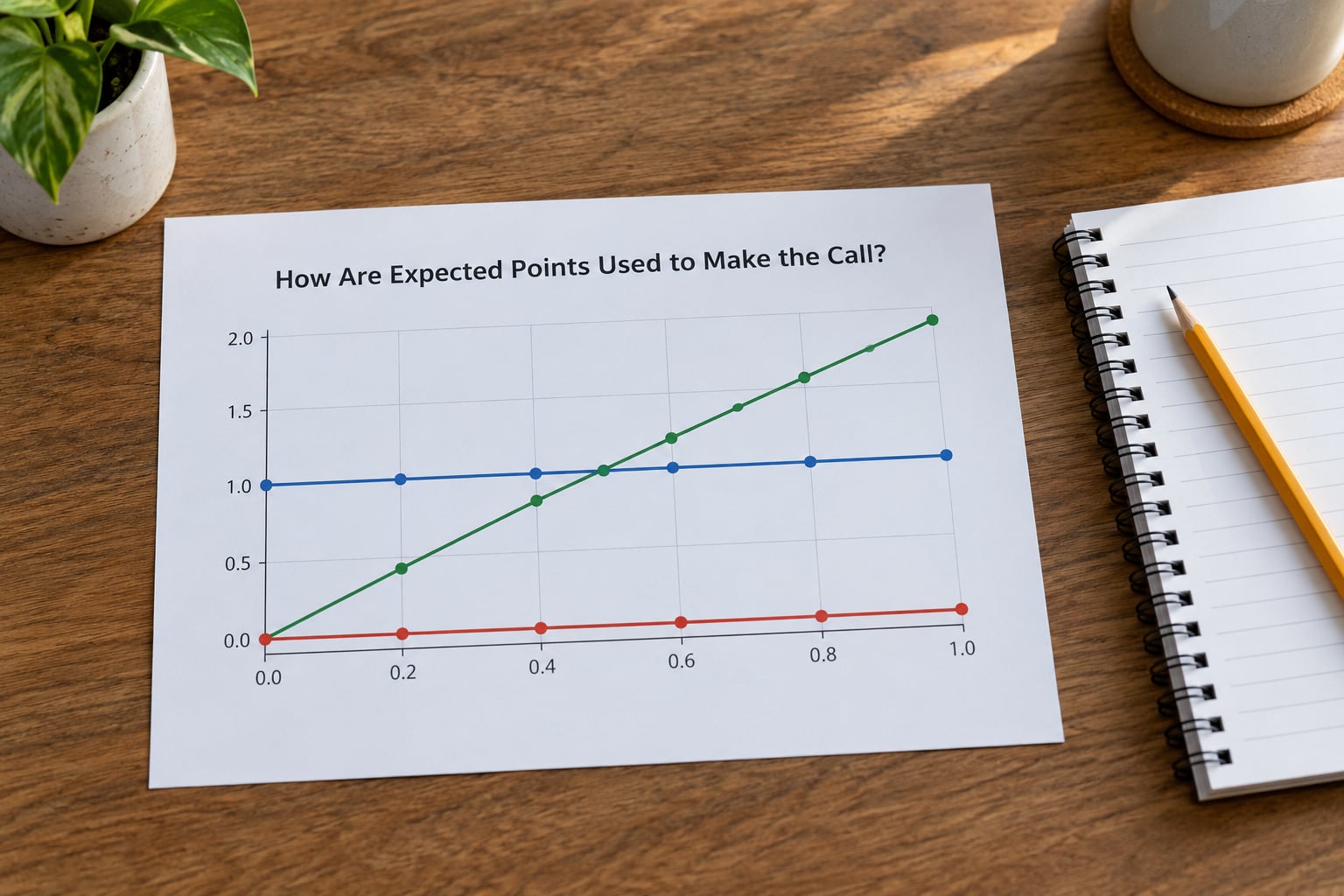
In expected points the two options are almost identical. A 95 percent kick is worth 0.95 points and a 48 percent conversion is worth 0.96, so the point totals alone would make every coach look like an idiot for trying anything. Scoring two is never better on average. It is better in the specific states where a one-point margin can lose you the game.
That is why the real comparison is win probability, not points. Each option gets a win probability for the situation as it stands, and the staff takes the higher one. Fans see the threshold expressed as a break-even rate: roughly in the forties for the common late situations, which matches the practical bar coaches quote, a conversion chance better than about 40 percent.
| Situation at the moment of the try | About what your play needs to beat |
|---|---|
| Down one late, going for the lead | A very low bar; most real plays clear it |
| Tied late, kicking to force overtime | A low bar, below a team’s typical rate |
| Down four in the final minutes | Low to mid range |
| Down eight in the final minutes | Around the forties |
| Up seven | Around the forties |
| Up nine | Roughly a coin flip’s worth of value |
| Down fourteen with one scoring chance | Your extra point rate, because the kick is the only real option |
When Do Coaches Go for Two Instead of Kicking the Extra Point?
The common situations are well known: down one late, tied late, up seven, up nine, and down four where the overtime math flattens the difference. A team down eight with eight minutes left is the classic one, because a conversion produces a nine-point lead that no field goal touches.
Less common cases are more revealing. Going for two down five to protect against a two-point score is technically correct and almost never done. Going for two to pick up a first down later in the game is a genuine value play when the kicker’s number is poor. And going for two down two in the third quarter makes sense for a team whose defense has already shown it can stop the clock and force punts.
Kicking has its own hidden value people forget. A made extra point starts the opponent at their own 25 with a full complement of timeouts, which is the least useful field position in football. A failed try gives them the ball on their own two. Coaches who go for two late on purpose are often buying the opponent worse field position as much as buying points.
What Are Common Fourth-Quarter Examples?
Down one with two minutes left, no timeouts. Kicking ties the game and hands the opponent the last word. A conversion attempt wins outright if it lands and leaves the opponent facing fourth-and-long, so a staff with a play better than about 40 percent should go, and a staff without one should kick and trust its defense.
Tied late in overtime. In the NFL the first overtime possession is kicked, which means a tie at the end of regulation simply repeats the kick. Going for two there trades a guaranteed tied score for a real chance to be ahead in a game you would then have to survive.
Ahead by one before the final drive. Nothing is available. The team on offense should kick to force the opponent to score a touchdown, and the team that is up one has no reason to convert unless the kicker situation is bad enough to matter.
Down eight and unable to tie with a field goal. Kicking produces a tie and overtime. A conversion produces a nine-point lead, and failing one produces no way to tie at all, which is why this row carries a higher bar than a casual read suggests. Failing early to set up a later attempt is a strategy people do describe, and it rarely survives contact with a defense that can field a punt.
The famous down fourteen case follows the same logic in reverse, because the kick is close to certain. A derivation circulated on r/nfl sets the two routes equal, treating the first conversion as fully valuable and the second as worth half as much, which reduces to P + (1 minus P) times P times 0.5 = 0.5 and solves to about 38.2 percent. Treat it as a teaching example rather than a rule. It assumes two clean scoring chances and equal kicking, and real games supply neither.
What Can Go Wrong When Coaches Use Conversion Data?
Small samples do most of the damage. A team that has gone for two three times and made two is not a 66 percent team, and a coordinator who reads it that way will take a bad shot with a worse one available.
Opponent effects matter just as much. Conversion rates differ by defense, by goal-line scheme and by front, and a rate computed across all opponents averages those differences away. Injuries, weather, the offensive line, and a defense that has already seen your package in the fourth quarter all move the real number without moving the season statistic.
Coaching staffs also separate what the model said from what they did, and both from what happened. When a coach goes against a number and the try fails, the result looks like a bad decision even when the reasoning was sound. The fair way to judge a call is to reconstruct the inputs at the moment of the decision, not to look at the scoreboard afterward.
One more edge case belongs here. A conversion attempt can be intercepted and returned for two points, and an offense can score a safety by being knocked down in its own end zone, which is worth one. The first defensive two-point conversion return in NFL playoff history came in January 2025, which is how a rarity became a headline.
Frequently Asked Questions
When should a football coach go for a two-point conversion?
Go for two when the extra point leaves you in a worse state than the try does: down one late, tied late, up seven, up nine, or down four with little time left. The practical test coaches quote is whether the play available converts better than about 40 percent. Everything else follows from how much possession and clock each option preserves.
Is going for two always better after taking a two-point lead?
No. A conversion gives you a three-point margin, which protects against one field goal but not a touchdown, and it does nothing for the rest of the game. Kicking leaves you up two and hands the ball back at your own 25. Early in a one-score game the kick is the safer state, which is why most early conversions turn out badly.
What conversion rate should coaches expect on a two-point try?
League-wide, teams have converted roughly 47 to 49 percent of attempts since the 2015 extra point distance change. Run attempts convert about 61.7 percent and passes about 43.4 percent. College attempts run at a similar clip, and the three-yard spot there is easier to reach than the two-yard line used in the NFL.
Does a team’s overall two-point conversion percentage predict its next attempt?
Not reliably. Teams rarely face identical situations, and a season number blends easy late attempts with fourth-quarter goal-line stands. The better predictors are the specific play, the opponent’s goal-line defense, and the scoreboard state. Staffs treat a season percentage as a starting guess and adjust it for matchup before committing.
How do analytics explain how two point conversion decisions are made?
Analytics compares the win probability of kicking the extra point with the win probability of running the try, using score, time, timeouts and the expected success rate of the play. The option with the higher expected win probability wins. Broadcast decision guides show fans that same comparison live, and most calls are worth less than a couple of points of win probability.
What Should You Consider First When Judging a Call?
Start with the score and the clock at the moment the decision was made, not the final margin. Then find the break-even rate for that exact state and ask whether the play the team ran had a shot at clearing it. Personnel and field position explain most of the gap between the model and the coach.
If you take one thing from this, let it be that expected points will never explain the call, and the final score will never explain it either. Convert the moment into inputs, and the call makes sense more often than the outcome suggests.