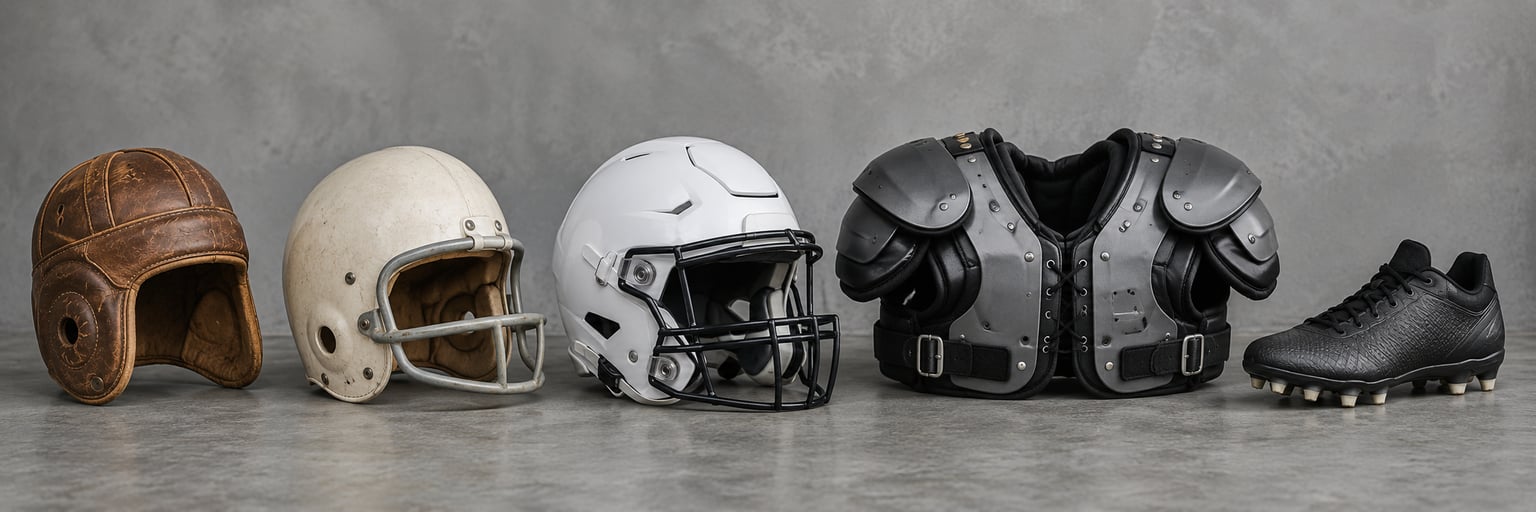
College football equipment has changed over time in three broad strokes: leather caps in the 1880s, fiber shell helmets by the 1930s, and polycarbonate shells with advanced facemasks today. The shift came from rule changes, new materials and rising safety standards, and it turned a nearly bare-knuckle game into one where every player wears a helmet, shoulder pads and position-specific protection.
Table of Contents
- How College Football Equipment Has Changed Over Time
- From Leather Caps to Hard-Shell Helmets
- Why Shoulder Pads and Body Armor Got Bigger
- How Facemasks Changed Style and Safety
- The Evolution of Cleats and Football Footwear
- How Uniforms Served the Game
- Technology Added a New Layer of Performance
- Why the Changes Were Not Always About Safety
- What Modern Equipment Still Cannot Solve
- Frequently Asked Questions
- The Big Takeaway
How College Football Equipment Has Changed Over Time
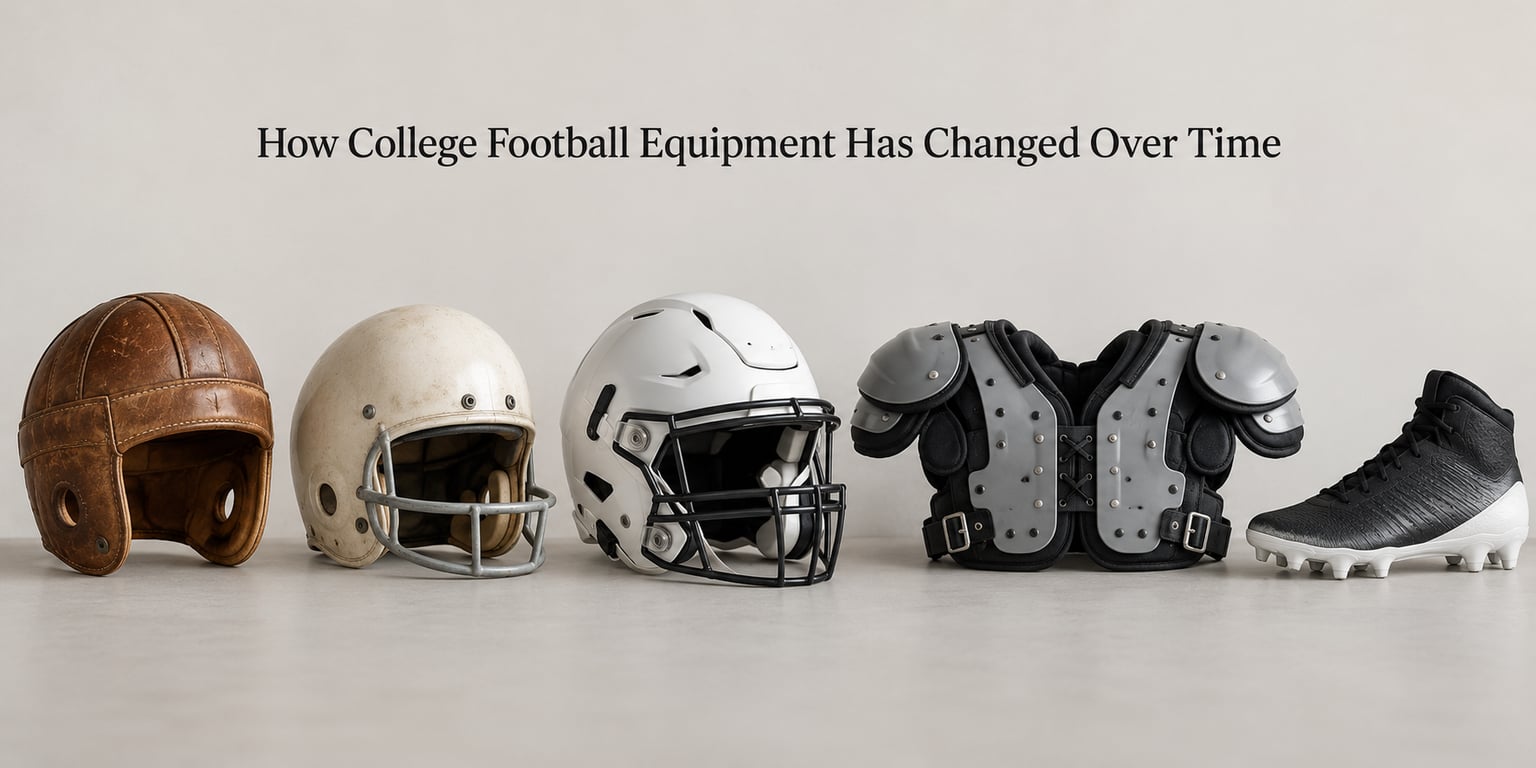
The clearest way to read the history is by era, because each material change made the gear before it obsolete almost overnight.
| Era | Helmet shell | Typical facemask | Typical pad silhouette | Signature look |
|---|---|---|---|---|
| Leather era (1886-1930s) | Molded leather with a leather head harness | None, or a leather strap | Canvas and quilted stuffing, no hard plates | Small soft cap, bare face, wool jersey |
| Fiber shell era (1930s-1950s) | Pressed paper and early plastic composite | Single-bar steel mask from the mid-1950s | Hard shoulder plates appear, neck rolls common | Rigid helmets, squared shoulder line |
| Plastic era (1950s-1980s) | ABS plastic, air bladder and suspension systems | Double-bar cage on most positions | Large plate pads, bigger thigh and rib padding | Bulky shoulders, thick neck rolls, loose jerseys |
| Modern era (1990s-now) | Polycarbonate composite, vented shells | Position-specific cages on low-profile mounts | Low-profile plates with segmented foam | Tight jersey, visible numbers, minimal padding |
Milestones worth remembering as you scroll old film or look at a current sideline:
- 1886 – George Barclay is credited with the first football helmet, a padded leather cap.
- 1888 – a rule change allowed tackling below the waist, and protection had to catch up fast.
- 1939 – college football makes helmets mandatory; 1943 the NFL follows.
- 1940 – the first plastic shell helmet arrives, and the chin strap moves into place.
- 1955 – the single-bar facemask, developed with coach Paul Brown, spreads through the sport.
- 1976 – the four-strap chin strap debuts in college football and becomes standard.
- 1980s and 1990s – polycarbonate shells and vinyl-coated steel alloy facemasks go universal.
- 2004 – Riddell introduces the Revolution helmet, the first major mass-market helmet aimed at concussion risk.
From Leather Caps to Hard-Shell Helmets
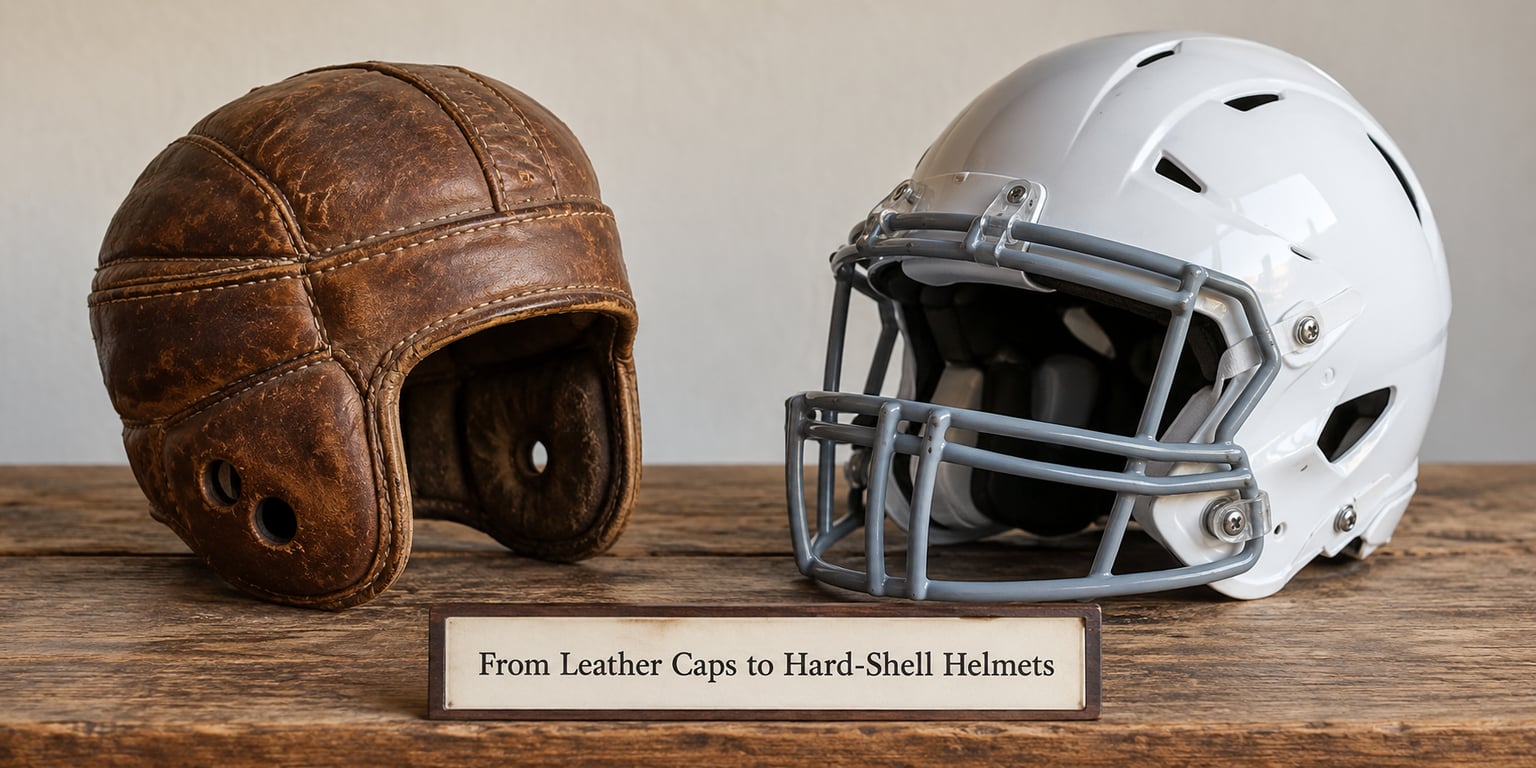
Early helmets were leather caps. They absorbed a little, mostly on the top and back of the head, and left the face, jaw and temples completely open. A 1920s Canton Bulldogs leather helmet or a 1930s Cleveland Skeletons full leather mask with its glow-in-the-dark eyeholes now reads as intimidation theater more than protective equipment.
Fiber shell helmets, pressed from paper and later reinforced with early plastics, spread through the 1930s and gave the head a rigid outer surface. That was the first real jump, because the shell could hold its shape on impact instead of deforming around it.
What came after was plastic, then polycarbonate composite. The modern shell is lighter than its plastic predecessors, vents air through channels cut into the crown, and is shaped to cover more of the temple and back of the skull than the leather caps ever did.
Designers still juggle the same four constraints they juggled in the 1950s: impact absorption, field of vision, weight and heat. Every gram removed from the shell is a gram less on the neck, and every degree of the shell’s surface area is a place where heat collects in a September fourth quarter.
Why Shoulder Pads and Body Armor Got Bigger
Shoulder pads started as soft cushions, essentially quilted stuffing sewn into a canvas or leather vest. They added almost nothing against a straight-line hit and nothing at all against a twisting one.
Structured plastic plates changed that. Hard plates over the shoulders, ribs, hips and thighs spread the force across a wider area of the body and kept a tackler’s weight from landing on one collarbone. That is the genuine protection story.
Everything past that point is silhouette. The 1970s and 1980s produced the widest pads the sport has ever seen, sold in sizes well past what an athlete needed, worn over neck rolls and thigh pads that added width rather than coverage. Collectors and fans describe that era as the last time football players looked like warriors on screen, and it is the era most of them picture when they say equipment got better.
Ribs, hips, knees and tailbone protection all matured over the same stretch. Gloves moved from leather palms to synthetic tackiness materials designed for grip in wet conditions, and the mouthpiece became a required, molded piece rather than something a player might keep in a helmet pocket.
| Category | Then | Now |
|---|---|---|
| Shoulder pads | Canvas and stuffing, then oversized plates | Segmented low-profile plates with foam impact layers |
| Hip, thigh and knee pads | Detachable, optional, inconsistently worn | Built into the pant system and tuned by position |
| Gloves | Thin leather palms | Position-cut synthetic gloves with reinforced palms and cuffs |
| Mouth and rib | Optional, sometimes improvised | Mandated molded mouthpiece, position-specific rib protection |
Position matters more than era here. A quarterback today wears rib protection because he takes hits on every dropback, a linebacker carries heavier hip pads for a reason, and a skill player strips the padding down to stay quick. Bulk alone tells you very little.
How Facemasks Changed Style and Safety
For decades the face was simply uncovered, then wrapped in a leather strap. The single-bar steel facemask arrived around 1955, developed by John T. Riddell with coach Paul Brown, and it was the first mask that both protected the nose and let players see the field.
Everything after that was incremental and rule-driven. Double-bar cages spread as rules penalized players for repeated facemask penalties and as defenders found a single bar gave a runner room to grab and pull. Position-specific cages followed, because a quarterback needs visibility a lineman does not.
Materials improved in parallel. Vinyl-coated steel alloy replaced bare steel, so a broken bar stopped slicing open a face, and attachment systems moved off simple bolted clamps onto quick-release mounts that teams can change between practice and game. Rule enforcement pushed this along as much as injury data did; once facemask contact carried a penalty, coaches treated the mask as a piece of equipment to be managed rather than a permanent fixture.
The Evolution of Cleats and Football Footwear
Molded leather cleats were the standard for most of the sport’s history, with studs cut into the sole. When grass gave way to artificial turf in the 1960s and 1970s, studs that gripped natural grass became a liability on a hard, fast surface, and the first interchangeable stud systems appeared.
The practical change was control. Screw-in studs let a player swap a long stud for a short one when the surface turned dry, and later systems moved to molded stud plates with replaceable studs on a rotary or releasable base. That mattered more than any styling change in the category.
Position-specific footwear followed the same logic as everything else. Linemen get wider, flatter bases for stability against a push. Skill players get narrower, more tapered molds because cutting and acceleration matter more to them than holding ground.
Keep footwear gains separate from other changes, though. A modern cleat grips better, but so does a modern field, and the speed of today’s offense comes from rule structure and scheme as much as from the shoe.
How Uniforms Served the Game
Early uniforms were heavy wool and cotton. They soaked sweat, restricted shoulders and made players heavy and slow by the third quarter.
Synthetic mesh changed that, and it changed it for a practical reason rather than an aesthetic one. Breathable mesh moves moisture away from the skin and vents heat, which matters in a sport played in September in the South. Stretch fabrics added later let a shoulder pad sit under a tight jersey instead of forcing a loose one to cover a wide pad set.
Padding itself moved into the garment. Integrated hip and thigh padding in the pants is now standard, so the protection travels with the uniform instead of depending on what a player remembers to strap on. Numbering improved at the same time, and the current fitted silhouette, with large numerals and a visible nameplate, exists partly because television needs to identify players instantly.
Technology Added a New Layer of Performance
Equipment stopped being only protective and became informational. Impact sensors in helmets and pads log hits and rotational forces, which gives medical staff data on a hit that knocks a player off the field rather than waiting for him to say something feels wrong.
GPS tracking turned practice into a measurable session. Coaches can see sprint counts, distances covered and how a player’s output changes across a week. Temperature and hydration monitoring, often delivered through the same wearable layer, flag heat risk that a practice schedule alone will not reveal.
Virtual and augmented training let a quarterback take reads against simulated fronts and let linemen work technique without a full unit on the field.
One rule holds across all of it: data supplements properly fitted protective gear, it does not replace it. A sensor reading does not tell a coach whether a helmet fits.
Why the Changes Were Not Always About Safety
Some of the most visible gear changes were driven by things other than injury prevention.
Television shaped the helmet and the uniform first. A facemask gave a player’s face to the camera, and a team logo large enough to read on a television screen became a recruiting tool before it became a brand tool. Bright uniform numbers exist so a viewer can follow a play, not because a defender needs help finding the ball carrier.
Intimidation has always been an honest motive. Hard plastic masks, oversized shoulder plates and long chin straps in the 1970s and 1980s were sized and shaped to make a player look larger than the man underneath them.
Rule enforcement changed equipment as surely as it changed tactics. Penalties for facemask contact, for striking with the forearm and for contact above the shoulders pushed coaches toward equipment choices that reduced the chance of a flag. The helmet collar, the reduced facemask and the padded elbow all carry a little bit of penalty prevention in their design.
Commercial competition pushed the rest. The modern era is defined as much by two equipment companies competing on shell geometry and moisture management as by any safety standard.
What Modern Equipment Still Cannot Solve
Better materials have not removed risk, and anyone who tells you otherwise is selling something.
Fit is the biggest remaining variable. A helmet that is a quarter of an inch off can rotate, and rotation is what the impact sensors are usually reading for. Poor fit comes from teams that skip the fitting process or reuse gear across positions.
Heat is the second problem. Vented shells and lightweight fabrics manage temperature, they do not erase it. A full set of pads in late-summer heat is still heavy.
Concussion risk sits underneath all of it. Modern helmets are tested against impact velocities and designed to manage rotational force, but diagnosed concussions have not fallen at the rate the materials science would suggest, because the game involves more contact and more practice contact than it once did.
Field conditions, position differences and improper use finish the list. A set of skill-position pads on a lineman looks like protection and functions as decoration, and cleats chosen for grass on artificial turf create problems that no facemask design solves.
Frequently Asked Questions
When did college football players first wear helmets?
The first credited football helmet dates to 1886, when George Barclay built a padded leather cap. Helmets were optional for decades after that, mostly because they were hot and heavy. College football made them mandatory in 1939, and the NFL followed in 1943. Plenty of college players still chose to go without until well into the 1940s.
Were early football helmets mainly for safety?
Partly. The leather caps of the 1880s through the 1930s offered little real impact protection, leaving the face, jaw and temples completely open. They also carried a serious intimidation function, and full leather facemasks like the 1930s Cleveland Skeletons design were as much about looking fearsome as about absorbing a hit.
Why did football facemasks become mandatory?
Facemasks spread because repeated penalties for facemask contact made them a practical choice, and because injuries to noses and eyes became visible and common. The single-bar steel mask developed in the mid-1950s offered real protection, and rules soon required teams to remove illegal bars. Modern position-specific cages exist partly for the same reason.
Can modern football equipment prevent concussions?
No equipment prevents concussions entirely. Polycarbonate shells, air bladder systems and rotational-force management reduce severity in testing, and impact sensors help staff catch hits that a player might not report. But diagnosed concussions have not fallen as much as the materials would suggest, because practice volume and contact in the game itself have gone up.
What equipment changes are fans likely to see next?
Expect more position-specific shells built for visibility and mobility, lighter composite materials as shell designs get refined, and sensors that feed a player’s medical record directly instead of only a team dashboard. Throwback and vintage-inspired uniform designs are also increasingly common, driven by growing fan interest in the high-profile eras of the sport.
The Big Takeaway
The whole arc is short enough to state plainly. Equipment went from limited protection to specialized protection, from simple construction to data-enabled systems, and from gear a whole team shared to equipment built around a single position.
If you want to trace the sport’s history through its gear, start with the helmet and padding era. That is where the visible change is clearest, where the dated milestones sit, and where almost every later question about college football equipment has its roots. Refresh this guide for 2026 gameday and you can hold your own in any conversation about why players looked the way they did in a given season.