Football helmets are rated for safety on three separate layers: a NOCSAE pass/fail certification that every legal helmet must clear, Virginia Tech STAR star ratings that rank certified helmets on concussion risk, and NFL/NFLPA lab results that grade pro models year by year. No layer makes a helmet risk-free, and each one answers a different question.
The confusion is understandable. A parent hears “NOCSAE approved” from a league and assumes that is the end of the safety conversation, while a fan sees a green helmet on an NFL poster and assumes it is the safest thing on any field.
Both assumptions are wrong. Here is how each rating system actually works, what it measures, and what it leaves out.
Table of Contents
- What Does It Mean to Rate a Football Helmet for Safety?
- How Football Helmets Are Rated for Safety
- Which Football Helmet Safety Standards Are Used in the United States?
- What Do the Helmet Impact Tests Measure?
- What Is the Difference Between a Certified Helmet and a Safe Helmet?
- How Do You Choose a Properly Rated Football Helmet?
- Frequently Asked Questions
- Conclusion
What Does It Mean to Rate a Football Helmet for Safety?
Rating a football helmet means measuring how much head acceleration the shell and liner absorb in laboratory impacts, then converting those measurements into a number that predicts injury risk.
Three organizations run the systems readers run into. NOCSAE, the National Operating Committee on Standards for Athletic Equipment, writes the standards and certifies models through the Safety Equipment Institute. Virginia Tech’s Helmet Lab tests helmets independently and publishes STAR ratings from one to five stars. The NFL and the NFL Players Association run their own lab and publish an annual performance poster for professional models.
What none of them do is promise that a player will avoid a concussion. Ratings describe performance under controlled laboratory conditions. Field use adds variables the lab cannot reproduce, including fit, age, neck strength, helmet age and how the head was moving before contact.
How Football Helmets Are Rated for Safety
How football helmets are rated for safety comes down to three layers of evidence. NOCSAE certification is a pass/fail floor built mainly around skull fracture risk. Virginia Tech STAR ratings rank certified helmets one to five stars, with five stars indicating the lowest modeled concussion risk. NFL/NFLPA lab results place pro models into recommended or limited tiers based on measured rotational and linear performance. Each layer answers a different question, and only the first two apply to most players.
- NOCSAE certification. A manufacturer submits a model to an accredited laboratory. If it clears every criterion in the applicable standard, the helmet can carry a NOCSAE seal and appear on the SEI certified list. There is no score, only pass or fail.
- Virginia Tech STAR ratings. Each certified helmet is put through 48 impacts. Sensors record peak linear and rotational acceleration at each hit, those values become injury-risk values, and the risks are summed into a single score. That score becomes a star rating.
- NFL/NFLPA lab results. Pro models are tested annually with the same basic approach but different equipment, and the results are published as a color-coded poster. Green models are recommended. Gray models are worn by fewer than one percent of NFL players.
| System | Who runs it | What it measures | Scoring | Who it applies to |
|---|---|---|---|---|
| NOCSAE certification (ND002) | NOCSAE, tested at SEI-accredited labs | Pass/fail performance against a published standard | Pass or fail, no ranking | High school and older |
| NOCSAE youth standard (ND006) | NOCSAE with the Safety Equipment Institute | Youth-specific impact limits plus mass and rotational caps | Pass or fail | Youth players, effective September 1, 2027 |
| Virginia Tech STAR ratings | Independent university lab, manufacturer-funded testing | 48 impacts, linear and rotational acceleration, weighted concussion risk | 1 to 5 stars, 5 is best | Anyone; youth and adult lists are separate |
| NFL/NFLPA lab poster | NFL and NFL Players Association | Linear and rotational performance on pro models | Recommended or limited tier | NFL players primarily |
Which Football Helmet Safety Standards Are Used in the United States?
NOCSAE standards are written by a committee with manufacturer representation, reviewed by the Safety Equipment Institute, and enforced by state high school athletic associations, the NFHS and the NCAA.
NOCSAE certification is the legal floor, not a ranking
The standard most adults ever meet is ND002, which covers football helmets used by players in high school and above. Its famous drop test lowers an instrumented headform onto a steel anvil from a set height at six impact locations, with a severity index ceiling of 1200. A lower severity index means the helmet softened the blow more.
Newer versions of the standard add rotational testing, because lab and field research both point to twisting acceleration rather than straight-line force as the mechanism most associated with brain injury. Community skeptics on helmet forums put it bluntly: the drop test is a skull-fracture test, so passing it tells you little about concussion protection.
ASTM International supplies the consensus test methods that NOCSAE’s requirements reference. Those are laboratory procedures, not consumer ratings.
The new NOCSAE youth standard (ND006)
ND006 is the first NOCSAE performance standard written specifically for youth players, and it takes effect September 1, 2027. Two numbers define it: a helmet tested on a small headform cannot exceed 3.5 pounds including facemask and attachments, and rotational acceleration during testing cannot exceed 5,000 radians per second squared.
The mass cap is the part that catches parents off guard. A heavy helmet adds rotational force to every hit, and youth players have proportionally larger heads and weaker necks than adults.
Families with a league that buys helmets should ask the administrator in advance how the transition will be handled, since requirements can change without much notice.
What Do the Helmet Impact Tests Measure?
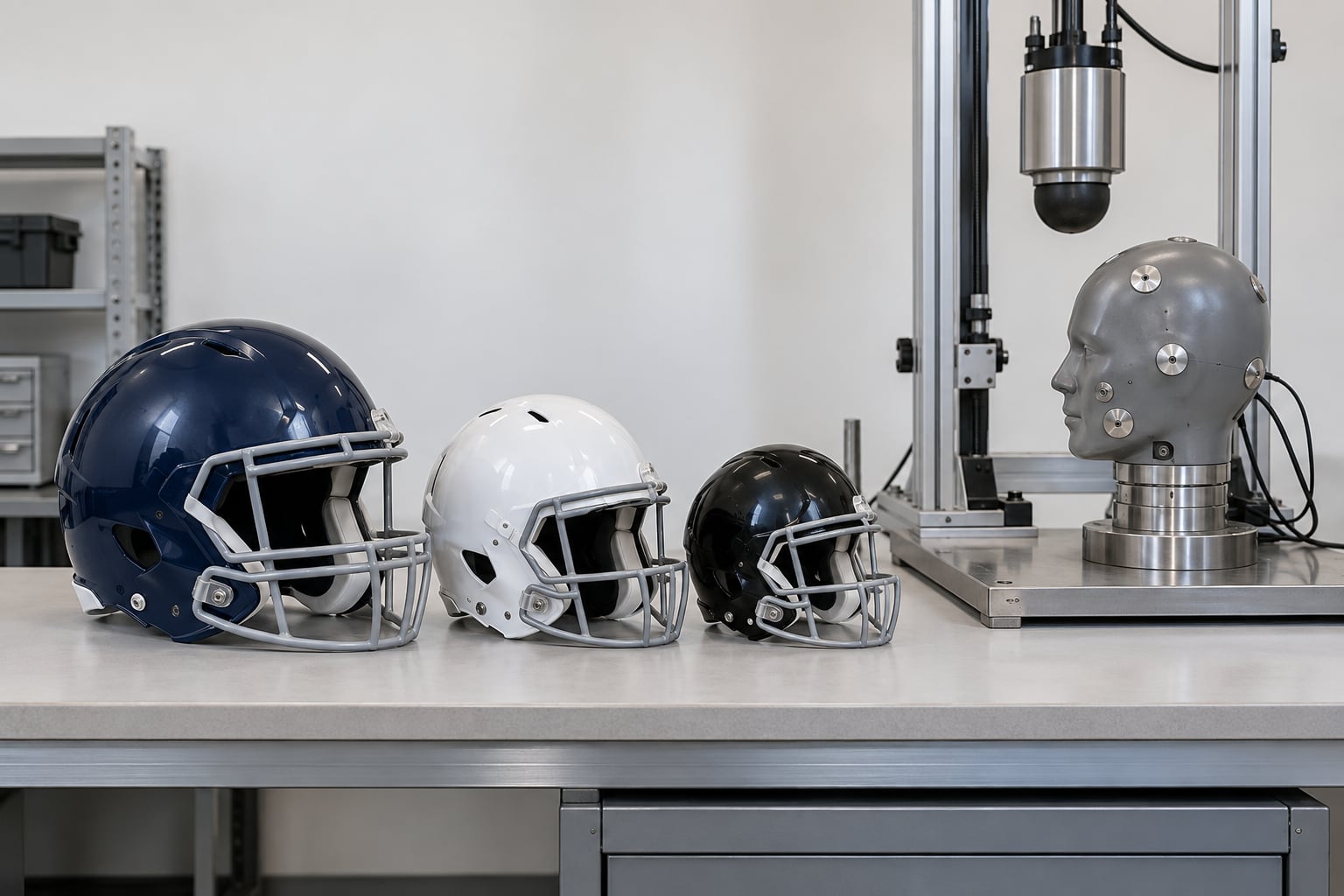
Every lab impact follows the same basic recipe: a calibrated impactor, often a pneumatic or drop-weight rig, strikes a helmet mounted on an instrumented headform at a defined location and speed.
Virginia Tech’s youth protocol runs 48 impacts per helmet, hitting the front, front boss, side and back of the shell at low, medium and high energies to mirror the mix of head-to-head and head-to-ground collisions in actual games. Adult tests follow the same logic with a different headform size and a youth-appropriate pendulum for the smaller helmet.
Linear versus rotational acceleration
Linear acceleration is the straight-line force of a head snapping forward or sideways, measured in g-forces. Rotational acceleration is the twisting force, measured in radians per second squared, and it is what laboratory work associates most strongly with diffuse brain injury.
This is why two helmets can sit on the same shelf with the same NOCSAE seal and behave differently in a game. Rotational performance is where the models separate, and it is also where a pass/fail standard says the least.
How the STAR score is calculated
STAR stands for Summation of Tests for the Analysis of Risk. Each impact produces a peak linear and rotational measurement, those numbers are converted to a predicted injury-risk value, and each value is weighted by how often that specific type of hit happens in real play before everything is added up.
The counter-intuitive part catches nearly every new reader: a lower STAR score is better. Lower scores then map onto five, four, three, two or one star. Only one helmet received five stars when Virginia Tech began publishing ratings in 2011.
Scores are not comparable across sports. The Virginia Tech bicycle and ski ratings use the same STAR machinery but different helmets, headforms and test protocols, so a five-star bike rating says nothing about a football helmet.
Why Virginia Tech star ratings change from year to year
Star ratings are curve-adjusted. Members on r/cycling and mtbr forums, and parents in youth-league groups, describe the same experience: a helmet keeps its name and its shell and still loses a star, because when enough newer helmets score better, the lab tightens the curve and recalibrates the scale downward.
So a rating change does not mean the helmet changed or that a safer helmet became unsafe. It means the yardstick moved. Anyone comparing ratings across seasons should compare only within the same published year.
What Is the Difference Between a Certified Helmet and a Safe Helmet?
Certification proves a helmet met a published minimum under laboratory conditions. Safety in practice depends on far more, which is why forum consensus treats fit as at least as important as the star rating.
An ill-fitted five-star helmet can underperform a snugly fitted four-star one, because a loose shell slides and rotates instead of carrying force through the liner. That is a fit problem, not a manufacturing defect.
Which rating applies at your level of play
| Level of play | Certification that applies | Rating data to check |
|---|---|---|
| Youth leagues | ND002 now, ND006 from September 1, 2027 | Virginia Tech youth football ratings list |
| High school | ND002, required by the state association or the NFHS | Virginia Tech adult football ratings list |
| NCAA | ND002, plus conference and NCAA equipment rules | Virginia Tech ratings, then your position rules |
| NFL and practice leagues | ND002 plus league-specific equipment rules | NFL/NFLPA Helmet Laboratory Testing poster |
The line that causes the most confusion: NFL/NFLPA results do not transfer to youth or high school play. Those tests use different equipment and a different headform, and the pro lab’s own ratings are not validated for smaller, younger players.
Fit, foam and replacement
Liner foam is viscoelastic. It compresses, absorbs energy, and slowly recovers, but it loses performance with heat, age and repeated compression, and it does not bounce back to factory condition.
That is the argument for recertification rather than automatic trust in a date that looks recent. Parents in youth-league groups share a simple habit: check the certification date on the back or inside the shell, and treat anything several seasons old as a conversation with the league rather than a keeper.
Do helmet add-ons like Guardian Caps count?
They do not appear in NOCSAE certification or in a Virginia Tech star rating, because neither body scores aftermarket attachments. Published testing on add-on cap systems reports reductions in the range of 3 to 8 percent for linear acceleration, 5 to 14 percent for rotational, and 15 to 34 percent for overall modeled concussion risk.
Treat those as directional rather than settled. The most common criticism from parents is that add-on pages use rating language to sell accessories, so look for independent testing rather than brand claims.
How Do You Choose a Properly Rated Football Helmet?
Start with the certification, then let the rating break ties between models that clear it. Six checks cover most of it.
Six checks before a player puts a helmet on
- Look for the NOCSAE seal on the shell. It should be molded or printed inside the shell, not on the packaging or a marketplace listing. Unbranded look-alike helmets with no seal show up regularly on resale sites.
- Confirm the model is on the SEI certified list. A seal on the shell is not enough if the model has been discontinued or never finished certification.
- Check whether the helmet is youth or adult. Youth helmets are built for smaller headforms, and the shell, liner and facemask sizing differ. Putting a child in an oversized adult helmet is a common and expensive mistake.
- Read the certification date. It tells you when the helmet was recertified. Older is not automatically unsafe, but it is a reason to ask the league about replacement.
- Pick the position-appropriate model. Linemen need a larger shell and a different facemask than a quarterback, and position-specific models are rated in their own category.
- Fit it in person, every season. The shell should sit level, the padding should touch evenly on both sides without gaps, and the chinstrap should stay taut when you tug gently. If a fitter is available through the retailer or the league, use them.
One honest caveat about the research side: some studies have found that helmetless practice reduced head impacts, which unsettles people who assume more helmet time is always safer. The careful reading is that these were practice findings, not game findings, and they do not apply to organized play where a certified helmet is required.
Frequently Asked Questions
How to tell if a football helmet is certified?
Look for the NOCSAE seal molded or printed inside the shell, then confirm the exact model appears on the Safety Equipment Institute certified list. A seal alone is not enough, since look-alike helmets and discontinued models both circulate. Check the recertification date printed on the shell as well, and buy from a retailer rather than a resale marketplace.
What are the NOCSAE football helmet standards?
ND002 covers football helmets for players in high school and older, combining a drop test with rotational impact limits. ND006 is the first youth-specific performance standard, capping helmet mass at 3.5 pounds on small headforms and rotational acceleration at 5,000 rad/s², and it takes effect September 1, 2027. Certification is pass or fail, so it sets a floor rather than ranking models.
How to tell if a football helmet is youth or adult?
Youth helmets are molded for smaller headforms and usually carry a youth size label inside the shell; adult and varsity models do not. The practical check is head measurement compared with the size range printed on the helmet. An oversized adult helmet adds mass and lets the shell shift, so a proper fit matters as much as the rating.
What is a good Virginia Tech helmet rating?
Four stars or better is the practical target, with five stars reserved for the top performer or two in a given year. Remember that a lower STAR score is better, and that ratings are curve-adjusted each year, so a helmet can lose a star without changing. Compare ratings only within the same publication year, and match the list to the player’s age group and position.
Do NFL/NFLPA helmet ratings apply to youth players?
No. The NFL and NFL Players Association lab tests professional models on adult headforms with different equipment, and those results are not validated for youth or high school players. Parents should rely on NOCSAE certification plus the Virginia Tech youth ratings list for younger children, and the Virginia Tech adult list for high school and older players.
When should a football helmet be replaced?
Replace it after any hard impact with signs of shell or liner damage, after a crash in which the helmet took a direct blow, or when the certification date on the shell is several seasons old and the liner feels hard or compressed. Recertification exists because liner foam loses performance with age and heat. League and school replacement rules vary, so check them before buying.
Conclusion
Here is what to do first: confirm the helmet carries a NOCSAE seal and appears on the SEI certified list, check the recertification date printed on the shell, then fit it properly and inspect the shell and padding for cracks or hardened foam. Follow your league or school replacement guidance, and if two models both clear certification, let the Virginia Tech star rating for that player’s age group break the tie.