Most college athletes who tear their ACL need 9 to 12 months from surgery to full competition, and the clock is not what decides when they play. A surgeon, physical therapist, athletic trainer and strength coach clear an athlete only after criteria are met, not when a calendar runs out. That single rule is the one to remember through the whole process.
The rest of this guide walks through what happens in the first days, why the surgery decision is more nuanced than it sounds, what each rehab phase actually looks like, and the parts nobody prepares a freshman for: the eligibility clock, the lost team identity, and the gap between being cleared and actually being the same player.
One note before we start. This is general information about how ACL recovery usually proceeds in the United States, not medical advice and not a plan for any individual knee. Your own timeline belongs to your surgeon and physical therapist, and anyone with a suspected tear or post-op knee should be talking to a qualified clinician, not a search result.
Table of Contents
- What happens after a college athlete tears the ACL?
- How do doctors decide whether surgery is needed?
- How long does it take to recover from an ACL injury?
- How college athletes recover from ACL injuries, phase by phase
- When can an athlete return to football, basketball, or another sport?
- How do college schedules and academics affect ACL recovery?
- How can athletes reduce the risk of a second ACL injury?
- What questions should athletes ask their medical team?
- Frequently Asked Questions
- How long does ACL recovery take for college athletes?
- When can I play sports again after ACL surgery?
- Can you recover 100% from a torn ACL?
- What is the recommended return-to-play protocol after ACL reconstruction?
- What happens 20 years after ACL surgery?
- Is returning too early after an ACL tear dangerous?
What happens after a college athlete tears the ACL?
The ACL, short for anterior cruciate ligament, is one of the four main ligaments inside the knee, and its job is to stop the shin bone from sliding forward and twisting relative to the thigh bone. When it tears, the knee loses that restraint, and athletes describe the moment as their knee giving way or folding, often with a pop, rapid swelling, and a feeling that the joint is unstable.
Tears happen in predictable situations: planting the foot and cutting in the other direction, decelerating hard, landing from a jump with the legs collapsing inward, or contact to the outside of the knee while the foot is planted. Those mechanics are why ACL tears cluster in football, basketball, soccer, lacrosse and gymnastics, and why they are disproportionately an issue in women’s sports, where landing and cutting mechanics differ measurably from men’s.
The sequence after the injury looks like this:
- Evaluation. An athletic trainer or team physician examines the knee, checks for instability and associated injuries, and grades the swelling.
- Imaging. An MRI maps the tear and looks for meniscus damage, cartilage injury, bone bruises and other ligament tears that change the plan. Roughly one in three ACL tears arrives with another structural problem in the knee.
- Protection. The knee is braced or placed in a limited-motion brace, crutches are used until the athlete can walk without limping, and swelling control starts immediately.
- The surgery decision. Operative or non-operative management, discussed below.
- Rehabilitation. A criteria-based physical therapy program that usually runs 9 to 12 months after surgery.
- Return-to-sport testing. A battery of strength, hop and movement tests before clearance.
Surrounding injuries change the calendar more than most people expect. A repaired meniscus, an injured MCL or cartilage damage can push the return back by weeks or months, and those surprises usually land inside a season the athlete has already lost.
How do doctors decide whether surgery is needed?
The honest answer is that there is no single rule, and college athletes fall into the exact group where the debate is still active. The decision usually comes down to the tear pattern, the other injuries in the knee, the demands of the athlete’s sport, and whether the knee is stable enough to function.
ACL reconstruction, the most common surgical path, replaces the ligament with a graft, usually an autograft from the athlete’s own patellar tendon, quadriceps tendon or hamstring tendon. It is well supported for athletes who want to return to cutting and pivoting sports. ACL repair, where the torn ligament is reattached to the bone, is a smaller operation with a growing evidence base for selected tears, though it is not available to everyone. Non-operative management pairs rehab with a brace, and it can work, but it carries a higher rate of the knee giving way again, particularly in young athletes returning to high-risk sport.
| Factor | ACL reconstruction or repair | Non-operative management |
|---|---|---|
| What it involves | Graft reconstruction or reattachment of the torn ligament, followed by structured rehab | Structured rehab, bracing, and activity modification |
| Time to full participation | Typically 9 to 12 months; some return earlier under a criteria-based protocol | Often shorter, but stability and confidence still take time to rebuild |
| Who it tends to suit | Athletes returning to cutting, jumping and pivoting sports | Lower-demand athletes, some cases with a stable knee and no other injuries |
| Main trade-off | A real surgical risk and a long rehab that demands consistency | Higher chance of the knee giving way again during sport |
| What tips the decision | Combined injuries, an unstable knee, high sport demands, a young athlete | Stable knee, few associated injuries, lower pivoting demands |
Position matters more than people expect. A basketball guard cutting off a screen and a football running back decelerating in traffic face different loads than a distance runner or a gymnast landing from a dismount, and the surgical conversation reflects that. Athletes who already have meniscus or cartilage damage often have little choice, because the timeline will be driven by that repair regardless.
Ask the surgeon how the choice affects your calendar specifically. A decision made in August can mean a full missed season; the same tear in February may still allow a return the following fall.
How long does it take to recover from an ACL injury?
Here is the realistic US picture: full return to cutting, jumping and contact competition usually takes 9 to 12 months after ACL reconstruction, with a meaningful number of athletes returning somewhere between 6 and 12 months depending on the sport, the graft, associated injuries, and how consistently rehab went. For non-operative management the range is often shorter, but the stability question follows the athlete for longer.
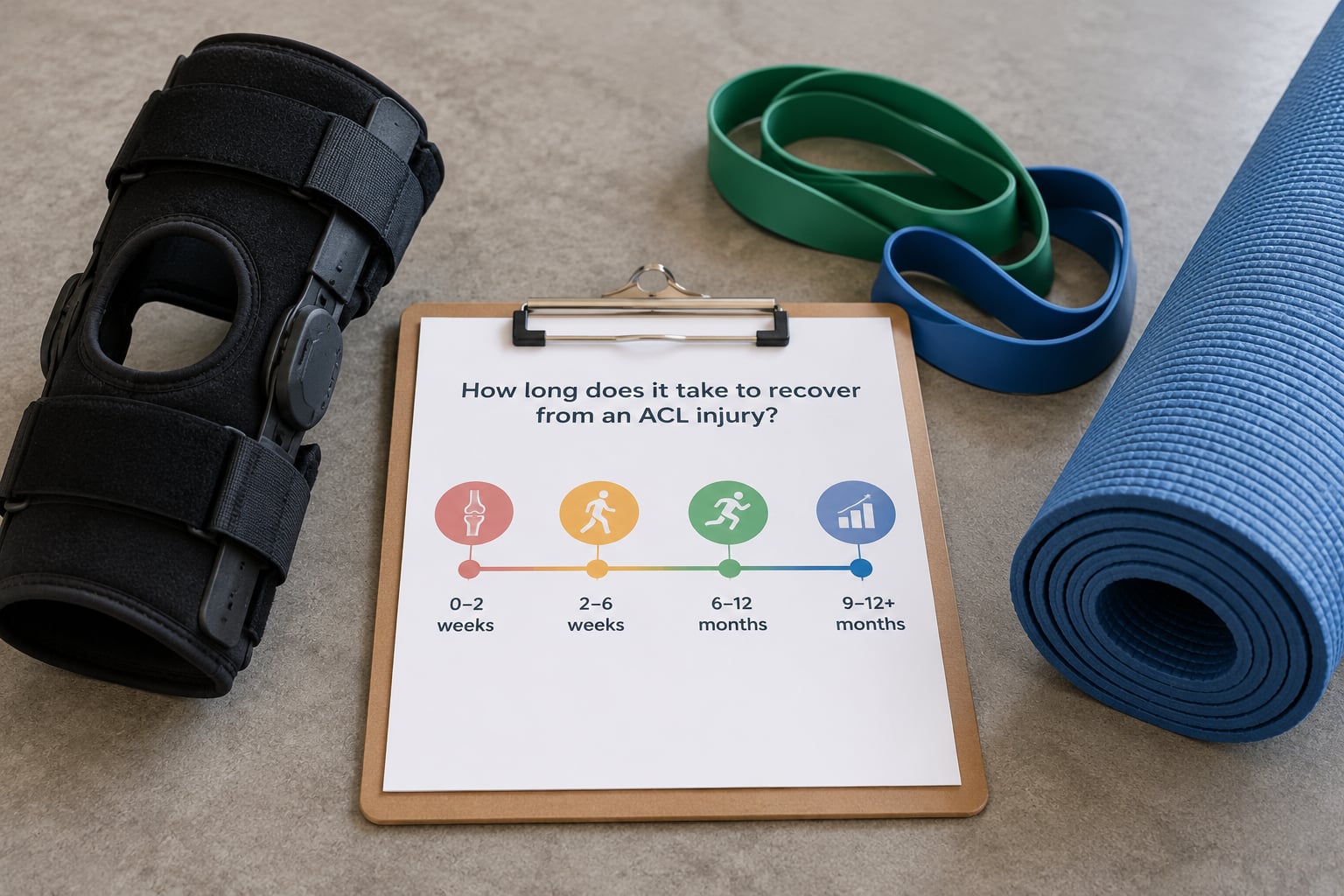
| Phase | Typical timing | Main goals | Gate to move on |
|---|---|---|---|
| 1. Protect and restore motion | Weeks 0 to 6 | Control swelling, protect the graft or healing tissue, restore full knee extension, begin quad activation | Full extension, minimal swelling, walking without a limp |
| 2. Build the base | Weeks 6 to 16 | Restore flexion, rebuild quadriceps and hamstring strength, closed-chain control, stationary bike and step work | Symptom-free loading, controlled swelling, reliable single-leg control |
| 3. Run and load | Months 4 to 6 | Return to running, then deceleration, change of direction and low-level plyometrics | Minimal effusion after loading, strength trending toward symmetry |
| 4. Sport-specific training | Months 6 to 9 | Sprint mechanics, cutting, jumping and landing, reactive and neurocognitive drills, sport simulations | Passing strength and hop test criteria, psychological readiness, team approval |
| 5. Return to competition | Months 9 to 12+ | Graduated practice participation, non-contact drills, full contact, then game time | Medical clearance from the surgeon and athletic trainer |
Real timelines from athletes themselves vary more than the textbook suggests. In long-running threads on r/ACL, athletes describe being cleared and playing again at 11.5 months post-op, some reaching sport at about six months under a structured brace, and plenty of people who at the six-month mark still could not run or ride a bike without swelling. Those are not failures. They are the ordinary spread.
Two well-known figures frame the whole conversation. Across sports, roughly 82 percent of athletes return to sport after ACL reconstruction, but only about 70 percent return to their prior level of performance, and in one study of college football players, only about 43 percent felt they were back to the level they had been at before the injury. The gap between being cleared and being the same player is where the disappointment lives.
How college athletes recover from ACL injuries, phase by phase
Rehabilitation is not a countdown. It is a series of phases, each with its own goals, and an athlete advances when they meet the criteria for the next one. A knee that is ready at month five can still be held back, and a knee that plateaus at month seven usually gets more time, not less. That criteria-based structure is the whole ballgame, and it is why timelines on the internet vary so much.
How college athletes recover from ACL injuries in the first six weeks
The opening phase is unglamorous and it is where the rehab is won or lost. The priorities are protecting the graft or the healing tissue, bringing swelling down, restoring full knee extension, gradually regaining flexion, and waking up the quadriceps without provoking more swelling.
Right after surgery, motion is usually limited by the surgeon and protected by a brace. The extension work matters more than it sounds: a knee that only reaches a few degrees short of straight changes gait, loads the patella and sets up later problems, so heel propping and extension stretching are often the most important early exercises despite looking unimpressive. Flexion is added gradually, and swelling is managed with elevation, compression, ice and careful pacing.
Then comes quad activation, and for a lot of athletes this is the worst part of the entire recovery. The quadriceps refuses to fire properly after an ACL tear, a pattern researchers call quadriceps activation deficit or quad shutdown, and the thigh atrophies faster than most people expect. Early work focuses on the basics: ankle pumps, quad sets, short-arc holds and range-of-motion work, sometimes paired with blood flow restriction training to load muscle with low weight. Athletes describe week seven and beyond as slow, repetitive and strangely harder than the sport they used to play, because they have to relearn how to fire a muscle that switched itself off.
Cruising on memorized protocol checklists can be tempting here, but this phase is where individualized assessment matters most, and only a physical therapist can set the load and the brace restrictions for an individual knee.
How do strength and movement testing support a safe comeback?
Testing is how rehab stops being a feeling. Around months six to nine, the medical team runs a battery that compares the operated leg with the uninjured one, and the results decide when an athlete can progress rather than how tough they seem on the field.
| Test | What it measures | Typical benchmark |
|---|---|---|
| Isokinetic or dynamometer strength testing | Peak quadriceps and hamstring torque, and the ratio between them | At least 85 to 90 percent strength symmetry between legs |
| Single-leg, triple and crossover hop tests | Power, distance covered and landing control on one leg | Within 90 percent of the uninjured leg, with no swelling response |
| Limb symmetry index | A single number comparing both sides, often used as the summary number | Typically at or above 90 percent before contact |
| Range of motion and effusion checks | Whether the knee bends and straightens fully and stays quiet under load | Full extension, motion matching the other side, no meaningful effusion |
| Movement quality and sport simulation | Landing mechanics, cutting posture, reactive decision-making under fatigue | Movement patterns hold up as speed, volume and fatigue increase |
| Psychological readiness | Fear of re-injury, confidence, trust in the knee | Agreement between athlete, therapist and coach, not just a number |
Quadriceps symmetry is the number people argue about most, and the reason it exists is that a weak, under-trained quadriceps is one of the clearest predictors of a second ACL injury. Strength asymmetry, poor landing mechanics and limited sport exposure are the three ingredients of reinjury, which is why the testing battery exists at all.
Passing the battery is not a guarantee. It is a filter for risk, and it is why researchers keep reporting reinjury rates that are higher than anyone wants to hear. Athletes still re-tear, and the honest framing is that a cleared knee is a well-tested knee, not a proof.
When can an athlete return to football, basketball, or another sport?
Return timing depends less on the calendar than on what the sport asks the knee to do. Sports are ranked by how much cutting, pivoting, jumping and reactive decision-making they demand, and that ranking sets the realistic return window after clearance.
- Football. Contact, abrupt direction changes and high-speed deceleration make football one of the most demanding environments for a reconstructed knee. The rebuild of reactive cutting in practice often adds months beyond a quiet rehab gym.
- Basketball. Repeated jumping, landing and pivoting on a hard surface for long stretches of play puts heavy demand on the graft, and competitive basketball seasons begin in November, which shapes when the injury happens as much as when the athlete returns.
- Soccer. Sustained running plus cutting in both directions, with far less time to stop and think than football, is why soccer athletes often return at the earlier end of the 9-to-12-month window once criteria are met.
- Lacrosse. High running volume with repeated cutting in a crowded space, a similar profile to field hockey and rugby.
- Gymnastics and track. Gymnastics adds repetitive landing and balance demands that require extra neuromuscular and reactive work, while sprint-focused track athletes need full power restoration before racing.
Clearance also arrives in stages, and athletes routinely confuse them. Return to sport means a training plan that includes the sport. Return to practice means being on the field with the team. Return to contact and full competition come last, and moving between those stages is a decision made by the medical team, not by how good the athlete feels in a workout.
How do college schedules and academics affect ACL recovery?
Clinic websites describe ACL recovery. Nobody at the clinic has ever had to sit through a chemistry exam with 40 minutes of physical therapy left in the day, and that is the part of college ACL recovery that makes it different from every other version of this injury.
Where the injury happens changes the season you lose. A torn ACL in late August can be managed toward a return the following year. The same tear in November ends the season almost immediately, and the rehab runs through winter finals.
The eligibility clock is a real decision. NCAA rules allow limited redshirt use in certain circumstances, and an athlete may not qualify for a medical redshirt at all if the school is not using the waiver. That conversation happens with an athletic trainer and compliance office early, not in the spring when the season is already gone.
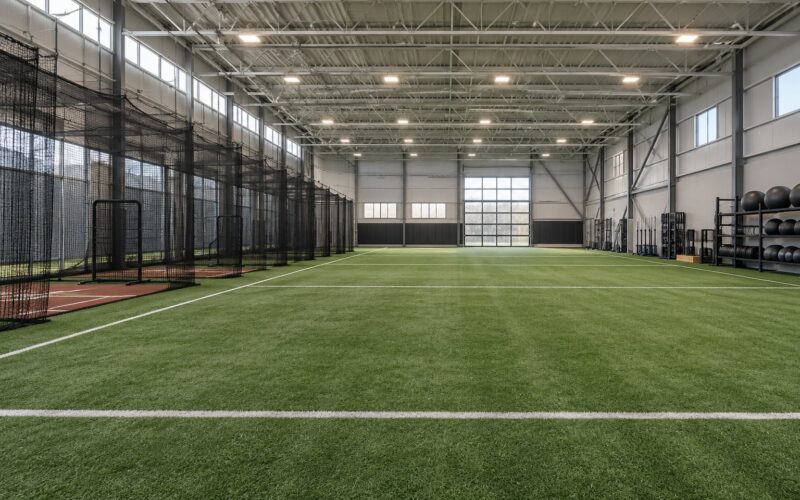
Resources are uneven. A school with a full-time sports medicine staff, daily access to a strength coach and an indoor turf facility gives an athlete more runway than a program without them. Ask directly what your rehab hours, facility access and supervised lifting look like, because consistency is the variable most tied to outcome.
Position competition does not pause. A rehabbing quarterback is still on a depth chart, and a rehabbing guard is still competing with an incoming recruit. Knowing who is medically limited and who is truly available is a job for the athletic trainer, not for a player trying to guess.
Identity loss is the part nobody plans for. In a qualitative study of collegiate athletes returning from ACL injury, players who had graduated or retired during rehab described reduced social support. They were on campus but out of the team, and that disconnection is a documented strain on recovery, not a soft subject.
Comebacks happen. Every so often a player returns months ahead of the expected 12-month timeline, and those cases get headlines. They are not a template. What they usually share is meeting the same criteria earlier, not skipping any of them.
How can athletes reduce the risk of a second ACL injury?
Cleared does not mean finished. The injury that just happened is the single strongest predictor of the next one, and the work that keeps a reconstructed knee on the field starts the day an athlete is told they can practice.
The most useful pieces are neuromuscular training programs that teach athletes to land, decelerate and cut with the hips and knees loaded in a way that survives fatigue; deliberate plyometric and progressive agility work; continued quadriceps and hamstring strength training after return, not just during rehab; workload progression that avoids sudden spikes in cutting volume after months of low activity; and fatigue management, since most tears in practice happen late in a session when technique breaks down. Bracing during the first return seasons helps some athletes feel more stable and can reduce early reinjury in younger players, though it does not replace training. Sports with well-run neuromuscular warm-ups, including FIFA-style prevention programs, consistently show lower tear rates.
The mental piece counts too. Athletes who re-tear often describe fear that changed how they moved, and an athlete who lands stiffly because they are protecting a knee is at higher risk than one who trusts it. Continued sport-specific and reactive practice rebuilds that trust, and a periodic strength check months after return catches the atrophy that quietly returns when a season gets busy.
What questions should athletes ask their medical team?
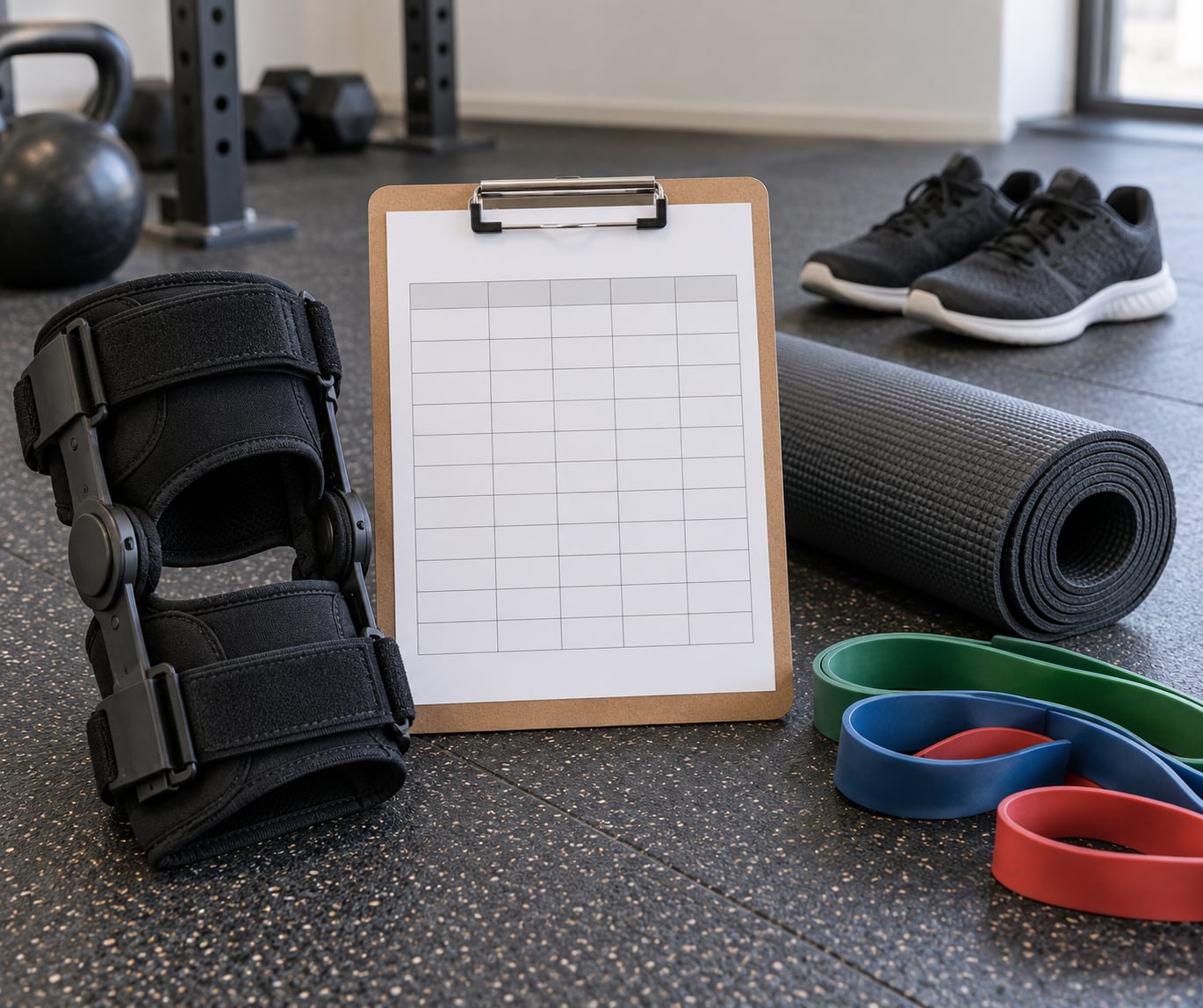
Bring a list. Athletes in pain and in a hurry ask thin questions, and a rehab that runs 9 to 12 months punishes thin questions.
- What exactly is torn, and what else did the MRI show?
- Do I have a surgical or non-operative option, and what does each mean for my season?
- What are the goals for the first six weeks, and when is my next re-evaluation?
- What are the criteria to advance from one phase to the next?
- When can I run, when can I sprint, and when can I start cutting?
- What strength symmetry do I need before I can play?
- Should I be in a brace for practice or games, and for how long?
- What swelling or pain response should stop me doing more?
- How does the return-to-play decision get made, and who makes it?
- What does the long-term outlook look like in 10 to 20 years?
- What prevention work should continue after I am cleared?
- Do I qualify for a medical redshirt, and who has to confirm it?
Asking about eligibility early is not cynical. It is how athletes make a rehab decision with clear information instead of guessing in November.
Frequently Asked Questions
How long does ACL recovery take for college athletes?
Most college athletes need 9 to 12 months from ACL reconstruction surgery to full competition in a cutting sport. Non-operative management is often shorter. The timeline moves with the sport, the graft, any meniscus or cartilage injury, and how consistently rehab went. Being cleared depends on meeting strength and hop test criteria, not on hitting a date, and forum accounts from athletes commonly range from about 6 to 12 months.
When can I play sports again after ACL surgery?
A common target is around the 9-to-12-month mark for return to a cutting, jumping or pivoting sport. Before that, an athlete usually walks without a limp, has full knee extension, minimal swelling, at least 85 to 90 percent quadriceps strength symmetry, and hop test results within 90 percent of the other leg. Clearance goes through the surgeon, physical therapist and athletic trainer.
Can you recover 100% from a torn ACL?
Most athletes return to their sport, around 82 percent in published data, but returning to the same level of performance is harder. About 70 percent return to their previous level overall, and one study of college football players found only about 43 percent felt they were back where they had been. Structural recovery and confidence take longer than the calendar suggests.
What is the recommended return-to-play protocol after ACL reconstruction?
A return-to-sport test battery is standard: isokinetic quadriceps and hamstring strength testing, a limb symmetry index, single-leg, triple and crossover hop tests, range of motion and effusion checks, and sport simulation drills that escalate in speed and fatigue. Psychological readiness is often assessed too. The battery identifies risk; it does not eliminate reinjury, which is why prevention work continues after clearance.
What happens 20 years after ACL surgery?
Most athletes live with a functioning reconstructed knee long term and many return to activity, though some report stiffness, mild pain or reduced confidence in high-risk pivoting sports. Athletes who sustain a second ACL injury can accelerate joint changes, and graft choice, strength maintenance and continuing injury-prevention work influence the long-term picture. Ask your surgeon about your specific graft and outlook.
Is returning too early after an ACL tear dangerous?
It is the single most studied risk in ACL rehabilitation. Athletes who return to cutting and pivoting sport before nine months after reconstruction carry a reinjury rate several times higher than those who wait. Younger athletes are usually held to a full 12 months for that reason. Research links reinjury to quadriceps strength deficits, poor landing mechanics and limited sport-specific exposure.
If you are following a teammate’s comeback, the first thing to watch is not the calendar on his Instagram story. It is whether his quadriceps looks like it did before, whether the knee stays quiet after a hard practice, and whether he is moving cutting drills with the same confidence as everyone else on the field.
For the athlete: get evaluated early, treat the first six weeks as the phase that matters most, and ask about redshirt eligibility the week you are hurt. For the parent or fan: support the boring middle of rehab, not just the comeback. And for all of you, if any of this describes a knee in front of you, a qualified clinician should be making the calls, not this page.