College sports apparel licensing is the permission system that decides who may legally print and sell a shirt, hat, or jersey using a university’s name, logo, or mascot. The school owns those marks, and the only businesses cleared to use them in commerce are approved licensees who pay royalties and follow the school’s brand standards. Knowing how college sports apparel licensing works explains why some fan gear vanishes from a marketplace listing overnight, and why licensed product costs more than the blank shirt underneath it.
Table of Contents
- What Is College Sports Apparel Licensing?
- Why Universities License Apparel and Teams
- Who Participates in a College Apparel License?
- How Does a Product Become Officially Licensed?
- What Rights Does an Apparel License Grant?
- Who Pays Royalties, and How Is the Money Calculated?
- How Are Retailers and Prices Controlled?
- How Can Fans Tell If Apparel Is Licensed?
- What Happens When a Product Is Unauthorized?
- Frequently Asked Questions
- Do colleges own every piece of apparel sold with their team name or logo?
- Can a small business sell college fan apparel without a license?
- Why can licensed college apparel prices differ so much?
- Is merchandise from a website that links to the school officially licensed?
- What is the difference between a reseller and an apparel licensee?
- How much of a licensed product’s price goes to the university?
What Is College Sports Apparel Licensing?
Licensing is a permission and payment arrangement, not a sale of ownership. The university still owns its name, logos, mascot, and color palette, and it grants a company the right to use them on products for a set period of time in exchange for money and compliance.
That is the whole dividing line between licensed and unlicensed apparel. A plain navy shirt printed with a school name in generic block letters is ordinary apparel. The same shirt carrying the school’s official mark, sold in a store, is licensed merchandise, and it needs an approved vendor behind it.
How College Sports Apparel Licensing Works, in Plain English
A university owns its trademarks, including its name, logos, mascot, and trade dress. It usually hires a licensing agent such as the Collegiate Licensing Company, Learfield IMG College, or Legends to manage the program. That agent approves vendors, reviews artwork against brand guidelines, authorizes production, issues authentication tags, and collects quarterly royalty reports and payments on the school’s behalf. Only those approved vendors, called licensees, may sell products bearing the marks.
One persistent myth deserves clearing up early. Plenty of sellers in apparel forums believe that adding a letter, dropping a character, or redrawing the logo by hand puts a product outside the trademark system. It does not. What matters is whether the mark is used in commerce, not whether the artwork is a near-copy. A long-running discussion on t-shirtforums.com makes the same point in slower terms: the annual renewal and quarterly royalty cycle applies to anyone selling with the mark, however the mark was drawn.
Why Universities License Apparel and Teams
Trademark protection is the headline reason. A school spends real money registering its marks and policing them, and licensing is how that work pays for itself instead of costing money.
Beyond enforcement, schools use licensing to control quality and availability, set a royalty rate rather than letting vendors pick one, expand the range of officially branded merchandise, and turn fan spending into operating money for the athletic department. Licensing and media rights together sit among the largest non-ticket revenue lines for most athletic departments, which is why the licensing office tends to be small, busy, and very rule-driven.
Control is the quieter half of the job. An unlicensed seller can flood a marketplace with thin fabric, wrong colors, and distorted marks. A licensing program gives the school a way to say no to all of that.
Who Participates in a College Apparel License?
Five parties sit in the chain, and each one has a job. The university owns the marks, usually held by the board of trustees or the athletic department. The trademark licensing office administers the program day to day. The licensing agent does the heavy lifting, screening applicants, reviewing artwork, and tracking reporting. The licensee designs and sells the product. The authorized retailer is the storefront that carries it, and the fan is the person buying at the end.
Three agents handle the large majority of college programs: the Collegiate Licensing Company, Learfield IMG College, and Legends. A smaller set of schools run licensing in-house, and which agent a school uses is one of the first things a vendor finds out when they call.
Players join the chain too, separately. A current or former student-athlete holds name, image, and likeness rights, often marketed as NIL. A company like The Brandr Group handles group agreements that bundle many athletes at once, and those agreements have sat with roughly twenty schools since the NIL era began in 2021.
How Does a Product Become Officially Licensed?
Every program words it slightly differently, but the path is remarkably consistent:
- The university owns or registers its marks, and the licensing office publishes brand standards for them.
- The university appoints a licensing agent to administer the program, unless it handles that work itself.
- A vendor applies to become an approved licensee, usually through the agent, with category and channel information.
- The licensee designs a product and submits a product request form with artwork, color callouts, and pricing.
- The agent or brand team reviews the submission against color palette, clear space, and third-party mark separation rules.
- Written approval authorizes production, and the licensee buys blanks only from authorized sources rather than printing on its own.
- Authentication labels or hologram tags are applied to finished units so buyers and the school can tell authorized product from counterfeit.
- The licensee files a quarterly royalty report, pays what is owed, and renews the agreement annually.
Steps four and five are where most delays happen, and they are the reason vendors are told to start early. Artwork revisions are routine, and a rushed submission for a gameday deadline usually stalls in the review queue.
What Rights Does an Apparel License Grant?
A typical apparel license grants the right to reproduce the school’s approved names, logos, mascot, and secondary marks on specified product categories, using artwork the school has signed off on. It covers the marks themselves, not a general right to anything school-related, and it is rarely exclusive. Two licensees can both sell a crimson T-shirt as long as both clear artwork and both pay royalties.
Agreements also set limits rather than blanket permission. Categories, channels, territories, and the term of the agreement all get defined, and the school keeps the right to approve or reject artwork and to pull approval at renewal. Exact permissions vary from agreement to agreement, which is why the contract text matters more than any general description of the system.
Player likeness sits outside that grant. A jersey carrying both a school mark and an athlete’s name, number, or face runs on two separate rights streams, and both have to be cleared before production.
Who Pays Royalties, and How Is the Money Calculated?
The licensee pays the royalty, and the school receives it. Most agreements calculate the royalty as a percentage of net wholesale or net retail sales, and the basis is written into the contract rather than assumed. Some schools set one standard rate; others vary it by product category, so a hat and a full jersey can carry different percentages.
West Virginia University publishes one of the clearest figures on any campus site. Its trademark licensing guidelines state a standard royalty rate of 13 percent for apparel and promotional products, which makes it a useful reference point, though not a universal number. Most schools land somewhere in a similar range, and the only reliable source for a given school is that school’s own guidelines page.
Three other pieces of money sit alongside the percentage. An advance is paid up front against future royalties. A minimum guarantee sets a floor the licensee owes regardless of sales. A term length defines how long the agreement runs before renewal.
Not everything is charged. West Virginia’s guidelines list royalty exemptions for employee and student uniforms, competition uniforms, and non-retail promotional items, and most schools run a similar list. Once royalties reach the school, they are distributed to the licensing office, the athletic department, and other university programs under whatever split the institution uses. Check your school’s current 2026 guidelines page for the numbers that actually apply to you.
How Are Retailers and Prices Controlled?
Licensing is as much about where product lands as about what is printed on it. Agreements define approved retail channels, cap the number of stores or accounts a licensee may serve, restrict certain categories, and set quality standards that inspectors can check. Retail marketplace rights are usually spelled out explicitly, which is why an authorized listing can vanish from a platform while an identical unauthorized one stays up for months.
Minimum order quantities are the other half of the story. A national licensee may be required to place thousands of units per style, and that requirement is the main reason small screen printers and one-person shops find the system closed to them. Vendors who once held college work describe losing it during a period of consolidation, when scale and offshore production mattered more than relationship and craftsmanship.
That also explains most of the price spread fans notice. The blank, the decoration, the quality tier, the distribution markup, and a royalty computed on retail rather than wholesale all push the final number in different directions, which is why two crimson shirts with similar logos can sit far apart.
How Can Fans Tell If Apparel Is Licensed?
Start with the seller’s own approved retailer list, which most schools publish through their licensing office. If a store is not on it, the product is not authorized, no matter how official the product photos look.
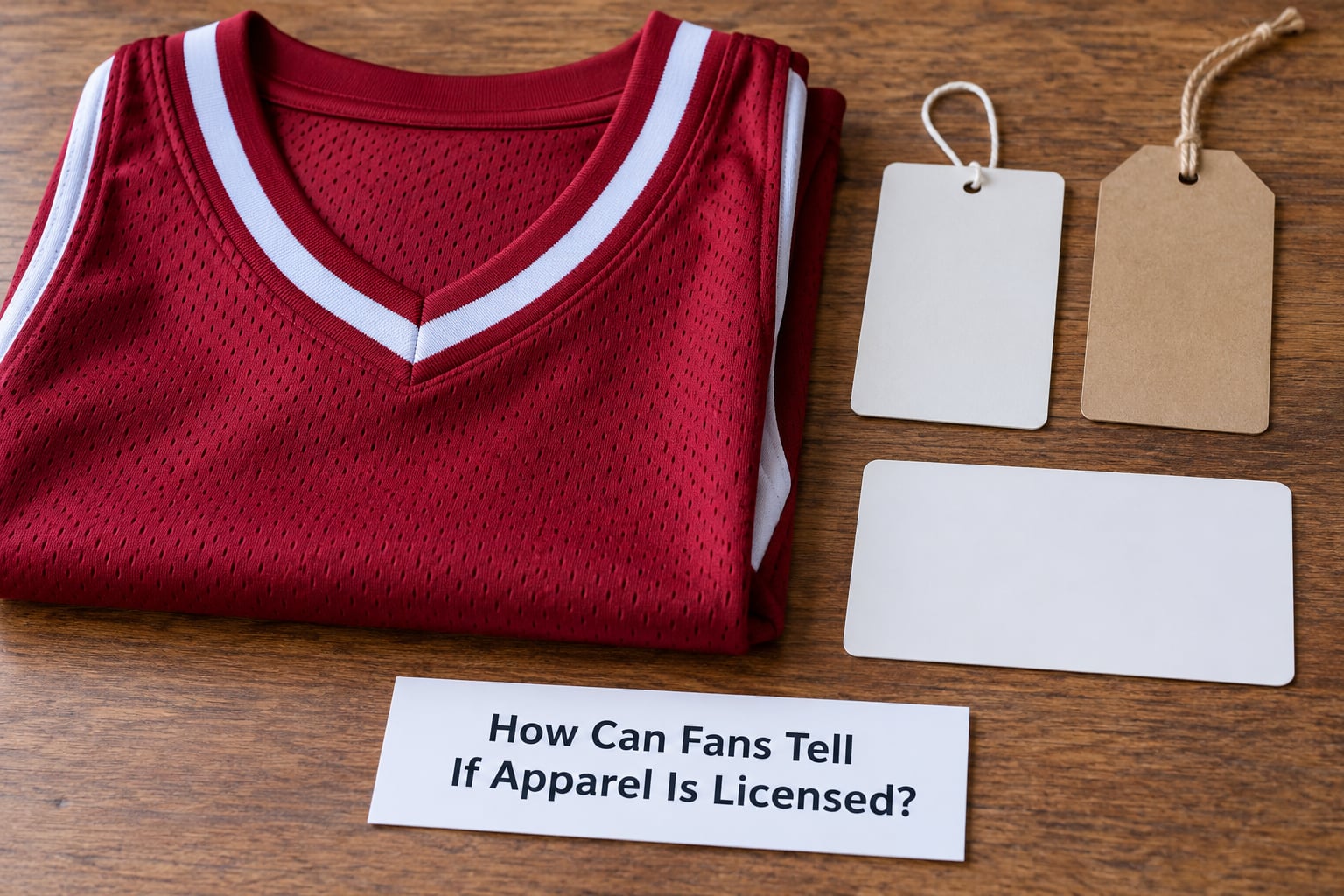
Then look at the item itself. Licensed apparel usually carries an authentication or hologram tag, a licensing label, or a hang tag naming the school and its agent. Official product pages on a school’s website list the authorized storefronts that carry the line.
Quality is a soft signal, not proof. Marks on licensed pieces follow the school’s clear space and color specifications, while unauthorized runs often show stretched lettering, wrong shades, and misapplied patches. Sellers who refuse to name the licensing agent or the brand guidelines are telling you something too.
What Happens When a Product Is Unauthorized?
Enforcement starts with a complaint, usually from the school, the agent, or an authorized licensee who lost sales to the same design. The first response is rarely a lawsuit. It is usually a takedown request to the marketplace, followed by a cease and desist letter, and the listing comes down before anyone answers.
Seller complaints in apparel forums focus on that silence. Listings disappear with no explanation of which rule broke, and the seller cannot fix what they cannot diagnose. The recurring problems are unlicensed marks, third-party logos placed next to school marks without separation, and product sold outside the approved channels.
The serious cases escalate. Vendors who worked unauthorized college merchandise describe equipment seized and businesses closed, including two Oregon embroidery owners who lost everything over unlicensed Oregon Ducks caps. Counterfeit merchandise can also carry federal penalties, separate from any civil claim by the school.
For buyers, the risk is quieter. An unauthorized jersey may arrive with a misapplied number, a fabric that fails after two washes, and no route to a return. The tag you did not check is the whole problem.
Frequently Asked Questions
Do colleges own every piece of apparel sold with their team name or logo?
The school owns its name, logos, mascot, and trade dress, and it decides who may use them in commerce. What fans buy is a permission, granted through a licensing agreement, not ownership. That is why a shirt sold under the school’s mark belongs to the licensee while the design belongs to the school. Players hold a separate set of rights in their own name, image, and likeness.
Can a small business sell college fan apparel without a license?
Not if the product uses the school name, logo, mascot, or protected colors in commerce. Personal use and informal school-spirit items are treated differently from sale. A small shop that wants to sell has to apply through the school’s licensing agent, meet category and channel rules, clear artwork, and pay royalties. Some programs also set minimums that are simply out of reach for a one-person business.
Why can licensed college apparel prices differ so much?
The final number reflects the blank, the decoration method, the quality tier, the number of units ordered, and how the royalty is calculated. Wholesale-based royalties and retail-based royalties produce very different results, and a national retail line carries distribution markup a local run cannot. Different schools also set different rates, and categories within one school can carry different percentages.
Is merchandise from a website that links to the school officially licensed?
A link to the school’s site is not proof of authorization. The reliable check is whether the seller appears on the school’s published approved retailer list, and whether the product page names the licensing agent or the brand guidelines it follows. Marketplace resellers and print-on-demand storefronts can look official while carrying unauthorized artwork, so verify the specific listing rather than the storefront’s overall presentation.
What is the difference between a reseller and an apparel licensee?
A licensee designs or manufactures product, holds an agreement with the school, submits artwork for approval, and pays royalties on what it sells. A reseller just buys finished authorized product and turns it over. Resellers usually do not need their own license as long as they sell approved product through approved channels, which is why buying from a listed retailer is the simplest way to stay inside the system.
How much of a licensed product’s price goes to the university?
It depends entirely on the agreement. West Virginia University publishes a standard royalty rate of 13 percent for apparel and promotional products, and its guidelines also list exemptions for employee and student uniforms, competition uniforms, and non-retail promotional items. Other schools publish different figures, and the basis may be wholesale or retail, so your school’s trademark licensing office is the only authoritative source.
Start at your school’s trademark licensing office page. It carries the approved retailer list, the current royalty rates, the brand standards, and the name of the agent handling the program, which answers most of what a fan or a would-be seller actually needs. Everything else in this guide flows from those four documents.