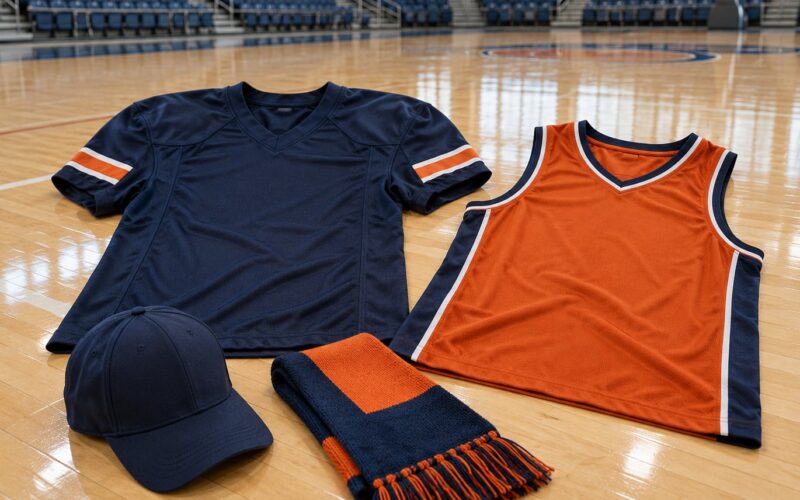
College logos and trademarks are protected primarily as trademarks: words, symbols, designs, and slogans that identify the source of a school’s goods and services. The artwork behind many logos is also copyrighted, and athletic marks often carry service-mark protection. Rights begin the moment a school uses a mark in commerce, and federal registration with the USPTO extends that protection nationwide.
That answer is where most legal explainers stop, and where most fans get stuck. Wearing a shirt is not the same as selling one. Printing a decal for your own tailgate is not the same as listing decals on a print-on-demand marketplace. And the line between those two things is not drawn by law so much as by how aggressively a particular school decides to defend its marks.
I have spent enough time reading athletics brand guidelines and licensing terms for this site that the practical side is what matters most here. Below is what protection actually looks like, what it covers, how enforcement works, and where a fan sits relative to all of it. Nothing here is legal advice, and trademark law is fact-specific, so treat this as a map rather than a ruling.
Table of Contents
- Why College Logos and Trademarks Receive Strong Protection
- What Must a University Register or Claim?
- How Colleges Monitor and Enforce Their Rights
- Can Fans and Students Use College Logos?
- When Is Using a College Logo Fair Use?
- How Licensing and Permission Work
- Common College Logo and Trademark Mistakes
- What to Do Before Using a College Name or Logo
- Frequently Asked Questions
- How long do college logos and trademarks last?
- Can I make shirts with my college’s logo for personal use?
- Can a university stop someone from using an old or retired logo?
- Is mentioning a college name or writing about its team trademark infringement?
- Can I use a college logo in a YouTube video or social media post?
- What should I do if my school stops an online seller from using its logo?
- What to Do First
Why College Logos and Trademarks Receive Strong Protection

A school mark is not just a drawing. It is a revenue stream, a recruiting tool, and a bargaining chip with sponsors, all at once. Licensing revenue from apparel alone runs into the millions for most large programs, and that money exists only because the mark keeps meaning something.
The fan is part of this equation too. A logo that reads as affiliated with a school carries that school’s reputation with it. If a local bakery puts the mark on a dozen boxes for free exposure, or a startup sells a hoodie with the logo and a vague “fan apparel” label, the school has no control over what quality message rides along with its name. That is the brand-protection problem enforcement solves.
Recruiting sits in the same bucket. A prospect evaluating a program reads the mark as a signal of what the program is, so schools argue that unauthorized versions blur the line between official and not. Conference marks get the same treatment, which is why an apparel design can infringe even when no single school name appears on it.
There is also a less obvious reason schools police their marks constantly: enforcement is what keeps them legally strong. A trademark that is tolerated on cheap merchandise for years can weaken, and in extreme cases the public can start treating the term as generic, which is how protection is lost. That is why a small college with a modest budget will still send a letter.
How College Logos and Trademarks Are Protected in Practice
Six layers usually do the work together, and any single logo can be covered by several at once. Here is what each one covers and where it stops.
| Protection | What it covers | What triggers it | How long it lasts | Main limitation |
|---|---|---|---|---|
| Trademark | Names, logos, words, designs that identify goods | Use in commerce | As long as used and policed, renewable every 10 years | Only covers confusion in commerce, not ideas or facts |
| Service mark | Same idea, applied to education, athletics, entertainment | Use in commerce | Same as trademark | Same as trademark |
| Copyright | The original artwork: illustration, mascot rendering, seal design | Original authorship fixed in a tangible medium | Life of the author plus 70 years | Covers copying of the art, not confusing name use |
| Trade dress | Overall look: uniform colors, distinctive layout, packaging | Non-functional design that signifies source | As long as distinctive and non-functional | Function elements are not protectable |
| Common-law nickname and mascot rights | Names, nicknames, mascot words used without registration | Local use as a source identifier | Until the public stops reading it as a source identifier | Geographic scope is narrower than a federal registration |
| Anti-dilution law | Famous marks against blurring and tarnishment | Registration plus fame | Indefinite while famous and policed | Only for marks the court considers famous |
The practical takeaway is that “logos aren’t copyrighted, so it doesn’t matter” is wrong on two counts. Even where copyright somehow does not reach a mark, trademark law does, and trademark is the body of law that actually matters here. The test is likelihood of confusion, not whether an image is byte-for-byte identical.
What Must a University Register or Claim?
Big schools maintain portfolios of dozens or hundreds of marks. The categories below cover most of what appears in those portfolios, and each one is handled differently.
- Word marks. The institution name, the athletic department name, and often the specific campus or college within a university system. These are the strongest and most frequently enforced.
- Stylized logos and design marks. The graphic mark itself, often registered both as words-and-design and as a design alone, because that lets the school enforce against someone using the exact name in a different font.
- Mascot names and character names. The mascot in isolation. This is the one fans assume is free, and it is often not. Separability helps only when the mascot is clearly distinct from the word mark.
- Seals and crests. Official seals carry extra weight, since they can imply governmental or institutional authority.
- Slogans and catchphrases. Registered as word marks once they become associated with the source.
- Colors and uniforms. Rarely protectable on their own. Specific color combinations can be claimed as trade dress when the combination is distinctive and non-functional.
- Conference and bowl game marks. Protected by the conference, not the member school, which is why an item can offend a league without offending any university.
Registration happens in classes, and the class list does most of the practical work. A school filing in Class 25 covers clothing and apparel, which is the category behind shirts, hoodies, and hats. Filing in Class 41 covers education and entertainment services, which is how the school protects athletics, camps, and the alumni and donor relationship. A mark registered only in Class 41 gives far less leverage against a seller of t-shirts than a Class 25 registration does.
One asset can carry several layers at once. A seal might be a registered trademark in Class 41, a registered design mark, and copyrighted artwork, all on the same image. That stacking is normal, not redundant, because each layer catches different conduct.
How Colleges Monitor and Enforce Their Rights
Enforcement runs on a ladder, and the rungs are not used equally. Most matters stop well before a courtroom.
- Monitoring. Schools and their licensing agents run online sweeps of marketplace listings, print shops, ticket sites, and social commerce, often with keyword alerts on the school’s name and mascot.
- Platform takedowns. A report to a marketplace’s brand-protection or intellectual-property team can get a listing pulled within days. No letter, no lawsuit, and for a small seller that is often the whole story.
- Takedown requests to payment processors. Reports routed to payment providers can freeze payouts or close an account. Forum discussions about print-on-demand sellers losing store access mid-season usually trace back to this step.
- Cease-and-desist letters. A formal letter identifying the mark, the violation, and the demand. Many sellers treat this as the end of the road rather than the beginning.
- Negotiation. In many cases this is where it resolves: remove the listing, destroy remaining inventory, pay a small settlement or legal fee split.
- Oppositions and cancellations. Where the infringer has filed their own application for a conflicting mark, the school can file an opposition proceeding at the USPTO within the published window.
- Litigation. Reserved for commercial scale, counterfeit rings, or repeat offenders. Federal trademark litigation is slow and expensive, so it is a tool of last resort for most schools too.
Consequences escalate with the conduct. Genuinely counterfeit goods can trigger criminal counterfeiting statutes, which is why a real licensee’s box of authentic shirts and a random seller’s listing look so different to the school’s lawyers. Damages can include profits, statutory damages per infringing item, and attorneys’ fees, which is why a single cheap print run can end up being the expensive decision.
Refusal to deal is another lever. A school can generally decline to license a vendor it dislikes, so no licensee can say the school approved their product. That quality-control power is why licensing agreements carry approval clauses at all.
Can Fans and Students Use College Logos?
Yes, in the overwhelming majority of personal cases, and this is where the gap between the law and what fans expect is widest. Personal, non-commercial use of a logo is almost never enforced. Commercial use without permission almost always is.
Generally fine:
- Wearing licensed or previously purchased apparel in public, at a game, or at a tailgate
- Printing a logo for yourself, your family, or a small group gift
- Reposting official graphics, photos, or graphics you did not create, with attribution
- Linking to the school’s official site and using the logo in a header on a personal page
- Commentary, criticism, review, parody, and reporting
- Decorating a cake, a poster, a scrapbook, or a dorm room
- Using the name in a sentence to identify who you are talking about
Where you need permission:
- Selling anything with the mark on it, at any volume, including single items
- Listing on print-on-demand or marketplace sites, where every listing is a commercial use
- Running a business where the mark appears on your website, packaging, or signage
- Using the mark in a way that implies endorsement, partnership, or official status
- Running giveaways, promotions, or paid advertising
- Using the mark on goods made for resale even if the quantity is tiny
Worth separating three things that get tangled together. Wearing a logo is not use in commerce. Reproducing a logo for yourself is generally tolerated. Selling the reproduction puts the mark into commerce, and that is where the trademark owner has a real claim.
The marketplace case is the one that catches people out. Uploading a logo to a print-on-demand service and selling a shirt through it is a commercial use with a profit motive, and the service’s terms of service usually put the legal risk on you rather than the platform. Checking a box that says you own the rights to an image is not a defense. It is an admission.
Students and student-athletes face an added layer under the name, image, likeness framework. A current athlete promoting their own deal generally cannot use school marks to advertise it without school approval, because the school controls those marks even when the athlete controls their own name and image. That distinction trips up local businesses more than anyone, since a popular player being available does not make the logo free.
Small schools are protected exactly as firmly as large ones. Forum advice often assumes a low-visibility Division II program or a public high school will not care. Public schools hold marks through their district or state entity, and the enforcement path is the same.
When Is Using a College Logo Fair Use?
Fair use is a defense you raise after being accused, not a permission you obtain in advance, and in trademark law it is narrower than the copyright version people carry around in their heads.
Copyright fair use asks four questions. Is the use transformative? Does it take the core of the work? Is the amount used proportionate to the reason? Does it harm the market? Trademark fair use analysis runs differently, centered on whether the use is descriptive, nominative, or expressive, and on whether it suggests sponsorship.
Nominative fair use is the one that matters most in practice. You can refer to a school by name or show its logo when you have to, as long as you use only what is necessary and you do not imply sponsorship. A blog post reviewing a game, a recruiting article naming a program, a news photo with a scoreboard in it: all fine.
Parody and satire are protected as expression, which is why a shirt reading “Harvard Variously” behaves very differently from one reading “Harvard Official Course Replica.” The line is whether the joke is commentary on the mark or just a ride on its fame.
Two popular theories fail. The first is that transformative use saves you. It is a copyright concept, and even in copyright it is one factor among four. The second is that adding commentary cures a commercial use. Commenting on a logo and selling the comment does not separate the two acts.
What fair use does not cover: reproducing a logo on merchandise for sale, running a business under a school’s identity, or using marks in a way that implies official affiliation. If the use makes money and is not strictly necessary to identify the school, stop treating fair use as your plan.
How Licensing and Permission Work
A licensing program is the official channel, and for most schools it is run by an outside agent rather than by athletics staff. The Collegiate Licensing Company handles a large share of college licensing, and Greek marks go through separate specialists such as AffiniTE Consultants. Universities that self-license publish their own guidelines and application forms instead.
The process generally runs: contact the licensing office or agent, submit an application describing the product, category, and distribution, get a written agreement, pay royalties, and submit artwork for approval before production. Licenses often include minimum guarantees, a per-unit royalty, a term, quality standards, and a right for the licensor to inspect or pull non-conforming goods.
Two details catch new vendors out. Approval is required before production, not after, so a design that ships unapproved is a breach regardless of how much the pre-approval would have cost. And channels are licensed separately, which is why you may hold apparel rights and still have no right to sell the same design on a phone case.
Royalty rates, minimums, and advance payments are negotiated and confidential. Vendors rarely publish them, and schools treat the rates as commercially sensitive, so any figure you see quoted as the standard is not a standard. The defensible way to answer a royalty question is to ask the licensing office what your proposed product would cost.
Common College Logo and Trademark Mistakes
These come up constantly, and the fix is usually simpler than people expect.
| The belief | Where it breaks | What to do instead |
|---|---|---|
| The logo is public domain, so anyone can use it | Copyright status does not affect trademark rights, which come from use in commerce | Treat any active school mark as protected regardless of copyright term |
| A disclaimer fixes it | Not affiliated is not a defense to likelihood of confusion | Get permission; a disclaimer does not substitute for a license |
| Changing the colors makes it a new design | The test is confusion, not pixel matching | Do not rely on recoloring or simplifying |
| The mascot alone is free | Mascots and nicknames are often registered separately | Check whether the mascot name is registered in its own right |
| TM and ® mean the same thing | ® is for registered federal marks; TM is an unfiled claim | Using ® without a live registration is a violation in itself |
| Small schools and high schools do not enforce | Public entities hold marks too, and enforcement costs little | Assume protection regardless of school size |
| Retired logos are fair game | Schools often keep rights and keep policing them | Check the current brand guidelines page for retired marks |
That ® point deserves emphasis because it is the one people trip over without realizing. A school that has filed but not yet been registered still cannot use ®, only TM or SM. Vendors occasionally design packaging with a registered symbol for a client, which exposes both of them.
What to Do Before Using a College Name or Logo
A short review before you commit to a design saves an enormous amount of rework.
- Identify the exact asset. Logo, word mark, mascot, seal, slogan, or conference mark are all separate claims. Look at the school’s brand or athletic site for the official marks and the current guidelines.
- Decide whether the use is personal or commercial. Personal and non-commercial is very likely fine. Anything sold, given as a business promotion, or monetized needs permission.
- Check whether the mark is registered. The USPTO’s trademark search lets you look up the school’s live registrations and see which classes they cover. Search the school name, mascot, and any slogan.
- Check retired and restricted marks. Older or discontinued logos are often explicitly listed as off-limits because they resemble current ones.
- Contact the licensing office or its agent. The athletics site or brand page usually lists the current licensing contact, and that page is the fastest route to a real answer.
- Get a lawyer when the use is genuinely ambiguous. If your situation does not fit a clean rule, that is what trademark counsel is for.
The federal search is worth doing even for a small run. It takes a few minutes, it tells you which classes are covered, and it tells you whether the school has a live registration you would be walking into knowingly.
Frequently Asked Questions
How long do college logos and trademarks last?
Trademark rights last as long as the school keeps using the mark in commerce and keeps policing unauthorized use, with renewals filed every 10 years. Copyright in the underlying artwork lasts the life of the author plus 70 years. A mark can be lost or weakened if a school allows it to become generic, which is why schools keep enforcing even when enforcement is expensive.
Can I make shirts with my college’s logo for personal use?
Printing a logo for yourself, your family, or a small gift is personal, non-commercial use and is very rarely enforced. Selling any of those shirts changes the analysis, even if you only list a single item. Print-on-demand marketplaces count as commercial use, and their terms of service put the legal responsibility on the seller rather than the platform.
Can a university stop someone from using an old or retired logo?
Yes, often. Retiring a mark usually means the school stops using it, not that it gives up rights, and many schools keep policing retired marks because they resemble current ones. Schools frequently list discontinued marks as off-limits in their brand guidelines for exactly that reason. Assume a retired logo is still protected until the licensing office tells you otherwise.
Is mentioning a college name or writing about its team trademark infringement?
No. Using a school’s name to identify it, and reproducing its logo where necessary to discuss it, is generally protected as nominative use. The limits come when the reference implies sponsorship or endorsement, or when the use is really commercial. News coverage, commentary, and recruiting articles sit comfortably on the safe side of that line.
Can I use a college logo in a YouTube video or social media post?
Usually yes for editorial or personal channels, especially if the logo appears incidentally and you credit the school. Problems start when the channel sells merchandise, sponsorships, or memberships built around the mark, or when a post implies official affiliation. Linking to the school’s site is not use in commerce. Monetized fan accounts sit in a murkier middle than personal ones.
What should I do if my school stops an online seller from using its logo?
A takedown usually starts with a marketplace report, and it is not a judgment against you, so treat it as a signal rather than a defeat. Pull the listing, check your other designs for the same asset, and contact the school’s licensing office if the product is genuinely licensed or you believe the takedown was wrong. Repeat listings invite closer review and account closures.
What to Do First
Assume any modern school name, logo, mascot, seal, or slogan is protected, whether or not you have seen a registration. Wear it, wear it to the game, post it, write about it, make one for yourself without worry.
Before you put it on anything you sell, advertise with, or hand out as a business, check the school’s brand guidelines and contact its licensing office. Five minutes there costs less than one takedown notice does.
Updated for October 2026. This article is general information about trademark and copyright practice, not legal advice. Rules and outcomes vary by state and by the facts of each case, so talk to an attorney about your specific situation.