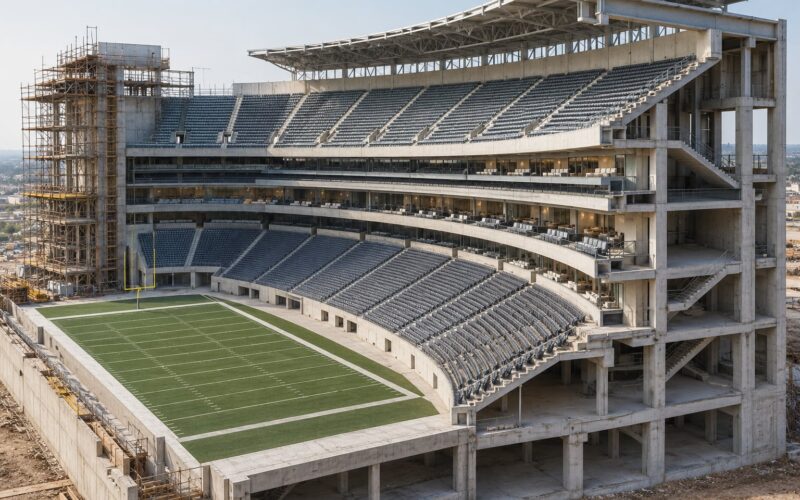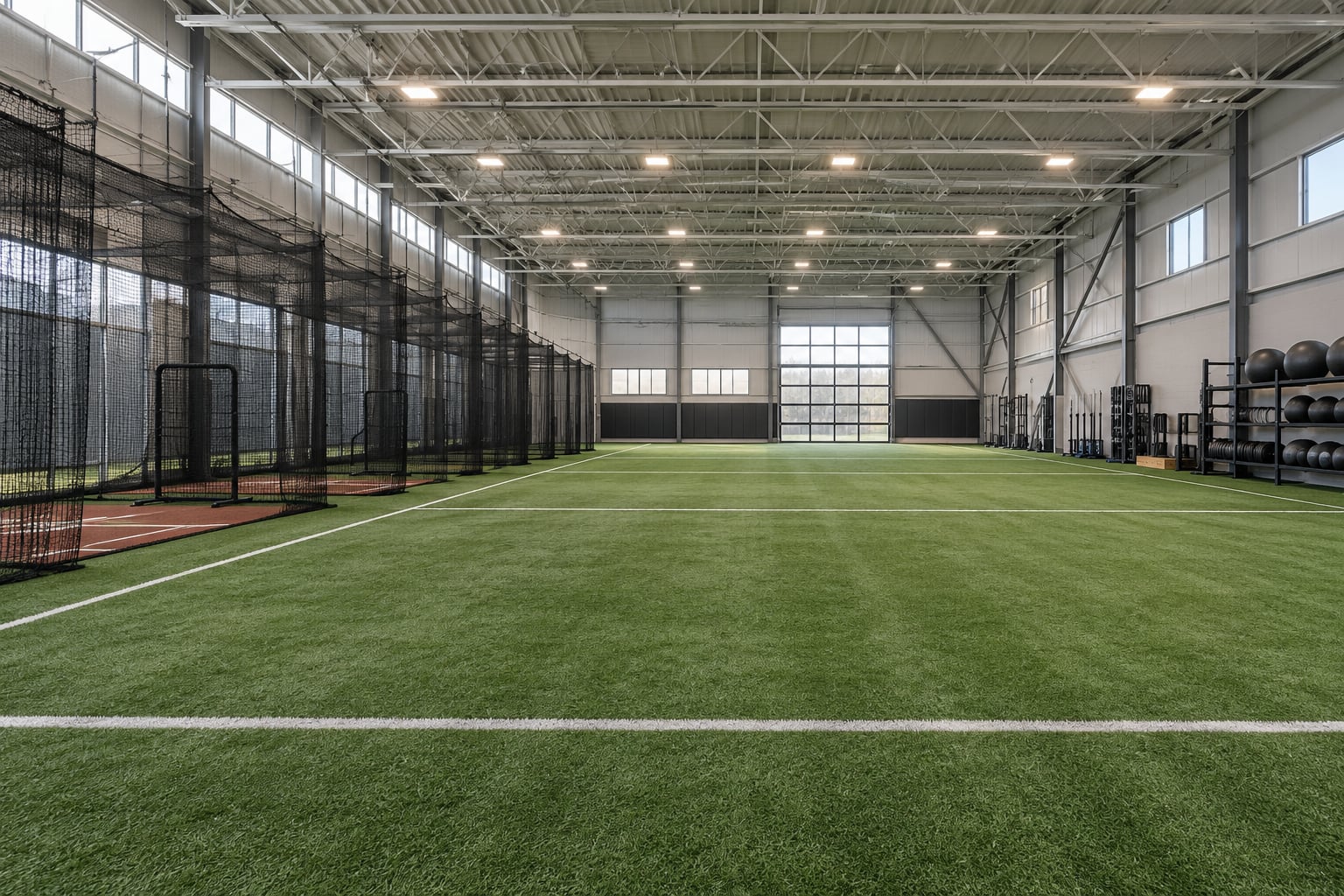
Indoor practice facilities help teams because they remove weather as a variable, so a scheduled practice happens on the same surface, under the same lighting, at the same temperature whether it is July or January. That consistency protects practice reps, shortens recovery and rehab timelines, and gives a program usable indoor time during the offseason and postseason when outdoor fields are closed. It also costs real money and real acreage, and it cannot fully replace reps in game conditions, so the honest answer includes both sides.
Table of Contents
- How Indoor Practice Facilities Help Teams: Benefits and Tradeoffs
- What Is an Indoor Practice Facility?
- How Indoor Practice Facilities Help Teams Make Better Use of Practice Time
- How Do Teams Control Weather and Year-Round Training?
- How Do Indoor Facilities Improve Player Safety and Recovery?
- What Team Benefits Come From Better Equipment and Practice Design?
- Which Sports and Teams Benefit Most?
- How Indoor Practice Facilities Affect Recruiting and Team Culture
- What Are the Costs and Tradeoffs of Indoor Practice Facilities?
- How Can a Program Decide Whether an Indoor Facility Is Worthwhile?
- Frequently Asked Questions
- Conclusion: Start With Consistency, Not the Building
How Indoor Practice Facilities Help Teams: Benefits and Tradeoffs
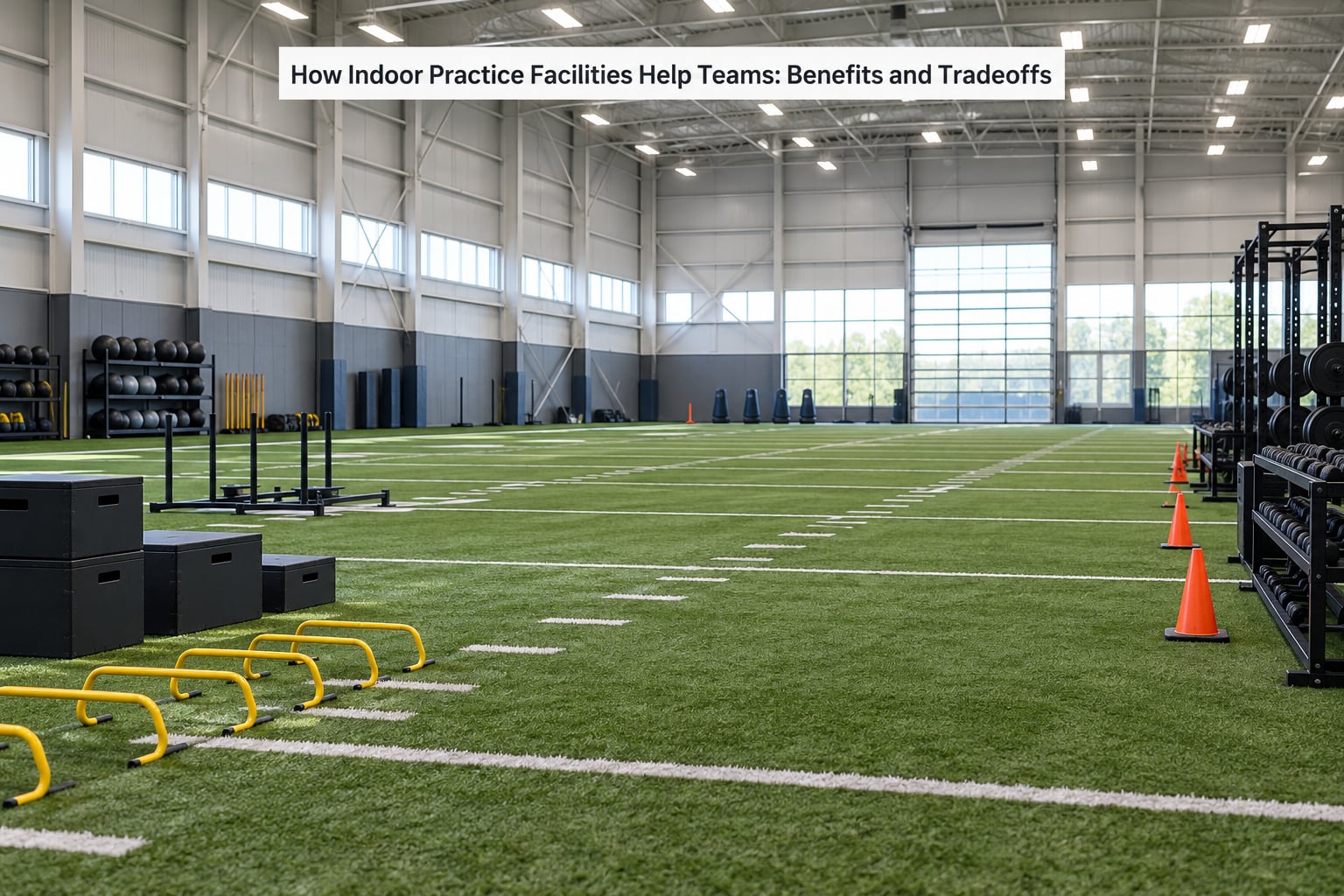
Quick take: An indoor practice facility gives a team a full-length field it can use in any weather, so coaches plan real sessions instead of contingency sessions. Players train on the same surface every day, which supports rehab, position work, and faster transitions between drills. Programs in harsh climates gain offseason and postseason preparation, and multi-sport departments share the cost. The tradeoffs are construction and energy bills, a permanent footprint, and the loss of reps in real game conditions.
| Benefit | What it solves | Who notices it most |
|---|---|---|
| Consistent practice reps | Plans change when a session is cut short or moved | Coaches building multi-week period plans |
| Weather-proof training | Rain delays, lightning shutdowns, heat limits, frozen turf | Programs in storm-prone or cold climates |
| Offseason and postseason work | Outdoor fields closed or frozen for months | Winter-sport-adjacent programs in the North |
| Player safety and recovery | Rehab and treatment happen next to the field | Programs managing injury-heavy seasons |
| Equipment and practice design | Drills that need cages, walls, nets, or film rooms | Baseball, softball, volleyball, track throwing |
| Multi-sport utilization | One structure shared across a whole department | Athletics departments with 15 or more varsity teams |
That table is the marketing version, and it is not wrong. But the same features produce the same problems for a program: a full-length field needs acreage, a climate-controlled building needs power, and a structure shared by six sports needs scheduling discipline.
The rest of this guide walks through each benefit, then the costs, the facility types, and the limits nobody puts in the press release. It is written so you can look at any program on your schedule and judge whether its setup actually works.
What Is an Indoor Practice Facility?
An indoor practice facility is a building, air-supported structure, or covered field that gives a team a full-length artificial-turf practice surface usable regardless of rain, lightning, extreme heat, or cold, typically attached to weight rooms, locker rooms, and athletic training space.
That definition separates it from the facilities it gets confused with. A stadium holds games in front of a crowd; a practice facility exists for the work nobody watches. A training center is a broader term that can include the weight room, nutrition room, and treatment spaces attached to any field, indoor or out. A domed competition venue is a revenue-producing building designed for ticketed events, which is a different financial animal entirely.
Fan forums keep circling one question here: is a sports complex a facility? A complex is a collection of facilities. When people say a program “has a bubble,” they usually mean a single air-supported structure over a field, often the first stage of a longer build plan.
How Indoor Practice Facilities Help Teams Make Better Use of Practice Time
Making better use of practice time means the session a coach wrote in January is the session that happens.
Outdoor practice is a negotiation. Wind flags alter a throwing drill, a wet field turns a cutting drill into a slipping drill, and a dark morning forces a move to an evening slot that conflicts with class schedules. Inside, a coach can write a rep count and get it.
Three things drive the gain. Lighting removes the sunset cutoff. Surface condition is identical across the calendar, so ball security and footing stay predictable. Temperature is managed, which matters most in the shoulder season and in the South, where a July practice is shortened by heat protocols rather than by the coach’s plan.
Programs that talk about the return on a facility rarely count reps gained. They count sessions that were not lost, and sessions that started on time.
How Do Teams Control Weather and Year-Round Training?
Weather control is the benefit almost every announcement leads with, and it is mostly about removing two things: interruptions and heat.
For interruptions, think about what a lightning protocol actually costs. When a storm closes a field mid-drill, the team loses the session and often the transition work after it. Tulane’s program provides a clear example of the alternative: the Green Wave have been busing players to the New Orleans Saints’ indoor facility for practices, a workaround described in Sports Illustrated’s coverage of the program’s facility plans in February 2025.
For heat, the industry standard is the Wet Bulb Globe Temperature reading, or WBGT, which combines temperature, humidity, wind, and sun exposure into a single heat-stress number. The American College of Sports Medicine publishes position-specific WBGT thresholds for modifying or canceling practice, and the University Interscholastic League adopted a WBGT standard in 2023 for Texas high school athletics. An indoor practice facility sidesteps the highest readings of the summer, though it does not make the sport itself safe on a hot day.
The year-round value shows up in three windows. Winter conditioning, spring practice when fields are saturated, and postseason preparation when a team is still playing but outdoor practice windows are shrinking or frozen.
One caution on claims: Montana State supporters argued the need became clear because of how hard the spring weather hit Bozeman, which is a recruiting-era observation rather than a measured one. Weather creates the demand, but a facility does not create good weather.
How Do Indoor Facilities Improve Player Safety and Recovery?
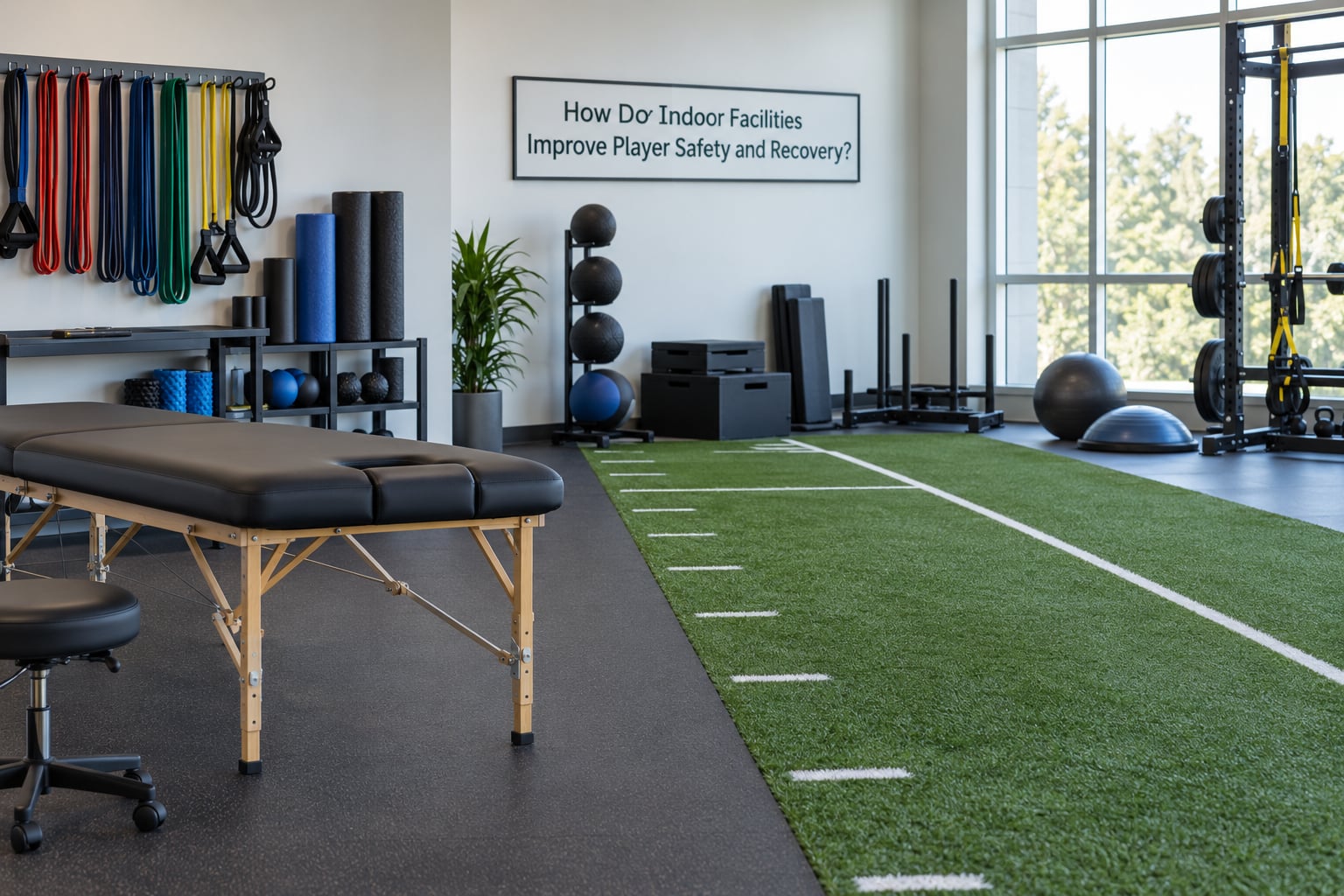
Player safety improves mostly because a consistent surface behaves the same way every session.
Natural grass has a memory. It gets chewed up in November, saturated in April, and frozen in January, so the same drill produces different stress on the knee, the ankle, and the hamstring depending on the month. A fixed indoor surface removes that variable from most of the routine, and it is one more reason rehab work can begin as soon as a player is cleared rather than waiting on field conditions.
Recovery also gets shorter when the treatment space sits next to the field. A player finishing a session can go straight to a treatment table instead of a locker room and a vehicle, and the athletic trainer sees the same athlete twice in one day rather than on a scattered schedule.
Here is the limit worth holding onto. Indoor practice does not reduce contact, and it cannot remove injury risk. A shortened field with a rubberized surface changes how a player loads the lower leg, and repeated low-speed work on a hard surface is not the same stimulus as grass. The American College of Sports Medicine’s guidance on load management still applies: build volume progressively, and treat an indoor session as a session, not a free day.
What Team Benefits Come From Better Equipment and Practice Design?
A purpose-built indoor space lets a coach design practice differently rather than just practice somewhere else.
Baseball and softball programs get the clearest gain, because hitting and pitching work needs a cage, a net, and a wall to stop balls. A facility that includes batting tunnels and pitching lanes converts a field day into a repeatable hitting session. Track programs get indoor throwing space and can move throws out of a cold, wet outdoor window. Volleyball gains a place to run sets and serve reps without weather interference.
Football and soccer use the indoor field for installation work, walkthroughs, and short, high-intensity segments, then go outside for the length of the field. That split is the pattern most coaches describe.
Support spaces matter as much as the turf. Film rooms, meeting rooms, coaching offices, nutrition space, and equipment storage all sit within a short walk, which is what turns a field into a practice center. Adrian College’s Sweebe Family Indoor Athletic Center, opened in August 2025 with an 11 million dollar price tag, is listed as serving football, soccer, rugby, track and field, baseball, and softball from one structure.
UAB took a different route. The program agreed to pay about 4.7 million dollars for a wall-less pavilion instead of the roughly 15 million dollars a conventional fully enclosed indoor facility would have cost, a trade CBS Sports covered as a cost-saving experiment. Covered is not enclosed, and programs should read the difference carefully before comparing line items.
Which Sports and Teams Benefit Most?
The sports that benefit most are the ones whose practice has hard environmental dependencies: field sports in bad climates, and racket-and-cage sports that need indoor surfaces anyway.
Football and soccer use the largest share of the footprint. Football needs full field length to run anything meaningful, and a field that is 80 yards long instead of 100 changes what a program can do. Soccer fits more comfortably into a shorter space and often shares with football.
Lacrosse, rugby, softball, and baseball use indoor time heavily, which is why they show up in nearly every multi-sport facility announcement. Adrian College’s list, and the multi-sport framing in coverage of Montana’s bubble discussions, both name football, track, soccer, and softball rather than football alone.
Track and field gets indoor throwing and conditioning space. Marching band, ROTC, and physical education classes are common secondary users, and a vendor analysis of school indoor facilities noted those programs as consistent occupants. Community and club rentals extend the hours, which matters for the operating math discussed below.
Basketball and gymnastics need something different from a practice facility. They need a gym, and most programs already have one. A turf dome does not help a center or a balance beam.
How Indoor Practice Facilities Affect Recruiting and Team Culture
Facilities help recruiting, but the size of the building helps less than the marketing photo suggests.
When Nevada began construction on its practice facility, coverage in the Reno Gazette Journal quoted a coaching staff view that from a recruiting standpoint the project was a game changer, with the pitch being that players have their own space and a comfortable place to get their work in. That kind of claim is common, and it is hard to audit.
What recruits actually notice is quieter. A freshman can find the same weights, the same treatment table, and the same film room in February as in September, and a program that trains year-round can evaluate a class repeatedly instead of once. A coach also gets a recruiting visit built in: the facility becomes the backdrop for every campus visit, whether or not the visit is a conversation about it.
Culture effects are real but easy to overstate. A space where the whole department shows up creates cross-sport visibility that outdoor fields rarely produce. It can also create resentment when one sport clearly dominates a shared building, which is why utilization gets watched closely by athletic directors and by fans.
The NIL-era pushback deserves a fair hearing. Fan forums split on whether facilities or direct revenue sharing now decides commits. Both matter, and the honest position is that a facility makes a promise easier to keep, not that it substitutes for money going directly to athletes.
What Are the Costs and Tradeoffs of Indoor Practice Facilities?
Construction runs from roughly five million dollars for a partially covered pavilion to well over twenty million for a full enclosed building with support space. Real named examples sit inside that band.
| Program | Facility type | Reported cost | Funding and year |
|---|---|---|---|
| UAB | Wall-less pavilion, covered turf | About 4.7 million dollars | Program funds, reported before construction |
| High school example (Crandall ISD) | 100-yard field, weight, training and nutrition rooms, plunge pool, locker facilities | About 4.8 million dollars | School district, reported in School Business Now coverage |
| Adrian College | Indoor athletic center serving multiple sports | 11 million dollars | Family gift naming the facility, opened August 2025 |
| Syracuse | Indoor practice center, training center for football and other programs | 13 million dollars | Major private gift, groundbreaking September 2013 |
| Montana State | Larger permanent structure pursued alongside an interim bubble | About 15 million dollars authorized | State authorization plus fundraising campaign |
Those figures are typical United States ranges at the time of reporting, and they move with region, site work, square footage, and how much support space is included. Treat them as anchors, not a quote.
Facility type explains most of the spread.
| Type | What it gives you | What it cannot give you | Best for |
|---|---|---|---|
| Air-supported bubble | Full field, fast build, low capital cost | Climate control, limited height, wear on fabric and turf | Bridging to a permanent building |
| Wall-less pavilion | Covered turf, natural air, much lower cost | Heat and rain blowing in from the sides | Warm climates on a tight budget |
| Covered field, open sides | Field protection, natural grass survival | Full weather protection | Programs wanting field life preserved |
| Fully enclosed building | Climate control, film and meeting space, weight rooms attached | The largest footprint and the largest bill | Programs in cold or storm-prone regions |
| Off-campus rental | No capital cost at all | Bus time, other teams’ rules, no home-field routine | Programs without the budget or the land |
Operating costs surprise people more than construction does. The University of Montana’s Grizzly Indoor Practice Facility ran a heating bill above 22,000 dollars for February alone, according to The Pulp’s coverage of the question. A large air-supported structure in a cold state is a heating problem before it is anything else.
Funding is where the argument gets loud. Fan forums are full of objections to state legislature money going to an athletics bubble while other campus needs wait, and the confusion around “authority only” appropriations has filled dozens of posts on the Montana board. In plain English: a bond measure is repaid by voters through taxes, a public appropriation comes from the legislature’s budget, and an authority-only bill lets a university spend money it already controls. Those three are not the same thing, and a program claiming private funding deserves to be asked which one it means.
Two more tradeoffs get less airtime. First, a dome is not game preparation. Tulane’s own reporting acknowledged the argument that preparing in the elements matters for a home stadium with real weather. Second, not every bubble delivers a real practice. A Lehigh forum poster described a proposed facility built for football and lacrosse that could not accommodate a true football practice and used a rubberized surface suitable for walkthroughs, which is the exact failure mode a board should ask about before approving anything.
One counterexample is worth keeping in view: reporting on Ohio State’s early bubble experience indicated the program did not benefit as much as might have been expected. A structure is an enabler. How a program uses it, and whether the program has a defined indoor practice period, decides the value.
How Can a Program Decide Whether an Indoor Facility Is Worthwhile?
A program can decide by measuring the practices it actually loses, then pricing those losses against what the space replaces.
Count the weather-cancelled or heat-shortened sessions over one full year. That number is the argument. Divide the capital cost by the number of sessions recovered, and the number should be small enough that the operating cost becomes the real question, not the construction bill.
Then work through six checks. How many varsity programs will use the space monthly, and can the surface serve more than one of them. Whether the field is full length and what the surface is, since that determines whether real practice or walkthroughs happen. What the climate does to the operating budget in a normal February. How the building slots into an academic calendar, since a daytime indoor block is worth more to recruiting classes and physical education than an evening block. Whether support spaces sit close enough to the turf to shorten transitions. And who pays, because a privately funded gift changes the public conversation entirely.
If the lost-practice count is low, the honest answer may be a bubble, a wall-less pavilion, or a rental arrangement like Tulane’s bus schedule. Cheaper options solve most of the same problem, which is why phased builds have become a genuine strategy. Montana’s approach is the clearest case: get a bubble in place short term for football, track, soccer, and softball, with the field and track built so a permanent structure later costs less and takes less fundraising time.
Frequently Asked Questions
Do indoor practice facilities reduce injuries?
They reduce one category and leave the biggest one untouched. A consistent artificial surface and adjacent rehab space can lower foot and ankle risk and shorten recovery timelines, and indoor sessions avoid the highest heat-stress readings of summer. But indoor practice does not reduce contact, and a hard or shortened surface loads the body differently. Load management guidance from the American College of Sports Medicine still applies, and injury rates are never zero.
How is an indoor practice facility different from a domed stadium?
A domed stadium is built to host ticketed competition, with seating, press facilities, broadcast infrastructure, and a revenue model attached. An indoor practice facility exists for training, typically a full-length turf field plus weight rooms, treatment space, and film rooms. Some campuses share a building for both, but the purposes, and the budgets, are completely different.
Can teams use indoor space for all of their training?
Not well, and programs that try it end up with a worse team. Walkthroughs, installation work, short high-intensity segments, catching, and short individual work work well indoors. Anything that needs full field length, real turf, or game conditions belongs outside. Programs that treat the indoor space as a supplement get the benefit; programs that relocate every practice lose the specificity that game day demands.
How much does an indoor practice facility cost to build?
Named United States projects range from about 4.7 million dollars for UAB’s wall-less pavilion to 13 million dollars for Syracuse’s indoor practice center, with Adrian College’s multi-sport center at 11 million dollars and Montana State authorized about 15 million for a larger permanent structure. A school-district project with a 100-yard field and full support rooms has been reported at about 4.8 million dollars. Operating costs follow, and can be steep in cold climates.
Do indoor facilities give a college sports program a recruiting advantage?
A modest and hard to measure one. A facility makes a promise a program can keep year round, gives recruits a real training environment during visits, and lets coaches evaluate a class repeatedly. But NIL and revenue sharing now weigh heavily in commits, and a bubble does not substitute for money paid directly to athletes. Fans who assume a bigger building outranks a bigger NIL payout are usually guessing.
Conclusion: Start With Consistency, Not the Building
How indoor practice facilities help teams comes down to consistency: the same field, the same lighting, the same temperature, the same treatment room, all year. That is what protects practice reps, shortens recovery, and gives a program usable offseason and postseason work.
So when you evaluate a program, count the practices it actually loses to weather, check the field dimensions and surface, look at the funding source, and ask whether the operating budget survives a February. The building gets the attention. Consistency is what wins games.