
Altitude changes two separate things in a football or basketball game: the athlete running the plays, and the ball in the air. Thin air delivers less oxygen per breath, which mostly shows up as slower recovery between efforts, and it reduces drag on a projectile, which adds a few yards to a punt or kick. In Tucson, sitting at roughly 2,300 feet, you get a modest version of both. The same physics that shapes a fourth quarter here plays out at every stadium, just with different numbers attached.
Table of Contents
- How Altitude Affects Football and Basketball Games
- What Does Thin Air Do to the Human Body?
- Why Does Altitude Change Football Performance?
- How Altitude Changes Basketball Strategy and Scoring
- Does the Ball Behave Differently at Altitude?
- How Do Teams Prepare for Games at High Elevation?
- How Much Can Altitude Affect the Final Result?
- Frequently Asked Questions
- Does altitude make football harder to play?
- Does basketball become easier at high elevation because the ball travels farther?
- How long should a team acclimatize to altitude before playing?
- Are home-court advantages greater in football or basketball at altitude?
- Why can visiting football players tire faster in the fourth quarter?
- Does cold or dry desert air have the same effect as altitude?
- Sources and Further Reading
- Conclusion
How Altitude Affects Football and Basketball Games
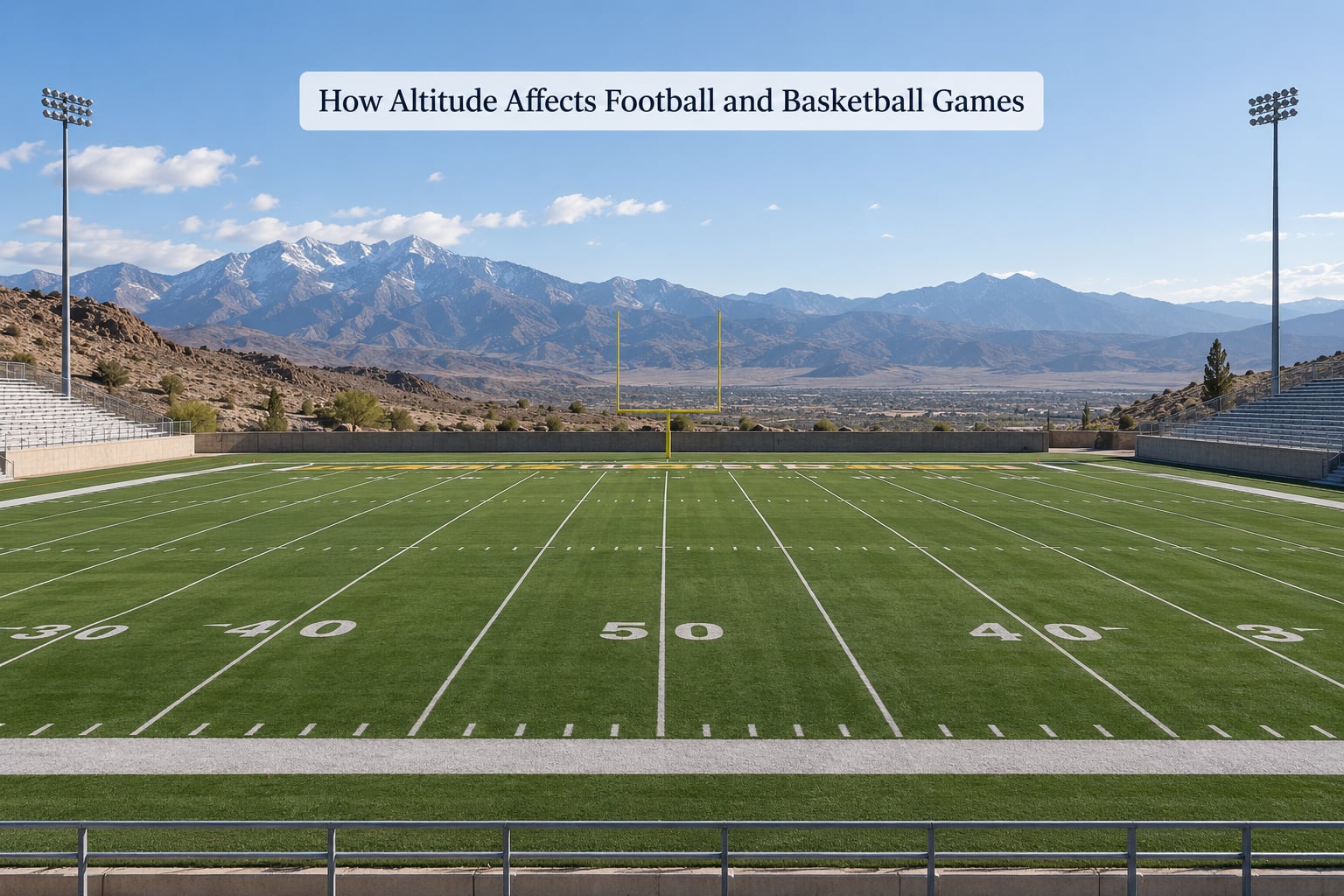
How altitude affects football and basketball games comes down to air pressure. Altitude and elevation are used interchangeably in sports talk, but the useful meaning is simply height above sea level, and the higher you go, the less the atmosphere presses down on you.
The two effects travel independently. The physiological effect hits the athlete: less oxygen available per breath, faster fatigue during repeated efforts. The physical effect hits the ball: less drag, longer flight. A kicker benefits from the second while quietly paying for the first.
Tucson sits at about 2,300 feet. That is high enough for a visiting athlete to notice on a long afternoon, and low enough that it rarely decides a game on its own. Compare that with Denver, where every stadium sits at 5,280 feet, and the same mechanisms produce a much larger gap.
| Elevation band | Typical height | What it does to a game |
|---|---|---|
| Sea level | 0 to 500 feet | Baseline. No measurable physiological difference for most athletes. |
| Moderate elevation | 500 to 3,000 feet | Light effect. Ball flight increases slightly. Most athletes notice nothing beyond ordinary fatigue. |
| High elevation | 3,000 to 8,000 feet | Real effect. Reduced recovery between efforts, longer kick and punt distance, visible fourth-quarter drop for visitors. |
| Extreme elevation | Above 8,000 feet | Acclimatization becomes mandatory. Acute mountain sickness enters the picture. |
How altitude affects football and basketball games, in short
Here is the part most articles bury. Altitude does not make an athlete slower at peak speed. It makes them slower at putting the effort back together after the effort is over, and that is exactly what a football game or a basketball game is made of.
What Does Thin Air Do to the Human Body?
The most common misconception is that the air high up contains less oxygen. It does not. Air is about 20.9 percent oxygen everywhere from the court at sea level to the top of a mountain ridge.
What changes is pressure. Barometric pressure is the weight of the atmosphere pushing down on you, and it falls steadily with height. Lower pressure means each breath carries fewer oxygen molecules. Randy Wilber, a senior sports physiologist with the U.S. Olympic and Paralympic Committee, put it plainly when describing Mile High: the percentage is the same, the volume is smaller.
Your blood carries what it can. The measure of that is arterial oxygen saturation, written SpO2, which is the share of your hemoglobin holding oxygen. At sea level it typically sits near 97 percent. In a Frontiers in Physiology study of repeated sprinting, saturation dropped from about 96.8 percent to roughly 81.8 percent across sprints in the reduced-oxygen condition.
One caveat worth carrying through everything below: lab studies usually simulate altitude by lowering the oxygen fraction of air at normal pressure. Researchers call that normobaric hypoxia. Real elevation uses lower pressure at the same oxygen fraction, which is called hypobaric hypoxia. The two are not identical, and most public discussion quietly slides between them.
None of this means every athlete responds the same way. Individual variation is real, and so is the difference between a 30-second burst and a 40-minute grind.
Why Does Altitude Change Football Performance?
Football is built on repeated sprints with short breaks. A defender runs a coverage for eight seconds, then stands on the sideline for forty. That recovery window is where elevation earns its money.
With less oxygen arriving, muscles clear lactate and rebuild capacity more slowly between snaps. A single effort usually looks normal. The twentieth effort of the game looks worse. That gap is the whole mechanism.
Consequences on the field follow from that one fact. Third-down efficiency tends to drop for the visiting team late in a game, because the offense that can recover from a failed drive is the offense that keeps its best linemen fresh. Deep passing to a tired secondary gets harder to sustain. Road teams that arrived from a lower elevation often run more plays to keep the clock and their own defense fresh.
Hydration matters more too. Fluid balance and the amount of water you can hold in the blood both interact with the thinner air, so the ordinary between-play drinking routine carries extra weight in a dry high-elevation stadium.
Here is where the experts honestly disagree. Dr. Dave Hnida has argued that football is a stop-and-go sport, that the effect on speed, stamina and endurance is minimal, and that a game does not last long enough for the deficit to compound much. Lab measurements point the other way: in that same Frontiers study, knee-extensor torque after repeated sprints fell about 9 percent in the normal-oxygen condition and about 14 percent in the reduced-oxygen condition, a graded drop across the simulated heights tested.
Both can be true. Peak output survives altitude. Recovery between efforts does not.
How Altitude Changes Basketball Strategy and Scoring
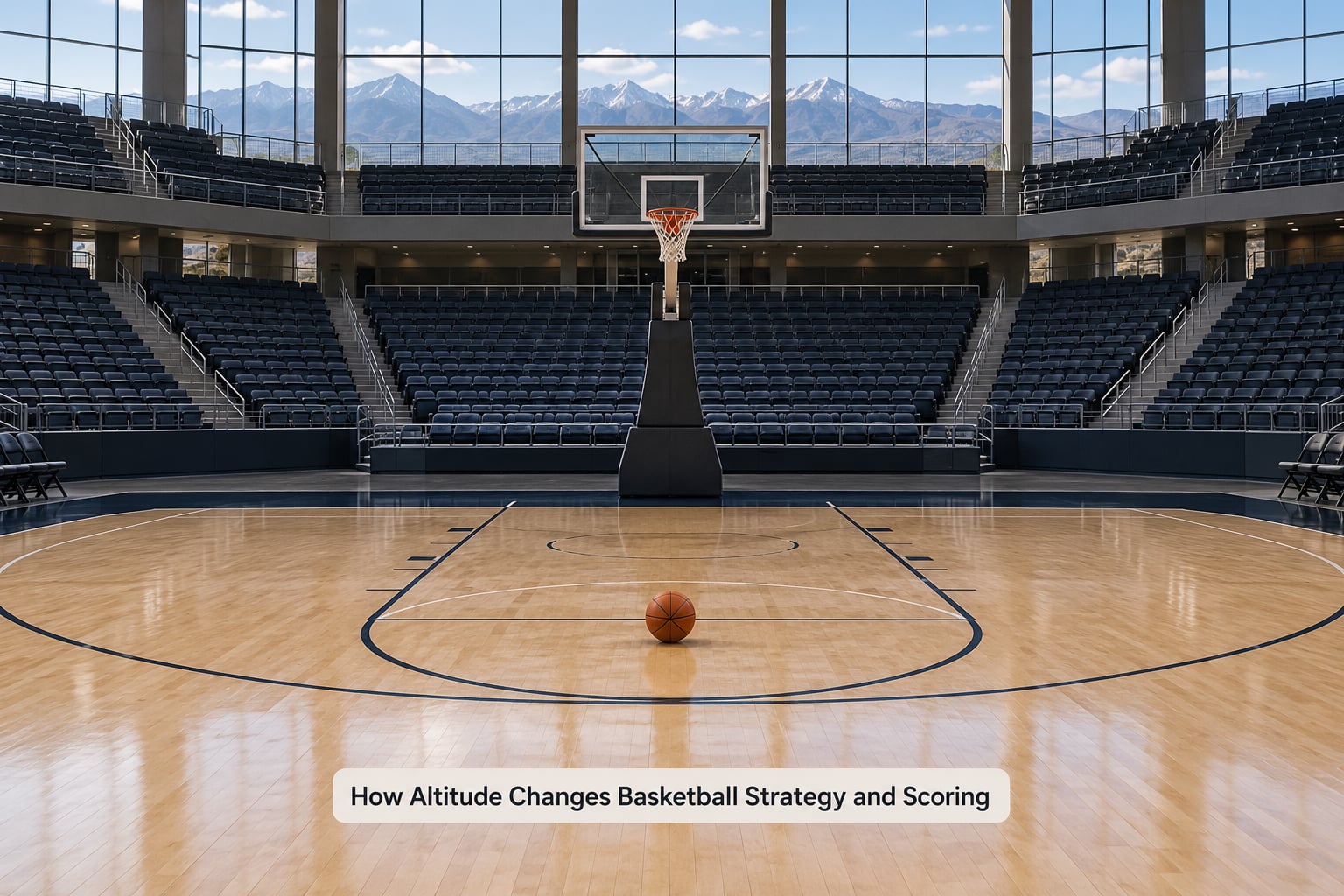
Basketball at elevation is a substitution problem more than a scoring problem. Possessions are shorter than snaps, but there are more of them across forty minutes, and a team that cannot restore its legs starts paying in the back half of possessions rather than all at once.
What that changes on a clipboard is concrete. Teams push pace earlier to bank points while legs are fresh. They call timeouts sooner to reset legs instead of grinding out a bad sequence. They use deeper rotations in the fourth quarter and treat the third unit as a real unit rather than a contingency.
Shot-making variance is the part fans notice late. A slight loss of control under neuromuscular fatigue shows up as a few open looks that should not be open. Reported cramping is another one, with players describing it in games played at elevation. Basketball players who live there year-round rarely show it, which suggests acclimatization and conditioning rather than the air itself.
| Priority | Sea level | High elevation |
|---|---|---|
| Pace of play | Settled by matchup preference | Pressed earlier, before visitor recovery degrades |
| Timeout use | Set plays and clock management | Earlier resets to restore legs |
| Rotation | Matchup and foul management | Deeper fourth-quarter bench |
| Shot selection | Space and efficiency first | Higher-percentage shots, fewer contested pull-ups late |
| Rebounding | Box-out discipline | Box-out discipline plus more crashes on the glass late |
Does the Ball Behave Differently at Altitude?
Yes, and it is the cleanest part of the whole story. A projectile flying through denser air loses energy to drag. Thinner air means less drag, and a ball in thinner air keeps its speed and travels farther before dropping into the same landing spot.
For football, that shows up on punts, kickoffs and field goals. Reports from Mile High put the gain at roughly five to seven yards over the same kick at sea level. Kickers plan for it, and returners adjust their depth because a kick that would be a normal return at sea level comes deeper than the call expects.
Basketball is a different question, and the honest answer is that the effect is small. A set shot is a much shorter arc over a much smaller distance, so the drag difference barely registers. Anyone telling you the ball is automatically easier to shoot at elevation is overstating a minor effect.
Keep the confounders separate too. Ball type, weather, and a kicker’s technique can each move a kick by several yards on their own. A cold dense morning changes ball pressure and flight more than most elevation differences do. Altitude is real, but it is one variable among several.
How Do Teams Prepare for Games at High Elevation?
The preparation principles generalize across both sports, and they are less exotic than the marketing around altitude gear suggests.
- Condition realistically. If a team plans to compete at elevation, the running and conditioning work needs to reflect repeated efforts with limited rest, not steady-state endurance. That is the standard of the sport, but the payoff at elevation is larger.
- Handle travel timing deliberately. Teams split between arriving a day early and arriving as late as possible. Dr. Hnida’s point is that a single extra day does almost nothing for a stadium game, and matters mainly above about 7,500 feet, where it is a ski trip rather than a football trip.
- Prioritize hydration and sleep. Not exotic measures, just the boring ones, done consistently across the trip.
- Use the warm-up as an adjustment tool. Longer, more progressive warm-ups and pacing early in the game give a visitor a chance to find their rhythm before the pace picks up.
- Plan rotations in advance. Decide the fourth-quarter bench before kickoff or tip-off rather than improvising it in the moment.
- Treat sideline oxygen as a comfort measure. It sits on the sideline and makes a player feel better. It does not meaningfully change arterial saturation over the length of a game.
One distinction worth making explicit, because altitude-training product pages rank alongside this topic and muddy it. Training at altitude to gain an edge back at sea level is a separate strategy with its own evidence base. Playing a game at altitude is a one-off exposure. Neither result transfers cleanly to the other.
Any athlete with a heart, lung, or blood-pressure concern who is heading to a high-elevation venue should talk it over with a qualified medical professional rather than reading it here.
How Much Can Altitude Affect the Final Result?
Altitude is one input among many, and it is routinely oversold. Talented teams win at elevation, mediocre teams lose at elevation, and plenty of games at 5,280 feet have been decided entirely by turnovers.
Two distinctions do matter. First, playing at altitude and traveling to altitude are not the same exposure. A host team has been breathing the air for years, a visitor arrived on a bus that morning.
Second, the effect concentrates where it always does, in recovery between efforts. A close game decided in the final quarter is the most vulnerable moment to elevation, because that is where the accumulated fatigue gap surfaces.
The psychological layer deserves credit too, because players routinely describe arriving already thinking about how thin the air feels. Forum threads about Denver teams fill with players pre-worried before the opening whistle. Expectancy is not physiology, but it changes how hard a team plays.
As for the record books, be careful with old numbers floating around forum threads from more than a decade ago. Home and away splits age badly. Treat the mechanism, not the statistic, as the durable fact.
Frequently Asked Questions
Does altitude make football harder to play?
Somewhat, but not in the way most people expect. A single sprint at altitude usually performs about the same as at sea level. What degrades is recovery between efforts, and a football game is built entirely on repeated efforts with short rests. That is why the effect shows up in the fourth quarter rather than in the first series of plays.
Does basketball become easier at high elevation because the ball travels farther?
Barely, and the effect is easy to oversell. A basketball shot covers a short distance over a modest arc, so the difference in air density barely changes the flight. The real high-elevation basketball effect is physiological. Players tire between possessions, which changes pacing, timeout use and fourth-quarter rotation rather than making every jumper easier.
How long should a team acclimatize to altitude before playing?
For a stadium game, one extra day does very little. Meaningful adaptation is measured in days to weeks, not hours. Reported timelines put a couple of days for light adjustment, about five days for many elite athletes, and roughly two to three weeks for red blood cell production to respond. One physician has argued early arrival mainly matters above about 7,500 feet.
Are home-court advantages greater in football or basketball at altitude?
Football, most likely. A football game spreads its exertion across more stop-start sequences and depends on specialist kicking and return decisions where a few yards of ball flight matter. Basketball has shorter, denser bursts and a longer stretch of continuous play. In both sports the advantage shows up late in games rather than as a decisive shift from the opening whistle.
Why can visiting football players tire faster in the fourth quarter?
Because recovery between efforts is the first thing altitude takes. With less oxygen available per breath, muscles clear fatigue and rebuild capacity more slowly between snaps. A visiting team arrives with less adaptation than the home team, so the gap is small early and compounds across a long afternoon of repeated sprints.
Does cold or dry desert air have the same effect as altitude?
No. They are separate variables that happen to coexist in places like Tucson and Denver. Altitude works through lower air pressure and reduced oxygen per breath. Dry air affects hydration and comfort instead. Cold changes how far a kick travels for its own reasons, and ball pressure responds to temperature independently of elevation.
Sources and Further Reading
Every quantitative claim in this piece traces to one of the following.
- High Altitude Increases Alteration in Maximal Torque but Not in Rapid Torque Development in Knee Extensors after Repeated Treadmill Sprinting, Frontiers in Physiology.
- Dr. Dave Hnida on why arriving a day early does not fix altitude adjustment, CBS News Colorado.
- Mile-High NBA advantage: how Denver altitude affects basketball, AP via Yahoo Sports, featuring Randy Wilber of the U.S. Olympic and Paralympic Committee.
- Acute Exposure to Normobaric Hypoxia Impairs Balance Performance in Non-Elite but Not Elite Basketball Players, Frontiers in Physiology.
Conclusion
Altitude affects football and basketball games through recovery between efforts and through reduced drag on the ball, in that order of importance. Watch the fourth quarter first, then the kicking and punt distances, then how deep the bench goes.
And check how long each team has actually been at elevation, because that single fact explains more than any statistic about home records.