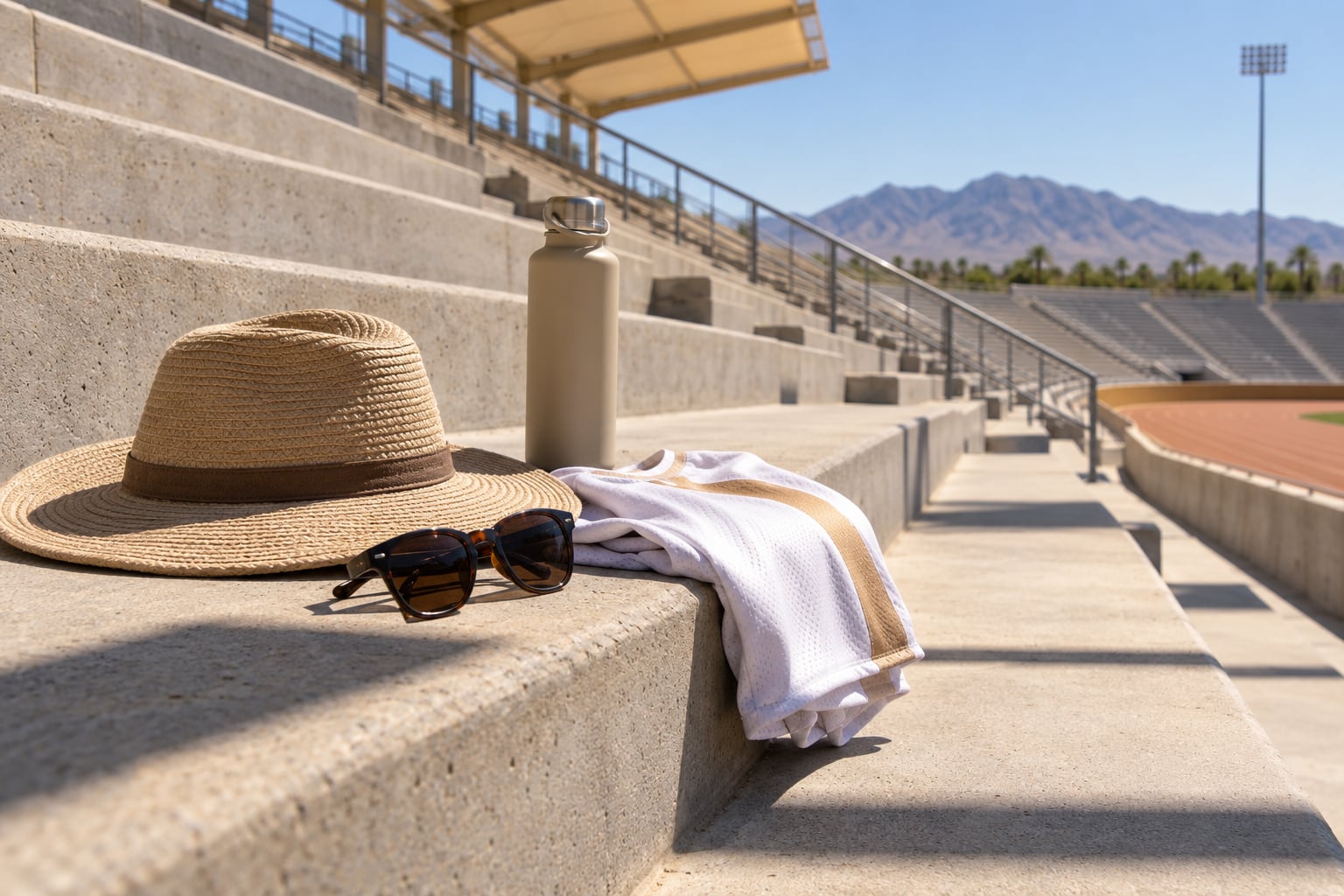
What to wear to a desert football game comes down to four things: a loose, light-colored team shirt or a sun shirt worn under your jersey, a wide-brim hat or cap, sunglasses, and closed-toe shoes with real cushioning. Dry desert air lets sweat sit on your skin instead of evaporating, so the outfit you pick is a comfort decision as much as a style one.
That difference is why a guide written for an 85°F game in the Midwest falls apart in Tucson or El Paso in September. Here the sun hits sun-exposed seats for the full three hours, the UV index regularly runs 9 to 11, and the concrete under your shoes has been baking since noon. Everything below is filtered through one question: will this still work when there is no shade anywhere in sight?
Table of Contents
What You Need for What to Wear to a Desert Football Game
The core kit is small. You need breathable team apparel in a light color, sun protection for your head, neck and shoulders, one layer you can add when the sun goes down, supportive closed-toe footwear, and a few small items: sunscreen, sunglasses, a refillable bottle and a clear bag that meets your stadium’s policy.
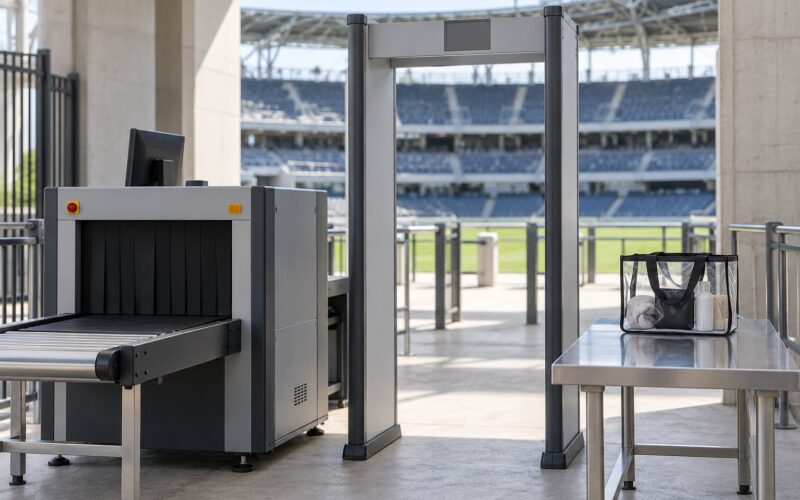
That last one catches people out. Bag rules differ at every venue and they change, so check your stadium’s official site rather than assuming a rule you read three seasons ago. A clear tote that fits the published size limit is the boring answer that saves you a trip to the gate.
What UPF actually means. UPF stands for Ultraviolet Protection Factor, a rating that tells you how much of the sun’s UV radiation a fabric blocks. A UPF 30 shirt blocks roughly 97 percent of UV, and a UPF 50 shirt blocks about 98 percent. In dry air with a UV index above 8, that number matters more than most people realize, because uncovered shoulders and the back of your neck take the longest to recover from a burn.
Use the kickoff temperature and the UV index together. Here is the outfit tier most fans land on:
| Kickoff conditions | Base layer | Sun protection | Footwear |
|---|---|---|---|
| Under 80°F, low UV | Team tee or jersey over a light long sleeve | Cap is plenty | Any cushioned sneaker |
| 80 to 95°F, moderate UV | Loose tee or sleeveless jersey over a UPF 30 shirt | Cap plus sunglasses, sunscreen on shoulders | Breathable runners with a cushioned footbed |
| 95 to 105°F, UV 8 to 10 | Lightweight UPF long sleeve, jersey worn open or over the top | Wide-brim hat, sunglasses, neck gaiter | Closed-toe shoes with moisture-wicking socks |
| 105°F and above, UV 10 to 11 | Loose woven or UPF 50 layer, light colors only | Wide-brim hat with a neck flap, sunglasses, full sun cover | Cushioned closed-toe shoes, no sandals if you will be on concrete all day |
One more variable matters as much as the forecast, and it is free: which side of the stadium you sit on. Fans on the shade side consistently report a comfort gap large enough to notice, and people who tailgate for a few hours before a sun-side game can talk themselves into a much lighter outfit than they should. If you can pick your seats, shade side is worth more than any single item of clothing.
Step-by-Step: Build an Outfit for Heat, Sun, and Stadium Comfort
Build the outfit in this order and you will not have to think about it in the parking lot. Forecast first, seat side second, team gear third, sun protection fourth, evening layer fifth, shoes last but not least.
How to Choose a Breathable Team Shirt or Jersey
Start with the base layer, which is the piece that touches your skin all afternoon. A jersey mesh or a team T-shirt in a light color is the right call, and fitted beats boxy only if the fabric is a performance knit that moves sweat off your body. Heavy cotton holds water against your back for an hour and stays heavy for the rest of the game.
Jerseys get complicated fast in dry heat, because they are usually thicker than a tee. On r/49ers, the advice that comes up most is a long-sleeve sun shirt worn under the jersey, which gives you the team numbers on top and a sun barrier underneath. It is the smartest single move in this whole guide, and it costs less than the jersey most people buy.
On color, light wins. One r/bigmenfashionadvice thread on beating summer heat is blunt about it: linen is the answer, bright colors reflect more heat, and black, gray and navy are the ones to avoid. Team spirit does not require wearing navy. Most schools have a light cap, a white tee or a sand or red accent that carries the same identity without adding radiant heat.
How to Add Sun Protection Without Overheating
Protection works in layers of different jobs. A wide-brim hat handles your face, ears and the top of your neck, which are the three spots that get burned in a way you notice three days later. A baseball cap shades your eyes but leaves the sides of your face and the back of your neck completely exposed, so on a sun-side seat add a neck gaiter or a lightweight scarf.
Sunglasses are not optional when you are looking toward a sun-facing field for two and a half hours. Polarized lenses cut the glare off concrete and cutlass grass, and they also make the early part of the game easier to watch.
Then the fabric does the rest. A UPF 50 long sleeve over your arms is a better answer than exposed skin and a better answer than a thick hoodie, because it blocks the burn without the insulating weight. Apply sunscreen to whatever stays uncovered, including the tops of your ears and the back of your hands, and put it on before you leave rather than when you notice the sting. Most sunscreen guides recommend reapplying every two hours in sustained direct sun, so set a phone reminder or tie it to the end of the first quarter.
Add a cooling towel to the clear bag. Wet it in a fountain or a bathroom sink, drape it over your neck, and it does more for your comfort than any outfit change.
How to Dress for Cooler Evenings and Indoor Seating
Here is the part people forget. Desert stadiums in October and November can swing 30 to 40 degrees between an afternoon kickoff and the fourth quarter, and an October night game in Las Vegas or El Paso starts warm and ends genuinely cold once the sun is down.
Bring one layer that you can add without digging through a bag. A lightweight hoodie, an overshirt or a packable jacket all work, and the best version of this is a piece in a team color or neutral so it does not look like a concession-stand uniform. A neutral zip layer over a team tee reads better and is easier to wear in September than a heavy team jacket.
Skip heavy outerwear. It is miserable at kickoff, and by the time you would want it you have been sitting on it for two hours. The layer should be something you can hold or tie around your waist until halftime, which is usually when the temperature in the stands actually drops.
How to Choose Comfortable Shoes and Accessories
Your feet will spend three hours on hard bleachers and then a long walk across sun-baked concrete to the car, so shoes matter more here than at a cooler game. Closed-toe shoes with a cushioned footbed and a breathable mesh upper are the safest pick. Moisture-wicking socks matter more than people expect, because a cotton sock stays wet and adds friction.
Sandals are fine for a shaded evening game or a lawn seat with a blanket, and a lot of people wear them. What you are trading away is the footbed cushioning and the protection from a walkway that has been in the sun all day, and if you are walking the length of the concourse you will feel it.
Do not wear brand-new shoes. Break them in at home first, on a long walk, a week or more before the game. Blisters on a concrete walkway at the end of a night game are a miserable way to end a rivalry.
For accessories, keep it to team colors that do not sit against your skin: a cap, a crossbody strap in a team color, earrings or a wristband. Skip anything metal around your neck that heats up in the sun, and skip a heavy bag. Check the size limit for your clear bag and leave room for the bottle, the cooling towel and your sunscreen.
If you only get one thing right, get the shoes right. When I watch people pick an outfit for what to wear to a desert football game, the footwear is the detail most of them skip and the one they regret first on the walk back to the car.
Common Mistakes When Dressing for a Desert Football Game
Most bad game-day outfits in the desert are the same handful of mistakes, and every one of them is fixable in a minute before you leave the house.
Wearing jeans or denim. Denim is heavy, absorbs sweat and then holds it against you. Pick lightweight non-denim shorts, loose athletic pants or a breathable woven short instead. If denim is the only thing in the drawer, that is a signal to sort laundry before kickoff, not a reason to suffer.
Choosing black, gray or navy. Dark colors absorb radiant heat in direct sun, which is exactly the condition in the sun side of a stadium. Wear your school color through light neutrals, white or a bright accent rather than a full dark look.
Layering a heavy jersey over a hot base. A thick jersey over an unbreathable layer doubles the heat load. Either wear a lighter jersey or go with a sun shirt underneath, which is what the r/49ers crowd keeps recommending.
Skipping sun protection because the forecast looks fine. The forecast says air temperature, not what the sun feels like on your shoulders. A hat, sunglasses, sunscreen and one UPF layer cost almost nothing and take ten seconds to put on.
Wearing new shoes. Break them in before game day, or pick shoes you have already logged hours in.
Overpacking accessories. The more metal and hardware you bring, the more of it ends up on a bleacher seat. A hat, a bottle, a towel and a small clear bag is the whole list.
Ignoring the evening drop. Check the hour of kickoff, not just the kickoff temperature. A 7 pm start in October in a high-desert market is a warm first half and a genuinely cool fourth quarter, and one light layer fixes that.
Now the part that matters more than any of the clothes: staying cool and staying safe in the stands.
- Hydrate before you go, not during the drive. Start in the morning with water rather than coffee or energy drinks.
- Bring more water than you think you need. A three-hour sun-exposed game costs you a lot of fluid, and an insulated bottle that holds cold is worth the weight.
- Consider electrolytes. Plain water alone does not replace the sodium you lose in sweat, and most venues sell electrolyte drinks or packets near the gate.
- Wear your hat from the first quarter, not when you start feeling warm. Prevention is the whole point.
- Keep the cooling towel on your neck and rewet it during every break you get.
- Take a shade break every quarter or so. Walk to a concourse opening or an underside of a level, stand for two minutes, and get out of the sun.
- Watch yourself and the people with you. Headache, dizziness, nausea, a racing heartbeat, heavy sweating or unusual fatigue are signs of heat exhaustion. Get to shade, get water, and get out of the sun.
- If someone is confused, fainting or stops sweating in the heat, treat it as an emergency. Call stadium staff or emergency services right away rather than walking it off.
A few extra notes if you have kids with you. Sunscreen on their ears, necks and the backs of their hands, a second bottle per child, and a plan to check in every quarter matter more than any outfit. If a venue allows it, a canopy or pop-up tent changes the day more than any fabric choice. Fans in r/flagfootball make the same point about shade, and they are not wrong: the temperature difference between standing in the sun and standing under cover is real and immediate.
One last thing. If you are drinking at a daytime desert game, pace it and keep drinking water. r/49ers threads about 90-degree weekends keep repeating the same advice about not overdoing it the night before, and the forums in r/AskPhoenix show just how routine extreme heat is in these markets. Knowing the signs early is what keeps a rough day from becoming a medical one.
Frequently Asked Questions
What to wear to a football game in heat?
Wear a loose, light-colored shirt or a UPF-rated long-sleeve sun shirt, add a wide-brim hat and sunglasses, and finish with cushioned closed-toe shoes. Choose light colors and loose woven or quick-dry fabric instead of dark cotton, denim or thick polyester. Bring a clear bag, sunscreen and a refillable bottle, plus one light layer for after sunset.
How do you keep cool at a football game?
Hydrate before you leave, keep an insulated bottle and electrolytes within reach, wear a cooling towel around your neck, and take a shade break every quarter. Light colors and loose woven fabric help, and so does sitting on the shade side of the stadium when you have a choice. Leave the stands if you feel dizzy or nauseated.
Should I wear jeans to a football game?
Skip them in the heat. Denim is heavy, soaks up sweat and then holds it against your skin for the rest of the game, which adds to the radiant heat you are already absorbing. Lightweight athletic pants, loose woven shorts or non-denim cotton blends do the job and feel far better on concrete bleachers.
How to dress to go to the desert?
Cover up, keep it light and let air move. Loose woven or UPF-rated fabric in light colors, a wide-brim hat with neck coverage, sunglasses, and closed-toe shoes for sun-baked ground. Add a layer for the evening drop and carry more water than you expect to drink, since dry heat lets sweat sit on your skin instead of evaporating.
What to wear to a football game without a jersey?
Build around a light team T-shirt, a cap and a couple of team-color accessories such as a crossbody strap, wristband or earrings. In the desert, pair it with a UPF long sleeve underneath so you still have sun coverage. Most schools read the light version of their colors just as clearly as the jersey.
What to wear to a football game at night in the desert?
Start with a light team shirt and a layer you can add rather than remove, because a night kickoff in the desert can swing 30 to 40 degrees by the fourth quarter. A lightweight hoodie, overshirt or packable jacket in a team color or neutral handles it. Closed-toe shoes still matter if you are walking across an unlit concourse.
Final Game-Day Checklist
If you only do one thing, do this first: open the forecast the night before and read the kickoff temperature, the UV index and the kickoff hour together. Those three numbers decide the shirt, the hat and whether you need a layer, and everything else on the list follows from them.
- Light-colored base layer in a loose woven, quick-dry or UPF-rated fabric
- Long-sleeve sun shirt under the jersey if the UV index is 8 or higher
- Wide-brim hat or cap, plus a neck gaiter for a sun-side seat
- Sunglasses, ideally polarized
- Sunscreen applied before you leave, with a reapply reminder set
- One light layer in a team color or neutral for the post-sunset drop
- Broken-in, cushioned closed-toe shoes and moisture-wicking socks
- Clear bag sized to your venue’s policy, with a bottle, a cooling towel and sunscreen inside
- Electrolytes, plus a plan to drink water before the game and during it
- A shade plan, whether that is seat selection, a permitted canopy or a concourse break each quarter
Desert game day is not about dressing up or dressing down. It is about covering the skin the sun will find, keeping air moving, and making sure you can still enjoy the fourth quarter. Updated for October 2026 — check your stadium’s bag policy and kickoff time before every game, because both change.