
Bowl games still matter to college football programs because a berth brings guaranteed conference revenue, national television exposure that shapes recruiting, meaningful reps for returning players, postseason bonuses and another chance at playoff positioning. The matchup itself is often ugly. The six things that appearance funds are hard to find anywhere else on a schedule.
Here is the short version, for anyone who has scrolled past a December schedule wondering why a 6-6 team took a trip it had no business taking.
- Money that arrives whether you win or lose. The bowl pays the conference, the conference shares the money out to every member school. In the 2023-24 season, the 40 non-College Football Playoff games distributed roughly 375 million USD to conferences, according to the reporting Front Office Sports published in December 2023.
- National exposure that a conference schedule cannot buy. A late-season upset on a regional broadcast reaches recruits across the country in a way four home games never will.
- Development reps against a different style. A postseason opponent that runs a scheme nobody in the conference plays forces the backup offense to solve a real problem.
- Postseason bonuses. Coach contracts routinely pay six figures for reaching a bowl, and a growing number of player contracts attach money to the same trip.
- Conference standing and playoff résumé. Winning your conference still means the best division spot, the best non-playoff berth, and a résumé that gets read closely in December.
- Fan travel, alumni giving and season-ticket renewals. A bowl trip is one of the few calendar events that gets a whole fan base on a plane in the same week.
None of that depends on beating the opponent across the field. That is the part that confuses people, because the score is the only part fans discuss at the bar.
Table of Contents
- Why Bowl Games Still Matter to Programs
- How Bowl Games Shape Recruiting and Program Visibility
- Revenue, Ticket Sales, and the Business Side of a Bowl
- How Bowl Appearances Develop Players
- Conference Prestige and Playoff Positioning
- Do Bowl Games Really Matter in the College Football Playoff Era?
- What Wins, Losses, and Revenue Mean for Fans
- Frequently Asked Questions
- Do bowl games still matter with the College Football Playoff?
- How much money can a college football bowl game make for a program?
- Does winning a bowl game help a team’s recruiting?
- Why do teams play in bowl games they may lose?
- How do bowl games help college football players develop?
- Does losing a bowl game hurt a program’s future?
- Conclusion: Judge the Bowl by the Program It Builds
Why Bowl Games Still Matter to Programs
A bowl berth is the rare item on a college football schedule that a program cannot manufacture on its own. Wins buy goodwill with fans. Postseason games buy cash, exposure and roster continuity, and they hand a school something it rarely gets otherwise: a national stage that lasts a full week and lands during recruiting season.
The mechanics are simple enough to explain in a few sentences. A school has to hit the eligibility standard, generally six wins and a winning record, then accept an invitation. The bowl organization pays the conference, the conference splits the payout among members, and the school keeps a share plus ticket revenue, sponsorship inventory and whatever local spending the week creates.
Because the money is pooled, one appearance subsidizes a dozen schools that never left campus. Reddit’s r/CFB has argued this point more forcefully than any editorial has: the recruiting reach and the conference-wide revenue are the two reasons people defend bowls, and everything else is nostalgia arguing on its own.
There is one more piece that rarely gets written down. Some coaching contracts pay a postseason bonus for reaching a bowl, and a few schools now attach player payments to the same appearance. That converts a nice-to-have into money in a player’s bank account, which changes how much weight players put on the trip.
How Bowl Games Shape Recruiting and Program Visibility

Here is the reason bowl games still matter to programs that no balance sheet captures: a bowl is the largest piece of earned national exposure a program gets without hiring an agency.
Picture a high school junior in Ohio whose team has never heard of the school you cover. He is not watching the game because of a rivalry. He is watching because it is on national television, or because it is on the streaming service his family already pays for, and it started at four in the afternoon while he was still in practice.
That exposure does two things at once. It puts the program in front of recruits who had never scouted it, and it puts current players in front of the same audience, which is exactly when NIL decisions and retention conversations are happening.
Why Bowl Games Still Matter to Programs: The Recruiting Angle
Take an in-state prospect who watches a late-season upset on television. Nothing about that game changed his ranking, and it never should have. But a few days later a coach he has never met is in his inbox, and a few weeks after that the same coach is sitting in his living room talking about a scheme he can see himself playing in.
The important detail is that this is earned reach. Coaches cannot buy that airtime, and a recruiting service cannot manufacture it. The four games against in-conference opponents that already made the schedule do not reach a prospect who has never heard of the school.
Programs treat a long postseason appearance differently for that reason. The week of a Rose or Sugar Bowl game is when a staff is on the road four nights in a row, when an offer can be floated to a fifteen-year-old before his parents have even picked a school, and when the follow-up visit happens while the buzz is still warm.
And this is where the long-term value and the final score come apart. A program can lose a December game and still bank a class built during that week. Winning helps. Exposure is what actually moves the recruiting board, and exposure is the part that does not care how the game ended.
Revenue, Ticket Sales, and the Business Side of a Bowl
Approximate figures, date-stamped, because they move every year. The 2023-24 numbers reported in December 2023 put the total paid to conferences by the 40 non-playoff games at roughly 375 million USD, with playoff participants receiving on the order of 6 million USD or more each. Sponsorship pricing reported at the time put the floor for a bowl name at about 500 thousand USD, a top non-playoff game between roughly 6 and 7 million USD, and the New Year’s Six deals above 20 million USD.
Split that by tier and the value of a berth gets easier to see.
| Bowl tier | What it looks like | Approximate value to a program | What a berth does for recruiting |
|---|---|---|---|
| New Year’s Six | Rose, Sugar, Orange, Cotton, Fiesta, Outback | Top of the range, several million USD per appearance | Puts a school in every national recruiting story for a week |
| Major non-playoff | High-profile early January games with rotating field | Roughly 6 to 7 million USD sponsorship level | National window, usually against a recognizable opponent |
| Mid-tier | Established December and late-December games | Low millions, varies by deal | Regional reach, useful for in-state and nearby pipelines |
| Lower-tier | Lower-tier and Group of Five-heavy fields, often 5-7 teams | Smaller, but often the largest share of a small program’s postseason money | First national television credit for many programs |
Ticket and gate revenue is real but secondary, and it is the number most often oversold. Payouts are distributed through the conference, so a mid-tier berth can be worth a meaningful sum to a school that never appears on television again all season, while the same game is rounding error for a power conference program. Travel and lodging for a traveling fan base run in the same direction as the ticket revenue, so the net to the school is smaller than the headline figure implies.
The naming-rights churn is worth noting too. When a sponsor leaves, the identity of the game goes with it, and a fan base that had attached itself to a name has to reattach. That instability is a small but real tax on the one asset a non-playoff bowl really sells.
How Bowl Appearances Develop Players
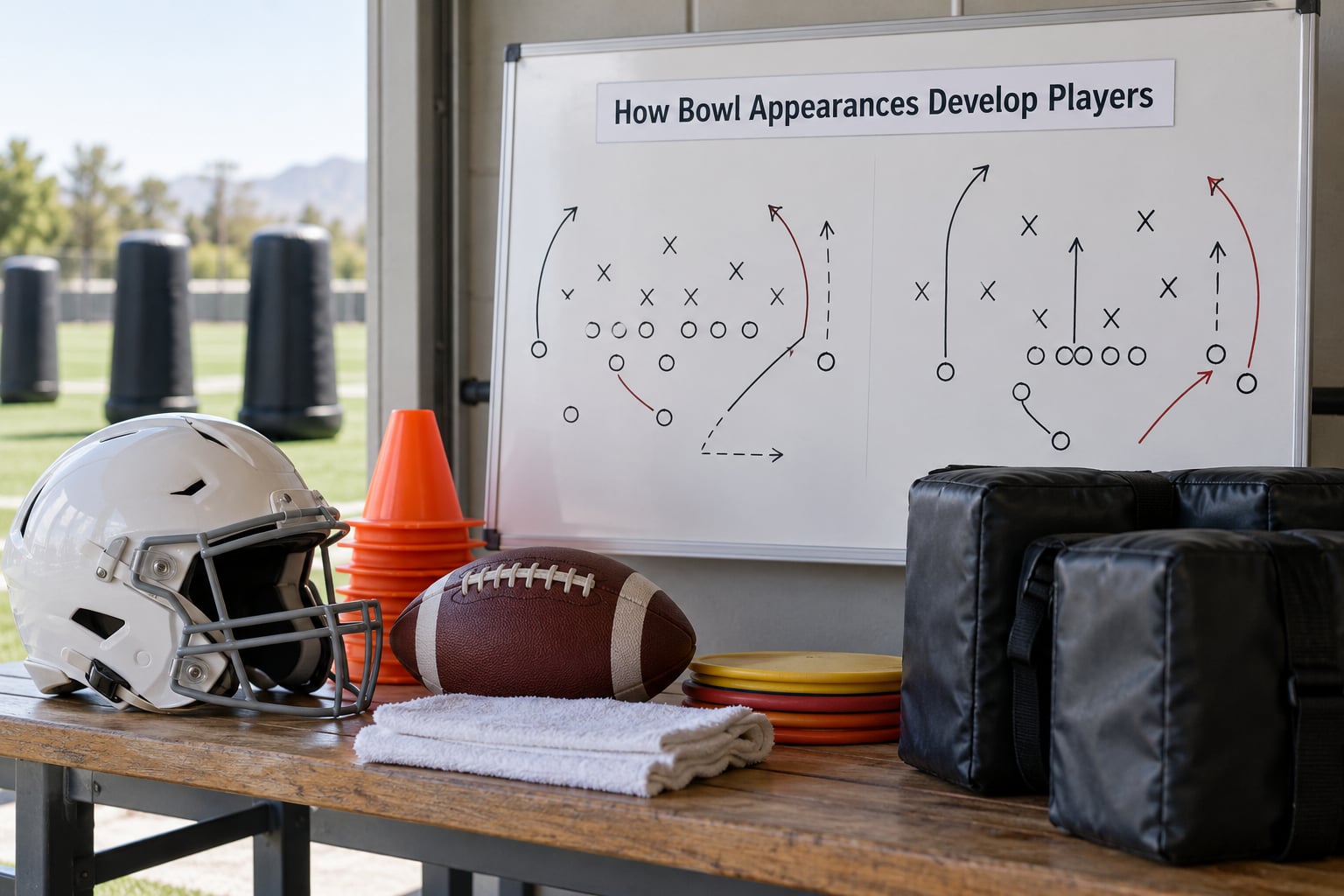
The best player-development argument for bowls is not about the starters who are already good. It is about the fifteen young players who spent the season as the third string at a position and get one real test in December.
A postseason opponent is useful precisely because it is different. A conference schedule repeats the same four schemes over and over, so a player can look good by pattern-matching. A bowl team that runs an offense nobody in the conference has seen forces the backup quarterback to make reads in the moment, and forces the young linebackers to adjust to a different pace.
Quarterbacks are the clearest case. Nico Iamaleava’s Citrus Bowl debut against Joe Milton is the example people still bring up, because a young starter throwing against an SEC-quality opponent in a neutral site is a different test than anything a conference game offers in November.
There is also the less measurable part. Players describe bowl trips as a reward, one last road week with teammates and families. Coaches describe them as the first practices of the offseason, where the roster that returns in January starts building habits before spring.
What a bowl cannot fix is a program that has been gutted by opt-outs. Declaring for the draft and the transfer portal can hollow out a roster before December, and then the developmental reps are not developmental at all. That is the honest limit of the case.
Conference Prestige and Playoff Positioning
Winning a conference still matters inside the postseason structure. A conference champion takes the top spot in its division and the best available non-playoff berth, and any serious résumé discussion starts with that result.
Bowl outcomes feed the selection process too, even when they are not playoff games. Selection committees weigh wins, losses, opponent quality, and how a team finished. A December win against a ranked opponent does work in that room; a December loss to an unranked one does damage that takes a season to undo.
Conferences also have their own reason to want teams in bowls. When a league keeps its teams in postseason games, the pooled payouts keep flowing to every member, and that shared revenue is a large part of how the league stays together while realignment reshapes the map around it.
Do Bowl Games Really Matter in the College Football Playoff Era?
The strongest objection is that this is settled. Teams care about the playoff, not about a December game that starts at 4:30 in the afternoon on a Wednesday. Under the 12-team playoff format, there are twelve playoff berths, so the argument goes, why pretend the other forty games matter.
That argument lands hardest at the top of the sport, and it deserves to be stated plainly. For a program with a realistic shot at a playoff berth, a non-playoff bowl is not the goal, and no amount of spin changes that.
Where it falls apart is at the other end. A Group of Five program, or a lower-tier power conference team, may have no realistic path into the field at all. For those schools a bowl berth is not a consolation prize competing against the playoff. It is the postseason, and it may be worth more than a playoff appearance is to an SEC power.
So the answer depends on the level. At the top, the playoff is the prize and bowls are about seeding and résumé. Everywhere else, a bowl is still the difference between a season that ended in November and a program that got a national week, extra practices, and money that reaches every school in the conference.
What Wins, Losses, and Revenue Mean for Fans
Supporters who want a fair read on a bowl berth can stop with the final score and look at six things instead.
- Preparation quality. Did the coaching staff spend the extra weeks installing something new, or play the safest game available?
- Opponent strength. A win over a ranked team in a major venue is worth more than the record of the game it happened in.
- Player opportunity. How many young players got real snaps, and did any of them look like future starters?
- Recruiting follow-through. Did the visits happen during the bowl week, and did the class move?
- Financial value. Payout share, ticket and gate revenue, travel costs for the fan base, and how much the conference spread around.
- Direction. A bowl loss that produced a better February is a different outcome from a bowl loss that exposed the same problems as October.
A program that answers those well has been moved forward even if the scoreboard says otherwise. A program that has not has wasted a week of everyone’s year.
Frequently Asked Questions
Do bowl games still matter with the College Football Playoff?
They matter differently depending on the program. For a team with a real shot at one of the playoff berths, a non-playoff bowl is secondary and mostly useful for seeding and résumé building. For Group of Five and lower-tier programs, a bowl berth is often the entire postseason, worth more in revenue and national exposure than a playoff trip would be. The playoff changed which games matter most, not whether postseason games matter.
How much money can a college football bowl game make for a program?
Figures change every season, but the reported 2023-24 numbers put the 40 non-playoff games at roughly 375 million USD distributed to conferences, with playoff participants receiving about 6 million USD or more each. A school receives a share of the conference payout plus ticket and gate revenue. Travel costs for the fan base run against the total, so the net is smaller than the headline number suggests.
Does winning a bowl game help a team’s recruiting?
Winning helps, but exposure is what actually moves a recruiting board. A national television week puts a program in front of recruits in states its conference schedule never reaches, and the coaching staff is on the road during exactly the window when offers get made. Programs routinely build commitments during the bowl trip itself, and a win simply makes the story better. The final score is the least durable part of the value.
Why do teams play in bowl games they may lose?
Because most of the value arrives before kickoff. The appearance brings pooled conference revenue that is shared with every member school, a national exposure week, extra practices, and postseason bonuses for coaches and, increasingly, for players under contract. Declining usually means declining all of it. The programs that pass on lower-tier invitations are usually protecting a playoff run or a roster already emptied by the transfer portal.
How do bowl games help college football players develop?
A postseason opponent usually plays a scheme nobody in the conference uses, which removes the advantage of repetition and forces young players to adjust on the fly. Third-stringers and early-career backups get the most meaningful snaps they will get all year. Quarterbacks benefit most, which is why a neutral-site start against a quality opponent, like Nico Iamaleava’s Citrus Bowl debut, is treated as a real test rather than a showcase.
Does losing a bowl game hurt a program’s future?
It can, and it depends on the opponent and the résumé around it. A December loss to an unranked opponent is harder to explain in January than a loss to a ranked team, because selection committees weigh how a season finished. The damage is often shorter than fans expect when the recruiting week went well and the young players developed. A bowl loss that exposes the same problems as October costs far more than the score suggests.
Conclusion: Judge the Bowl by the Program It Builds
Bowl games matter when they move a program forward: a better recruiting class, real developmental reps, shared conference revenue, postseason bonuses, or a cleaner résumé in December. Before deciding a berth was meaningless, ask which of those it delivered. Then look past the score, which is the last thing on the list.