How college football games are rescheduled comes down to one thing: the home institution’s game management staff and athletic director, working with the conference and the visiting school, decide the original date cannot be played and lock in a new one. Weather, health protocols, field and facility problems, travel disruption and broadcast obligations are the usual triggers. Nothing moves without someone signing off, and that sign-off sits in different places depending on the game.
That last part trips up a lot of fans. A postponed regular-season home game and a pushed bowl game travel through different chains of authority, reach different outcomes, and leave very different paper trails. Once you know where the authority sits, most of the confusion about rescheduled games dissolves.
Table of Contents
- Who Decides to Reschedule a College Football Game?
- What Can Force a College Football Game to Move?
- How College Football Games Are Rescheduled From Start to Finish
- Why Do Games Resume at a Different Time or Place?
- How Do Conferences and Bowls Approve Schedule Changes?
- What Happens to Tickets, Travel, and Fan Plans?
- Can a Rescheduled Game Affect Standings or the Playoff Race?
- What Do Weather-Related Rescheduling Rules Usually Cover?
- How to Follow a College Football Rescheduling Decision
- Frequently Asked Questions
- What is the difference between a delay and a postponement in college football?
- Can a college football game be moved to another stadium or city?
- Who officially announces that a college football game has been rescheduled?
- Do I keep my ticket if a college football game is postponed?
- Can a rescheduled college football game become a no-contest game?
- What Fans Should Do First
Who Decides to Reschedule a College Football Game?
The home institution decides, through its game management staff and athletic director, for regular-season games played on its campus. Game management is the group in the booth that calls in-game delays and suspensions; the athletic director owns the call on whether a game is postponed, moved or canceled.
Conferences hold authority over the league schedule itself. When a postponed conference game needs a makeup date, the conference commissioner and the conference’s operations staff usually have to clear it, because a new date can collide with another league game, a televised window or a championship week.
Bowl games belong to the bowl organization and the host institution, not to the two teams. The College Football Playoff is the clearest case: the CFP Management Committee sets the postseason calendar, and the executive director implements it. When the committee published its December 2021 policy on forfeitures, it wrote that semifinals would not be made up, that a team unable to play forfeits and its opponent advances, and that the national championship could be pushed as late as mid-January with a vacant title declared if it still could not be played.
Who has authority outside the regular season
Officials, trainers and medical staff do not decide anything on their own, but their input is what starts the process. A referee who sees lightning, an athletic trainer who pulls a player, or a police detail that reports a problem on the field will trigger a conversation between game management and the athletic director, and that conversation is where the actual call happens.
Visiting teams get no vote. A thread on a Yards Before Lunch forum after the January 2023 Iowa-Northwestern postponement made the asymmetry plain: the home side held the decision, and the visiting fans absorbed the loss of a trip they had already paid for. Fans generally accept a weather delay, but they get angry fast when a move looks like scheduling convenience rather than safety.
What Can Force a College Football Game to Move?
Lightning inside strike distance is the most common trigger by a wide margin. Severe weather of every kind follows it: thunderstorms, high wind, hail, extreme heat or cold, snow and ice on the field, flooding and standing water, and wildfire smoke or poor air quality.
Then there are the things nobody expects. A lighting failure or a scoreboard malfunction can send a fourth quarter into a dark stadium. Police and emergency services can be stretched thin by something happening in the surrounding city, and a stadium will not operate without a workable public safety plan. Grounded flights and closed airports have stranded visiting teams outright.
Health events sit in the same category. A team dealing with a cluster of cases, or with state or local health restrictions, can be told to stay home. During the 2020 season, cancellations traced to positive tests and contact tracing dominated the calendar, and the Virginia-Virginia Tech season opener announced just days before kickoff became the symbol of how little notice fans can get.
Institutional policy can also force a move, and so can the calendar itself. Shared stadiums sometimes turn games into early Saturday or late night affairs to clear construction or pro-team conflicts. Perceived inconvenience almost never drives a decision on its own, which is exactly why a game moved for television reasons tends to draw a harsher reaction than one moved for lightning.
How College Football Games Are Rescheduled From Start to Finish
How college football games are rescheduled, step by step
A reschedule runs through roughly seven steps, and most of the work happens before the announcement fans see.
- Confirm the trigger. Game management talks to officials, trainers, facility staff and, for weather, the meteorologist or the lightning detection system. A rumor on social media is not a trigger; a confirmed report from an official source is.
- Escalate to the athletic director. The on-scene call becomes an institutional decision. This is the point where a game stops being a weather problem and becomes a scheduling problem.
- Pick the outcome. Delay, relocation, shortened contest or postponement. Officials, the visiting team and, when the game is televised, the network all have to agree to the last option, which is why the final call is rarely the first suggestion.
- Search for a mutual date. Both athletic operations teams check remaining calendar openings against the FBS schedule limit, academic obligations, class schedules, recruiting visits and facility reservations. This is the slowest step and the one that most often fails.
- Clear it. The conference commissioner approves the date for league games. Bowl and playoff games clear through the bowl organization or the CFP Management Committee instead.
- Notify everyone. The school pushes updates through its athletics site, app, email, stadium text alerts and social channels, and the conference and television partner update their listings.
- Reconcile records and consequences. Standings, win-loss records, the season’s schedule limits and any postseason implications get adjusted, and ticket and travel policies get published.
Those three outcomes in step three behave very differently, which is why the table below matters more than it looks.
| Outcome | Typical window | What it changes |
|---|---|---|
| Kickoff delay or suspension | Minutes to a few hours | Nothing about the schedule; the game is still played at the same place |
| Relocated or neutral-site contest | Same date or a near date | Home-field advantage, ticket ownership and revenue split for both schools |
| Shortened contest | Same day | The agreed number of periods, and the record is treated as played under conference rules |
| Postponed to a new date | Days or weeks later | Both teams’ remaining calendar, ticket validity, travel plans and sometimes the outcome of the season |
| Canceled or declared no contest | Never | The game does not exist in the record; a forfeit does exist as a loss |
Two different games that look identical to a fan can also land in different boxes here, which is where the arguments start.
Why Do Games Resume at a Different Time or Place?
A game resumes at a different time because the problem was temporary, and at a different place because the original venue could not be made safe or playable. A kickoff delay pushes the start by an hour or three. Moving a game later the same day trades revenue and start time for the chance to play it at all.
Moving a contest to another date keeps the matchup intact, which matters more than it sounds. Fans keep their season-ticket meaning, both teams keep the game on the books for the record, and a postponed game becomes a makeup game in the same season. That is the option administrators reach for first.
Relocation is messier. A neutral site turns the host into an away team, forces a new seating chart, splits gate and television revenue under the contract’s terms, and complicates compliance for both programs. A thunderstorm in the third quarter of a rivalry game is a better candidate for relocation than a season opener called off a week ahead.
A shortened contest is the least common and the most negotiated. It requires both schools and the conference to agree on the number of periods in advance, so it is usually planned rather than improvised.
How Do Conferences and Bowls Approve Schedule Changes?
Regular-season games have room to move. Postseason games rarely do, because every date after the regular season is already spoken for by a conference championship, a bowl or a playoff semifinal.
Conference policies differ more than fans expect. The Big Ten, SEC, Big 12 and ACC have handled the same situations with different procedures, and what counts as enough absences or cases has shifted by season. Conference offices also weigh television windows, which are contractual, and bowl selection rules, which tie dates to selection committee meetings and contract terms.
The always-on constraints are the recruiting calendar, the December academic exam period, facility reservations and the FBS schedule limit. With a maximum number of games per season and bylaw limits per calendar year, a school cannot simply add a twelfth opponent in December, so the makeup date has to come out of an existing week, which pushes another game down the road.
That squeeze is why teams end up playing back-to-back games or taking an unexpected opponent in a week that was supposed to be open. The game being moved causes other games to move, and those moves ripple outward through the standings.
What Happens to Tickets, Travel, and Fan Plans?
Usually your ticket stays valid for the rescheduled game, and if the game moves to a different stadium, the school often lets you either keep a seat at the new venue or take a credit. Refund rules are set by each institution and differ in the details: some give automatic refunds for a cancellation, some issue credit, some require a request through the ticket platform.
Travel is where fans take the loss. Hotels, flights and rental cars booked for a game that slips two weeks are usually the fan’s problem, and r/CFB threads about multi-hour weather delays make the point that fans will sit through a long night far more gracefully than they will eat a canceled trip.
Practical advice: confirm through the school’s official athletics site or ticket account before you change anything, note any refund deadline the moment the announcement drops, and keep screenshots of your booking confirmations until the game is played or the policy explicitly resolves your claim.
Can a Rescheduled Game Affect Standings or the Playoff Race?
Yes, and it often does, in ways that are easy to miss. A team that postpones may play fewer games, which changes who it faces, which weeks it plays, and how much rest it gets before the postseason.
Different divisions use different tiebreakers when teams finish with the same record, so a single postponed conference game can hand one school a division title it would not otherwise have won. In the playoff era the stakes are higher still: fewer games means fewer chances to build a case with the selection committees.
Postseason games carry their own rules. Under the CFP’s December 2021 policy, a team unable to play a semifinal forfeits and its opponent advances rather than waiting for a makeup, and the national championship retained a movable date with a vacant title as the last resort.
What Do Weather-Related Rescheduling Rules Usually Cover?
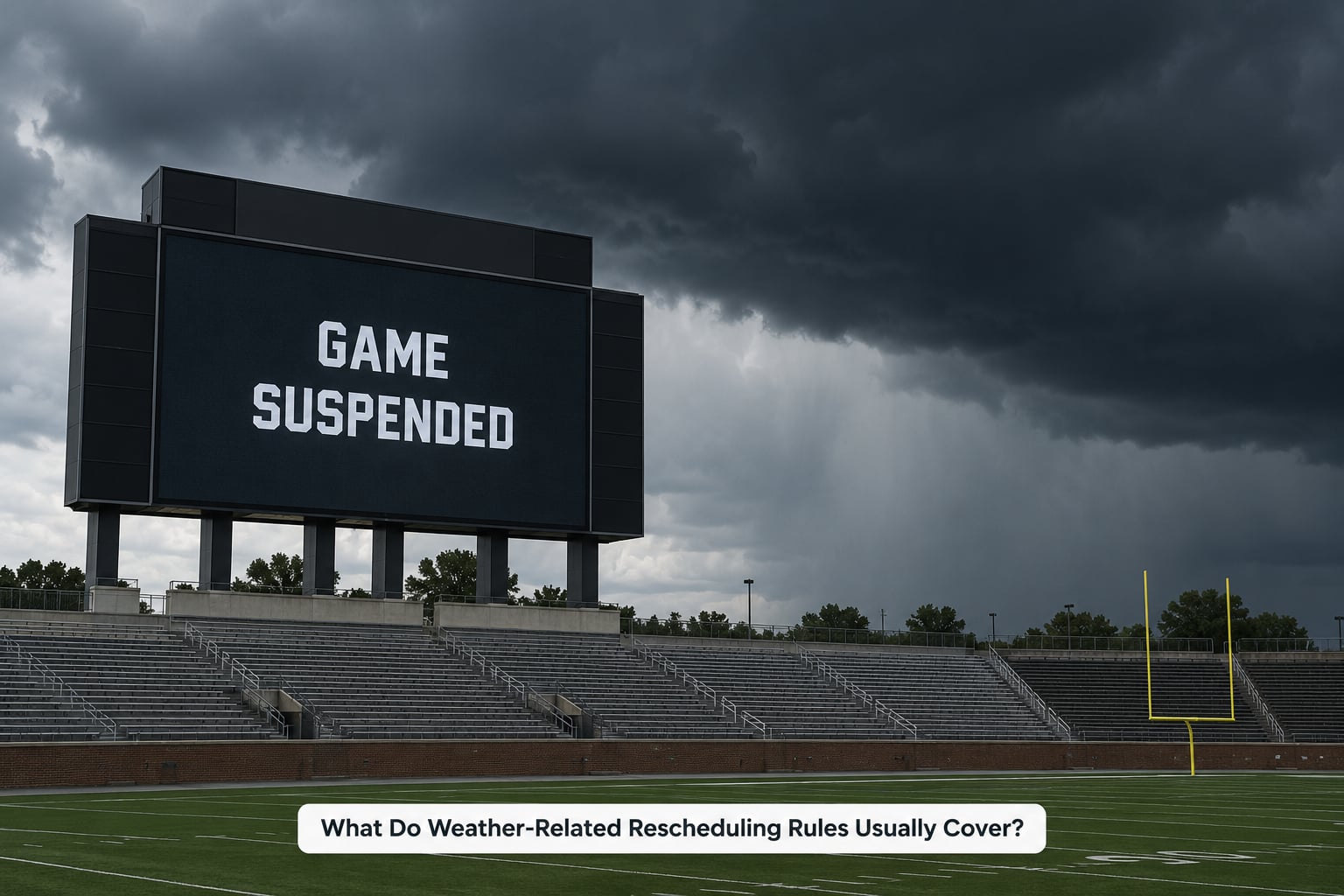
Weather rules come in three layers, and most schools apply all three: a lightning policy, a field-condition standard and a written school safety plan.
The lightning layer is the most familiar. The common standard suspends play when lightning is within roughly eight to ten miles of the field, and requires the stadium to be cleared rather than sheltering spectators in place. Some schools also suspend when thunder is heard, since sound travels farther than most people expect. The widely used thirty-minute rule requires a full half hour of clean weather after the last thunder before play resumes, and a second strike restarts the clock.
The field layer covers turf, drainage and footing. Officials decide when a field is playable, but the school owns the surface, so a saturated field in November or ice after a night game can end a game that started fine.
The safety layer covers heat, air quality and evacuation. Wildfire smoke has pushed some kickoffs, and extreme heat triggers water breaks, shortened breaks or earlier starts.
A delay becomes a postponement when the clock beats the weather. If thirty minutes of clean air does not arrive, or the field will not drain, the game is either moved to a safer venue or put on a new date, depending on how far along it was and whether a venue and an opponent calendar are available.
How to Follow a College Football Rescheduling Decision
Check the school’s official athletics site first, then the conference’s site, then your ticket account and any stadium text alerts you have signed up for. Those four channels carry the confirmed information, and everything else is downstream of them.
Television listings and streaming apps are useful for catching a change late, not for confirming it. A game disappearing from a network’s schedule is a signal, not an announcement.
The vocabulary tells you what happened. A delay or suspension means the game is still on at that stadium. Rescheduled or moved means a new date. Relocated means a different venue. Shortened means fewer periods than usual. Canceled or postponed means no game at that time, and only the school’s official notice tells you whether a makeup exists.
Treat unconfirmed social posts as unconfirmed. A thread going around at midnight is often ahead of, or contradicting, the actual decision.
Frequently Asked Questions
What is the difference between a delay and a postponement in college football?
A delay holds the game at its original stadium and time, often by hours, with the same ticket and the same result. A postponement moves the game to a different date or venue entirely. A suspension is the in-progress version of a delay: play stops, teams and fans wait in place, and resume conditions are stated out loud. Only a postponement changes your travel plans.
Can a college football game be moved to another stadium or city?
Yes, though it is the least common outcome. Relocation happens when the original field cannot be made playable or the site itself is unsafe, and it usually affects a game already in progress rather than one called off in advance. Relocating makes the host team an away team, forces a new seating arrangement, and splits revenue under the game contract, which is why administrators try postponement first.
Who officially announces that a college football game has been rescheduled?
The institution does, through its official athletics site, app, email, social accounts and stadium alert system, and the conference confirms league games on its own site. Postseason changes come from the bowl organization or, for the College Football Playoff, from the CFP Management Committee through the executive director. Third-party scoreboards and social reposts are not an announcement.
Do I keep my ticket if a college football game is postponed?
Usually yes. If the game is rescheduled to another date at the same stadium, your ticket generally stays valid, and many schools also offer a credit or refund option. If the game moves to a different stadium, schools commonly let you either take a seat at the new venue or convert to a credit. Refund rules are set institution by institution, so read the notice on the athletics site and note any request deadline.
Can a rescheduled college football game become a no-contest game?
Yes. If the game cannot be played and no makeup date is found, schools may declare it a no contest, meaning no team is credited with a win or a loss. A forfeit is different: one team is declared the winner because the other could not play. In the College Football Playoff, the published policy has said a team unable to play a semifinal forfeits and its opponent advances, rather than waiting for a makeup.
What Fans Should Do First
Confirm the status through the school’s official athletics site or the conference site before you touch a hotel, a flight or your ticket account, and note any refund or credit deadline as soon as the notice appears. Do not act on an unconfirmed social post, even one that looks detailed.
Understanding how college football games are rescheduled also tells you what to expect next. The cause and the decision authority change across conferences, bowl organizations and the playoff, so the answer to “will they make this up?” is always found in the specific institution’s policy rather than in a general rule.