
College football playoff expansion turned a four-team bracket decided by a dozen selectors into a 12-team field with guaranteed spots for conference champions, a December opening round played on campus, and three extra chances for a team to reach the title game. Before 2024, only four schools had a path to the national championship and everyone else was watching from a November couch. Now twelve teams play for it, and almost every decision in the sport feeds into who ends up in that field.
If you only understand one thing about the current setup, understand this: the top four seeds get a bye into the New Year’s Six quarterfinals, and seeds five through twelve play each other in home and away games the third weekend of December. That single line explains most of what fans argue about now.
Seven things changed, and they all connect:
- A 12-team field replaced a 4-team bracket.
- Conference champions get guaranteed automatic bids, and from 2026 all four Power Four champions plus the highest-ranked Group of Six champion get one.
- The playoff starts in December on campuses instead of at neutral bowls in January.
- More programs have a mathematical chance at the championship, including Group of Five schools.
- Every regular-season game in November carries playoff stakes for a much larger slice of the sport.
- The bowl schedule lost its old pecking order, and the Rose Bowl no longer hosts the national championship.
- Conference realignment and playoff expansion became the same conversation.
Table of Contents
- What College Football Playoff Expansion Changed
- How the Playoff Field Expanded from 4 to 12 Teams
- How the 12-Team Playoff Format Works
- What Expansion Means for Conference Champions and Nonconference Powerhouses
- How Expansion Changed the Regular Season
- How the Playoff Affected the National Championship
- How Expansion Changed Recruiting and Player Strategy
- What Fans Should Watch Under the Expanded Format
- Frequently Asked Questions
- Why did the College Football Playoff expand to 12 teams?
- How does a 12 team college football playoff work?
- Did the 12-team playoff devalue the regular season?
- Which conferences get automatic bids in the College Football Playoff?
- Who decides the College Football Playoff field?
- Will the College Football Playoff expand again?
- Conclusion
What College Football Playoff Expansion Changed
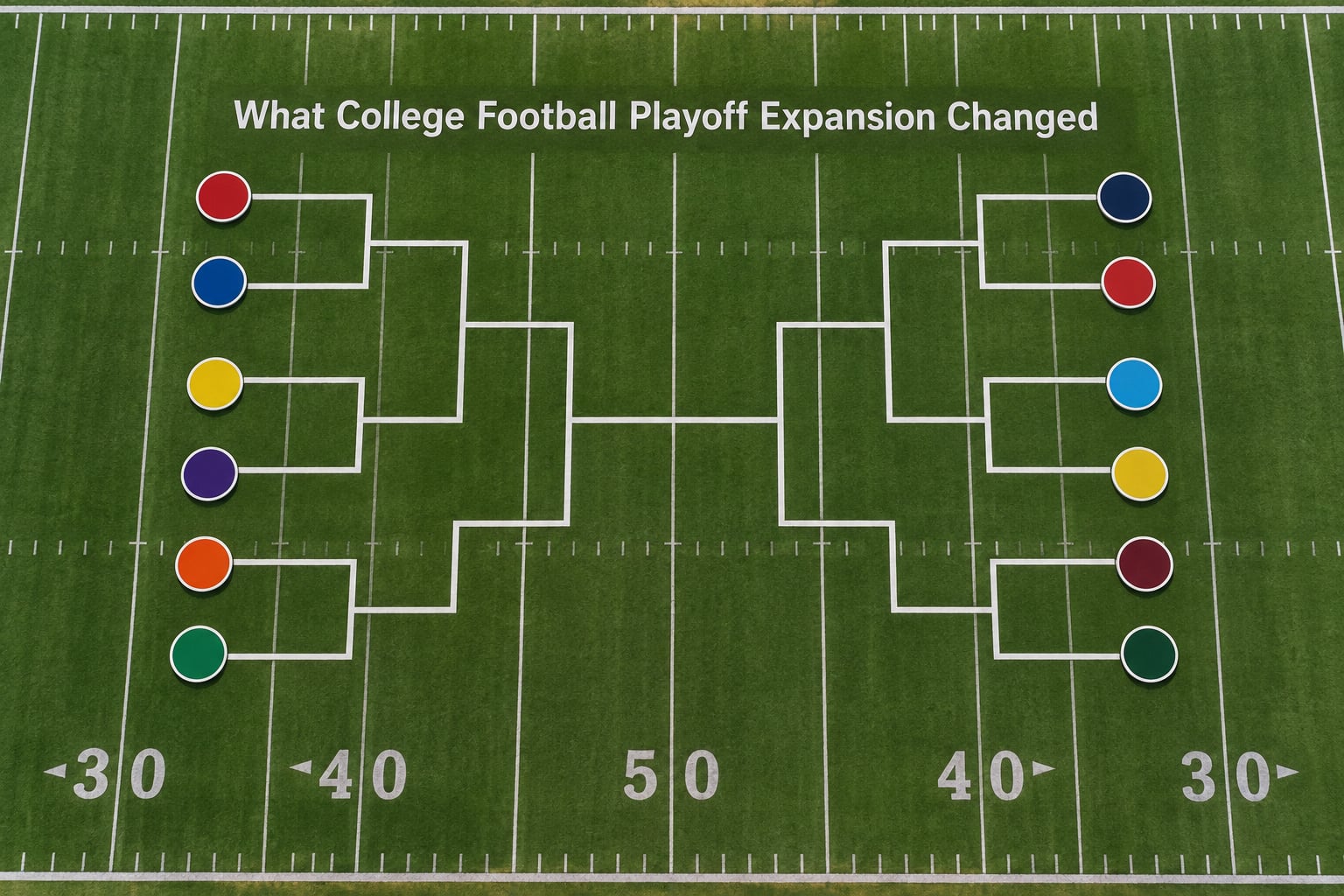
Expansion changed college football in two ways at once: it widened who gets in, and it moved when the games happen. Widening access is the part everyone debates. Moving the postseason into December is the part fans actually feel, because a home playoff game means a stadium in December instead of a bowl trip.
Under the four-team format, the field was the four best teams, period. Losers of conference championship games on the final Saturday went home while selection committee members argued on television about whether an unbeaten team from a smaller conference deserved a spot more than a two-loss team from a power conference. Those arguments were loud precisely because they were unresolved, and because the cost of being left out was the end of the season.
Expansion did not end that argument. It shrank the penalty. A team that loses in November now often has three more games to play, so the conversation moved from whether a team belongs in the field to whether it belongs at seed seven instead of seed four. That is a smaller stakes, but it is a stakes change that shows up in every ranking show, every poll voter and every coach’s November decisions.
The other shift is the calendar. A four-team playoff meant four January games. A 12-team playoff means eight December games on campuses, six New Year’s Six games, and a Monday night championship. Roughly three-quarters of college football’s postseason inventory now sits inside about three weeks, which is why the December and January weekends feel crowded and why bowls outside the playoff have lost their luster.
How the Playoff Field Expanded from 4 to 12 Teams

The playoff went from four teams to twelve in stages, and the politics mattered as much as the proposal. Here is the actual sequence, because a lot of what circulates online mixes the dates up.
2013 to 2023: the four-team era. The College Football Playoff began in 2014 with four teams and stayed that way for a decade. Selection was, and still is, by committee. The bowl partnership also changed during this period, ending the BCS era and its provisional national championship concept.
2021: the study. The CFP commissioned a working group in June 2021 to study every expansion scenario it could find. The recommendation was a 12-team field with four automatic bids for conference champions and eight at-large selections.
February 2022: the ACC objected. The ACC said the proposal created the wrong incentives, arguing that a guarantee for any of its champions meant a team could win the league and still miss the playoff. That objection stalled the vote and became the loudest argument in the expansion fight.
Summer 2022: realignment intervened. The SEC and Big Ten agreed to add Texas and Oklahoma, and the Pac-12’s position weakened before the vote. Once the Power Four no longer shared a single conference map, the ACC’s leverage went with it.
September 2022: unanimous approval. The CFP Board of Managers voted unanimously to adopt the 12-team field, with the first season played in the 2024 postseason. There was no 14-team experiment and no return to four teams; the format went straight from four to twelve and then got tweaked again in 2026.
How the 12-Team Playoff Format Works
The current format has three parts: guaranteed spots, committee selections, and a fixed bracket with reseeding. Getting those straight fixes most of the confusion people have about the field.
Automatic bids: the guaranteed spots
An automatic bid means a team qualifies for the field by winning its conference, subject to eligibility rules. A conference champion must belong to a league with at least eight members to qualify, which is why some Group of Five conferences cannot claim one on their own.
In the first expanded seasons, four conferences held automatic bids: the SEC, Big Ten, Big 12 and ACC. That was the sticking point. A champion from the ACC was guaranteed in, and a champion from a smaller conference was not, which looked like a different kind of unfairness rather than a solution to one.
From 2026, the field guarantees all four Power Four champions plus the highest-ranked Group of Six champion, and Notre Dame gains protection if it finishes in the top 12 of the committee’s rankings. Notre Dame still has no automatic bid, because independents have no conference championship, but the top-12 protection gives it a floor of sorts.
At-large bids and how the committee picks
Everything else comes from a 13-member selection committee that publishes rankings every Sunday from early September through selection day. Members include conference commissioners, the CFP executive director and others with ties to conferences or the game.
The guidelines list factors in order: win-loss record, strength of schedule, the relative strength of the opponent’s wins, conference championships, and head-to-head results as the first tiebreaker. Head-to-head matters less than it once did because many teams no longer play one another across conferences.
Members with a conflict recuse themselves from voting that week, which happens occasionally and quietly. The bigger complaint, raised repeatedly on fan boards including r/ACC and r/CFB, is that the committee’s stated standards seem to move week to week. A team one week is “proven” and the next is “not proven” with the same record. Some of that is genuinely new information from late games, and some of it is the weekly television product doing its job.
How expansion changed seeding, byes and the December calendar
The top four seeds, always the four highest-ranked teams, skip the opening round. Seeds five through twelve play four games on the third weekend of December, hosted by the higher seed. The opening round games are 5 versus 12, 6 versus 11, 7 versus 10, and 8 versus 9.
The quarterfinals, semifinals and championship happen at the New Year’s Six bowls, with the championship on a Monday. The bracket is reseeded after the first round, so a first-round upset can move a team up into a New Year’s Six berth.
Larger field models that keep coming up
None of the larger models below has been adopted. The active argument in 2026 is whether the SEC and Big Ten push for a field with conference-interest allocations, which would cap any single conference’s share of the field. Fans tend to hear those proposals as a fix to one problem and a new problem at the same time.
| Format | Automatic bids | Byes | Rounds before title game | Feasibility |
|---|---|---|---|---|
| 12 teams (current) | 5, including all Power Four champions | 4 | 3 | Proven in production since 2024 |
| 16 teams | Would likely need conference caps | 4 | 3 | Widely discussed; simple to model |
| 24 teams | Varies by model | 4 to 8 | 3 to 4 | Weeknight games and doubleheaders needed |
| 28 teams | Varies by model | 8 | 4 | Doubles the field for one extra round |
| 32 teams | Unlikely to work | 8 | 4 | Breaks the single-game television model |
What Expansion Means for Conference Champions and Nonconference Powerhouses
A guaranteed bid helps a champion, but it does not help a champion much. It removes one failure mode, and the field still has twelve slots competing for them. What it really changes is the risk profile for everyone below the Power Four, and it puts Group of Five schools in the selection process in a way they had never been.
Under four teams, Group of Five programs were excluded so often that fans built spreadsheets to prove it. Forum back-testing in the r/CFB community keeps returning to the same examples: Boise State missed the field in eight of twenty-four seasons before expansion, and the undefeated 2020 teams, Cincinnati and Coastal Carolina, were left out at selection time. Those are the cases that made the case for expansion concrete rather than theoretical.
Since 2024, Group of Five and Group of Six teams have actually played in the playoff, including first-round games hosted on their own fields. Their odds of going deep remain thin. What changed is that entry is possible on the strength of a conference title rather than a ranking committee’s judgment about who deserved a final chance.
For the Power Four, the automatic bid removes a different kind of stress. Under the four-team format, winning your conference did not guarantee anything, and a power conference title was sometimes treated as a rounding error by the committee. That was the ACC’s argument in 2022, and the change to guarantee all four Power Four champions is the sport’s answer to it.
Notre Dame sits in the awkward middle. No conference means no conference championship game, no automatic bid and no guaranteed path, and the school does not share in playoff revenue the way conferences with teams in the field do. The top-12 protection added in 2026 is a partial answer and an ongoing source of argument.
How Expansion Changed the Regular Season
The claim fans make most often is that expansion devalued the regular season. The argument usually goes: if more teams are in, then being in means less, so late-season games mean less, so the sport got softer. That argument is coherent, and it is wrong in the direction it points.
Look at what actually changed in November. Before expansion, roughly a dozen teams had a live path to the field and the rest of the sport was already mathematically eliminated by mid-October. After expansion, teams in the eighth through twelfth slots of the committee rankings are playing each other for the last at-large spots through the final regular-season weekend. A game that used to be a tiebreaker for two teams now matters for six.
The cleanest way to see it is that the regular season gained more playoff-contending teams, not fewer. A power conference team with two losses in September used to have to be perfect to matter. Now a two-loss team can sit at number 14 and have a live shot depending on what happens around it.
What did get softer is the conference championship game, and the honest version of that critique is about conference championships, not the regular season. A team that loses a conference title can no longer call it a crisis. That trade is real, and it is the one the ACC objected to in 2022.
Two other regular-season effects are real. Strength of schedule now carries more weight in the committee’s reasoning, because more teams have comparable records and the tiebreakers do more work. And nonconference scheduling decisions at the top of the sport became more consequential, since a schedule that is soft can end a season in September under a 12-team field too.
How the Playoff Affected the National Championship
The championship game itself looks the same. Two teams, one site, one trophy, played on a Monday night. Everything around it changed.
Under the four-team format, reaching the title game required surviving a four-team bracket. A team could win three games and be one bad Saturday from elimination, and a loss in the conference championship was effectively the end of the season. Now a team can lose in the first round on campus, win twice in New Orleans and Atlanta, and reach the title game anyway with a double-digit point deficit still on the board in the other bracket.
The semifinals also moved. They now land on consecutive days rather than a week apart, which concentrates the season’s biggest games into a short stretch and removes the long gap where a semifinal loser had time to stew. Fans get the two games in one weekend; the trade is two full days of recovery for the finalist.
Every November loss now carries a survivable consequence, which changes the emotional weight of a Saturday in a way that is easy to measure and hard to argue about. A team that wins its conference and loses in the December first round still played three more games, and a team that drops a New Year’s Six quarterfinal still finishes the season inside the top ten rather than sliding out of the top twenty.
How Expansion Changed Recruiting and Player Strategy
Recruiting changed in one straightforward way: there are more credible playoff paths to sell. Before 2024, a recruit at a program outside the power conference was choosing between a good season and a theoretical one, because the field was the field. Now a conference title in the American, Sun Belt, Mountain West or MAC is a playoff berth, and that is a recruiting pitch that did not exist three years ago.
The same logic reaches up. Programs that once pointed recruits at a conference title as a dead end now point at an automatic bid, and schools in the Big 12 and ACC use the guaranteed spot to argue that a player can develop in conference and still reach a December home playoff game.
Exposure is the other half. Seven at-large spots mean more teams get a weekly national ranking, and a ranked team sells tickets, sells the season and sells the recruiting class. The playoff’s weekly top 25 is now a recruiting document as much as a selection tool, and coaches build nonconference schedules partly to get a ranked opponent early enough to matter.
The cost is workload. Playoff-path seasons run 15 to 17 games, and an FBS player who makes the title game plays a January game after a December run. That is a genuine workload increase on the players, and it is the reason the discussion has moved from fairness to player safety. The FBS postseason is now a full season plus a championship run, and no part of that is optional for a team that reaches December.
What Fans Should Watch Under the Expanded Format
Six things are worth tracking if you want to understand a season instead of just reacting to it.
Who holds an automatic bid. Four conferences held guaranteed spots in the first expanded seasons, and from 2026 the highest-ranked Group of Six champion joined them. If a conference champion is not in the automatic group, its title still means less.
The gap between the top four and the rest. Seeds one through four have byes and control their own path. Everything below that starts on a campus in December. A team ranked eighth has a materially harder route than one ranked fourth, and that difference matters in the committee’s own arguments.
The last three at-large spots. With five automatic bids and seven at-large selections, the field’s edges are decided by committee judgement rather than a trophy. That is where the real argument lives every December.
The committee’s weekly shifts. Sunday rankings are an ongoing conversation, not a hidden vote. When standards appear to move, that is usually the committee reacting to what it saw the previous Saturday.
Reseeding. The bracket is redrawn after the first round, so the December games genuinely change who is in the New Year’s Six. Treat the opening round as an opportunity rather than a formality.
Reaching the field versus winning the title. These are separate achievements now, and they are measured separately. A team that makes the field and loses in round one has still accomplished something the old format would not have let them attempt.
Frequently Asked Questions
Why did the College Football Playoff expand to 12 teams?
The CFP expanded to 12 teams to settle two arguments at once: whether a conference champion should be guaranteed a place, and whether schools outside the power conferences deserved a path in. The 2021 working group found that eight teams were being excluded from a sport with over 130 FBS programs, and that the conference championship meant little if a champion could still be left out. A 12-team field guarantees bids and adds at-large spots, which converted a recurring offseason fight into an annual December one.
How does a 12 team college football playoff work?
Five teams qualify automatically, including all four Power Four conference champions and, from this season, the highest-ranked Group of Six champion. Seven more teams are chosen at-large by a 13-member selection committee that ranks teams weekly on win-loss record, strength of schedule, opponent wins, conference titles and head-to-head results. The four highest seeds get byes. Seeds five through twelve play at home on the third weekend of December, reseeding happens, then six New Year’s Six bowls and a Monday championship follow.
Did the 12-team playoff devalue the regular season?
Mostly no, and the reason is arithmetic. Under the four-team format, roughly a dozen teams had a live path in and the rest were eliminated by mid-October. Now teams ranked eighth through twelfth play meaningful games through the final weekend, and a two-loss team in September still has a route to December. The part of the critique that holds is about conference championship games, which no longer carry do-or-die stakes for the loser.
Which conferences get automatic bids in the College Football Playoff?
The SEC, Big Ten, Big 12 and ACC each have a guaranteed spot for their champion, and from this season the highest-ranked Group of Six conference champion is guaranteed as well. Eligibility requires a conference of at least eight members, which is why smaller leagues cannot claim an automatic bid of their own. Notre Dame remains an independent, plays no conference championship game and has no automatic bid, though it now gains protection if it ranks in the committee’s top 12.
Who decides the College Football Playoff field?
The CFP Board of Managers sets the rules, and a 13-member selection committee picks the at-large teams. Committee members include conference commissioners, the CFP executive director and figures with conference or coaching ties. They publish rankings every Sunday from September through selection day, and members with a conflict recuse themselves. Common complaints about shifting week-to-week standards are about how the committee communicates, not whether the rules changed.
Will the College Football Playoff expand again?
Proposals for 16, 24, 28 and 32 teams keep circulating, and the SEC and Big Ten have both pushed for larger fields, sometimes with conference-interest allocations that would cap any single league’s share. The practical ceiling is the calendar. A 32-team field needs weeknight games and doubleheaders for several rounds and breaks the one-game-a-time television model the sport relies on, so most observers treat 16 as plausible and 32 as unlikely.
Conclusion
The lasting change from college football playoff expansion is not the size of the field. It is that the postseason now starts in December on campuses, a conference title in a smaller league is worth something real, and the December weekends carry as much weight as the January ones that used to define the sport.
Start with the mechanics: five automatic bids, seven at-large selections, four seeds getting byes, and four rounds from the December opening games to the Monday championship. Once that is clear, most of the arguments about the sport fall into place, including the ones you are still having about your own team.