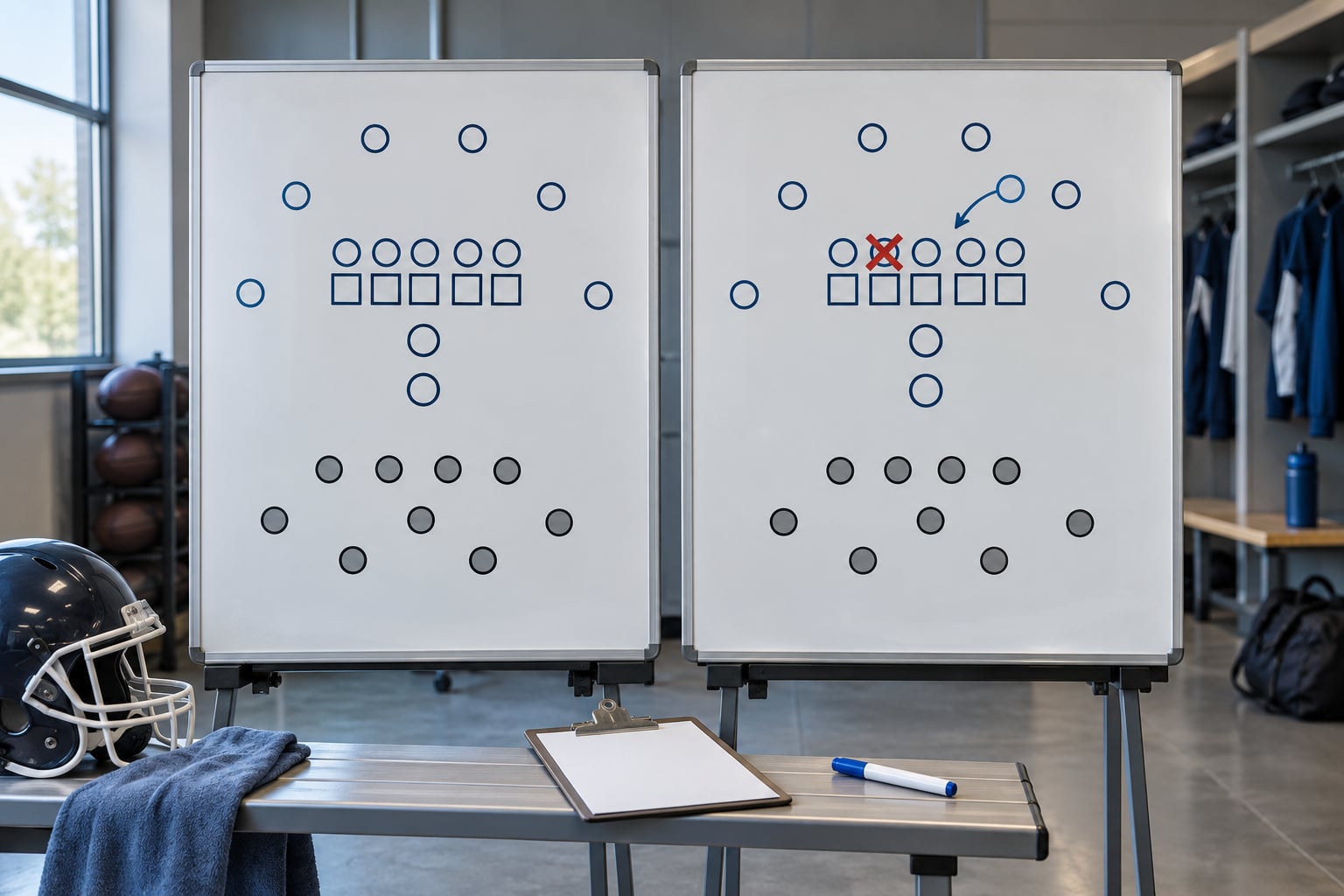
Spring transfer portal moves affect depth charts in two directions at once. Every departure removes a player, a set of reps and a set of expectations from a position group, and every arrival adds a body competing for those same reps. Because most entries now close in the January window, the reshuffling shows up in spring practices themselves rather than in summer conditioning.
That timing is the whole story. Coaches hand out most of the meaningful reps in about 15 spring practices and the spring game, so a roster change that lands after February forces a position group to be rebuilt instead of patched.
Here is the mechanics, position by position, plus a tracking method you can run yourself through the offseason.
Table of Contents
- How Spring Transfer Portal Moves Affect Depth Charts
- What happens during the spring transfer window?
- How do departures change a team’s depth chart?
- How do incoming transfers create competition?
- Which positions react most strongly to portal moves?
- Quarterback battles: why one portal move can reset an offense
- What do spring practices reveal, and what do they not?
- How can one transfer affect players at several positions?
- A practical depth-chart tracker for evaluating transfers
- Frequently Asked Questions
- When does a spring transfer change an official depth chart?
- Can a transfer become a starter as soon as he signs?
- How do transfer portal moves affect basketball depth charts?
- Does eligibility determine a player’s role on the spring depth chart?
- Why can two unproven players have very different projections?
- How should fans interpret unofficial spring depth-chart rankings?
- Conclusion: What to Watch First
How Spring Transfer Portal Moves Affect Depth Charts
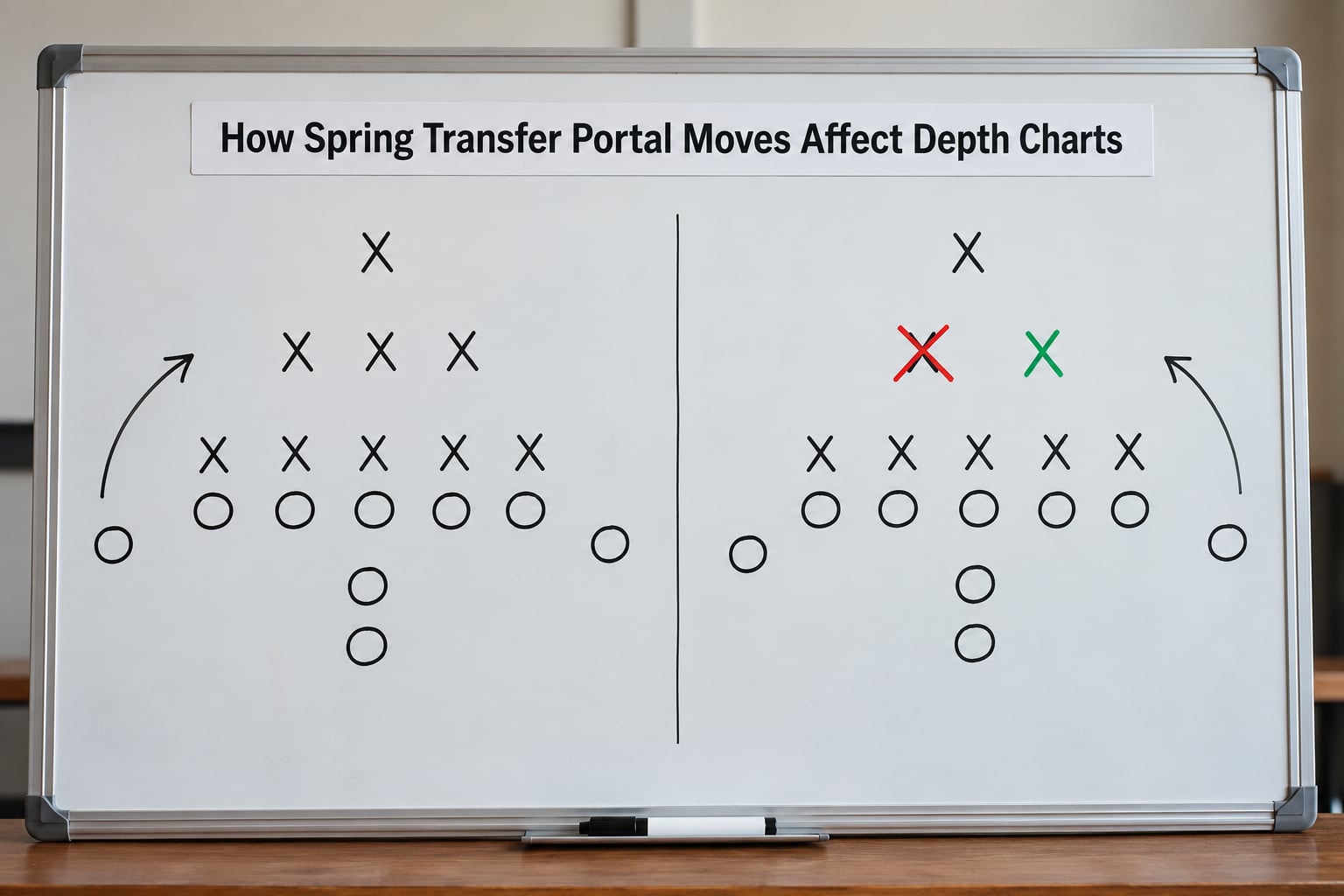
The short answer: a spring transfer portal move changes a depth chart by changing the competition, not by filling a hole on paper. A player who leaves takes his production, his experience and his share of practice reps with him. A player who arrives takes those reps from whoever held them.
Departures and arrivals do different work
A departure is subtractive. The program loses whatever that player produced and has to redistribute the snaps behind him. If he was a starter, that redistribution lands on the backup who was already waiting, and the chart reshapes around a new top name.
An arrival is additive, and usually competitive. A new player takes a roster spot, a set of practice reps and a share of the coaching staff’s attention. Even a player expected to sit behind the incumbents changes the ceiling on the group, because the incumbents know someone is behind them.
The six effects that matter most
- Immediate replacement. A starter exits, so the No. 2 player at that spot moves to No. 1 by default and inherits the job description.
- Competition restart. A new arrival pushes incumbents down a slot, sometimes more than one, even when nobody left.
- Position conversion. A player is asked to change spots, which frees a spot elsewhere and reshuffles two groups at once.
- Role reshuffle. A player who was a rotational piece becomes a full starter, or the reverse, when the group’s makeup changes.
- Recruiting class promotion. A true freshman or sophomore who was waiting gets a first-team role earlier than projected.
- Scholarship reallocation. A saved roster spot, which can include a walk-on becoming a scholarship player, changes who is on the chart in the first place.
What happens during the spring transfer window?
Spring football runs on a tight clock. Practices start in the winter, competitive ones are spread across roughly 15 sessions, and the spring game closes the spring phase. Players who entered the portal during the winter may be gone, committed elsewhere, or still sitting out while an eligibility decision clears.
Entering the portal is a public step. Committing to another school is a separate step. A player can be listed for a day and never leave, which is why roster trackers and message boards treat portal chatter as rumor until a commitment shows up in a roster announcement.
What changed with the single-window rule
The NCAA Administrative Committee moved away from the two-window system and eliminated the separate spring window, leaving one January window for football. That means what used to happen in April now has to happen in December and January, ahead of spring practice rather than after it.
There are carve-outs. A postseason window exemption opens after a season for players meeting certain conditions, and a head coaching change triggers a 30-day immediate transfer exemption for players from the previous staff. Those exceptions keep some movement alive between seasons, but the general April window most people picture no longer exists in the same form.
The consequence for depth charts is straightforward. What used to land in the gap between spring and fall camp now happens before a single practice, so coaches build their charts with most of the roster already known.
Community consensus on message boards was that this removes the escape hatch players used to have. Historically a buried player could watch the reps play out in spring, decide the depth chart spot was not changing, and use the April window to leave. Without it, that player is more likely to hold out, ask for a role change, or sit in a season where nobody moves them.
Spring game as a signal
The spring game is where depth chart conversations get loudest. Players who expected to start and did not get the ball in a scrimmage hear it loudly too, and that is usually when speculation about portal entries spikes. It is a signal, not proof. Coaches also use spring scrimmages to test players in situations they will not see in September, so a quiet night does not settle anything either.
How do departures change a team’s depth chart?
Losing a starter and losing a reserve are very different events. Losing a starter creates a vacancy that somebody fills this season. Losing a reserve mostly changes the depth below the two-deep, which usually matters more in a long season than it does in the spring when the chart is being set.
Quarterback
When a starting quarterback leaves, the chart does not just shift down one. It re-forms around a new lead candidate, and the backup who was there becomes the incumbent by default. In many cases that means a true freshman or a first-year starter who was never projected to take reps in February.
Offensive line
Losing a starting tackle or guard is the most disruptive kind of exit because five bodies have to move together. A replacement guard can slide to the open spot, but then someone else slides, and the whole five-man unit has to re-learn its timing together. Coaches rebuild these groups deliberately rather than by matching names to slots.
Skill positions
A running back or receiver departure is the most common event in the spring window, and the least destabilizing. These groups are usually wide, so a departure moves the top of the rotation up one and shifts the rest down one. A receiver departure can also trigger a position change, with a slot receiver moving outside and a true freshman moving inside.
Secondary
Losing a corner is often bigger than it looks, because of the nickel and dime packages. One starting corner leaves and the program may need a third corner who did not previously take meaningful reps. That is the position group where one spring addition can decide three roles.
Specialists
Kickers, punters and long snappers are the odd ones out. A specialist loss is usually filled the same day by a transfer, and specialists almost never move in the spring window because they are not competing for a shared role. When one arrives in spring, the role is settled immediately.
How do incoming transfers create competition?
Coaches sort arrivals using a checklist that is much less glamorous than recruiting rankings. The checklist is roughly: prior starting credentials, familiarity with the scheme, production against comparable competition, recruiting pedigree, physical fit for the role, eligibility status, and willingness to play a different position.
That last item often decides the chart. A 6-foot-1 receiver who has never played outside is a different prospect than a 6-foot-1 receiver who spent two seasons on the outside, and coaches price that difference heavily in the spring.
Arrivals also change the pressure on incumbents even when they will not win a job. A player who was unquestioned at a spot will spend the summer with a new body behind him. Most coaches use that as motivation. A few use it as a reason to move on from the incumbent entirely.
Forum users watching spring rosters consistently make the same point: a single arrival often decides a position battle that looked settled in January. At programs that took two dozen players out in a window and brought in close to twenty, a handful of those additions settle individual position contests on their own. A center pushes a guard to the pivot. A defensive back claims nickel full time. A kicker takes a job that had been contested since January.
Which positions react most strongly to portal moves?
Position sensitivity comes down to two things: how many qualified players a program has, and how expensive a mistake is. Groups with three or more proven options absorb moves quietly. Groups with one or two do not.
| Position group | Spring move volume | Depth chart reaction |
|---|---|---|
| Quarterback | Low | Extremely high. One departure resets the entire offense. |
| Offensive tackle | Low | High. Five-man units have to be rebuilt together. |
| Guard and center | Low to moderate | High. One addition can trigger a conversion across the line. |
| Wide receiver | High | Moderate. Deep groups absorb an exit with a one-slot shift. |
| Defensive back | High | High in nickel-heavy schemes, moderate otherwise. |
| Defensive line | Moderate to high | Moderate. Rotation depth absorbs most entries. |
| Running back | Moderate | Low to moderate, except at programs with one featured back. |
| Linebacker | Moderate | Moderate. Role labels change more than the top of the chart. |
| Specialists | Very low | Binary. One arrival, one settled role. |
The pattern that shows up in almost every window: scarce positions barely move in spring because there is no surplus to move, while deep positions move constantly because players want a role they cannot get at their current school. Quarterback and tackle sit at one end of that range, receiver and corner at the other.
Quarterback battles: why one portal move can reset an offense
Imagine a program loses its starting quarterback to the portal in the January window. Three things happen immediately, in this order.
First, the backup is promoted by default. Not because he won anything, but because he is the only option with any spring reps behind him.
Second, the coaching staff decides whether to re-commit to that plan or bring in a transfer. That decision drives the whole summer, because it determines how much of the offense is installed around the current option.
Third, the developmental timeline resets. An underclassman who was a year away from competing is suddenly in open competition, and his offseason changes shape.
That is why quarterback exits get more attention than any other position. Every other group can absorb a change with a rotation. Quarterback is a single job with a single decision attached to it, and one portal entry can redefine what the offense looks like for a full season.
What do spring practices reveal, and what do they not?
Spring practices are the best public evidence a fan gets before the season, and they are still evidence, not a verdict. Here is what to read and what to discount.
What to watch
- Reps distribution. The clearest signal available. Count first-team snaps by period across the practices you can watch.
- Unit groupings. Which players line up together says more about the plan than individual highlights do.
- Technique and communication. You cannot hear it from a video, but coaches who hold a scrimmage for media day usually let the repetition and the sideline correction show.
- Position flexibility. A player working at a new spot in practice is being told something real.
What to discount
- One practice. A single bad session means almost nothing in February.
- Depth charts that skip non-starters. Coaches publish the first team and leave the rest blank. The blank part is where portal movement lives.
- Scoring drives in a spring game. Scripts and tempo make them nearly useless as evidence.
- Public practice reports with no sourcing. Someone is always guessing.
The practical version: treat the spring chart as a hypothesis about the top of the roster, and treat everything below the first team as unknown until fall camp.
How can one transfer affect players at several positions?
Cross-position effects are where the transfer portal does the most damage to a projection, because one addition can touch three groups. The common patterns:
- An offensive lineman arrives at guard, and the current guard moves to center. That frees a tackle to slide down, which moves the whole rotation.
- A slot receiver arrives, and the outside receivers shift inside. A player recruited as a boundary receiver can end up as a third option in the slot.
- A corner arrives and plays nickel full time. That keeps a safety on the field more often, which changes the safety rotation too.
- A two-way player arrives from a smaller program. He covers both sides of the ball, so his arrival adds a body to two separate depth charts.
Track the conversion, not just the newcomer. If you follow only the position he was recruited for, you will miss the two other charts that moved.
A practical depth-chart tracker for evaluating transfers
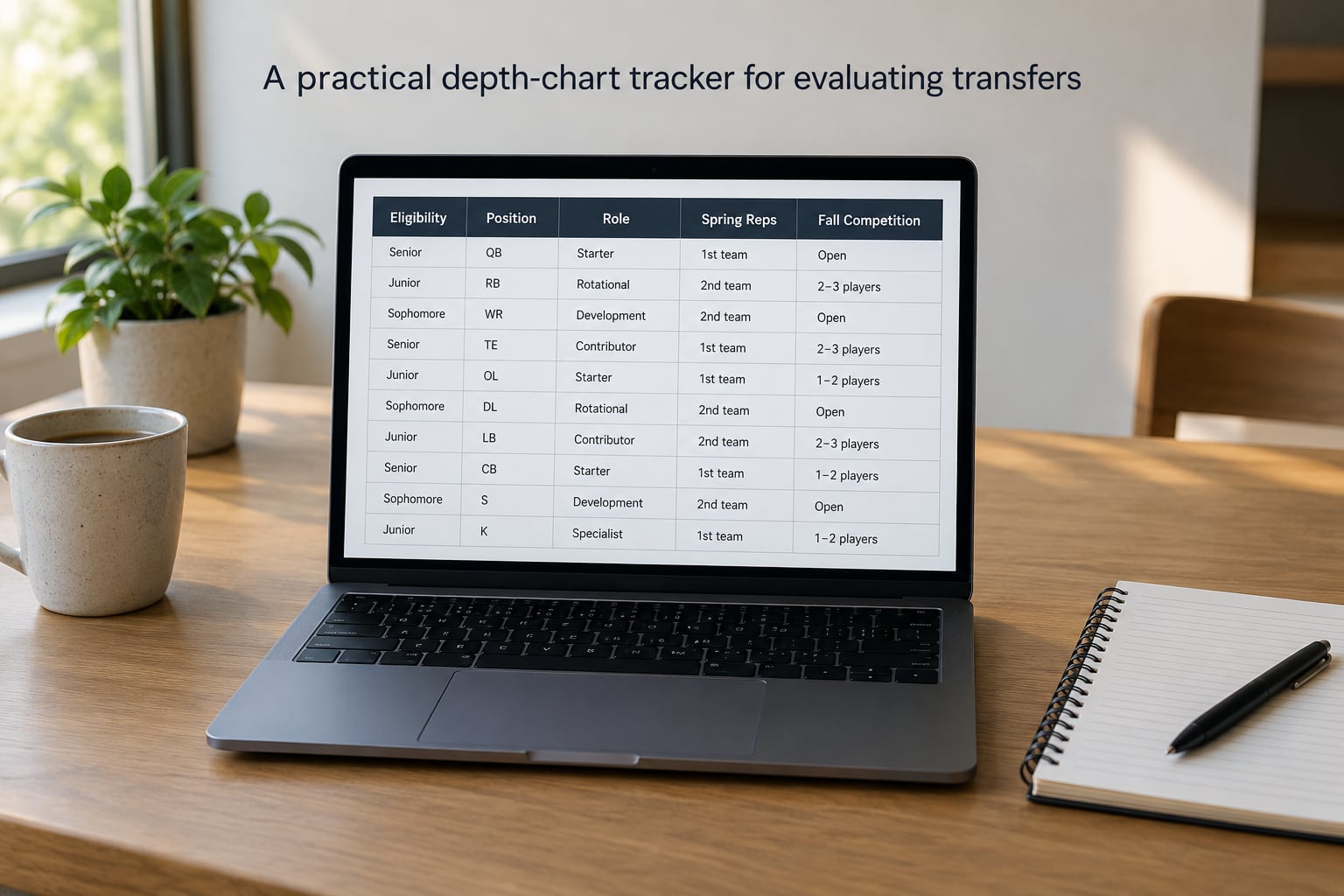
Keep one row per player and update it monthly through the offseason. Seven columns is enough to keep it honest.
| Player | Status | Eligibility | Projected role | Spring evidence | Fall progression | Still unknown |
|---|---|---|---|---|---|---|
| Name | Entered, committed, enrolled, withdrew | Cleared, pending, unknown | Starter, rotation, two-way, specialist | First-team reps, position change, limited work | Up, down, holding | The one question that decides the role |
Fill the “still unknown” column first. It forces you to name what you are assuming, which is usually where a projection goes wrong.
Three habits make the tracker worth keeping. Log the date of every change, because a status that lasts two days means nothing. Keep “entered the portal” and “committed elsewhere” in separate columns, since conflating them is the most common error fans make. And leave the fall column blank until fall camp, because filling it in spring is exactly the overconfident leap this article is warning against.
Frequently Asked Questions
When does a spring transfer change an official depth chart?
Officially, rarely during spring. Most programs publish a depth chart at or just before fall camp, so a spring window move usually shows up in the offseason news rather than on the chart itself. What changes in spring is the internal order: the player who took first-team reps, and the group that will be rebuilt once the roster is final.
Can a transfer become a starter as soon as he signs?
Yes, but signing only makes him eligible, not a starter. A player who enrolls in January has a full offseason of practice, strength work and film to compete for a role. Programs do hand starting jobs to mid-semester arrivals, and those are rare, so expect a summer of competition before the chart settles.
How do transfer portal moves affect basketball depth charts?
The same logic applies with one important difference: basketball rosters are smaller and roles are shared, so a single arrival can change a rotation rather than a slot. A grad transfer usually takes minutes immediately because the program needs the production now. Football depth charts spread roles across a chart of two and three-deep positions.
Does eligibility determine a player’s role on the spring depth chart?
It determines whether he can be on it at all. Eligibility status is a gate: a player awaiting a decision may take no contact reps, which limits what coaches can evaluate. Within that gate, role comes from reps and performance, not from how long the paperwork has been pending.
Why can two unproven players have very different projections?
Because coaches weigh different inputs for each one. One player may arrive with three seasons of starting experience and a known role, while another is a developmental project competing for the same slot. Without a spring of reps, the gap in projection reflects the staff’s read on readiness, not certainty about the future.
How should fans interpret unofficial spring depth-chart rankings?
Treat them as a summary of practice reports, not as a source. They are usually built from a handful of observed practices and inherit every rumor in circulation. They are useful for tracking direction, meaning whether a player is rising or falling, and unreliable as a statement of who will start.
Conclusion: What to Watch First
Start with four things, in order: confirmed eligibility, the position groups that lost a starter, the first unit groupings at the first practice you can watch, and which incumbents were moved to a new position. Those four answer most of what an unofficial spring chart gets wrong.
Treat every transfer as a competitor, not a starter, until the reps say otherwise. That single habit keeps you out of most bad depth chart arguments between February and August.