Short answer: yes, college coaches do watch AAU basketball, but exposure is only one input to a recruiting decision and it is not the deciding one. How AAU basketball affects college recruiting comes down to four things — access to coaches, volume of games, level of competition, and relationships. AAU cannot create the skill, size, or performance a coach is buying, and it does not replace the academic and eligibility requirements every recruit still has to clear.
For parents, the real question is narrower than “will this get my son a scholarship.” It is: does adding a spring and summer schedule put him in front of the right coaches while he’s still improving as a player? Sometimes the answer is yes. Often the honest answer is that a good high school season and honest coaches would have gotten him the same look.
Table of Contents
- What is AAU basketball?
- How does AAU basketball influence recruiting?
- What recruiting factors can AAU basketball improve?
- How AAU basketball affects college recruiting differently by age group
- Can AAU basketball lead to a college scholarship?
- How do college coaches evaluate an AAU player?
- What is the role of AAU rankings and showcases?
- How can players maximize their recruiting chances through AAU basketball?
- What mistakes can hurt AAU recruiting?
- Frequently Asked Questions
- Conclusion
What is AAU basketball?
AAU basketball is club basketball organized under the Amateur Athletic Union, played outside the high school season, mostly in spring and summer. Programs run year-round, which is why AAU teams play a much longer calendar than a school team does.
Three words get used interchangeably, and they are not the same thing:
- High school basketball runs under your school’s rules, roughly November to March, with a limited schedule and school-controlled tryouts.
- Club basketball is a general term for any non-school team, including rec leagues, travel teams, and school-affiliated club programs.
- AAU basketball is a specific designation tied to the AAU, with its own age-group structure, tournaments, and showcase circuit.
Age groups are labeled with a number and a U, like 14U or 17U. The U is the maximum age of a player on that roster, so a 15U team accepts players up to age 15. Kids frequently start in the third or fourth grade and move up as they grow, which is why the youngest age groups are often crowded and the 16U and 17U brackets are the ones with scouts in the gym.
One structural detail changes how coaches evaluate: AAU basketball generally uses unlimited substitution and running time. A player who can hold his own for two minutes in a high school rotation can be on the floor for twenty-five at an AAU event, and that changes which parts of his game a coach actually sees.
How does AAU basketball influence recruiting?
It influences recruiting in four measurable ways, and none of them is a guarantee.
1. Access to college coaches in one building
A tournament weekend can put forty to sixty teams in the same gym complex. A coach with a weekend can watch hundreds of prospects without taking fifty separate trips to see them play one game each. One coach put it plainly in a basketball coaching forum: a weekend with a large concentration of talent in one gym “alone makes it worth watching and covering.”
That efficiency is the core of the recruiting value. Division I coaches are allowed to watch in-person during specific recruiting windows, and a sanctioned live period event is one of the few situations where dozens of players and dozens of programs overlap in time and space.
2. More games, more reps against real opposition
A high school season might be 25 to 30 games. A full AAU year adds 40 to 60 more against teams chosen by ability bracket. More possessions means more chances to show decision-making, and more chances to make mistakes in front of a coach who was watching for exactly that.
3. A higher average level of competition
The bracket system sorts teams, so a good player is more likely to face opponents who can actually pressure him. Some of the best college prospects in a state play almost no high school basketball because their school program is weak, and AAU is how they get evaluated at all.
4. Direct relationships with coaches
Two years of spring and summer contact with a coaching staff builds familiarity that a highlight video cannot. Coaches remember who communicated well, who coached hard, and who never checked out in a blowout. On a loaded roster, being remembered is most of the battle.
What recruiting factors can AAU basketball improve?
Competition level and decision-making are the clearest gains. A guard who spends a spring playing against high-level wings starts making quicker reads, because a bad read becomes a turnover against someone who punishes it.
Role clarity improves too. Nothing like competing for minutes to teach a player which skills matter when the bench is short and the game is close.
Physical development is a mixed bag. More games mean more strength work and more athleticism built, but also more fatigue, and often more injury risk without proper oversight.
Film is better. A full AAU season produces more hours of usable game footage than a short high school season, which is why recruiting services exist in the first place.
Here is the honest part: there are things no weekend can tell a coach. Nobody learns from three games whether a player will handle the grind of a full college season, whether he has grown in a way that matters, or whether he can play within a structured system rather than an open-flow AAU style. A coach in a r/Basketball discussion made the same point from the other direction — the complaint there wasn’t AAU’s exposure value, it was that exposure was being sold as a substitute for teaching the game.
How AAU basketball affects college recruiting differently by age group
AAU recruiting value rises sharply as a player approaches graduation eligibility, and the effect is small before that. Here’s how it usually plays out by stage.
| Stage | Recruiting value of AAU | What actually matters |
|---|---|---|
| 3rd-6th grade | Very low | Fundamentals, love of the game, whether the child stays in the sport |
| 7th-8th grade | Low | Fundamentals, motor development, competition that is a little faster |
| 9th-10th grade | Moderate | Growth, body development, building a competitive record |
| 11th grade | High | Play against high-level opponents; this is where most live period looks happen |
| 12th grade | Highest | Film, relationships, visits, offers — exposure matters most now |
| Post-grad / transfer | Variable | Second looks at schools that passed, junior college options, JUCO-to-four-year routes |
Coaches at younger levels are not evaluating college potential, and they say so to families. What they are watching is whether a player’s growth over two years is real and whether the kid actually wants the work. In a r/Basketball thread titled “When does AAU REALLY matter,” the recurring answer was the same: it matters when you’re in the two or three years before eligibility, not before that.
There’s also a serious age-placement trap. Parents sometimes jump a child up an age group for exposure to older competition. A physically smaller player placed with a stronger age group often spends a season on the bench or, worse, gets minutes without ever learning how to compete — and that is the “Entitlement Affliction” pattern one basketball coach wrote about: early specialization without ever learning defense, off-ball movement, or how to fit a system.
Can AAU basketball lead to a college scholarship?
Indirectly, yes, but the chain has more links than most families expect. A realistic path runs: AAU schedule → a coach notices you → the coach watches more and requests film → you get contacted during a contact window → unofficial visits → a scholarship offer → financial aid comparison → eligibility confirmed → you sign during the signing period. AAU is the first link, not the outcome.
Size the funnel honestly. The NCAA has reported that roughly 3.6 percent of high school athletes who play sports go on to compete at any NCAA division, and about 1.1 percent compete at Division I. Those are not AAU numbers; they describe every path into college sports combined. A tournament circuit that serves thousands of players will produce a small number of paid Division I roster spots.
The NCAA also governs when contact can happen, which shapes the whole calendar. These are the windows that matter (they shift slightly by year, so check the current NCAA calendar for exact dates):
| Recruiting window | What a college coach may do |
|---|---|
| Contact period | Direct communication and in-person contact with prospective student-athletes and their parents |
| Dead period | No recruiting contact or communication of any kind |
| Evaluation period | In-person, off-campus evaluation and observation; communication stays limited |
| Official signing period | Binding national signing offers and letters of intent become official |
That dead period is why an AAU spring season can be genuinely valuable. It runs in the heart of winter, overlapping the high school season, and it’s one of the last stretches where a college coach can watch players live before recruiting rules tighten toward signing.
Basketball is also not the only route in. NAIA, NJCAA, Division III (which offers no athletic scholarships but offers need-based aid), and Division II programs together account for far more roster spots than Division I does. A dcurbanmom forum thread asked whether joining AAU would “boost my chances” and the thread’s most useful answer was that the odds come from the level you’re actually competing for, not from the badge on your AAU jersey.
How do college coaches evaluate an AAU player?
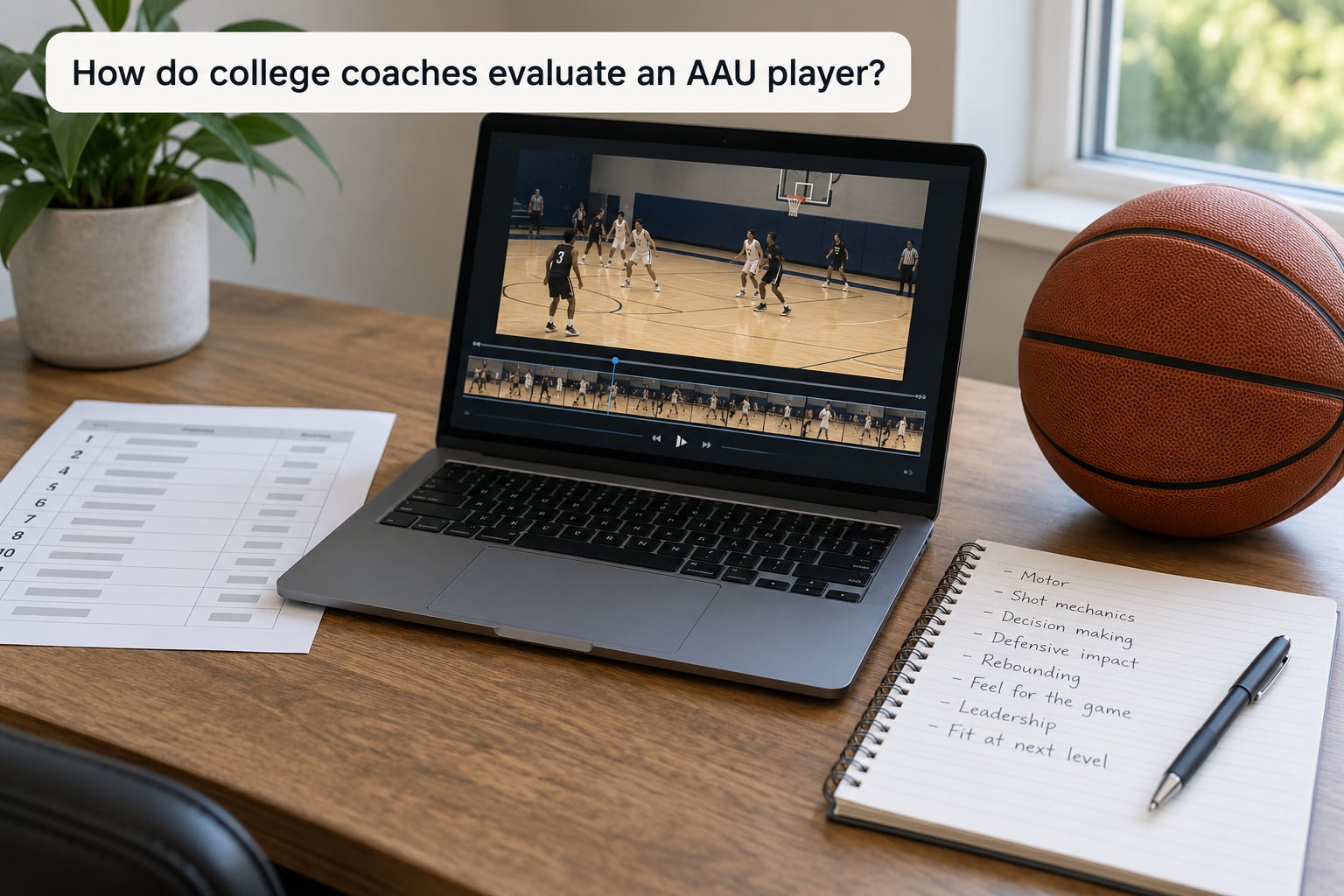
They watch for a handful of concrete things, in roughly this order.
Competitive context. Averages, strength of schedule, and the caliber of the bracket matter more than raw points. A 14-point performance against a weak 16U team tells a coach almost nothing; the same score against a top-ranked opponent tells him plenty.
Skill transfer. Does the player do the same thing effectively against three different kinds of opponents, or does he have one move that disappears when the game gets physical?
Decision-making and communication. Calling plays, communicating on switches, staying engaged in blowouts. These are the most visible separators between players at the same skill level.
Role clarity. A player who clearly understands “I defend the best wing and hit 35 percent of threes” is more useful to a college staff than a player with a wider but unfocused skill set.
Effort and coachability. Body language between possessions, how a player responds to being subbed out, whether the same mistakes happen all weekend.
Academic profile. Every coach, at every division, checks eligibility and the student’s own academic record. Athletic performance gets a player evaluated; academics decide whether they can stay.
Fit. Scheme fit, roster composition, class needs, and personality. A player who does everything a program needs is often easier to sign than a player with a bigger highlight reel.
Highlight video is supporting evidence, not the evaluation. It shows a coach a good night, and it has to be contextualized honestly: what part of the game, against which opponent, and what happened on the other end of the floor. A parent forum thread made the sharpest version of this point — for one player, “AAU games did little to help that progression,” while hard skills work, conditioning, and playing three-on-three did most of it.
What is the role of AAU rankings and showcases?
Rankings and showcase events serve one function: they put more evaluated players in front of fewer evaluators. They do not assign a recruiting fate.
A ranking is a comparison against other players in the same age group and division, often using evaluations submitted by coaches and handlers rather than by scouts with a stopwatch. It is useful to a player who is trying to locate their own level. It is far less useful as a promise, because a high-ranked player in a strong region may have less visibility than a top-five player from a thin talent area.
Showcase events work the same way. The organizers pack the best available players into a short window, and the value comes from who is in the building, not from the event’s name or logo. Coach responses in r/basketballcoach forum threads were consistent on this: what appeals to college coaches is competition level and the chance to evaluate several players against each other in one sitting.
The practical use of a ranking is narrower than families expect. Use it to calibrate your level of competition, then spend your energy on the work a ranking can’t do — become a better player, a better teammate, and someone a coach wants to coach.
How can players maximize their recruiting chances through AAU basketball?
Eight steps, roughly in order of how much they matter.
1. Pick the hardest honest bracket. Compete against the best players you can handle, not the best group you can survive. A schedule that produces losses teaches more and scouts better than one padded with weaker teams.
2. Play your role loudly. Tell coaches what you do and do it every possession. A player who is 6’4″, defends the other 6’4″, and shoots 38 percent is easier to build a roster around than a 6’4″ who does everything a little.
3. Talk to college coaches early. Send a short, factual introduction with your grade, position, and a link to current film. Ask a specific question about their system. Coaches remember the players who made their job easier.
4. Build relationships with your high school coach, not around them. High school coaches run the in-season film, the recommendation, and often the school relationship. Tell them early what you’re doing; surprises cost more than honesty.
5. Request appropriate film. Requesting a video for a specific situation — a specific matchup, a specific role, a specific weakness — signals that you understand your own game.
6. Protect your academics. Core courses, GPA, and a clean record are the boring gate every recruit passes through. Failing it ends a recruiting process that no amount of exposure started.
7. Follow up once, politely, after a live period. A short thank-you referencing a specific moment in a game goes a long way. More than one follow-up does not.
8. Stay healthy. A full year of AAU plus a high school season is a lot of games. Confirm that your program has a strength coach, a proper warm-up, and some kind of medical coverage at tournaments, and treat pain as a reason to rest, not to push through.
What mistakes can hurt AAU recruiting?
Chasing visibility instead of development. A weak schedule full of unevaluated opponents produces volume and no information. The core complaint on basketball forums was “early specialization and tons of games” — exposure substituted for skill work.
Changing teams too often. Each move resets continuity with a coach and with a group of teammates. Two or three well-documented seasons beat seven partial ones.
Assuming playing time follows the fee. Parents paying team fees sometimes expect guaranteed minutes, and that expectation leaks into the gym as entitlement. Playing time in AAU is usually earned, and the families who accept that have calmer relationships with coaches.
Letting highlights stand in for a full game. A video built only of dunks shows a coach almost nothing. Full possessions, both ends, win more than a highlight reel ever will.
Building a school list too early. Sophomores and juniors should be building relationships, not ranking schools. Overestimating your level early leads to a dead period full of unreturned emails and a lot of discouragement.
Treating a ranking as a guarantee. Rankings measure players against players. They do not measure roster spots.
Forgetting spring sports and school life. High school coaches lose athletes to spring AAU seasons, and a missed shot at a school that needed a specific position can end a recruiting process quietly.
Skipping oversight questions. Some tournament venues have no athletic trainer on site. Ask what the emergency plan is before the season starts, not after an ankle turns wrong in the third quarter of a semifinal.
Frequently Asked Questions
Do colleges look at AAU basketball?
Yes. Most college coaches watch AAU games during NCAA recruiting windows, especially live period and evaluation periods, because tournaments concentrate many players in one gym. What they are looking for is competition level, decision-making, effort, and how you fit a system, not just your stat line. AAU is one credible way to get evaluated, alongside strong high school play, and it never replaces eligibility or academics.
Can you go Division I without playing AAU?
Yes. Plenty of Division I players come from strong high school programs, and recruiting services film high school games too. AAU helps most when your school team is weak, plays a low-level schedule, or you have no film worth looking at. If your high school competition is legitimately strong, adding AAU may cost you spring sports or rest without adding real evaluation value.
When can NCAA coaches talk to recruits?
During a contact period, when coaches may communicate directly with prospects and their parents. During a dead period, no recruiting contact or communication is allowed. During an evaluation period, coaches may evaluate in person off campus while staying within limits on communication. Officially, contact periods for high school recruits typically begin on July 1, and the dead period falls in the late winter, though dates shift — check the current NCAA calendar.
What does 14U mean in AAU basketball?
14U means the roster accepts players up to age 14, not that everyone on the team is 14. Younger players can often play up. Age-group labels matter because a 15U bracket usually has stronger competition and more college coaches in attendance than a 14U bracket, so placement affects who sees you. Placing a player up a group where he cannot compete physically often costs more development than it gains exposure.
Is AAU basketball worth the cost?
It depends on the program and the player, and you cannot answer that from a brochure. Costs usually include team fees plus travel, hotels, and entry fees for out-of-town tournaments, and those add up quickly over a season. The honest test is whether your child is getting real coaching, hard competition, and growth. If the program cannot name specific developmental goals for your player, the money is buying a uniform and some optimism.
How many AAU games do college coaches attend?
Division I coaches typically attend a handful of high-level events each season rather than a full circuit, often concentrating on regional showcases and major tournaments held during recruiting windows. A coach with one free weekend can observe many prospects at one event, which is why the best-known tournaments carry more weight. Lower-division and NAIA coaches often attend more events and watch more fully.
Conclusion
AAU basketball affects college recruiting through access, volume, competition, and relationships, and those four things are real. But exposure is an input, not a result, and a season spent collecting highlight clips instead of becoming a better player produces a longer highlight reel and no better recruiting outcome.
Start with the part nobody can buy: play in the hardest bracket you can genuinely compete in, protect your grades, learn to play the role the team needs, and build honest relationships with your high school coach and the college coaches who come to watch. The exposure follows that, not the other way around.