
A college basketball transfer portal window is the limited stretch of time a Division I player can tell their current school’s athletic department they intend to transfer while other coaches are allowed to recruit them. For men’s and women’s basketball, the standard window opens the day after the NCAA Tournament national championship game and stays open for 15 days.
That is the short version. The details trip people up, because four different calendars run at once: the NCAA window, conference deadlines, each school’s own recruiting rules, and the federal contact rules. This guide separates them, and it flags the dates you should confirm at NCAA.org before you plan around them.
Table of Contents
- What Is a Transfer Portal Window in College Basketball?
- How Transfer Portal Windows Work in College Basketball
- When Does the College Basketball Transfer Portal Open?
- How Long Does the Transfer Portal Window Stay Open?
- Do All College Basketball Transfer Windows Have the Same Rules?
- What Happens When a Player Enters the Transfer Portal?
- What Does the Transfer Portal Mean for Recruits, Players, and Fans?
- Frequently Asked Questions
- Can a college basketball player enter the transfer portal more than once?
- Is entering the transfer portal the same as transferring immediately?
- Can schools contact a player while they are in the transfer portal?
- Does a player have to leave their current school to use the portal?
- How can fans tell whether a transfer rumor is confirmed?
- What to Verify Before the Next Window
What Is a Transfer Portal Window in College Basketball?
A transfer portal window is a defined period during which a Division I student-athlete can register an intent to transfer, which puts the player’s name in a national database that athletic departments watch. Once a school is notified, other coaches are permitted to contact that player.
The most common misunderstanding is that entering the portal is a release. It is not. Entry is a notification to the athletics staff at the player’s current school, and the school still controls whether it grants a release from the scholarship and whether a player who changes their mind can return.
What the window is not
It is not a one-time-per-career pass. Basketball players move more often than fans expect, and the real ceiling on how often a player transfers is the eligibility rules, not the portal.
It is also not a commitment to leave. Players enter to be found, look at offers, and sometimes withdraw. That is a normal part of the cycle rather than a scandal.
The four calendars that people mix up
Players often ask about a position-group window the way they would ask about football’s, but basketball does not use that structure. Instead, four separate layers apply at once.
- The NCAA window sets when basketball players may enter and be recruited.
- Conference deadlines control things like signing dates and scholarship offers inside a league.
- School recruiting rules set contact limits, visit rules and when a coach may speak to a player.
- Eligibility rules decide whether the player can actually play next season.
Keep those four straight and most portal confusion disappears. I have seen readers argue for twenty comments about a football dead period rule that has nothing to do with a basketball roster.
How Transfer Portal Windows Work in College Basketball
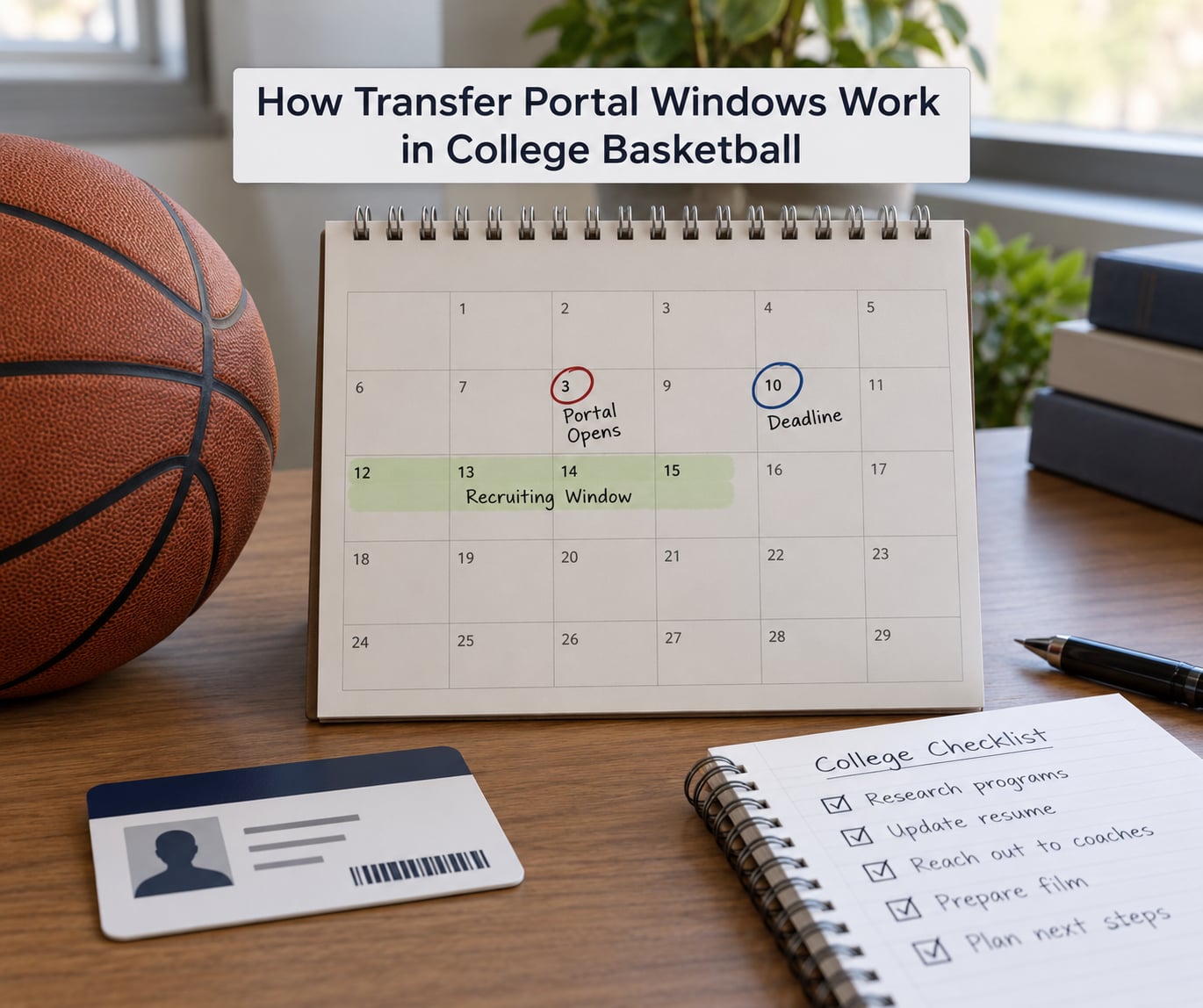
The process runs in a predictable order. Eligibility gets checked first, then the player enters, then the entry becomes visible to coaches, and only then can recruiting contact begin. Nothing in the sequence is automatic after entry; every later step depends on what the former school and the new school decide.
- Review eligibility. A player, usually with an athletic administrator, checks what the transfer would mean for immediate eligibility and what aid is attached.
- Notify the current athletic department. The school records the request and informs the head coach. This is the moment the former coach typically finds out.
- The entry becomes visible. Once recorded, the player appears in the transfer database that other programs monitor.
- Coaches make contact. Subject to the applicable recruiting contact rules, schools reach out to the player.
- Visits, offers and decommits. A short visit can lead to an offer, and an offer can be pulled back. Teams have been known to scout a player in a day and move on, a pattern coaches have publicly worried about.
- Sign, or withdraw. A player who signs is done. A player who changes their mind withdraws from the portal and may return, depending on the aid situation at the old school.
The table below shows which of those steps the player controls outright and which ones a school controls.
| Step | What happens | Who controls it |
|---|---|---|
| Enter the portal | Current school is notified and records the request | Player, with the athletic department |
| Become visible to coaches | Entry posts to the transfer database | Automatic once recorded |
| Grant of a release | Former school responds on the scholarship and release | Former school |
| Recruiting contact | Coaches reach out within the applicable rules | Recruiting rules, not the window |
| Visit and offer | Program evaluates and extends a scholarship | Program |
| Withdraw and return | Player pulls out of the portal | Player, with the former school on aid |
When Does the College Basketball Transfer Portal Open?
For men’s and women’s basketball, the window opens the day after the national championship game. Because that game lands on a different date each season, the calendar moves every year, which is why a fixed date printed in an older article is almost always wrong.
The trigger is the championship, not a calendar date. A postseason ending early pushes the window earlier; a deep tournament run pushes it later. Men’s and women’s basketball run the same structure, so the two windows usually sit close together.
Players can declare before the window opens
Declaring an intent to transfer and being in an open recruiting window are not the same thing. Players sometimes say publicly that they are entering well before the window date, and coverage of those declarations circulates while the window is still closed.
Treat those announcements as intent rather than availability. The window date is when recruiting contact is permitted.
Why the gap between the Final Four and the window matters
A team playing in the tournament has a known end date. A team eliminated in round one has weeks of waiting. Players are unsure whether their coach will keep them, and coaches cannot know how many scholarships they are replacing.
That dead stretch is the main complaint aimed at the compressed basketball window. Kentucky’s Kenny Brooks described the 15-day format as leaving a lot of people in limbo for a very long time and said the previous setup was probably better. Matt Painter framed the new structure as a reverse lottery, since the teams that miss the tournament have the widest pool of available players.
How Long Does the Transfer Portal Window Stay Open?
The basketball window stays open for 15 days. A second 15-day window exists for programs that change head coaches, and it opens five days after the new coach is hired or publicly announced. If no new coach is announced within 30 days of the previous coach’s departure, that window opens on the 31st day instead.
Those two windows are independent. A player can use either one, and a program can be dealing with both at once: an unhappy coach’s players and a coaching change in the same week.
Entry deadlines inside the window
The 15-day window is not one long free-for-all. Entry itself is limited, and a widely cited date for men’s basketball, May 1, applies to all men’s basketball transfers including graduate transfers. That detail comes from a discussion of NCAA legislation and should be confirmed against NCAA.org before anyone plans around it.
Graduate players are often assumed to be exempt. Community discussion around that May 1 rule suggests otherwise, which is exactly the kind of detail worth verifying directly rather than taking from a thread.
Once the window closes, the process is closed to new entries under that cycle’s rules. A player already in the database keeps whatever status that status carries, subject to the eligibility rules below.
Do All College Basketball Transfer Windows Have the Same Rules?
No. The NCAA window is uniform across Division I basketball, but the requirements around it are layered, and they change by player status.
How the NCAA window differs from school deadlines
The NCAA window is when a player may be recruited. A school’s deadline is when that program stops taking calls for a cycle. One is a national rule, the other is a recruiting choice.
Conference rules sit alongside both, controlling signing periods and aid offers inside a league. So a player can be fully legal under the NCAA window while still working around a league schedule and a head coach’s preferences.
Why transfer rules vary by player status
Eligibility is where the real variation lives, and it is the part most portal coverage skips.
- One-time transfer. The traditional route: leave once, sit out a year, then play. It still exists and it still costs a season of eligibility.
- Immediate eligibility. A player who meets the conditions can leave and play right away without sitting out.
- Midyear transfer. A player who enrolls in the first academic term of the season generally cannot compete that season, which is why midyear transfers are a limited move.
- Five years in a five-year span. Approved in June 2026, this rule lets a player use up five years of eligibility inside any five-year span. It is the practical ceiling on how often a player can realistically move.
Tom Izzo has argued that the portal turned college basketball into a year-round sport and questioned whether it delivered what it was supposed to. Fran Fraschilla raised the part that still gets skipped: what happens to programs sitting short after the window shuts.
Why a player confirms requirements before entering
Entry is hard to undo and the paperwork is slow. Checking eligibility, aid conditions and the former school’s release process first costs far less than discovering a problem after the window closes.
Two specific tools come up often. The NCAA Eligibility Center handles certification, and a waiver of final appeal exists for eligibility decisions. Players facing a complicated case talk to an administrator first, not to a beat reporter.
What Happens When a Player Enters the Transfer Portal?
Entering is the notification step, and it is the only genuinely automatic part of the whole process. Everything after it is negotiation.
- Entry is recorded. The current athletic department logs the request and notifies the head coach. This is usually how a coach learns about it, which is why entry often reaches the news before the player is ready.
- The profile becomes available. The entry posts where other programs can see it. Nothing about the player’s aid, academics or eligibility is guaranteed at this point.
- Schools reach out. Programs that need a player at that position make contact within the applicable rules.
- Visits happen, often fast. Short visits are normal now. Coaches have described scouting players in a single day, and decommitments that follow are routine enough that players should expect to compare more than one offer.
- Offers and scholarships. A school extends aid, and the player weighs role, roster, coaching and academics.
- Withdraw or sign. A player who pulls out stops receiving recruiting contact. Returning to the original school is possible but depends on that program still having a scholarship open.
Players describe the unclaimed case as the hardest part. A player who enters and hears nothing is not automatically released, not automatically dismissed, and not automatically back at the old school with the same terms. That gap is why so much of the criticism from coaches centers on the closed window rather than the entry itself.
What Does the Transfer Portal Mean for Recruits, Players, and Fans?
For recruits and their families
A high school senior’s path is different from a transfer’s. Recruiting rules and contact restrictions apply in their own cycle, and entering a portal is not the mechanism for changing a commitment after signing. Anyone asking whether a high school athlete has to sit out a year by transferring is mixing up two different rules entirely.
For players already in college
The portal is a job search with a deadline. It says who is available to whom, and when contact is allowed. Everything about aid, playing time and eligibility still has to be worked out school by school.
For fans tracking roster moves
Most frustration among fans is a data problem, not a rules problem. Entries, commitments and decommitments are scattered across dozens of reporters’ feeds with no single page holding all of it.
For a reliable picture, check the NCAA’s own transfer database first, then follow a dedicated tracker, then treat a school’s athletics account as the final word. A rumor becomes confirmed when the player, his school or a school he is visiting says so out loud.
Frequently Asked Questions
Can a college basketball player enter the transfer portal more than once?
Yes. The portal is a notification system, not a one-time pass. A player can enter, withdraw and re-enter under the applicable rules, and basketball players move more often than most fans expect. The real limit is eligibility: the five years in a five-year span rule caps how much eligibility a player can use, so several transfers are possible while only a limited number of seasons remain.
Is entering the transfer portal the same as transferring immediately?
No. Entry tells your current athletic department you intend to transfer. From there, coaches recruit, visits happen, offers get extended and decommitted, and a player eventually signs somewhere. The former school also still decides what happens to the scholarship and whether it grants a release, so entry is the starting signal rather than the move itself.
Can schools contact a player while they are in the transfer portal?
Yes, within the recruiting rules that apply during the window. Once a player’s entry is recorded, their name is visible in the transfer database and coaches can reach out. Contact is limited by recruiting rules and by the 15-day basketball window rather than by a school-by-school permission, so a program’s interest is real even when no offer follows quickly.
Does a player have to leave their current school to use the portal?
No. Entry is a notification, not a forced departure, and players can withdraw their name. Returning to the original school is possible, but it depends on that program still having a scholarship available and on how the athletics department handles the paperwork. Several communities have raised this confusion as one of the most common misconceptions about the portal.
How can fans tell whether a transfer rumor is confirmed?
Treat a rumor as confirmed when the player, his current school or a school he is visiting says so directly, or when an offer and signing are reported by an official athletics account. A posting saying a player has entered the portal only confirms availability, not a destination. Commitment and decommitment news travels through beat reporters fastest, but the schools’ own announcements are the firmest source.
What to Verify Before the Next Window
Start with the NCAA’s published calendar, because the basketball window opens the day after the national championship game and shifts every season. Then check your conference’s signing and aid deadlines, and the specific program’s recruiting rules.
Before entering, confirm what the move does to eligibility, what happens to the existing scholarship, and whether immediate eligibility is realistic or whether a year is coming off. Those three answers come from an athletic administrator, not from a message board.
For fans, the habit that helps most is separating entry, commitment and signing into three different kinds of news. Entry means a player is available. Commitment means a school is pushing. Signing is the only one that moves a roster.
Last updated: October 2026. Rules and dates change at least annually, so confirm every date on NCAA.org and with the relevant conference before relying on it.