International players usually get recruited because a coach found usable game film, decided the player fits a roster need, and then worked out whether the paperwork could clear. That is the whole process in one sentence. Everything below is the detail: who finds you, what they check, and what has to happen before you actually play.
This guide covers how international players get recruited to college basketball, written for overseas players and their families first, then for coaches and fans who want to understand why a roster in 2026 looks the way it does. If you are the parent reading at midnight wondering whether a recruiting service is legitimate, the outreach section is the one to read.
Table of Contents
- How Does the International College Basketball Recruiting Process Work?
- What Do Coaches Look for in an International Prospect?
- How Do Players Build a Recruiting Profile?
- How Do International Players Reach College Coaches?
- What Happens During the College Recruiting Process?
- How Does NCAA Eligibility Work for International Players?
- Can International Players Receive an Offer Before Finishing High School?
- What Happens After a Player Signs?
- What Can Make an International Player Easier to Recruit?
- Frequently Asked Questions
- Can an international player be recruited directly by an NCAA college basketball coach?
- Do international basketball players need to take the SAT or ACT?
- What level of high school basketball experience do college coaches expect from international players?
- Does an offer from a Division I coach guarantee a scholarship?
- When should an international basketball player start the college recruiting process?
- Conclusion
How Does the International College Basketball Recruiting Process Work?
There are no official visa steps and no agent who can guarantee anything. Coaches watch players, decide whether they fit a roster and a rotation, contact them or their intermediary, and then the athlete works through eligibility paperwork and a visa timeline that often runs longer than the recruitment itself. The order rarely changes. Only the speed does.
| Stage | What happens | Who drives it |
|---|---|---|
| Self-assessment | Player compares current ability and academics against a realistic division level | Player and family |
| Eligible roster level | Target NCAA Division I, Division II, NAIA or a junior college path | Player, family, agent |
| Competitive record | Club, academy or national team season that produces verifiable statistics and film | Player, club |
| Skill evaluation | Coach or scout reviews game film, sometimes at a live event | College staff |
| First contact | Direct message, intermediary introduction or a recruiting service listing | Coach, agent, service |
| Academic file | Transcripts, course records and a high school equivalency are assembled | Player and family |
| Eligibility certification | NCAA Eligibility Center reviews the academic record and amateurism status | Eligibility Center |
| Conversations and visit | Coach relationship, school visit where offered, roster expectations discussed | Both |
| Offer and signature | Written offer, financial aid agreement, then enrollment and visa processing | Program compliance office |
What Do Coaches Look for in an International Prospect?
Coaches are not looking for a highlight reel. They are looking for a player who can do one thing reliably, in a specific role, for four years, without costing the team a roster spot they needed for someone else.
Production a coach can trust
Numbers from a credible competition carry weight. Scoring and shooting against strong adult or elite youth competition means something; the same numbers from a low-level domestic league means much less. Coaches also read assist rates, defensive effort and how a player performed against players who later went pro.
The skills coaches name out loud
Coaches interviewed about this trend keep circling the same three things. A high understanding of pick-and-roll coverage reads, a willingness to pass the ball rather than shoot over a contest, and perimeter shooting that does not break down against a physical defender. Fundamentals drilled from a young age show up in how little a player has to be re-taught in year one.
Character and coachability
Coaches running international recruitment say the same thing about the ones who work out: they arrive already knowing how to practice, how to be coached and how to handle being benched. Language and cultural adjustment matter too, though programs with an established pipeline handle both better than programs building one from scratch.
How Do Players Build a Recruiting Profile?
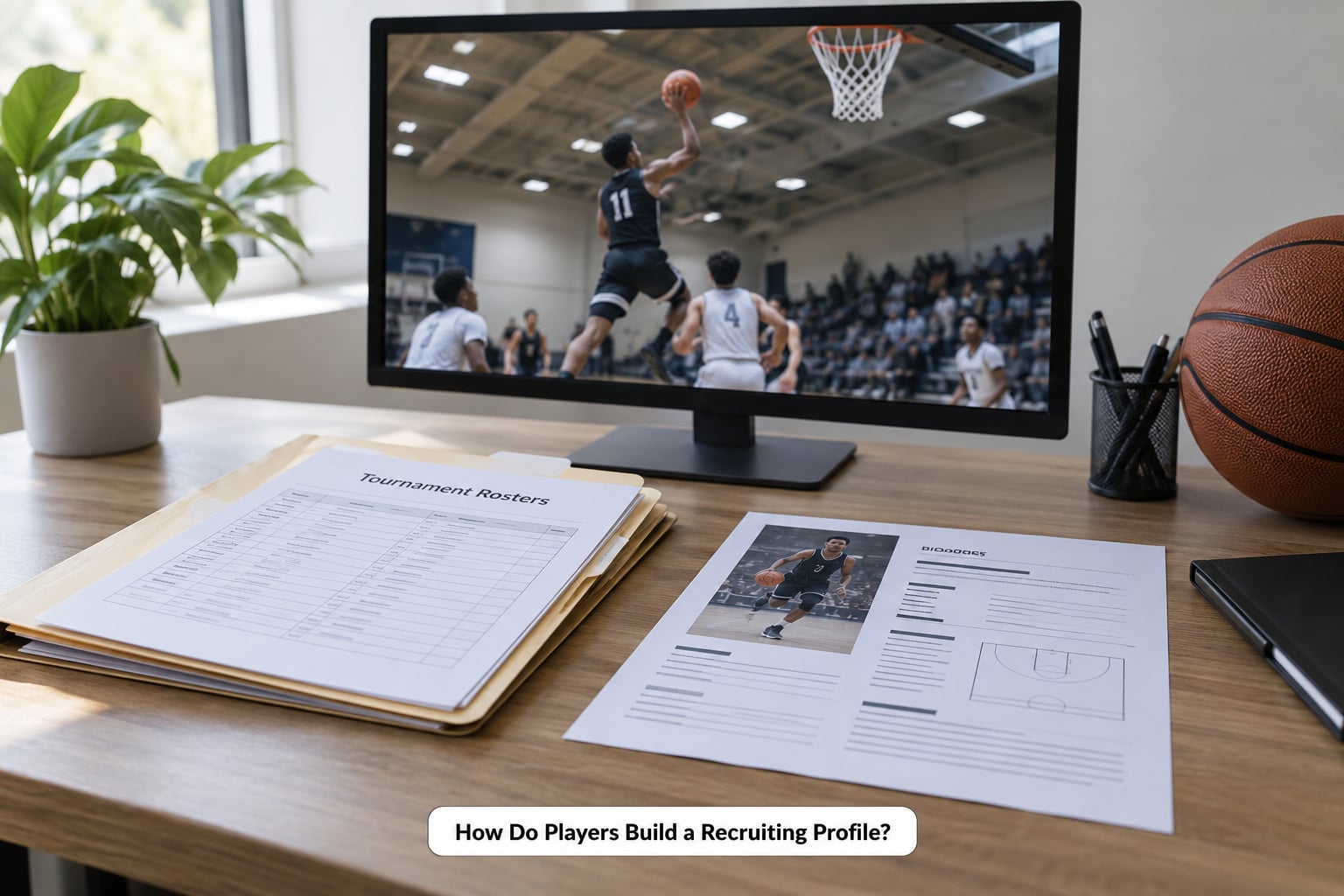
A recruiting profile is just proof, assembled so a coach who spends ninety seconds on it reaches a clear conclusion. Build it around film first, because film is what gets watched.
Film a coach can actually evaluate
A current highlight reel beats a long one. Coaches want the most recent full games, not a package of highlights from three seasons ago, and they want unedited game footage where a scout can see the full rotation. Full games from a tournament stream work; curated mixtapes of only dunks do not.
The documents behind the film
- Full game or tournament statistics, with the competition level named
- Academic transcripts and any high school equivalency documentation, in English and in the format the eligibility center expects
- Tournament and national team roster records that can be verified
- A short written profile: position, size, age, what the player does well, and a direct contact method
- A recommendation or introduction from a current coach, which travels further than any message a stranger can send
Keep the whole file current. A profile that describes a 17-year-old in a 19-year-old’s game gets filed away and never reopened.
How Do International Players Reach College Coaches?
Coaches rarely discover a player by accident. They work through a small number of channels, and most of them are relationships rather than advertisements. Knowing which channel a given program actually watches is the difference between being seen and being ignored.
| Channel | How it works | Best used for |
|---|---|---|
| Program’s own international pipeline | Coaches with existing relationships in a country or region watch specific clubs and academies | Players already inside a well-watched club or academy |
| International tournaments and FIBA events | Coaches attend in person or review published results and streams | Players with high-level national team or continental exposure |
| College coaching staff who have coached abroad | A staff member with overseas connections calls players and coaches directly | Players whose style fits that coach’s system |
| Agents | A representative builds the profile and contacts coaches who fit | Players with film strong enough to sell |
| Recruiting services | A paid service lists a player to subscribing coaches and manages the outreach | Players who need help reaching US programs without a network |
| Direct contact | A player or parent emails a coach with film and specific context | Players who know which program and which coach fits |
Bulk message lists rarely work. Programs are explicit that they do not open unsolicited recruiting emails, and a message with no film, no transcript and no explanation of why that specific program should want the player is the kind that gets deleted on sight. A coach who watches your work and then asks you a specific question about your role on the team is worth a hundred unreplied emails.
On agents and services, be careful. Forum discussion about this pipeline repeats one theme: players describe being promised a Division I career by someone who had no film to show a coach and no relationship of their own. Anyone who guarantees an offer is telling you something about their own position in the process. Ask what the arrangement costs, what the service actually does, whether the representative has placed players who are still on rosters, and who is allowed to speak to your family directly.
One more piece of advice from a player who went through it and wrote about the experience publicly: visit before you commit, and treat a refusal to arrange one as a serious red flag.
What Happens During the College Recruiting Process?
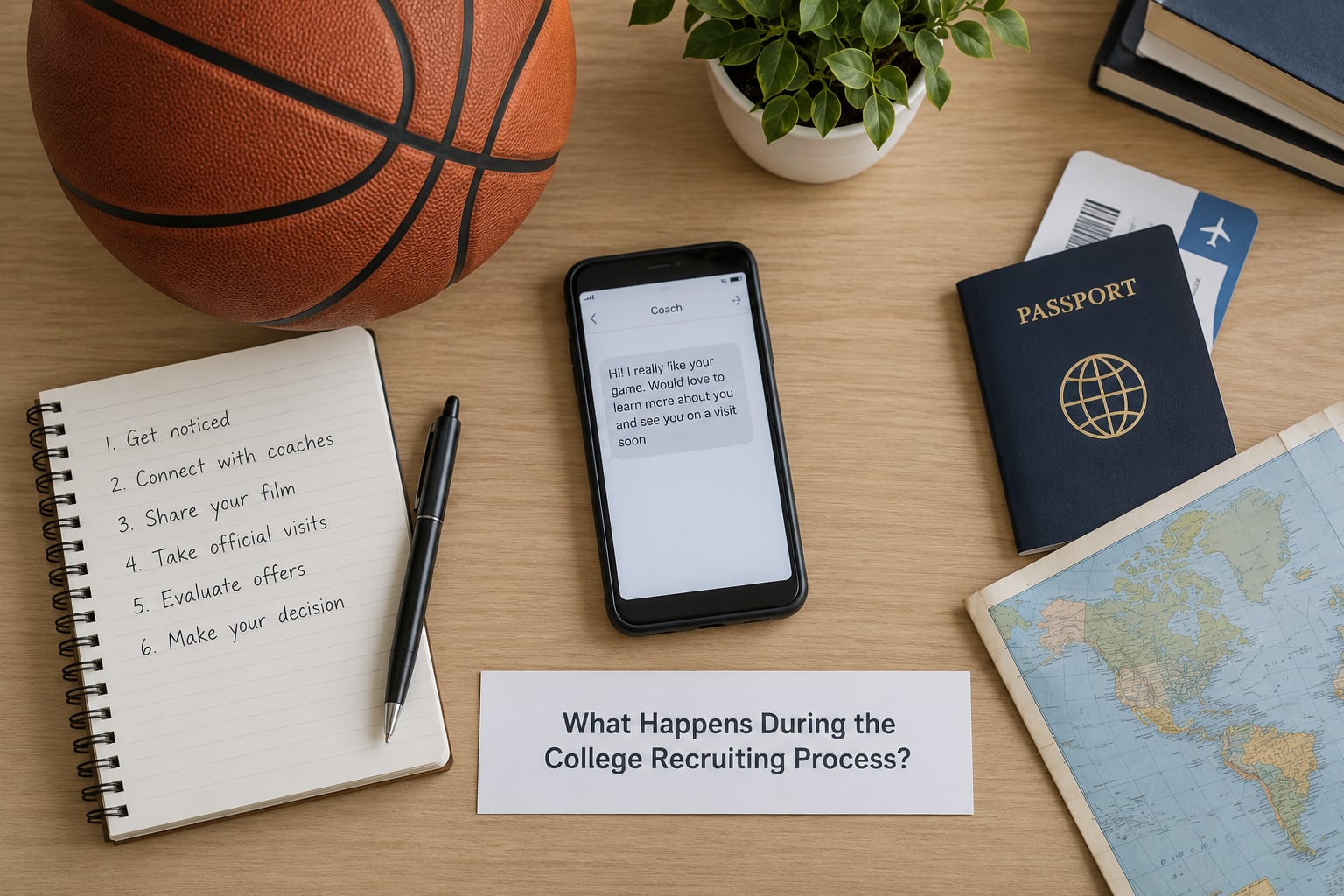
Once a coach makes contact, the process stops being about being discovered and starts being about being chosen. Four things usually happen in sequence.
Film evaluation. The coach watches game film and decides whether the player fits a role. International players hear most about shooting, passing and pick-and-roll reads because those are the traits coaches describe most often when explaining why they went after a particular prospect.
Conversations. Regular contact with the coach, sometimes weekly. This is where a coach learns what the player is like on the phone, and where the player learns whether the coach’s stated plans are real.
Visits and relationships. Campus visits are not automatically extended to international recruits, so an invitation carries real signal. Players who go, watch a practice and meet the academic staff get a clearer picture of the school than any brochure.
The offer and the roster math. A written offer comes with a financial picture attached. Scholarship amounts, roster limits and the depth chart behind them determine whether a spot is genuinely available. Players should ask about playing time expectations directly, because many international commits are recruited to a depth chart position that changes once a higher-rated American prospect commits.
Recruitment continues after the offer. Coaches are re-recruited constantly and players can be cut. Forum players describe committing, then watching a new class shift their role, and treating the transfer as a normal part of the process rather than a failure.
How Does NCAA Eligibility Work for International Players?
Eligibility is the step that derails careers, and it is the one families worry about most. International players go through the NCAA Eligibility Center, which reviews the academic record and confirms amateurism status before clearing them to compete. The paperwork must be submitted, reviewed and approved before the player is academically eligible to practice or play, and families describe the timing as the single biggest source of stress in the whole process.
What the 40-60-80 rule does
The 40-60-80 rule governs the course record required for certification. A player needs 40 courses at the high school level, 60 at the next level and 80 at the level above, depending on where the player is being certified. International students who attended school in a system structured differently from the US high school model usually supply a translated transcript plus an equivalency evaluation, which is where the process most often stalls.
Certification versus final eligibility approval
Certification is an initial academic review. It is not the same as final eligibility approval, and a player can be certified and still face questions later if the school needs to verify records or if the amateurism review is reopened. Programs report that teams routinely wait on the NCAA to clear international players before a season begins, which is why families start early.
The amateurism side matters just as much. Any actual compensation for playing basketball, before enrollment, can trigger a finding that affects eligibility. Practices and scrimmages generally are not treated the same way as organized competition, but anyone who has been paid in any form should get a specific answer rather than an assumption.
A workable sequence looks like this: gather transcripts and course records early, request the equivalency evaluation as soon as the school year starts, submit the amateurism questionnaire with accurate history, and keep copies of everything. Families who discover a documentation problem in the summer before the season have very little room left.
Can International Players Receive an Offer Before Finishing High School?
Yes, but the offer is usually conditional, and the condition matters more than the offer. A conditional offer depends on the player finishing the required secondary education and clearing the eligibility process. Many international prospects sign before graduating because their national school calendar runs on a different schedule, and they finish their remaining coursework on arrival.
Coaches also distinguish sharply between verbal interest and a formal written offer. Expressions of interest during a coach’s trip, a conversation at a tournament or a positive message about a player’s film are not offers. Only a written offer with stated terms counts, and players and families have been burned repeatedly by treating the first one as the second.
Early signing windows do exist for NCAA basketball, and rules around them have shifted in recent years, so players should confirm the current calendar directly with each program rather than relying on what a third party told them a season earlier.
What Happens After a Player Signs?
The offer is the start of a second process, and this is where international families spend most of their stress. Four things need to happen before a player plays.
Academic placement comes first. Transcripts, course equivalencies and English language requirements determine which courses the player takes and what classes they are placed in during their first term. Players who assumed English test results would be waived sometimes find out otherwise after signing.
Medical documentation comes next. Pre-participation physicals and medical history forms have to be on file before participation, and the process takes longer when records have to be translated or requested from a physician in another country.
Financial planning and the aid agreement matter more than families expect. The written aid agreement sets out what the program covers and what the family owes, and it should be read line by line before anything is signed. Under the settlement in House v. NCAA, Division I schools can share revenue with athletes through an arrangement set by the school, and international players count in that pool alongside everyone else on the roster.
NIL is a separate question from a work visa. NIL money is compensation tied to the athlete’s name, image and likeness while enrolled, and international student-athletes can participate in it. Work authorization to play professionally in a foreign league is a different legal matter entirely, and it is the one that needs an answer from the school’s compliance office rather than an assumption.
Travel and arrival come last: passport validity, visa processing, housing and arrival logistics, and a reporting date. Families who have not accounted for visa processing time are the ones arriving late.
What Can Make an International Player Easier to Recruit?
Most of the work happens years before a coach ever makes a call. A coaching-forum answer puts it plainly: programs start recruiting international players as early as they can, immediately after a new season, which means a player who is invisible in year one is already behind.
Play competition that means something. A strong national league, a continental event or a national team appearance produces film, statistics and a verifiable record that a coach can trust. Regional leagues are fine for development and poor for recruitment.
Fix one positional gap instead of collecting highlights. A guard who cannot shoot under pressure is harder to sell than a guard who is good at two things and clearly understands his role. Coaches build rotations, not highlight reels.
Communicate early and specifically. A short message to the right coach with recent film and a clear reason for reaching out beats mass outreach every time. Program fit research matters too: a program with a track record of signing and developing players from your country is a more realistic target than a famous program that has never signed one.
Keep the paperwork clean and keep the transcript current. Much of what separates an offer from a near miss comes down to whether the eligibility file could be assembled without a scramble.
Frequently Asked Questions
Can an international player be recruited directly by an NCAA college basketball coach?
Yes, though it happens through a limited number of channels rather than open invitations. Coaches with international pipelines, international tournaments, staff who have coached abroad, agents and recruiting services all produce first contact, and a strong direct message with recent game film can work. Programs are clear that they do not open general recruiting emails. A player with verifiable game film, a documented tournament record and academic records in order is far more likely to be answered than one sending a generic highlight package.
Do international basketball players need to take the SAT or ACT?
Usually not, because most international students certify through their own national academic records or an equivalency evaluation rather than a US standardised test. The exact requirement depends on the certification route a player’s transcript supports and on the program. English language proficiency requirements can still apply, and those are separate from academic certification. Players should confirm the current requirement with the NCAA Eligibility Center and with a program early, because the answer affects which courses they take after enrollment.
What level of high school basketball experience do college coaches expect from international players?
Coaches expect a player who has been the best or near-best in a credible setting, not simply participation in organized basketball. A national league, an elite academy or national team duty tends to carry more weight than a lower-level domestic competition, because a coach can compare the player against known competition. Fundamentals, role discipline and the ability to practise properly are what programs notice most in a first meeting, often more than raw scoring.
Does an offer from a Division I coach guarantee a scholarship?
No. An offer is a statement of intent, and the money depends on the financial aid agreement attached to it. NCAA programs have a limited number of athletic scholarships to distribute, and which players receive them varies by sport and division. International players also compete for a limited number of roster spots. Players should ask for the aid terms in writing, read what the family is responsible for, and understand the depth chart the offer is attached to.
When should an international basketball player start the college recruiting process?
Earlier than most families assume. Coaches begin tracking international prospects as soon as a season ends, so a player with strong film at 16 is already being noticed. Practical first steps are assembling transcripts and equivalency records, getting evaluated at credible tournaments, and building a current highlight reel with verified statistics. Families who start documentation late lose months, and eligibility paperwork is what most often determines whether a recruited player can actually play in year one.
Conclusion
International players get recruited to college basketball because they show, on film, that they can fill a specific role on a specific roster, and because their academic file can be cleared in time to play. The path runs through competitive play, a documented record, real relationships with coaches who scout your country or your league, and eligibility paperwork started long before anyone offers anything.
If you are starting now, do three things this month. Document your current eligibility situation, including transcripts and any equivalency requirement. Assemble proof of performance that a coach can verify in under two minutes. Then contact a short, specific list of well-matched programs instead of as many as possible. That last part is where most families waste a year.