The NFL Scouting Combine is a four-day, invitation-only event in Indianapolis where roughly 300 to 330 top college football players undergo physical measurements, medical exams, athletic testing, position-specific drills and formal team interviews in front of every NFL coach, scout and general manager ahead of the NFL Draft.
Short version: every player in the draft class runs the same tests, in the same room, under the same conditions, in front of the same decision-makers. That is the whole idea. If you have watched the televised workouts and wondered why a 40-yard dash time moves a player three spots on a draft board, the answer starts here.
Table of Contents
- What Happens at the NFL Combine?
- How the NFL Combine Evaluation Works
- NFL Combine Medical and Measurement Day
- What Do Players Do at the NFL Combine?
- Which NFL Combine Tests Matter Most by Position?
- NFL Combine Pro Day Drills and Individual Workouts
- How NFL Teams Use Combine Results
- Common NFL Combine Questions
- Frequently Asked Questions
What Happens at the NFL Combine?
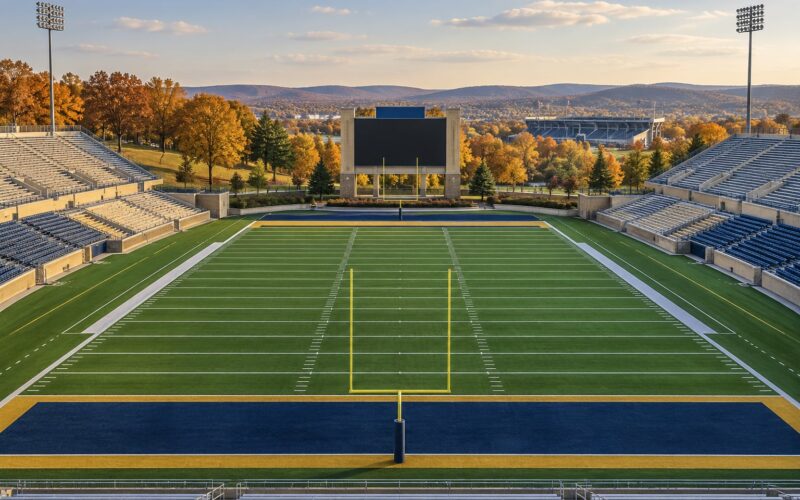
The Combine is the league’s centralized scouting event, held every February at Lucas Oil Stadium. The Indianapolis Colts’ stadium is turned into a testing lab: measuring stations in one corner, medical imaging rooms in another, interview suites lined up along the concourse, and an indoor field where the standard drills run in front of a standing crowd.
It is not a game, and it is not a practice. Nobody is trying to win a football game. A prospect’s job that week is to answer four questions as clearly and as honestly as possible: How fast are you? How strong are you? Are you healthy? And can you think on your feet when a coach asks you about football?
Why It Is Called the Combine
The name comes from the idea of combining information. Instead of 32 teams each running their own private workout on their own schedule with their own timing equipment, the league pools every prospect into one place and standardizes the tests. Every number you see on television was produced under the same conditions for every player that week.
That standardization is the entire point, and it is also the main criticism. Scouts who distrust laboratory numbers point out that a timed 40 is not the same as a fourth-down catch on a Saturday afternoon. The league’s counter is that a neutral comparison across 300 players is still useful, especially when combined with game film and interviews.
How Players Get Invited
There is no application, no tryout camp and no entry exam. Every one of the 32 teams submits an invite list, and the league also takes input from several independent scouting services. Those lists get pooled, duplicates are removed, and the invitations go out.
The target has been somewhere in the 300 to 330 range in recent years, though the number moves a little each cycle. Players who are not invited are not excluded from the draft. Plenty of starters every year never set foot in Indianapolis, and teams still put them on their boards because of the film.
One more thing worth knowing: a Combine invitation does not require a player to declare for the draft at the time he attends. Plenty of underclassmen show up, test, and go back to campus for another season. Showing up early can help a player get a later first look, and plenty of teams schedule a second private visit later in the spring.
How the NFL Combine Evaluation Works
Nobody decides anything from a single number. The Combine is one input into a file that a scouting department has been building for two or three years, and every organization weighs it differently.
A scouting director will usually divide the report into four buckets: production on the field, athletic testing, medical information, and character. The athletic portion is easy to quantify, which is exactly why it gets the most airtime. The character and football IQ portions come mostly from the interview sessions and from coaches watching film with the player.
Position coaches handle the position-specific portion. A quarterback prospect throws in front of the quarterbacks coach and the offensive coordinator. A defensive lineman takes part in pass-rush and run-defense work with the defensive line coach. Those sessions are short, they are not televised, and in my view they are the part of the week that most reliably changes a grade.
Analysts then layer on context that raw numbers miss. A 4.55 40 from a cornerback who never made a tackle in college means something very different from the same 4.55 from a blocking guard. Two players can post identical Combine sheets and land twenty spots apart on the board.
So when a broadcaster says a prospect is flying up after a workout, take it as one input. The board gets finalized across the following month of team visits, and the Combine is where a lot of the preliminary sorting happens.
NFL Combine Medical and Measurement Day
Before anyone runs a timed drill, every prospect goes through official measurement and a full physical. Measurement is quick and somewhat unglamorous: height in a stockinged stance with the shoes off, weight on a scale, arm length and wingspan, and body composition measured through a skinfold caliper. Every figure goes into the league’s central database, which is why media outlets can list measurements for players before they have actually tested.
The medical is the part that takes a real day. Players report early, sometimes hours before their on-field slot, and cycle through a physical exam, vision and hearing screening, blood pressure, bloodwork, and imaging ordered by team doctors. An MRI of a knee, shoulder or back that a team wants to see in person can add hours to the visit.
Prospects describe these days as the most draining part of the week. Sitting in a waiting room for an imaging slot is not glamorous, and the pressure of a long day in front of 32 franchises is real. Some players come out of it feeling the process treats them like a part on an assembly line, and that criticism has a long history behind it.
Here is why the medical carries so much weight. An injury flagged on an MRI can cost a player a full round on a draft board, because teams price in the risk that a body will not hold up. A prospect with the tape of a first-round player but an unclear knee can slide well below the talent on his film. The Combine is the one place a neutral doctor can look at that knee in front of every team at once.
One practical note for fans following the numbers: the officially reported height and weight are the ones from that central measurement session, and they are the only ones teams treat as gospel. Anything a player says in a press conference or a reporter’s notebook is a different, unofficial number.
What Do Players Do at the NFL Combine?
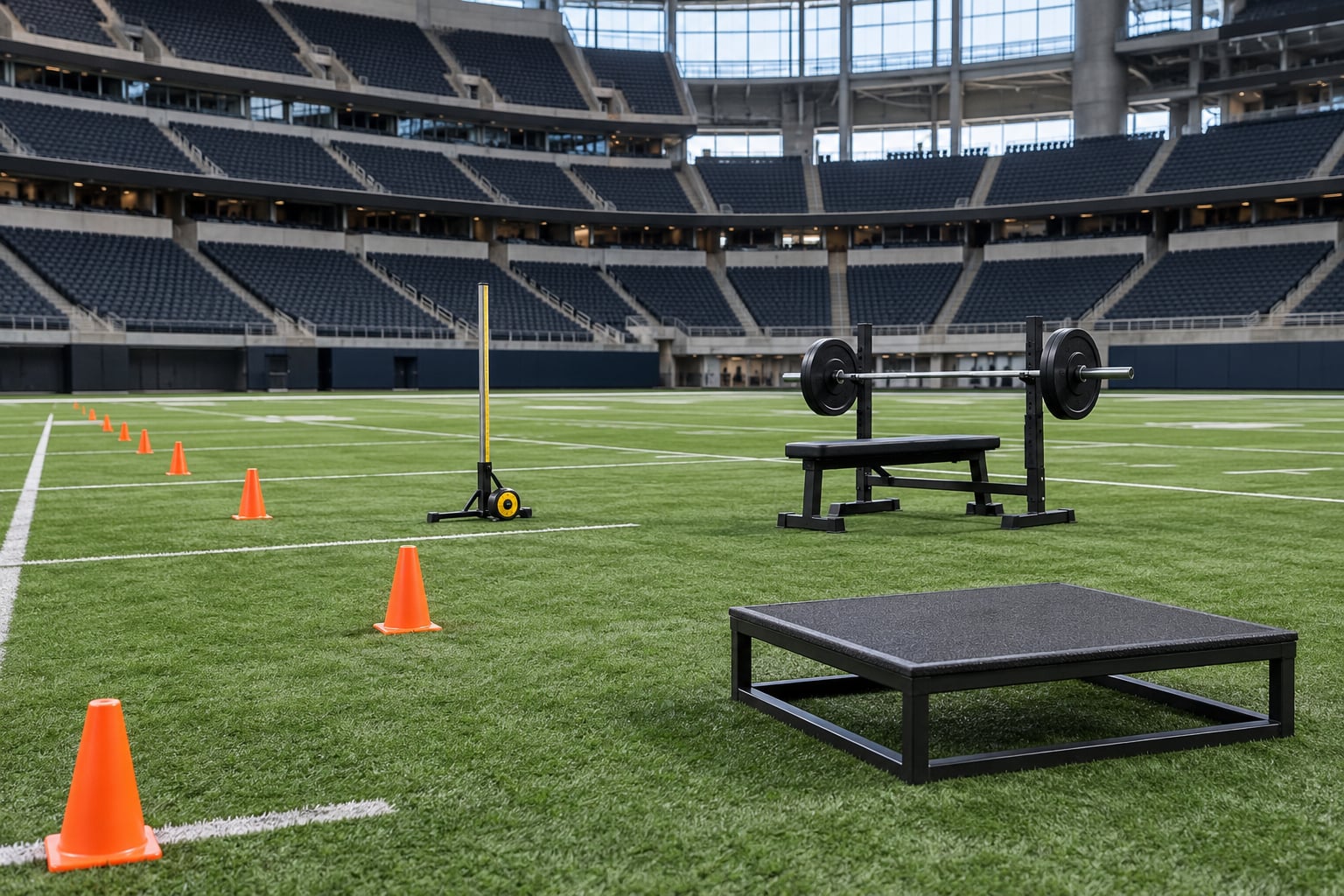
After measurements and medicals, the prospects hit the indoor field for the standard testing block. Six drills run for nearly everyone, and every one of them is trying to isolate a different physical quality.
| Drill | What It Measures | A Good Mark |
|---|---|---|
| 40-yard dash | Straight-line speed, with 10 and 20 yard splits showing acceleration | 4.40 or faster for receivers and defensive backs, 4.50 for backs, 4.70 to 4.80 for quarterbacks |
| 225-pound bench press | Upper body strength and effort, a favorite for offensive linemen | 25 to 30 reps is a strong mark for most positions, 35 or more for a lineman |
| Vertical jump | Explosive leg power, often tied to the player’s reported test numbers from college | 34 inches or better is considered elite, 40 is rare |
| Broad jump | Horizontal power and body control, valued by defensive backs | 10 feet or more is a strong mark |
| 20-yard shuttle | Short-area quickness and lateral movement | Under 4.3 seconds is a top-tier mark |
| Three-cone drill | Multi-directional agility, the classic test of hip turning and body control | Under 6.9 seconds separates the elite from the rest |
A few details that get missed in the highlight reels. The 40 is hand-timed at the 10, 20 and 40 yard marks, and many evaluators care more about the split than the final number. A player who runs a 4.50 but opens with a 1.45 ten is fast and lacks the lower body to exploit it. A 4.60 with a 1.32 ten shows the opposite profile, and offensive coaches get excited about that one.
The bench press is a straight bar with 225 pounds added, lifted as many times as the player can, and 2011 brought a 49-rep performance from Stephen Paea that still stands as the mark most people bring up. What gets a lot of airtime is not the rep count but the spotter touching the bar, and a single assisted rep tends to draw a poor grade.
Then there are the position-specific sessions. A quarterback throws a full route tree and takes coaching in real time. A wide receiver runs routes against press coverage. A defensive back tries to cover a receiver one-on-one. Offensive and defensive linemen go through a full line drill with hand placement and blocking technique. None of that is televised, which is precisely why it is the part scouts trust most.
Which NFL Combine Tests Matter Most by Position?
The tests are not equally weighted across the league, and treating every number the same is the most common mistake fans make. A 6.9 three-cone that would sink a linebacker means very little to a quarterback, while a 4.6 40 that would hurt a cornerback is unremarkable for a tight end.
| Position Group | Tests That Carry the Most Weight | What Gets Overlooked |
|---|---|---|
| Quarterbacks | Height, wing span, throwing session, decision-making under pressure | The 40 is a projection, since quarterbacks rarely run it in games |
| Receivers | 40 with splits, 3-cone, route tree, release against press | Bench press, which is nearly irrelevant at this position |
| Running backs | 40, 3-cone, pass catching, ball security in the short-yardage drill | Height measured in a stockinged stance rather than on film |
| Tight ends | Size, 3-cone for a big slot role, blocking technique in line drills | Raw 40, which says little about route running |
| Offensive linemen | Bench press, 40, arm length, work in the full line drill | Everything short of technique work in the trenches |
| Defensive linemen | Bench press, 40, power from the three-cone, pass-rush and run-defense work | Agility numbers, which skew small for the position |
| Linebackers | 40, 3-cone, short-area quickness, coverage and run reads | Bench press, less useful than closing speed here |
| Defensive backs | 40 with splits, 3-cone, broad jump, one-on-one coverage | Bench press, which is a weak signal for the role |
The split-time habit is worth building if you follow draft season closely. Two receivers who both run 4.50 look identical on a spreadsheet and are completely different football players, and the one with the sharper ten-yard split is the one whose ceiling drops off a route he has to run in a tight window.
NFL Combine Pro Day Drills and Individual Workouts
The Combine and pro day answer different questions, and treating them as the same event is the source of most draft chatter online. At the Combine, a player performs a fixed set of standardized tests for every team at once. At pro day, the school opens its campus and runs its own session for the coaches who show up.
Pro day is closer to a real practice. A wide receiver runs a full route tree and takes a handoff and some screens. A quarterback throws live-ish snaps in a format that imitates a game script. A defensive lineman lines up against the starting offensive line in a live period. Those are football situations, and the coaches watching know exactly what they are looking at.
The trade-off is that pro day numbers are harder to compare. The field conditions, the timing methods and the defensive help all differ, and a host school sometimes runs a fast clock. The Combine is slower and more artificial, but everyone runs the same test under the same conditions.
The Senior Bowl sits in a third category entirely. It is game reps against other conference players, with coaching happening on the field, so it is the best place to watch a prospect handle real adversity. Most serious evaluators pull from all three, which is why a Combine sheet alone never decides anything.
How NFL Teams Use Combine Results
Combine results feed a draft board that is already fairly well built. Game film gets the heaviest weight, and the Combine sharpens it: it confirms size, it fills in acceleration data nobody could measure from a tape, and it answers medical questions in a neutral room.
The most common way a Combine affects the draft is through trade value. When a team falls in love with a fast receiver, other clubs start asking what it would take to move up. A sudden jump on one player’s board shows up quickly in that conversation, which is why fans notice Combine performances more than almost any other event of the offseason.
Downward movement happens just as often. A mediocre 40, a bad medical, or an interview that reads as scripted can push a prospect down. The people most affected by this are the workout warriors: college athletes who train specifically for the Combine, hit enormous numbers in February, and then spend years without the production to match. Scouts have cited the 1995 draft as the standing cautionary tale, when a defensive tackle taken in the top ten never became a starter while the pass rusher picked right behind him carved out a long NFL career.
Nobody is fooled by that story, and the Combine still has it every year. Preparation helps, but it cannot manufacture game tape. A draft board is a prediction about football games, and a February number is not a game.
Fan arguments in places like r/nfl and r/NFL_Draft hit the same wall every year, which is telling. The people who watch most closely are usually the ones who understand that the televised workout is the least predictive part of the week.
Common NFL Combine Questions
NFL Combine Testing Explained
Raw athletic testing and football evaluation are not the same thing, and the Combine is careful to keep them separate. The timed drills measure a physical capacity that football only partly uses. Skills evaluation happens in the position-specific sessions and the team interviews, where a prospect is asked to break down a film clip, explain a mistake, and show how he reads a defense. A player can be extraordinarily athletic and be a poor prospect. It is rare, but it is the reason nobody on a scouting staff watches only the 40.
Can Fans Attend the Combine in Indianapolis?
Mostly not in the way people expect. Lucas Oil Stadium is not open to the general public for the week. Access is limited to credentialed individuals, which includes league staff, team personnel, accredited media, and guests holding tickets through the NFL OnePass program during the publicly available sessions.
Even with a credential, most of the building is closed off. The measuring and medical areas are off limits to fans entirely, and the on-field workouts that you see on television are the only part that plays out in a stadium bowl with a crowd.
How Do You Watch the Combine?
TV is the realistic option, and the entire event is carried on NFL Network. NFL+ and the NFL app stream the workouts live for subscribers, and in recent cycles the league has run selected sessions through NFL OnePass as well. Fan sites like Pro Football Network and NFL.com publish the full measurement and testing numbers shortly after each session, usually within minutes of a player finishing.
The practical tip from people who follow this every year: the 40 times go up on social media faster than any broadcast can post them. If you want numbers, keep a results feed open on your second screen rather than waiting for television.
Does It Cost a Player to Attend the Combine?
No, and there is no way to buy your way in either. Invitations come from the league and the 32 teams, the trip is covered for the player, and the testing is free. The only real cost falls on the programs, which spend real money sending their staffs and often paying to have players train for the Combine specifically.
Do Combine Numbers Decide Who Gets Drafted?
No, not close to it. In most drafts the top picks are players whose college production and projection made them top picks before February began. What the Combine does is sort and adjust the board around that core, and it can move a player a round in either direction when the numbers, the medical, or the interview do not match the tape.
Can a Player Improve His Numbers Each Year?
Sometimes, and it is one of the most debated topics in draft season. Officially, measurements are recorded once a year in a controlled setting, and teams treat the official figure as final. That said, players lose weight and change their testing program in the offseason, so a prospect can legitimately post better numbers in February than the ones he put up as a freshman, and the improvement shows up on the sheet for that cycle only.
Which measurement a team believes is the interesting question. Staffs have their own habits here, and none of them are consistent league-wide. The safe assumption for a fan is that the league’s central record is the number that ends up on the board, and everything else is noise.
Frequently Asked Questions
What is the purpose of the NFL Combine?
The Combine gives all 32 teams a standardized look at the same draft class. Every invited prospect runs identical tests, is measured by league officials and is examined by team medical staff in one place, so coaches can compare players directly instead of relying on different workouts run under different conditions. It is a sorting and information-gathering event, not a competition.
Who is eligible to attend the NFL Combine?
All 32 NFL teams submit invite lists and several independent scouting services also weigh in, with the league pooling the recommendations into one invite list of roughly 300 to 330 players. Anyone can be invited, including underclassmen, and an invitation does not force a player to declare for the draft. Plenty of players who are never invited still get drafted on the strength of their film.
What events are held at the NFL Combine?
Prospects go through official measurement of height, weight, arm length and body composition, followed by a full physical, vision and hearing screening and any imaging a team requests. On the field they run six standard drills: the 40-yard dash with 10 and 20 yard splits, the 225-pound bench press, vertical jump, broad jump, 20-yard shuttle and three-cone drill. Each position group also has a team workout and a 15-minute interview session.
Do NFL Combine results determine which players get drafted?
Rarely on their own. Game production and projection set the top of most draft boards before February arrives, and the Combine sharpens that list rather than building it. What the numbers do is move players within a range: a fast 40 can raise trade value, while a poor time, a medical flag or a flat interview can cost a player a full round.
Can a player change his draft standing at the Combine?
Yes, in both directions, and this is the main reason fans watch. Strong testing, a healthy medical report and a confident interview can move a player up several spots. Poor testing or a flagged injury can move him down just as fast. The changes are usually small compared with the film, but they influence which teams call and which trade offers come in during the following weeks.
What is the difference between the NFL Combine and pro day?
The Combine is standardized: every player runs the same tests under the same conditions in front of all 32 teams at once. Pro day is run by the player’s college for the coaches who travel there, and it looks more like a real practice with live routes, snaps in a game script and trench work against the starting line. Combine numbers are easier to compare; pro day tells a coach more about how a player plays football.
What happens at the NFL Combine, in short: every invited prospect gets measured, medically examined, timed, interviewed and put through a position workout in front of all 32 teams, and the results feed a draft board that gets finalized over the following month.
If you want to follow the numbers well, do three things. Watch the splits rather than the total 40 time. Read the medical reports instead of skipping to the highlights. And treat the position-specific sessions and pro day as the parts that actually tell you whether someone can play, because that is where the scouts are doing the deciding.