Power conference teams play FCS opponents because the visiting small school carries a guaranteed cash payment for the date, which fills a scheduling slot that would otherwise sit empty or cost more to fill. On top of the money, the game lowers injury risk for starters, gives young players live reps, and lets the two schools share a regional audience. Those four pressures — revenue, risk, roster development, and schedule structure — explain nearly every such matchup on a Power Four slate.
Table of Contents
- Why Power Conference Teams Play FCS Opponents
- Power Conference vs. FCS Football: The Basic Difference
- The Main Reasons for These Games
- How Scheduling and Revenue Make the Arrangement Work
- Why Power Conference Teams Play FCS Opponents for Player Development
- The Relationship Between the Schools
- What Critics Say About the Games
- What These Games Mean for the FCS Program
- Frequently Asked Questions
- Why do power conference teams play FCS opponents?
- Do power conference teams make money playing FCS games?
- Should every power conference team stop scheduling FCS opponents?
- Is an FCS game a loss for the power conference team?
- How do these games affect the power team’s playoff hopes?
- What does an FCS program gain by hosting a power conference team?
Why Power Conference Teams Play FCS Opponents
There is no mystery here. An FBS school in the ACC, Big 12, Big Ten or SEC books an FCS program for a nonconference date, and the FCS school receives what the industry calls a game guarantee. The FBS side gets a home date it can sell, a low-risk win, and a chance to test players who would otherwise sit. The FCS side gets a payday and a weekend in a large stadium in front of a national broadcast.
The short version, then: money, risk, schedule fit, and player evaluation. Everything below unpacks those and the smaller reasons behind them.
Power Conference vs. FCS Football: The Basic Difference
FBS stands for Football Bowl Subdivision, the division of Division I that fields the large conferences, plays conference championship games and competes for College Football Playoff berths. FCS stands for Football Championship Subdivision, the tier below it that fields its own national championship through a playoff bracket.
The two divisions differ mainly in structure and in how they fund themselves, not in whether the players care about winning. FCS programs play a full scholarship sport at a smaller budget, in smaller stadiums, often in markets of a few hundred thousand people. That is not a comment on any individual program, and several FCS teams have genuinely good records against top FBS opposition.
| Category | FBS | FCS |
|---|---|---|
| Scholarships in football | Up to 85 (NCAA limits differ by conference agreement) | Roughly 30, using the old 5-4-3 allocation model |
| Postseason access | Conference championships and the College Football Playoff | Separate FCS playoff bracket |
| Average stadium capacity | Tens of thousands of seats | Generally under 15,000 seats |
| Typical nonconference date | Sold through season tickets, suites and sponsorships | Frequent home date available on short notice |
| Games against an FBS opponent in 2026 | Hosts most of them | 127 such games, 57 involving Power Four teams |
The Main Reasons for These Games
1. The guarantee is dependable revenue
The core reason power conference teams play FCS opponents is the game guarantee, a negotiated payment attached to the date. Associated Press reporting carried by Fox Sports put the average Power Four payout to an FCS opponent at about 525,000 dollars in 2026, inside a typical range of roughly 250,000 to 750,000 dollars. For comparison, the average Group of Six host was paying around 1.3 million dollars.
A revenue share from the conference is spread across a full membership. A guarantee is a single named line item, and an athletic director can point at it in a budget meeting.
2. The game costs less than the alternative
Filling a nonconference date with another FBS program means travel, a hotel block, charter costs, and a payout that has climbed every year. Filling it with an FCS program usually means hosting, which removes the travel line and keeps the travel budget intact for one game instead of four.
Her Sports Enterprises data cited in the Opta Analyst piece shows the direction the market has moved. Guarantees for lower-level opponents have grown faster than the underlying gate revenue those games produce, which is exactly why a regional matchup has become the budget-friendly choice.
3. The schedule has a remaining slot
This is the part most explanations leave out, and it is the most important one for power teams specifically. The ACC, Big 12 and SEC each require every member to play at least one Power Four nonconference opponent each year. That mandated date uses up one of the four nonconference slots on a 12-game slate.
The remaining three are spoken for by league rivals, by a Group of Six regional opponent, and by whatever else the athletic director can move. The FCS game is what fills the last seat, which is why it keeps showing up at programs that otherwise schedule as hard as anyone. Boston College against Maine, Colorado against Weber State, Georgia Tech against Mercer, Louisville against Villanova and Purdue against Indiana State all fit that pattern in the 2026 schedules.
4. Roster evaluation needs real repetitions
A quarterback who has not taken a live snap since August cannot be evaluated on a practice field. Coaches need a manageable setting in which a young passer, a rebuilt offensive line or a first-year punter can see real defense speed and make mistakes without the outcome swinging.
Players coming back from injury get the same benefit. The tape from a low-stakes game is often more useful to a coaching staff than a nail-biter against a ranked opponent.
5. Regional ties carry weight in admissions and fundraising
Many of these matchups sit inside a single state, sometimes within the same athletics footprint or recruiting base. An FBS school that shows up in a smaller market spends marketing dollars in a place where they are known, and it gets a reason to point local students at its own admissions and athletics programs.
For the small school, the visit puts its name in front of a national audience for free.
6. It protects the playoff calendar
Playoff selection weighs strength of schedule, and a full nonconference slate of power opponents is expensive and risky. Scheduling one soft date lets a committee-facing program keep its margin for error while still holding a quality opponent in September or late November.
That reasoning is not always honest, which is why the game draws heat. But it is the logic most athletic departments are working from when they fill the slot.
How Scheduling and Revenue Make the Arrangement Work
Position matters as much as the opponent. The FCS date usually lands in the first three weeks, where the FBS team is still finding its identity, or in mid-to-late November, after the conference race is settled. Week One dates are worth more to the small school because they help fill a home schedule that still has empty seats.
Ticket pricing is where the FBS side sees a limit, and honest budget writers know it. A mid-tier FBS stadium will not sell out against an FCS opponent at premium prices. The real return is usually a combination of a smaller attendance bump, corporate hospitality packages sold on a season basis, and the value of the extra home date itself.
The guarantee comparison below is the cleanest way to see the economics:
| Arrangement | Typical money to the visitor | Usual outcome | Main benefit |
|---|---|---|---|
| Power Four vs. FCS | Roughly 250,000 to 750,000 dollars | FBS wins | Cheap home date, low risk, roster reps |
| Group of Six vs. FCS | Average near 1.3 million dollars | FBS wins most often | Largest single guarantee an FCS school can land |
| FCS vs. Division II home game | Small guarantee or gate split | FCS wins most often | Extra home date and a win before an FBS road trip |
Notice the direction of travel. The money flows from the large program to the small one, and the small one is the one taking the field risk. That trade is the whole arrangement.
Why Power Conference Teams Play FCS Opponents for Player Development
The phrase “player development” sounds like a euphemism until you look at which players actually get on the field in these games. It is rarely the first-string roster walking out in week two.
Typical groups include:
- Quarterbacks in their first year or two of real action, often competing with another prospect for the same job.
- Young offensive and defensive linemen who need reps at game speed after a season of limited snaps.
- Specialists, including punters, long snapper candidates and placekickers.
- Players returning from injury working back to full contact on a controlled schedule.
- Position groups rebuilding depth after graduation, which usually shows up at running back and defensive back.
Coaching staffs describe the value in film terms. Twenty-five meaningful snaps against a real defense tells a staff far more than a week of practice, and the game that follows it is the reason the film matters.
Two honest caveats. The claim that these games exist purely as tune-ups understates how much money is involved, and no coach would describe a season-defining opponent as a warm-up. But the developmental function is real, and it is the part fans rarely see because the starters sit on the sideline.
The Relationship Between the Schools
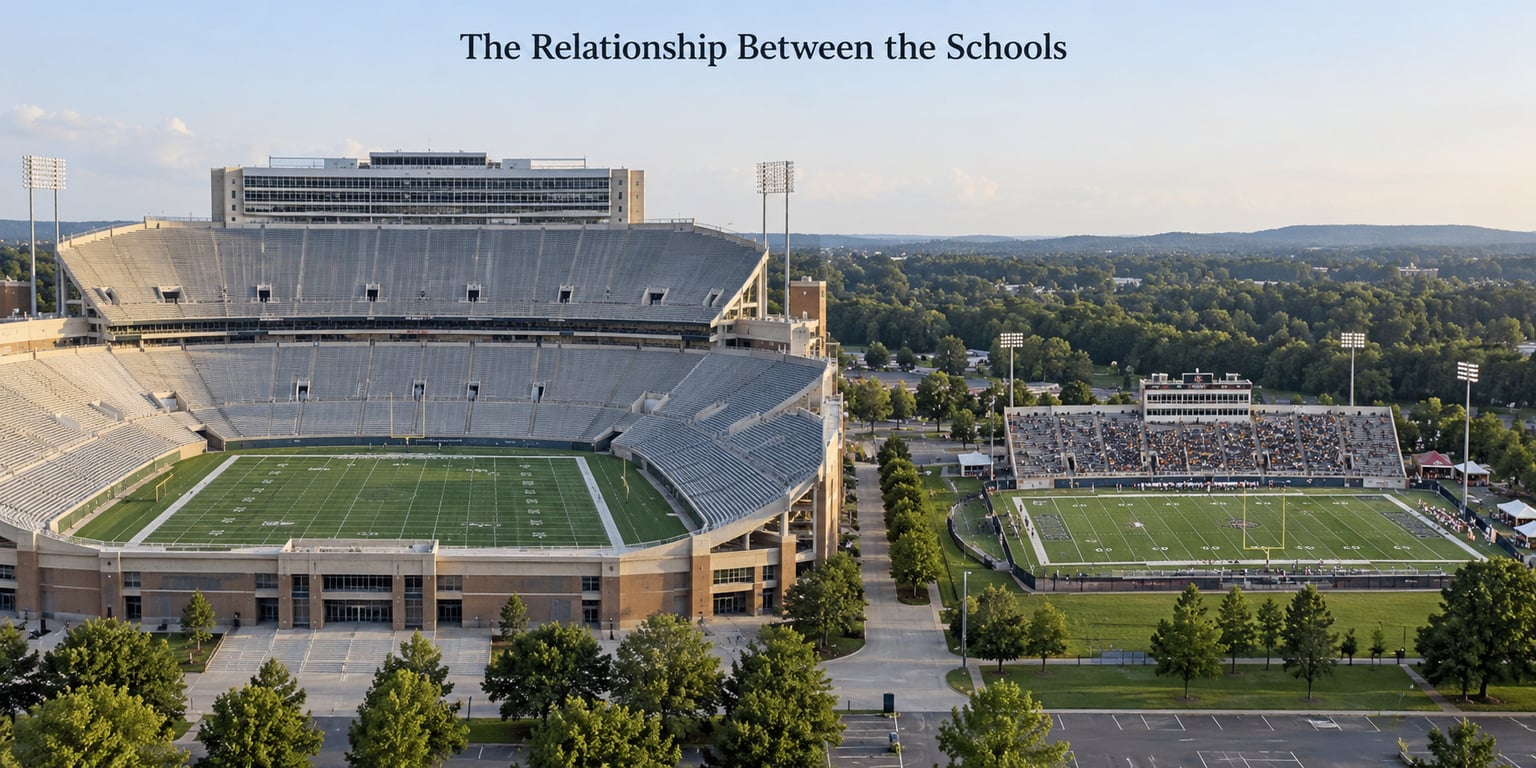
A lopsided matchup becomes a real relationship when geography and history cooperate. In-state games carry local news coverage, familiar name recognition and the possibility of alumni attendance, all of which raise the gate more than a neutral site would.
Facility use matters too. Big programs rent practice fields, use indoor practice space and occasionally hold camps at smaller venues. Academic partnerships and summer-camp arrangements sometimes follow. None of this is contractual or guaranteed, and it rarely shows up in an athletic department’s revenue line, but it makes the relationship cheaper to maintain than a cold transaction would be.
There is a limit worth naming. A school that plays an FBS opponent once every few years is not building a rivalry, and r/fcs posteriors have asked pointedly why so few exist despite decades of shared geography. Historic series have mostly come from conference realignment rather than deliberate design.
What Critics Say About the Games
The criticism is well organized and deserves a straight answer rather than a dismissal.
Competitive imbalance. FCS teams went 4-122 against FBS opponents last season, and the all-time record since the 1978 division split sits near 497-3,708, roughly 13 percent. A schedule that includes many such games inflates records without testing them, which is why strength-of-schedule metrics discount them.
Revenue dependence. Forum users on r/CFB are blunt about the dynamic: for several in-state FCS programs, one such game supplies most of their annual athletics budget. That is a genuine bargaining imbalance, and it is worth separating from the fact that both sides still voluntarily transact.
Opportunity cost. Critics argue the money could fund better competition at home. A counterargument gets raised in the same threads: money that arrives regardless of on-field results can fund facilities, staff and the recruiting class that eventually does win games.
The favorite-favorite example. Appalachian State over Michigan in 2007 remains the reference point, and it is the reason nobody claims a win here is meaningless. A win rate near 13 percent is not the same as a guarantee.
What the criticism gets right is that the arrangement is lopsided and that programs should not pretend otherwise. What it gets wrong is the assumption that the small school is a victim. Every FCS athletic director quoted in the recent reporting, including Chaves, McGuffin, Pifer and Bazemore, described the money as essential rather than charity.
What These Games Mean for the FCS Program
From the other side, hosting a power conference team is one of the few large checks an FCS athletic department can land. The average Power Four guarantee sits near half a million dollars, delivered without regard for how the football team performs, which makes it the most predictable revenue line on the books.
Beyond the guarantee, the weekend brings a national broadcast, a visiting fan base that spends money in local restaurants and hotels, and visibility in front of recruits who play in that state. r/fcs users describe the week as the one that makes the rest of the calendar survivable.
There is also a strategic wrinkle that only appears in detailed coverage. Several FCS programs schedule a Division II home game immediately before an FBS road trip, banking both a likely win and a gate on the way to a loss. Mercyhurst, Florida A&M, East Tennessee State, Furman and Cal Poly have all used variations of this sequencing, according to the Opta Analyst.
The limits are real. Rising guarantees are squeezing out the FCS programs that cannot afford travel to a big stadium, a complaint that appears repeatedly in FCS forums. So the money game is a lifeline that is not equally available to everyone who could use it.
Frequently Asked Questions
Why do power conference teams play FCS opponents?
Because the date comes with a guaranteed cash payment attached, and because it fills a nonconference slot with the lowest cost and lowest risk available. Power teams also use it to evaluate young quarterbacks, linemen and specialists in live action and to protect starters from injury in a week that should be easy to win.
Do power conference teams make money playing FCS games?
Often, though the direct gate is usually modest because premium tickets do not sell against an FCS opponent. The return usually combines a normal home-date bump, hospitality packages sold on season plans and the value of keeping a home date on the calendar. The guarantee paid out is the clearest expense the school avoids.
Should every power conference team stop scheduling FCS opponents?
Probably not, though a handful of programs have priced themselves out of the arrangement. The real pressure comes from strength of schedule and playoff selection, not from the games being unplayable. FCS programs also lose a dependable revenue line if power teams drop them, so a total ban would have consequences on both sides.
Is an FCS game a loss for the power conference team?
Almost always on the scoreboard, and the numbers show it: FCS teams went 4-122 against FBS opponents last season and sit near 13 percent all-time since 1978. What makes it defensible is the developmental value, the guarantee received and the fact that teams are judged on their full schedule, not one game.
How do these games affect the power team’s playoff hopes?
Mixed at the margins. Committees weigh strength of schedule, so a slate full of soft dates can hurt a resume that looks strong on the scoreboard. The counterweight is risk management, since one missed or injured starter in September can cost a season. Most programs use one such date and spend the rest of the nonconference slate on real opponents.
What does an FCS program gain by hosting a power conference team?
A guaranteed payment that averages near half a million dollars for a Power Four opponent, plus gate revenue, a national broadcast and recruiting exposure in the visiting fans’ home state. Many programs also schedule a Division II home game the week before to bank a win and a gate before the expected road loss.
If you are looking at a specific slate this season, find the nonconference dates first and check how many of them belong to the same regional grouping. Then look at what the FCS host did the week before. Those two details explain most of the arrangement.