When a school changes conferences, its football schedule gets rebuilt from the ground up. The automatic games against its old conference partners disappear, a new slate of annual opponents arrives with the new league, and every nonconference slot has to be refilled with whichever opponents will accept the date. That is the whole answer to how conference realignment affects college football schedules, and it is why one announcement can add or remove six or seven dates from a single team’s calendar.
Everything else hangs off that rebuild. Rivalries get downgraded from annual conference games to occasional nonconference dates, travel budgets stretch across time zones that did not matter five years ago, and playoff math shifts because the selection committee judges a schedule through the conference it sits in. For Arizona fans, none of this is theoretical: the Wildcats traded a West Coast conference for a Big 12 schedule and now live with the trade every September.
Table of Contents
- How Conference Realignment Affects College Football Schedules
- Why Do Conferences Realign?
- How Do New Conference Members Change Schedules?
- A Conference Realignment Schedule Example
- How Realignment Affects the College Football Playoff
- What Can Fans Expect During the Transition?
- Why Does This Matter to Arizona Wildcats Fans?
- Frequently Asked Questions
- How are college football teams divided into conferences?
- Why do colleges change conferences?
- What happens to traditional rivalries when a team realigns?
- How does conference realignment affect the College Football Playoff?
- How long does it take for a conference schedule to settle after realignment?
- Does realignment make a team’s schedule harder or easier?
- What It Comes Down To
How Conference Realignment Affects College Football Schedules
Five things happen almost every time, whether a school joins a league or leaves one.
1. The opponent list resets. Conferences guarantee a fixed number of games. Leave an eight-game-schedule conference and you hand back eight dates; join a nine-game-schedule conference and you owe nine. Those games come pre-scheduled, which is the fastest way a departure reshapes an entire league at once.
2. The scheduling model changes with the league. A school adopting a rotating-division model inherits divisional opponents it may play every year and never play again. A school adopting a nine-game model inherits a fixed rotation of everyone, divisional or not.
3. Rivalries get reclassified. Annual in-conference games become multi-year nonconference games, then occasional games, then nothing. Some are preserved out of sentiment; some quietly disappear because neither side wants a game that no longer produces a result that matters.
4. Travel changes. Geography was once the organizing principle of a conference. Once media rights overrode it, teams routinely fly coast to coast on a two-day turn, and the calendar fills with kickoff times that make no sense locally.
5. Playoff positioning shifts. The committee evaluates schedules in context. A strong schedule inside a strong conference is treated differently from the same record in a league the committee considers light, and an automatic-qualifying spot can be worth more than an extra win.
The model differences matter more than casual fans expect. Here is how the three common setups actually work.
| Scheduling model | How it works | What realignment changes |
|---|---|---|
| Eight conference games | Eight league games plus four nonconference dates, with divisional opponents as a soft minimum | A departure removes eight dates and frees the school to sell or fill them against anyone |
| Nine conference games | Nine league games across two eight-team divisions, plus three nonconference games | Joining means committing to the full rotation, including division opponents once every four years |
| Rotating divisions | Teams are locked to divisional opponents for several years, then reshuffled to balance the league | New members trigger a redraw, so the opponents a school had this year can be gone by year three |
| Pod or regional model | Small regional groupings rotate through the schedule to control travel | Works best when members stay regional, so any cross-country addition forces the pods to be rebuilt |
None of this is hypothetical churn. The Mountain West moving to a nine-game conference schedule beginning in 2028 shows how a league can change its model without changing a single member, which changes every date on every team’s calendar.
Why Do Conferences Realign?
Geography built most of college football. The Big Eight, the Southwest Conference and the original Pac-10 were carved out of map lines, and fans could draw a conference on a napkin. That logic faded as television money arrived.
The University of Texas and Oklahoma left the Southwest Conference for the Big 12 in 1996 because the league’s television deal was worth dramatically more than anything a regional conference could offer. The Big Ten’s East Coast expansion followed the same logic in 2014, and the ACC’s move into the former Big East footprint did the same in 2013. Every one of those moves was sold to alumni and athletes as an athletic upgrade, and every one was really a media decision.
Three forces now drive nearly every move:
Media rights value. Conferences negotiate as blocks, so a school’s share depends on the quality of the other twenty teams. That is why adding a blue blood lifts everyone, and why a league of good-not-great teams loses members first.
Grant of rights and exit fees. Long television contracts and revenue-sharing agreements often bind a school to a conference for years, and leaving early can trigger a large repayment. Those contracts are the main reason leagues attempt expansion before they collapse rather than after.
Competitive and strategic positioning. Conferences want automatic-qualifying paths and CFP credibility. That pushes them toward large membership, which pushes them toward bigger television contracts, which loops back to the first point.
For athletic directors, the decision is rarely about geography at this stage. It is about contract length, market size and the cost of getting it wrong.
How Do New Conference Members Change Schedules?
A new member reshapes a schedule in a predictable order, usually starting before the football season ends.
First, divisions get redrawn. A league built around two divisions of equal size has to either absorb the newcomer into one division or shift several existing teams across the line. That single act changes opponents for every school in both divisions, not just the one that moved.
Second, permanent rivalries get declared, usually in the first season of membership. Conferences like new permanent games for television purposes, because a fresh in-conference rivalry produces better inventory than a matchup nobody has seen in fifteen years. A new team playing its new conference rivals for the first time becomes a selling point within a season or two.
Third, nonconference games get reworked. When a school leaves, its former conference partners need opponents to fill those dates, and the departing school now needs opponents in a different region. Those two problems often solve each other with home-and-homes between programs that never previously cared about each other.
Fourth, the nonconference window either shrinks or stays. A nine-game model leaves three open dates. Three open dates is enough for one rivalry and one bowl-tune-up game, which means nonconference rivalries that used to be guaranteed are now negotiated every few years.
Rivalries, Travel, and the Fan Experience
Rivalry is the part fans feel first. When two schools shared a conference, their annual game was a fixture in the calendar. Once one of them leaves, that game has to be re-earned. Some pairings negotiate a multi-year home-and-home series right after the move; others play once, see how it goes, and never speak again.
The result is a strange rhythm in which a rivalry game can carry more emotional weight than a conference game that decides a division title. Fans get fewer meetings with the opponent they actually care about and more meetings with a stranger picked to fill a date.
Attendance follows. Historically, conference rivalries moved the most tickets per school. A replacement game against an unfamiliar opponent usually sells worse for a year or two, then improves as the rivalry grows or the matchup lands in a good television window.
Travel is the quieter cost. Cross-country conference games mean early-morning kickoffs for the home team on the West Coast, long travel days, and compressed preparation time. Players get less of a genuine off week, and academic calendars get tighter. Fans who fly to games face a much bigger invoice, which is why regional geography still matters to supporters even when league offices treat it as a secondary concern.
A Conference Realignment Schedule Example
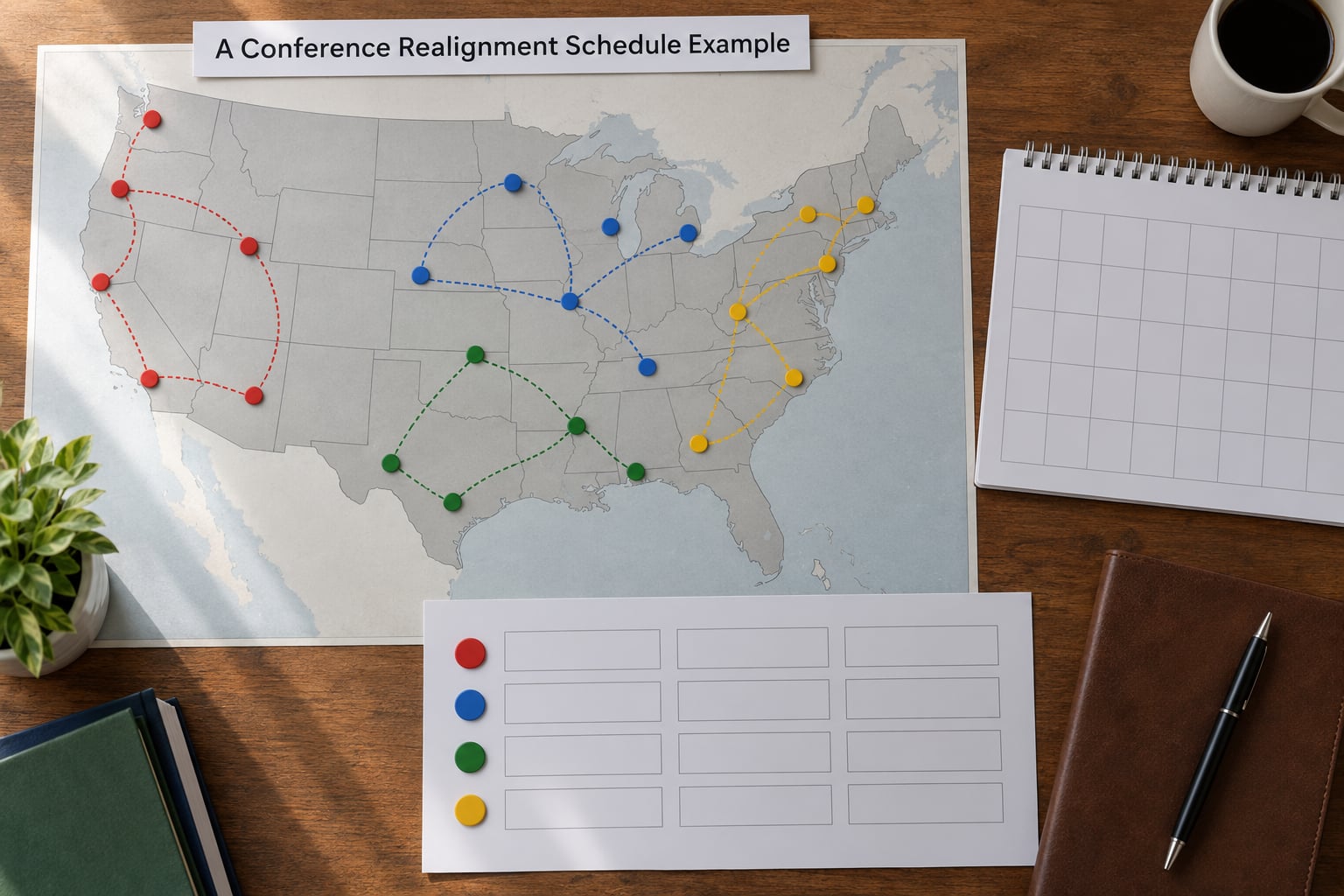
Picture a hypothetical Tucson school leaving a twelve-team West Coast conference and joining a sixteen-team league that plays nine conference games. The whole rebuild fits on one page.
Before the move: eight conference games inside the old league, including a short drive to the state’s other flagship school, plus four nonconference dates. Three of those four were protected in-conference rivalries that had been on the calendar since the 1980s. Two nonconference games sat in the same time zone.
Year one after the move: the eight conference games are gone and replaced by nine new ones, most in the Mountain West and Plains states. The old in-state rival is now a conference game too, since it made the same move, which is the rare case where a rivalry gets saved by a relocation rather than a negotiation. The three long-standing nonconference games have to be re-negotiated, and one of them is kept as a nonconference game at a neutral site. The other two are replaced by opponents in the new region, chosen partly because they play in the same September window.
Steady state, roughly three years out: the division rotation has produced four permanent-ish opponents, and the rest of the nine-game rotation cycles through the rest of the league. The nonconference dates hold two early-season games against the new regional powers and one open date that the athletic department fills with a home game, a bowl game, or an opponent chosen because of travel cost rather than football merit.
Compare that to what would have happened without the move, and the trade is easy to see. The old schedule was cheaper, closer, and full of games the fanbase had a stake in. The new one is more valuable to the school, more competitive, and far less local. Both things are true at once, which is why realignment arguments never really resolve.
The same logic applies in reverse across the map. A school that leaves loses money if its old conference’s television value falls with it. Two well-known programs leaving together can leave a conference with a smaller contract, which weakens everyone who stayed, which is exactly what happened to the teams left behind in the former Big East and the collapsed Pac-12 footprint.
How Realignment Affects the College Football Playoff
The playoff used to reward winning almost mechanically. Now it does not, and realignment is the reason.
The current twelve-team format awards eight automatic bids and four at-large selections, with the highest-ranked Group of Six champion guaranteed a place. That guarantee is the single biggest competitive reason for a mid-major program to join or rebuild a conference, because it turns a strong regular season into a playoff berth without a committee argument.
Automatic bids concentrate in two directions: only the two largest conferences can produce two automatic-qualifying teams, because only those leagues have enough members to run a meaningful championship game and leave a runner-up still inside the top ten. A reorganization that turns a twelve-team league into a sixteen-team league can put that league in contention for a second automatic bid. A reconfiguration that shrinks a league, or that makes its championship less meaningful, puts the two-bid path out of reach.
Conference championship structure matters too. When a championship excludes several teams, those programs fall back into at-large consideration, where the committee reads their schedules more skeptically. Schedules built for a division title are not automatically built for national profile, and moving conferences resets that profile.
Rematch rules tighten the whole picture. The playoff has historically limited first-round and quarterfinal rematches, including a restriction on pairing two teams that met in their own conference championship. Schedulers negotiate around those rules, so a realignment deal sometimes takes years to fully work out because a promised rivalry game could block a team from a playoff matchup.
Finally, strength of schedule is a moving target. The committee evaluates opponents relative to their conference. A team that wins nine games against opponents the committee now considers strong looks different from a team that did it two years ago, which is why an unproven new schedule gets patience for roughly a season and not much more.
What Can Fans Expect During the Transition?
Schedules are built years ahead, so a move announced today shows up on a calendar years later with gaps in it. The messy period is normal, and it usually looks like this.
Placeholder dates. Announced nonconference games carry TBD opponents, and those TBDs often survive a season or two. Teams are sometimes listed against no one at all in conference play during a transition season.
One-time “unfinished business” games. Two programs that just parted ways frequently sign a two-year or four-year series to keep the rivalry alive while everyone learns the new arrangement.
Back-loaded scheduling. New conferences often stage a debut event early: a nonconference showcase against an opponent chosen for television rather than competition, or a rivalry game pushed into a prime weekend to sell the new league’s identity.
More neutral-site games. Neutral sites are the standard replacement for a home-and-home series when two schools need neutral ground. Expect a few of them in the first seasons of any realignment.
Revisions inside the stated window. Kickoff times and dates get adjusted late more often than they used to, because the league is optimizing television slots for a schedule it has never run before. A 10 a.m. Pacific start on a Saturday is the classic example, and it is almost always a conference opponent from the other side of the country.
Roughly three to five years is when most schedules look settled again. Divisional rotations complete, permanent rivalries have either held or collapsed, and the nonconference dates turn into an annual pattern. Movement at that point is usually small.
Why Does This Matter to Arizona Wildcats Fans?
Arizona left the Pac-12 after the 2023 season, joining the Big 12 alongside Arizona State, Utah and Colorado. For a program whose identity was built on West Coast football, that single decision rearranged more than a calendar.
The Desert Rivalry with Arizona State survived intact, which was the good outcome. Some former Pac-12 fixtures did not: Utah is now a conference opponent with a very different competitive profile, and games against programs the Wildcats played annually out of conference had to be renegotiated or dropped. Utah games that used to be September novelty road trips became the kind of rivalry that requires a real reason to travel.
Travel is the daily adjustment. Tucson to the Mountain West and Plains is manageable; Tucson to the Deep South and the Northeast is a genuine trip. Home kickoff times move to suit eastern audiences, and a September stretch that once meant West Coast football now looks like a Big 12 slate. Fans planning travel budgets had to rebuild their whole season around it.
Recruiting changed in the other direction. The Big 12 footprint reaches Texas, Oklahoma and the central plains, which is territory Arizona had not competed in for the program’s modern history. The trade is fewer traditional in-state battles against Pac-12 schools and many more against Big 12 schools who have plenty of reason to recruit the Tucson area.
The playoff stakes are clearer now too. The Big 12 champion is a serious path back into the field, and the conference’s largest television markets make that championship meaningful. A football program moving from the Pac-12 to the Big 12 in the current era moved from the most volatile path to one of the strongest, and the schedule reflects that shift in its quality and its demands.
For anyone watching from Tucson, the practical lesson is that schedule stability is the rarest thing in college football right now. Announcements come with nine years of consequences, and the scoreboard of who moved and who stayed tells you most of what any program will look like by the late 2020s.
Frequently Asked Questions
How are college football teams divided into conferences?
NCAA Division I FBS schools belong to conferences, and those conferences set the number of guaranteed league games each season, usually eight or nine. Conferences also decide divisional alignment, championship game format, and automatic playoff qualifying spots. Membership is entirely voluntary. A school can petition to join another conference, and its current conference can decline the request, which is why grants of rights and exit fees exist.
Why do colleges change conferences?
Media rights value is the dominant reason. A school earns more when it shares a television contract with stronger programs and larger television markets, so a conference that loses its best draw becomes hard to afford. Conferences also chase automatic playoff qualifying spots, and individual schools chase recruiting territory and better postseason access. Geography and tradition rarely outrank those pressures now.
What happens to traditional rivalries when a team realigns?
Usually the rivalry survives as a nonconference game for a few years, then depends on geography and television. When two schools share a new conference, the rivalry is saved outright. When one leaves and stays behind, conferences often negotiate a two-year or four-year home-and-home series to keep the games on the calendar. If the two schools are far apart and neither gains much, the series quietly dies.
How does conference realignment affect the College Football Playoff?
It changes both automatic bids and how the committee reads your schedule. Leagues large enough to run a meaningful championship game can produce two automatic qualifying teams; smaller ones cannot. The highest-ranked Group of Six champion also gets a guaranteed berth, which gives mid-major programs a strong reason to invest in a conference rebuild. Rematch rules also constrain which games are worth scheduling.
How long does it take for a conference schedule to settle after realignment?
Three to five years is the usual window. Divisions get redrawn in the first season, permanent rivalries are declared and then tested, and the division rotation needs several cycles before every team knows its full set of annual opponents. Until then, schedules carry placeholder dates, one-time rivalry games, and neutral-site games meant to fill gaps the move opened.
Does realignment make a team’s schedule harder or easier?
It depends on the move. Leaving a strong conference for a weaker one usually makes the schedule easier and lowers the ceiling on playoff access. Joining a strong conference does the reverse. Schedulers also balance travel, television windows, and division rotation, so opponents are not always selected purely by competitive balance. Cross-country travel and unfamiliar opponents add difficulty that never shows up in a record.
What It Comes Down To
Watch the divisions, not the headline. The conference name in the announcement tells you almost nothing about your Saturdays; the divisional redraw and the rotation model tell you almost everything. When a realignment is announced, find the two divisions, count the annual opponents inside each one, and check which of your old rivalries made the nonconference slate. That is the schedule you will actually live with for the next four years.