Here is how rivalry week affects recruiting in short: four channels. It concentrates in-state attention between two programs that want the same players, it puts a stadium full of high-profile recruits in the room, it hands coaches a very visible win-or-loss signal about trajectory, and it lands close enough to the December early signing period that deadlines start to bite. None of that creates a commitment by itself.
That distinction matters, because “recruiting” gets used loosely online. A coach texting a recruit during rivalry week is activity. A scholarship offer is a decision. An official visit is a scheduling event. A signed letter of intent is a binding move, and the window to make it is narrower than most fans realize.
What follows is the mechanics, in the order they usually happen: the pressure, the visibility, the timing, then what each side actually does with it.
Table of Contents
- How Rivalry Week Influences College Recruiting
- Recruiting Effects of Rivalry Week at a Glance
- How Competitive Pressure Changes Recruit Conversations
- How Visibility and Game Context Shape Recruiter Attention
- Why Rivalry Week Can Affect Offer and Visit Timing
- What It Means for Recruits, Families, and Coaches
- How Coaches Can Recruit Well During Rivalry Week
- How to Tell Whether Rivalry Week Actually Changes Recruiting
- Frequently Asked Questions
How Rivalry Week Influences College Recruiting
How rivalry week affects recruiting is mostly a question of compression. Coaches who would otherwise touch a recruit once every few weeks suddenly have a reason to talk, because the same in-state prospect is now being courted by the other school. Families feel it because the decision window is closing. Fans feel it because every local commitment now reads as a scoreboard update.
Three things do not change, though. Rivalry week does not create a scholarship offer by itself, it does not reset the dead period, and it does not override a recruit’s existing commitment. A coach still cannot do anything on the field that the calendar forbids.
Recruiting Effects of Rivalry Week at a Glance
| Area | What changes during rivalry week | Who feels it most |
|---|---|---|
| Recruiting pressure | Two programs compete for the same regional prospects instead of recruiting in isolation | Coaches and high school coaches |
| Program visibility | National and local attention concentrates on a handful of games | Coaches pitching distant prospects |
| Coach contact | Frequency and directness of messages both increase | Recruits and families |
| Offer timing | Coaches reassess depth charts and sometimes move earlier | Uncommitted recruits near a deadline |
| Family attention | Homes fill with opinions, including from people outside the household | Families of uncommitted recruits |
| Decision confidence | Noise rises; some families wait for a result, others commit harder because of it | Anyone holding multiple offers |
Read the table as a pattern, not a guarantee. Every row describes pressure. Only some rows produce movement.
How Competitive Pressure Changes Recruit Conversations
The first change is cadence. When a program knows its in-state rival is actively recruiting a player, the ordinary schedule of contact breaks down. Calls come on days that used to be quiet. Text threads get answered the same evening. A recruiting coach on a recruiting board described it as recruiting in waves, where the goal is to keep the board deep until players eliminate themselves. Rivalry week is where that pressure peaks.
The second change is specificity. A coach with nothing to prove pitches the general case: playing time, development, campus, the conference. A coach trying to hold off a rival talks about a specific role, a specific position on the depth chart and a specific date when the offer might come.
The third change is pressure on the family, which is where things get uncomfortable. Fans in comment sections and parents of other players will happily tell a recruit what to do during that week. That is not the same as coaching, and it is worth ignoring.
How Visibility and Game Context Shape Recruiter Attention
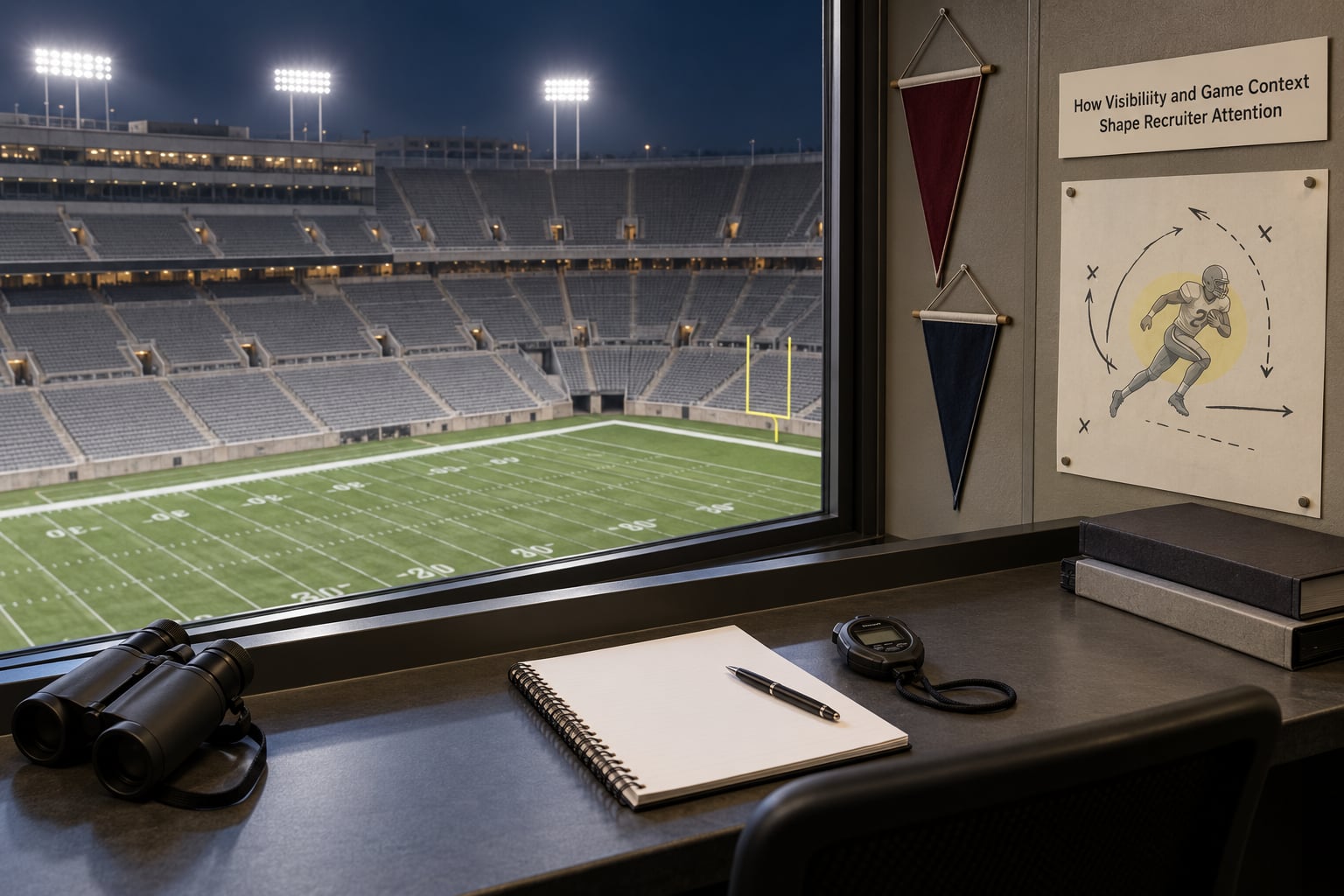
Rivalry week hands coaches an argument they cannot build any other way: the season is happening in front of everyone right now. A coach can describe a program’s trajectory for months, but a ranked, watched game compresses the message into one weekend.
It also puts recruits in the building, which is the underrated part. A 247Sports report from a Michigan State rivalry game described recruits in attendance, including committed players from the 2026 class and high-profile targets from the 2027 and 2028 classes, reacting to the atmosphere and to how staff treated them. The report noted that the impression landed even though the game was a loss.
That is the useful distinction. Atmosphere, hospitality and staff authenticity survive a bad result more often than coaches and fans assume. Media attention, however, is a spike, not a pipeline. A crowded press box does not convert into a commitment by December.
Why Rivalry Week Can Affect Offer and Visit Timing
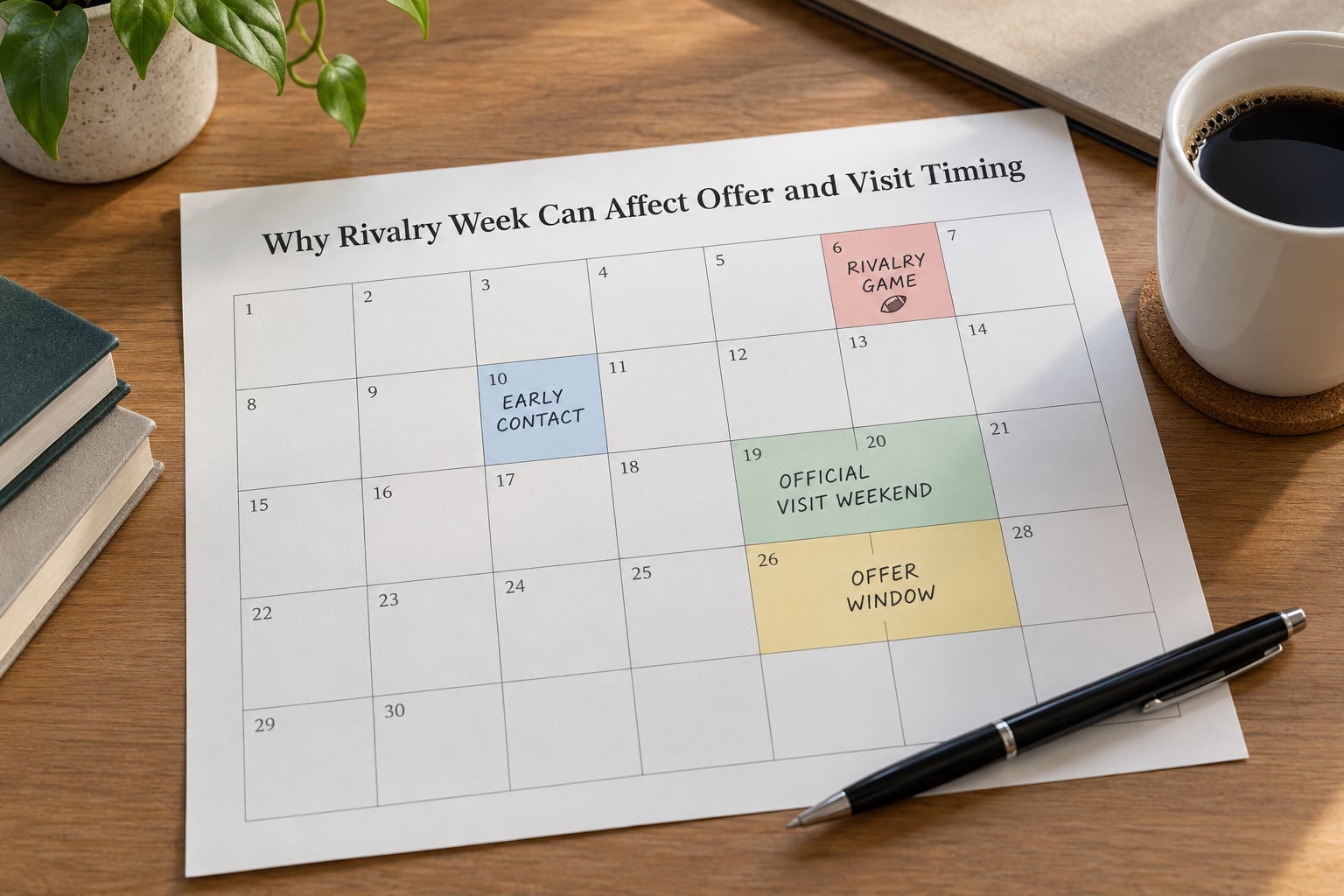
Late-season games force a coaching staff to look at its own roster instead of a depth chart on a whiteboard. A running back who had three carries in October has a different outlook when the starter is a senior with a bad week. That internal conversation is what moves some staffs to make offers earlier, ask for earlier visits, or add deadline language to a conversation that was previously open-ended.
Common scenarios look like this. A coach who planned to offer after a December game moves the offer up. A recruit already scheduled for an unofficial visit gets invited to an official one. A family that was leaning toward one school gets a visit date at the other. A decommitment gets filed within a day or two of the result.
None of these are rules. They are reactions, and they vary by program, by staff and by year. What is not a reaction is the calendar itself. Rivalry week sits in the recruiting service period, when coaches may communicate with prospects on their list, but it does not extend the early signing period or move National Signing Day.
What It Means for Recruits, Families, and Coaches
For the recruit
A rivalry week in your own state is a recruiting event whether you treat it as one or not. If you are uncommitted and local, expect more contact and expect to be asked for a timeline. If you are committed, the main risk is a decommitment decision made in a hurry.
For the family
Families compare programs during rivalry week in a way they rarely do in October. It is a useful time to re-check the practical details: what the offer actually covers, what the roster situation at the position looks like, and what happens to the offer if the athlete changes direction later.
For the coaching staff
Staffs get a short window to make a measurable impression on undecided prospects and a harder job keeping committed players from drifting. The recruiting board is deeper than the depth chart, and a rivalry week is when the difference shows.
How Coaches Can Recruit Well During Rivalry Week
- Use the rivalry as context, not as leverage. “We play them Saturday” is a reason to talk. It is not a reason to threaten.
- Do not manufacture urgency that does not exist. A deadline the staff cannot back up costs more than the commitment it wins.
- Explain the timeline in plain language. When the next contact period opens, when the offer decision will be made, what a visit looks like.
- Confirm offer details in writing. The terms people repeat at a kitchen table are often not the terms on the letter.
- Keep the long-term fit in front. A recruit who fits the roster for four years is worth more than one flipped on a single Saturday.
- Separate atmosphere from performance. The environment is part of the pitch; it is not a substitute for one.
How to Tell Whether Rivalry Week Actually Changes Recruiting
Look for behavior, not volume. A program that wins on Saturday and sends twelve celebratory tweets has not necessarily moved anything. A program that changes its contact pattern has.
- Increased direct contact. Phone calls that used to be monthly become weekly, from the head coach rather than only the recruiting staff.
- Earlier visits. Unofficial visits convert to official ones, or get scheduled sooner than the athlete expected.
- Roster-specific messaging. The pitch starts naming a position, a starter and a timeline instead of talking about the program in general.
- Deadline language. “We need to decide before signing day” appears in a conversation that had no deadline a week earlier.
- De-commitments with dates attached. A public decommitment the day after a result is a signal about perception, not only about fit.
- Schedule changes. When a rivalry moves, gets neutralized or disappears, the annual recruiting showcase goes with it.
None of these prove a change happened. Combine two or three of them before drawing a conclusion.
Frequently Asked Questions
What is a rivalry week?
Rivalry week is the calendar stretch, usually in November, when a conference’s most storied head-to-head games are played. For recruiting it matters because these are the games that draw the largest crowds, the most media attention and the most in-state recruits to the stadium. Late in the season it also lands directly before the December early signing period, so the pressure to decide rises quickly.
Does winning a rivalry game help recruiting?
Sometimes, in specific places. A win in a shared-state rivalry can reinforce a program’s claim on local recruits, and a strong performance gives coaches a credible trajectory story. But most commitment decisions are made over months, not weekends. Atmosphere and hospitality often move a recruit’s impression more than the final score does.
Why do recruits decommit after a rivalry loss?
Usually a loss is a symptom, not the cause. A defeat can make program trajectory look shaky to a family that was already undecided, and fans on social media turn that into pressure within hours. De-commitments tend to cluster in the days right after a high-profile loss, which makes the timing look causal when the underlying doubt was older.
Can a coach offer a scholarship during rivalry week?
Usually yes, because rivalry week falls inside the recruiting service period when communication with prospects on a coach’s list is allowed. What the calendar does not change is the signing window. An early signing period in December and National Signing Day in February are fixed, so a late-November offer still has to fit inside one of those windows.
The honest answer to how rivalry week affects recruiting is that it changes pressure, not outcomes. Watch for contact cadence, visit timing, roster-specific pitches and de-commitments, and treat crowd size and highlight reels as atmosphere rather than evidence. One Saturday cannot sign anybody.