College football traditions start when a small group of students repeats the same gameday ritual for two or three seasons straight, until other people expect it. That is the honest answer to how college football traditions start on campus, and the process is more consistent than most fans expect. The idea is almost never handed down from the athletic department. It begins as a chant, a costume, a pregame gathering or an entrance gag in a student section, gains a shape and a cue, gets picked up by the band and the spirit program, and finally becomes institutional habit that survives a losing season.
That is the short version. What follows is the longer one: how you spot a ritual in its first season, what each group on campus contributes, what the game-day calendar does for a growing custom, and what students should do if they want to start one themselves without annoying the alumni who have been coming for thirty years.
It helps to know that a tradition is not the same thing as a novelty. Most gameday ideas die in year one, and the ones that survive do so for predictable reasons. Those reasons are the subject of this guide.
Table of Contents
- What Starts a College Football Tradition on Campus
- The First Signs of a Campus Ritual
- How Student Groups Turn Ideas Into Traditions
- Why Game Days Give Traditions Room to Grow
- How a Local Custom Becomes Campus-Wide
- What Makes a Tradition Last Across Generations
- How Traditions Change Without Losing Their Identity
- How to Start a Tradition on Your Campus Responsibly
- Frequently Asked Questions
- Who usually starts a college football tradition?
- How long does it take for a campus ritual to become a tradition?
- Can a university or athletic department create a new football tradition?
- Why do some college football traditions disappear over time?
- How can fans preserve authentic traditions as game day changes?
- The First Step in Building a Lasting Tradition
What Starts a College Football Tradition on Campus
A tradition is a ritual that three or more graduating classes have accepted as part of school identity. That threshold is the whole game. Anything before it is a ritual, and the difference between the two is purely repetition across time and people.
Four things get confused with traditions, so it is worth separating them.
- A stunt happens once. A flash mob at a homecoming game is a stunt until somebody tries it the following season.
- A custom is shared but shallow. A local bar giving a discount to anyone wearing a hat is a custom; it is not tied to the field, the section, or a specific moment.
- A promotion is a sponsored activation with an end date. Some promotions feel like traditions for a few years, but the brand decides when it stops.
- A tradition is owned by the people in the stands, has a repeatable shape, and carries meaning that the current group of students could explain without being prompted.
Schools care about the difference because atmosphere is hard to buy. A stadium that is loud on a losing Saturday is the product of behavior, not capital projects, and that behavior is exactly what traditions organize. It is also a visible recruiting and retention asset, which is why athletic departments and universities pay attention once a student idea starts working.
The First Signs of a Campus Ritual
Every tradition began as something slightly awkward. A chant nobody had heard. A costume assembled from a thrift store. A group that walked to the tailgate a certain way and simply kept doing it. The early stage is always a little embarrassing, which is a good sign.
Here is what an origin usually looks like in practice. One person or a small group does something on its own, unprompted by administration. A handful of people copy it the next week. The thing acquires a cue, which is usually music, a hand signal, or a specific moment in the game. The ritual gets a shape rather than just a concept. The people doing it can say what it means.
Five signs tell you a ritual has a chance of outlasting its originators:
- It repeats without promotion. Nobody is announcing it, and it still happens.
- It is tied to a specific moment: the third quarter, the team entrance, the walk back from a road win, the last song.
- New students join it after hearing about it once, rather than needing instructions.
- It survives an ugly moment, such as a big loss or a rain delay, when people could have quietly dropped it.
- Someone outside the original group can explain the meaning and get it right.
If a ritual only works when its founders are running it, it is a habit, not a tradition yet. The founders graduate in May, which is the first real test.
How Student Groups Turn Ideas Into Traditions
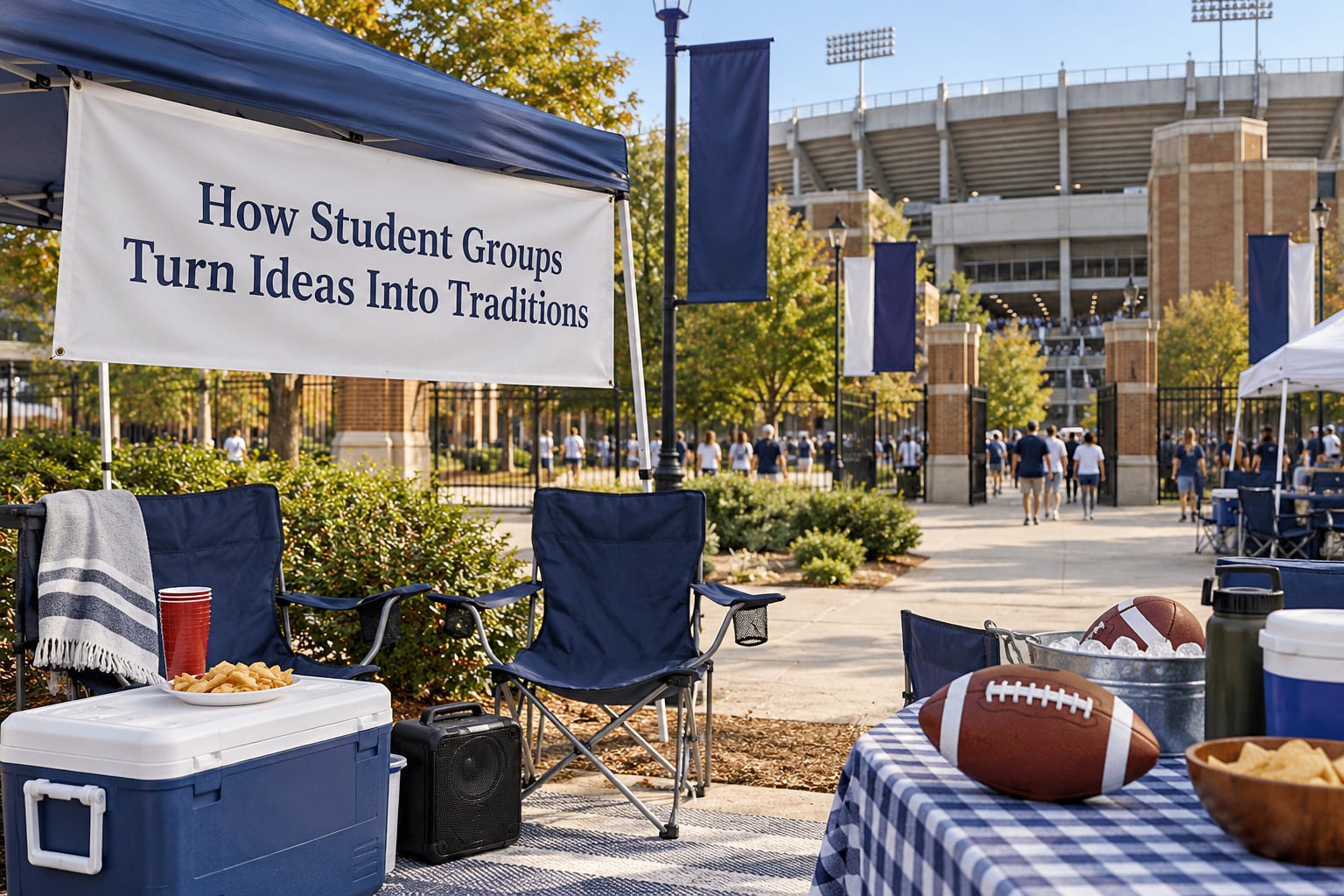
Very few traditions are invented alone. They get assembled by a handful of groups who each own a piece, and if you want to understand how college football traditions start on campus, you have to know who those groups are and what they control.
Student organizations and spirit programs supply the initial idea and the recurring leadership. Spirit program directors, student government and the student section board are where a ritual gets a budget, a calendar slot and a group of people who are still around in November.
The marching band controls a lot more than most students realize. A new pregame entrance, a fight song arrangement or a drum feature needs rehearsal time, a director’s approval, and a chart of what the band can actually play at a given moment in a game. Bands that say yes early tend to make traditions happen; bands that find out in September tend to kill them.
The athletic department holds the schedule. Pregame time, tunnel access, senior night, homecoming, bowl submissions and away travel all run through it. It also holds the budget, and it holds the liability question, which is why a student idea usually needs a staff sponsor before it can scale.
Student media matters more than people expect. A student newspaper feature or a well-made video is often what turns a section in one stadium into a story the whole campus repeats, and what convinces a coach or a donor that the idea has legs.
Alumni groups come in late on purpose. Once a ritual has survived a few seasons, an alumni chapter or a booster club is the group that turns “we did this at school” into “we do this at the stadium now.”
Getting the logistics right is where most new customs quietly fail. The honest answer to how college football traditions start is that idea generation is cheap and repetition is expensive, so most of the work sits in scheduling, rehearsal time, and who owns the budget line.
On message boards, fans keep asking the same practical question: who approves this, who funds it, and when can the band rehearse it. There is no single answer that works everywhere, but the path is always the same. Start at the student level, find one staff member who will sponsor it, get it into the athletic department’s calendar, and treat each of those as a step rather than a formality.
Why Game Days Give Traditions Room to Grow
Traditions need occasions. The football calendar is an unusually dense one, and every entry on it is a free opportunity to run a ritual again in front of a crowd that is already paying attention.
The season opener sets the tone and usually has the loosest atmosphere of the year, which makes it a good testing ground. Homecoming week is the strongest single test of a campus-wide ritual, because nonstudent families and alumni are watching. Rivalry games supply the emotional stakes that make new customs feel earned. Senior night and family first game bring multi-generational audiences, which is where a tradition starts feeling inherited rather than invented.
A playoff or bowl run compresses everything. A tradition that only gets run at home games can look thin in a postseason run, and a tradition that travels to a conference championship or a neutral-site bowl becomes part of the program’s public face. Conference championships are the test of portability, because a visiting student section is a small, loud minority.
Camp and the first day of practice are quieter and less covered, but they are where a lot of rituals actually originate. A tradition invented in the first week of August has a full season ahead of it to become habit. One invented in November has no runway at all.
How a Local Custom Becomes Campus-Wide
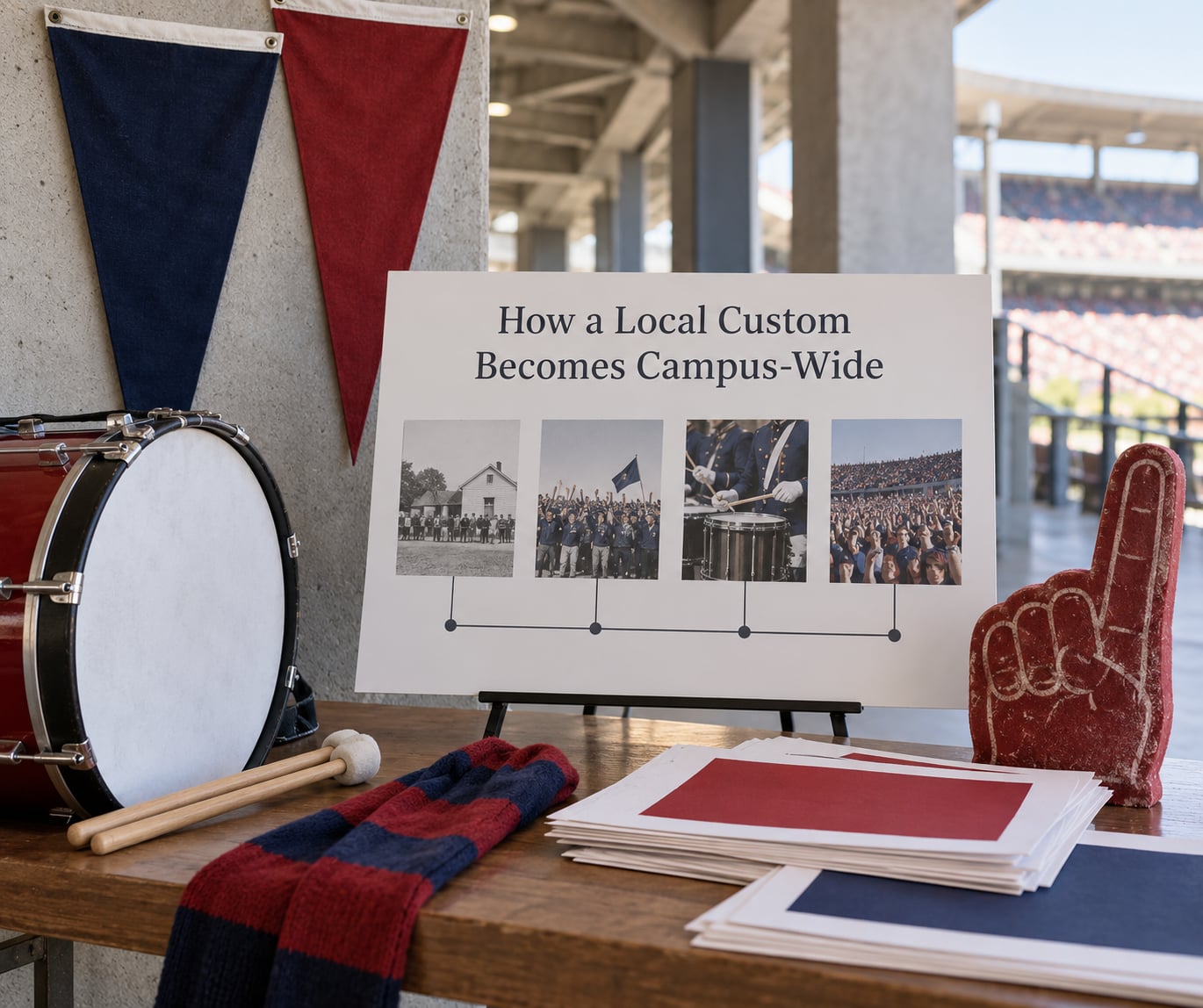
Adoption is gradual and mostly bottom-up. The usual path runs through seven stages, and a tradition that skips a stage usually does not last.
How college football traditions start on campus: the seven stages
- The spark. One person or a small group does something small and unrehearsed.
- The student-section pilot. It runs for a few weeks and other students join in.
- The first full-season run. It survives to the end of the season, which is the minimum real test.
- A second and third class repeats it. This is the actual threshold; before this it is a habit.
- Institutional adoption. The athletic department schedules it, the band rehearses it, and staff own part of it.
- Portability. The student section takes it to road games, bowls and neutral sites.
- Lock-in. It survives a losing season, a coaching change, and gets handed to the next class intact.
Not every tradition travels the same route, and the origin type shapes what happens next. The differences matter more than most fans expect, and no competitor on this topic explains them.
How the origin type changes the outcome
| Origin type | Example | Typical outcome |
|---|---|---|
| Program or staff-invented | Live mascot releases, a coach’s entrance signature | Strong resources, weak ownership; fades when the person leaves |
| Student-invented | A student section’s call-and-response chant built season by season | Strongest ownership, slowest official adoption |
| Borrowed from another school | Entrance-music cues spreading across conferences | Fast adoption, low local meaning unless customized |
| Borrowed from local culture | Regional call-and-response shaped into a game-day ritual | Deep meaning, hard to export, often long-lived |
The pattern is consistent. Student-invented customs take the longest to become official and last the longest afterward, because when the athletic department finally adopts something the section already owns, it is codifying a habit rather than imposing one.
Word of mouth does the rest. A new student hears about the ritual in the orientation, the housing meeting, or from an upperclassman, and repeats it without being persuaded. The three or four strongest carriers of a tradition are usually the student media account, the spirit program, the band, and one or two loud and consistent student leaders. When a tradition outlives all four, it is safe.
What Makes a Tradition Last Across Generations
Durability is mostly about documentation and repetition. The ritual itself is the easy part.
Someone has to write the origin down. Oral history is fragile, and an origin story with a date, a name, and a place is worth more than five seasons of repetition with no record. A student journalist writing the 400-word version of why a chant exists is doing more for a tradition’s survival than a full season of loud repetition, because the story travels to alumni and to the freshmen who were not there.
Execution has to be steady. A tradition that appears at two home games a year and misses the rivalry game is a nice idea, not an institution. The calendar has to be predictable enough that people plan around it, which is why senior night and homecoming are such reliable hosts for new customs.
Institutional support is what protects a tradition during a bad stretch. A ritual with a staff sponsor and a budget line survives a 4-8 season. One that exists only because three seniors show up survives a winning season and nothing else.
The hardest test is a losing one. Traditions are behavior, and behavior responds to results. When the team is bad, the student section shrinks, the energy drops, and the easiest thing is to skip the ritual. The schools that keep theirs running treat game day as a separate product from the win-loss record, which is a decision, not an accident.
Then there is pushback, and it deserves an honest paragraph. In a long thread on r/CFB about whether schools should start new traditions, the recurring split is between older fans who see an invention as a threat to something they love and younger fans who argue that a place where students can shape their school and traditions, not just blindly abide by them, is worth protecting. Both sides are right about their own value. A tradition that asks veterans to give something up usually dies, and a school that refuses to let students add anything eventually loses the section.
The workable middle is additive. Add a new ritual next to the old one rather than in place of it, and let the veterans keep their thing untouched. Traditions with real symbolic backstories outlast shallow ones for a predictable reason: people protect what they can explain. Vanderbilt’s anchor, tied to the school’s naval namesake, is still being explained to freshmen sixty years later. A chant with no story behind it needs a louder section to survive.
How Traditions Change Without Losing Their Identity
Traditions are allowed to edit themselves. The test for a legitimate change is whether the meaning and the central symbol survive it.
Changing the music while the timing stays fixed is a normal adaptation. Bands add arrangements, drop instruments, or shorten an entrance to fit a stricter start time, and the ritual still reads the same to a fan in the stands.
Expanding participation is usually an improvement. A costume tradition that starts as a senior tradition and opens to the whole section a few years later has changed scale, not identity.
Adding a purpose is the healthiest edit. A chant that raises money for a scholarship program or a walkout that collects donations for a local food bank gives an existing ritual a second reason to exist in years when the football is not good.
Moving formats is riskier but workable. A tradition that lived entirely in the student section can add a video board element or a social media version, as long as the in-stadium version stays the real one. A ritual that only works on a screen is a promotion.
What breaks identity is changing the symbol, the meaning, or the moment. A costume tradition that swaps its central object for a new logo is a different tradition wearing the same name. So is a pregame ritual that moves to a different point in the game day, because the timing is most of what the crowd remembers.
Some things also deserve a hard look as cohorts change. Imagery that references Native or Confederate symbols now gets formal review at many schools, and chants built around alcohol references are a common source of friction when a campus tries to recruit. Both are cases where a tradition’s identity has to be renegotiated rather than preserved intact, and doing it early is better than being asked to do it after a complaint.
How to Start a Tradition on Your Campus Responsibly
If you are a student who wants to start something, this is a framework, not a formula. The point is to build something that works for people who were not there when you invented it.
Start from a shared need. The strongest origin stories begin with a complaint the section already agrees on. One program on a message board said plainly that the motivation for a new entrance was atmosphere, not novelty, because their stadium was not the loudest. That is a real need with a measurable outcome.
Pick something repeatable. A gesture tied to a moment in the game can be executed on a schedule. An idea that depends on a good performance or a perfect setup will not survive October.
Test it for one full season without announcing it. If you have to advertise every week, it is not organic yet. Let it be discovered.
Find one staff sponsor. One person in the athletic department, student life, or band who will own it with you is worth more than a committee. Ask early about the calendar, the budget, and the rehearsal time, because those three constraints decide whether it can happen.
Document the origin while you remember it right. Write down who started it, when, and why. This is the single cheapest thing you can do for its survival.
Invite rather than pressure. Handouts at orientation, an upperclassman explaining it once to the section, and a spot where newcomers can learn it. Traditions that feel mandatory from above stay small.
A few things to avoid. Do not take a chant, fight song, or entrance cue from another school without giving it local meaning; borrowed rituals without a local reason are the first to be dropped when a new coach arrives. Check that anything you want printed or branded is cleared, since university marks and licensing are not free to use. Plan for accessibility, because a ritual that physically excludes part of the section is a bad tradition before it is a tradition. And keep the alcohol reference out of anything you want to be official; several schools have moved toward alcohol-free alternatives in the student section for that reason.
The most common year-one mistakes are all the same mistake: treating a first successful execution as the finish line. Announcing too early, skipping the second season, letting the founders graduate without a handoff, and not writing the origin down. A tradition that is not documented is a tradition that one conversation can end.
Frequently Asked Questions
Who usually starts a college football tradition?
Students almost always start them, usually a single student or a small group inside the student section, a spirit program, or a campus organization. Coaches and athletic departments occasionally seed one, but staff-invented customs generally fade when the person who created them leaves. The exceptions are the rare customs tied to a live mascot, a long-standing regional culture, or a coach’s own signature.
How long does it take for a campus ritual to become a tradition?
Most real traditions need at least three graduating classes, which usually means three to four seasons. A single successful season is not enough, because anyone can run a good game day once. The practical threshold is a second and third class repeating the ritual without the founders organizing it, and full institutional status usually arrives a year or two after that.
Can a university or athletic department create a new football tradition?
Yes, and most schools have. But an administration-created ritual starts with resources rather than ownership, and it tends to fade when the staff member behind it moves on. The ones that last usually begin with students and are later adopted by the athletic department, the band, and the calendar. If a program wants one, starting it as a student pilot first tends to work better.
Why do some college football traditions disappear over time?
The usual reasons are a losing season that shrinks the section, a coaching change that removes its champion, a scheduling cut, or a founder class that graduates without a handoff. Traditions also die when a new one replaces them, when a band or athletic department stops scheduling it, or when nobody wrote down why it existed. Documentation and a staff sponsor are the two strongest protections.
How can fans preserve authentic traditions as game day changes?
Add rather than replace, and keep old rituals on the calendar while new ones get introduced. Document the origin of each tradition with a date, a name, and a reason, so the story survives the people who started it. Make room for new student ideas as additive customs instead of threats, and let traditions adapt in scale, music, and charitable purpose while keeping their central symbol intact.
The First Step in Building a Lasting Tradition
Start with a ritual that answers a real complaint, tie it to a fixed moment in the game day, and give it a full season before you decide anything. Everything after that is repetition, documentation, and finding the one staff member who will own it with you.
That is how college football traditions start on campus, and it is why the ones people still remember are the ones a whole section could explain without being asked.