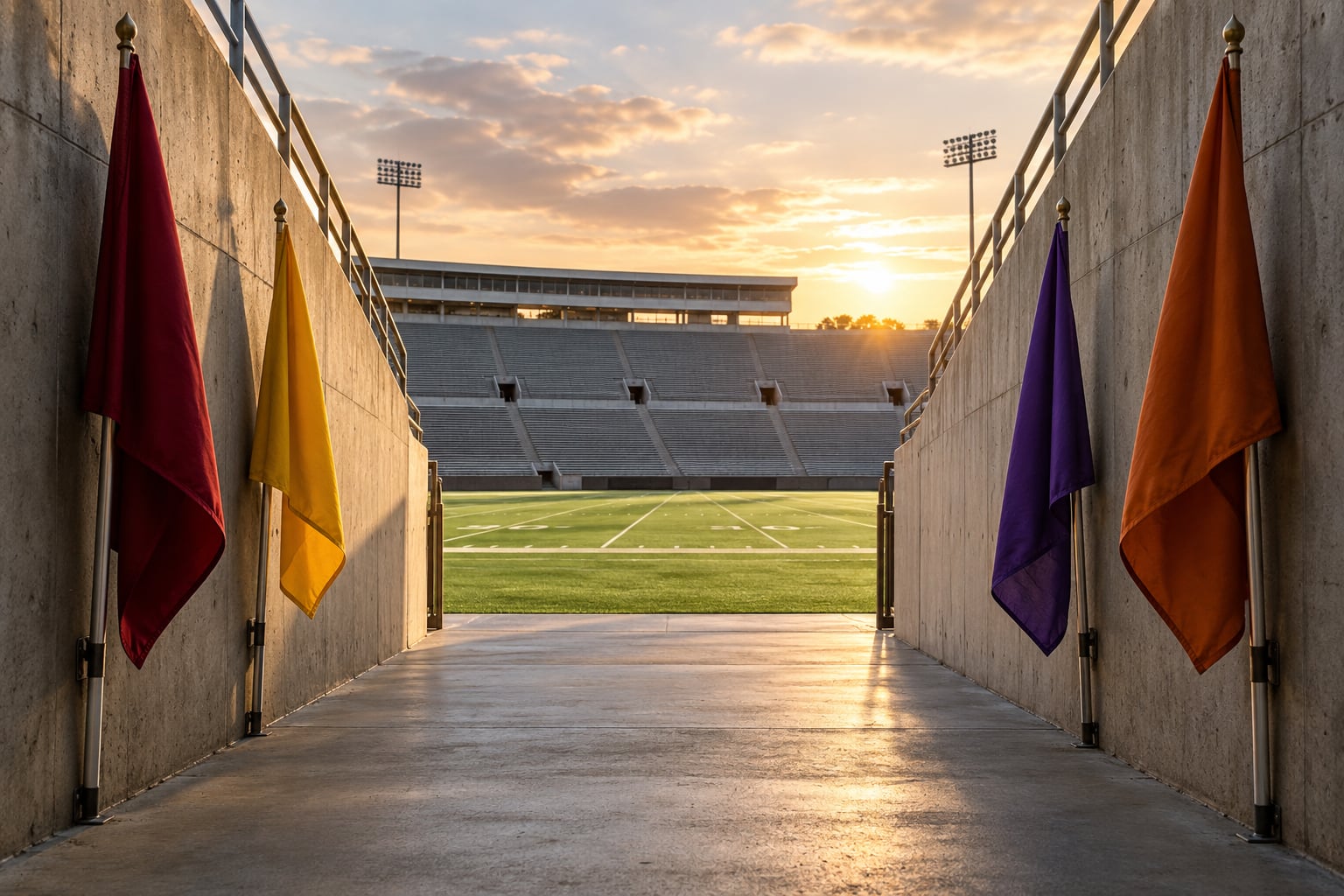
Flags turn a team entrance into something you can see from the upper deck. Schools carry them out of the tunnel to signal unity, to show the school is bigger than one roster, and to hand the crowd a moment to peak before kickoff. These are ceremonial flags carried by players and student groups, not penalty flags.
If you searched your way here through a pile of penalty-flag rules and flag-football news, that collision is worth naming once. A yellow flag is an official’s tool for enforcing a foul. The flag in this article goes the other way: it is walked onto the field before the first snap, held high so the stands can see it, and put away until the next game.
Table of Contents
- Why College Teams Run Out of Tunnels With Flags
- How a Flag-Lined Tunnel Entrance Creates Game-Day Energy
- What do the flags represent at college sports games?
- How Has the Tunnel Entrance Tradition Developed?
- Why do universities keep these traditions?
- Who Carries the Flags During a Team Entrance?
- Are Flag Runouts and Team Traditions the Same Thing?
- What Makes a Great College Team Entrance?
- Frequently Asked Questions
- Conclusion
Why College Teams Run Out of Tunnels With Flags
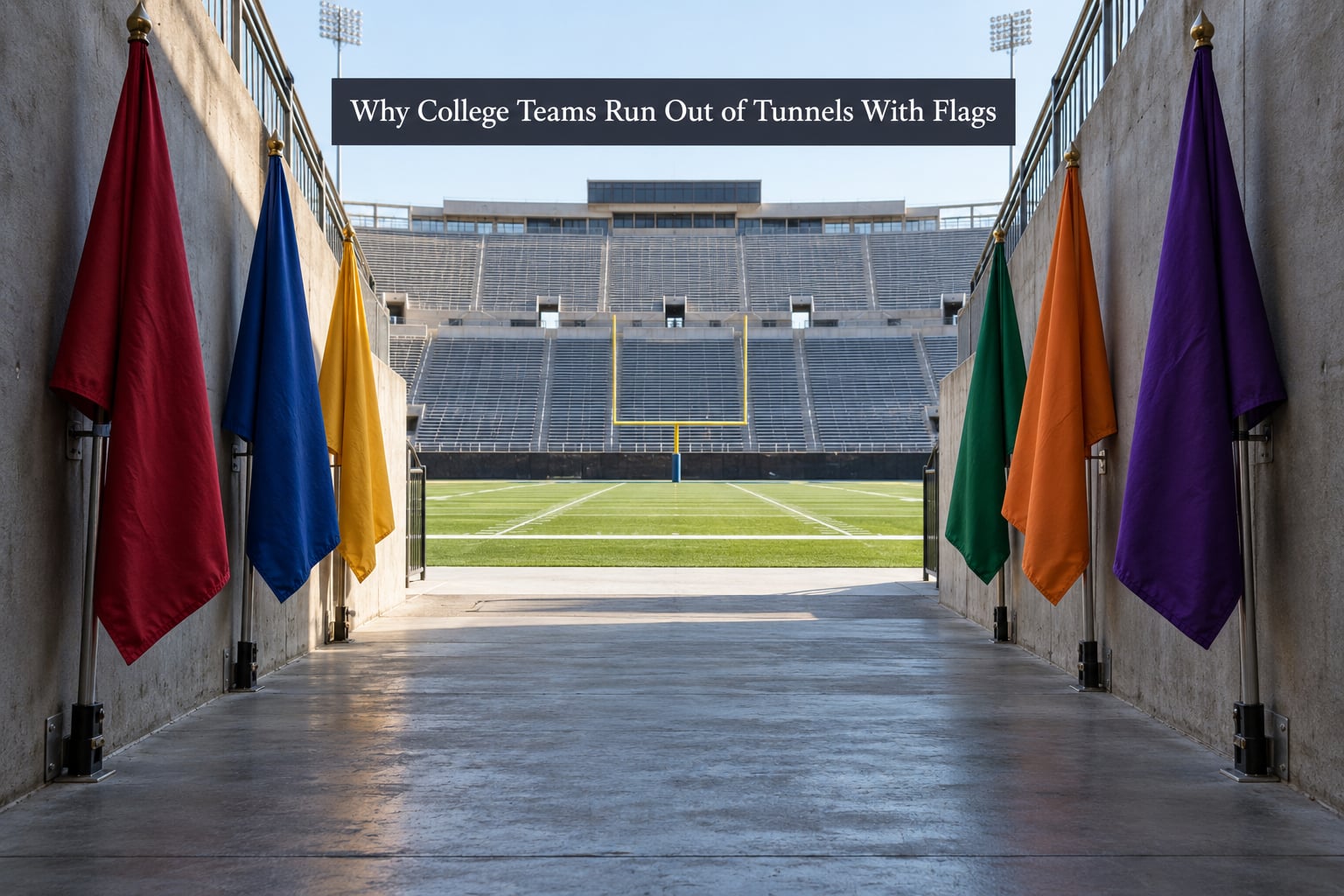
The short answer is that flags are the cheapest, most portable piece of pageantry a program owns. One object, carried by one person, that every person in the stadium can identify from any seat in about two seconds. That makes it unusually good at what an entrance ritual is actually for.
Strip away the noise and five things are going on when a team comes through that tunnel with a flag.
- Shared identity, made physical. Uniforms and helmets identify the eleven players on the field. A flag identifies everybody behind them: the seniors who built the program, the students in the tunnel, the alumni who funded the stadium. A 19-year-old quarterback walking out behind a school flag is doing something a national broadcast cannot show, which is telling the local crowd that this is their team too.
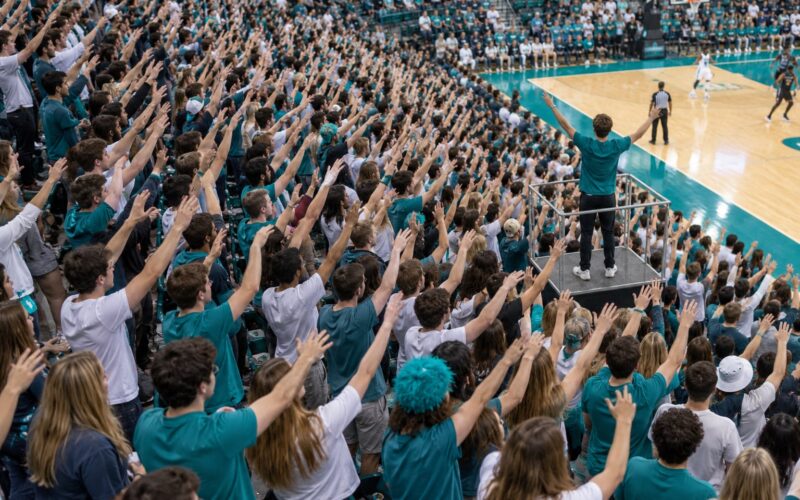
- A hand-off of noise. The stadium is already loud. The entrance is where the volume goes vertical, and a moving object in the crowd’s sightline gives people something to react to rather than just something to hear. The run is short, maybe twenty seconds, but it is the loudest sustained stretch of the pregame.
- A ceremony the players earned. At several schools the flag is not assigned by a randomizer or handed to a manager. It is awarded. That turns a promotional walk into a reward, and gives the returning players something to protect.
- Something an opponent has to walk past. A visiting team enters through the same structure a few minutes later, and it enters after the home flag has already been raised. The context is the point.
- A broadcast moment. A wide shot of a flag, a banner and a team bursting through reads well on television and plays well on a phone. Pageantry that photographs is pageantry that gets renewed.
How a Flag-Lined Tunnel Entrance Creates Game-Day Energy
The sequence is tighter than most people expect, because stadium entrances run on a clock. Kickoff is fixed, the anthem is fixed, the coin toss is fixed, so the ritual has maybe ninety seconds to work.
It usually starts with a cue. A fight song, a chant, or a track the band has drilled for weeks starts inside the video board and inside the bowl. The team is already standing in the tunnel, in a set position, waiting on the coach’s hand or on a horn. That waiting is the buildup. Nothing moves for several seconds, and the crowd reads the pause as imminent.
Then the object appears. Sometimes it is a flag bearer walking out first. Sometimes it is a banner held across the tunnel mouth that gets torn or jumped through. Tennessee’s band has built the Power T since 1965 and opened a lane through it. Michigan’s players and coaches leap to touch the M Club banner on the way out. Nebraska runs the Tunnel Walk, and Texas Tech leads players out under the Masked Rider in a scarlet cape on a live black horse.
Baylor inverts the whole thing. The freshmen in gold jerseys run out first, carrying flags and signs shaped like bear claws, then form a human tunnel the team runs through. Because the tunnel cuts into the middle of the student section at McLane Stadium, the players come out surrounded on both sides instead of emerging into open space.
That reveal is why people remember these moments years later. On the r/CFB subreddit, people still describe the confused moment of looking around trying to work out what was happening before realising it was a planned tradition. The choreography is designed to be one beat behind your understanding.
What do the flags represent at college sports games?
Mostly one of four things: the nation, the state, the school, or the honor itself. Which one shows up depends on what the program wants the crowd to feel.
State and Commonwealth identity. Flagship schools lean into geography as branding. Massachusetts uses the flag of the Commonwealth when its teams take the field, and that positioning as the state’s flagship school is doing real work in the branding. NC State’s flag bearers are a well-documented case: two players are selected each week to carry the American flag and the state flag onto the field, a practice that began under Tom O’Brien in the late 1990s.
Institutional history. At Army, the parachute entrance carries two large flags, one bearing the Black Knight logo and one reading West Point. That is not decoration, it is a service academy explaining what it is in the ten seconds before the game starts.
Commemoration. Boston College carried the American flag out of the tunnel during the seasons its players wore Wounded Warrior uniforms. The same flag that reads as generic on a normal Saturday reads as a promise on a memorial Saturday, which is the whole argument in one object.
Earned honor. Some flags are not symbols of the school at all. They are trophies. Boise State’s coaches award the right to carry the Hammer out of the tunnel to the player who turned in the best performance of the week, per the National Football Foundation’s write-up of the tradition.
Practices differ by stadium and by school, and plenty of programs carry nothing at all. The rule of thumb is that the object has to be specific to that program. One Boston College fan’s argument from 2014 is still the sharpest version of it: a flag that could belong to any team does not separate you from anyone else, so it is not doing the job the tunnel needs it to do.
Why do college football teams run out of tunnels with flags?
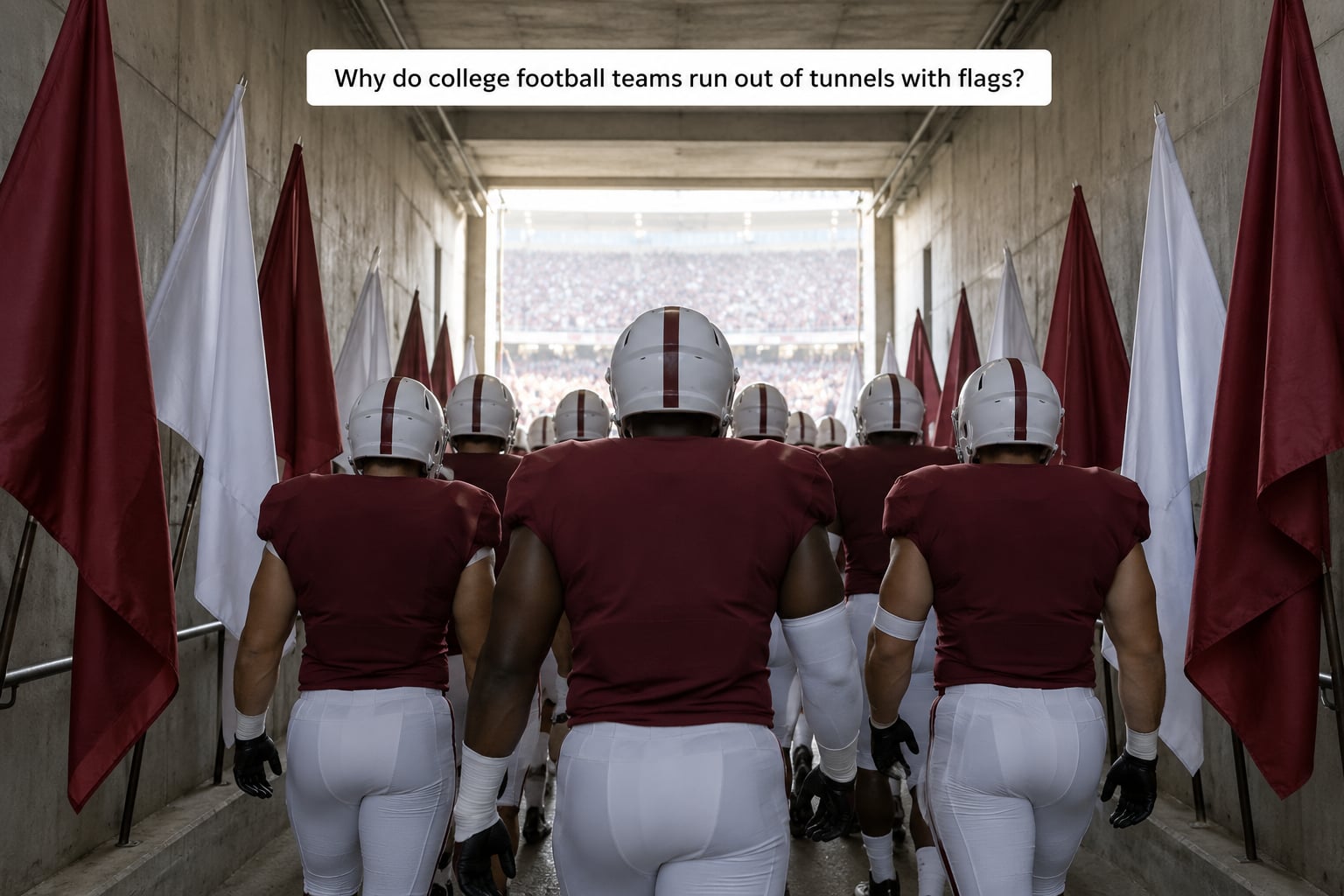
Because in football the tunnel is a hard-edged moment. Basketball players get names read over a PA system while the arena is still warming up. A football team has no such buffer. It goes from a concrete corridor to ninety thousand people in about fifteen seconds, and the team has to arrive as a unit.
Arizona State’s Pat Tillman Tunnel shows how a program can turn that transition itself into the tradition, wrapping the team’s walkout in a named structure that belongs to the school and not to a generic pregame sequence. The Wildcats’ own entrance is a regional example of the same custom, and schools across the Southwest keep it even without a landmark venue to attach it to.
The regional spread is worth noticing. Flags and state identity run heavy in the Southeast, where the Clemson Hill and Howard’s Rock, Florida State’s Osceola and Renegade planting a flaming spear, and South Carolina’s 2001 smoke sequence all lead the team’s arrival. Touched objects dominate the Big Ten and the ACC, from Howard’s Rock to Maryland’s Testudo nose rub and Virginia Tech’s Enter Sandman.
Do college basketball teams also run through tunnels with flags?
Yes, but the scale and the setup are different. Basketball’s version of the ritual is the starting lineup introduction, and flags tend to frame it rather than lead it: a school flag unfurled behind the announcer, an honor banner for a retired number, a championship banner hung before tipoff.
Football’s tunnel entrance is a physical run with a crowd that can hear footsteps. Basketball’s introduction is a 90-second broadcast with the arena already at full volume and a floor you have to be cleared onto. That constraint pushes basketball toward ceremony, where football pushes toward spectacle.
The Baylor case is the exception that proves the point. The running-the-line tradition with flags and signs is the most famous freshman ritual in college sports, and the arc is deliberate: freshmen do it early in the season, then seniors take over in November so the cycle closes. A Dallas News feature put it plainly, the ritual bonds the team to the students and pulls new freshmen into campus life before they have any other reason to feel attached.
How Has the Tunnel Entrance Tradition Developed?
The honest answer is that nobody can point to one origin story, and anyone who tries is usually borrowing someone else’s story. What we can trace is a slow shift in what an entrance is for.
The early version was drill. College athletics borrowed heavily from military formatting, and school colours had a long, tidy history as identifiers long before anybody thought of them as theatre. Pregame ceremonies grew out of that: the anthem, the colours, the band’s set pieces, the homecoming court.
The stadium era changed it. Once the team entered through a structure rather than walking on from the sideline, the entrance became a place where something could be built and broken. A banner goes up and comes down. A letter gets formed and opened. Smoke starts and stops. As venues added video boards, pyro and field lighting, traditions started mixing objects with effects, and the music cue became as important as the flag.
| Tradition | School | What is carried or led | Why it works | Origin |
|---|---|---|---|---|
| Running the Line | Baylor | Freshmen in gold jerseys carry flags and claw signs, then form a human tunnel | Bonds students to the team; a freshman rite of passage that hands off to seniors in November | About 55 years |
| Weekly flag bearers | NC State | Two players carry the American and state flags onto the field | Earned honor plus state pride, re-selected every week | Late 1990s |
| Parachute entrance | Army | Two large flags, the Black Knight logo and West Point | Military heritage stated in ten seconds | Longstanding |
| The Hammer | Boise State | The Hammer is carried out of the tunnel by one player | Awarded to the top performer each week | Longstanding |
| Howard’s Rock and the Hill | Clemson | Players touch a quartzite rock, then run down the Hill | Contact with a relic, then the downhill release | Gifted to Frank Howard in the 1960s |
| The Tarp | North Carolina | Students bang on the tarp the Heels run out through | Fans physically inside the entrance, not watching it | Longstanding |
| Running through the Power T | Tennessee | Band forms a T and opens a lane through it | A gate built by the band; the team runs through a letter | 1965 |
| M Club banner | Michigan | Players and coaches leap to touch the GO BLUE banner | Physical contact with school identity on the way out | Longstanding |
| Tunnel Walk | Nebraska | Team walkout into Memorial Stadium | Crowd volume peaks as the team emerges | Longstanding |
| Masked Rider | Texas Tech | A rider in all black with a scarlet cape on a live black horse | The first live horse used as a lead in college football | About 70 years |
| Ralphie | Colorado | A live buffalo leads the team onto the field | No other school can put a live animal at the front | Longstanding; Ralphie VI debuted in 2021 |
| War Eagle | Auburn | An untethered golden eagle circles and lands at midfield | A living symbol, and the crowd noise that greets it | 20-plus years of eagle flights |
| Osceola and Renegade | Florida State | Osceola plants a flaming spear at midfield | Living-history pageantry, among the sport’s oldest | Longstanding |
| Enter Sandman | Virginia Tech | No flag; the entrance is the song and the jumping crowd | Volume and repetition do the work instead of an object | Longstanding, pre-2009 version |
Read across that table and the pattern is clear. Almost every tradition pairs one specific object with one specific place, and the ones that survive are the ones a visiting fan can explain to a friend the next morning.
Why do universities keep these traditions?
Because rosters turn over and the ritual does not. A coaching staff changes every five or six years, and with name, image and likeness deals plus the transfer portal, the roster can change almost completely inside a single season. The entrance is one of the very few things that stays constant while the people inside it change.
There is also a practical case. These ceremonies are how a school introduces itself to people who have never set foot on the campus, whether that is a recruit on a visit, a student seeing the stadium for the first time, or a television audience that only knows the name.
And there is the alumni check. A banner in the tunnel reminds people who donate that they are part of something continuous. Campus tradition debates get loud, particularly in tradition-ranking threads where fans argue that Florida State should not be near the top and that some schools are rated too high. The arguing is the point, and it only exists because people care.
Who Carries the Flags During a Team Entrance?
Usually players, and usually chosen rather than volunteered. Boise State’s Hammer is the clearest version, awarded by the coaches to the player who produced the best performance. NC State’s flag bearers are selected week to week to carry the American and state flags. Both make the flag a reward instead of a chore.
At schools with strong student sections, students carry the flags. Baylor’s freshmen run out with flags and claw signs before the team does. Elsewhere the carriers might be cheerleaders, color guard members, a student government officer, an alumni club, or a service organization. Army’s parachute entrance pairs the flags with ceremonial participants and paratroopers.
Every school sets its own rules, and the selection method usually says more about the program than the flag does. An elected or posted-selection ritual points to student government energy. A coaches’-award ritual points to accountability. A fixed ceremonial role points to tradition over novelty.
Are Flag Runouts and Team Traditions the Same Thing?
No. They get described in the same breath, which is why search results mix them together.
A team entrance happens once before kickoff, from the locker room tunnel to the field, and it is choreographed in advance. A runout happens after a scoring play, usually in the end zone, and it is improvised or lightly scripted.
Flags appear in both. NC State’s flag bearers walk the American and state flags onto the field pregame. Some schools also send a flag into the end zone after a score. Same objects, completely different job: one establishes who the team is before the game starts, the other celebrates something that already happened.
What Makes a Great College Team Entrance?
Look for a few things when you are in the stands. Is the object specific to that school, or could it belong to anyone? Specific usually wins, which is why Howard’s Rock travels and a generic banner does not.
Is the ritual tied to the venue? Nebraska’s Tunnel Walk only works because the crowd is stacked around that one door. Baylor’s human tunnel only works because it opens into the student section.
Does the crowd participate, or watch? UNC’s Tarp puts fans inside the entrance. A scripted smoke-and-pyro routine asks them to look. Participation is the more durable version.
Is there a cue people know by heart? Enter Sandman, Script Ohio, the fight song everyone can sing. The chants work the same way, and at several schools the chant is literally the signal the team waits on.
And is there a route that keeps people safe and a crew that has drilled it? Every one of these has been rehearsed dozens of times. The parade feel is the product of repetition, and that is also why nobody improvises it.
One more thing worth watching for: whether the object is earned. Traditions where one player gets the honor each week generate a different kind of crowd investment than traditions where the same four people are always there.
Frequently Asked Questions
Who carries the flags during a college team entrance?
Usually players, and usually chosen rather than volunteered. Boise State awards the Hammer out of the tunnel to the player with the best performance of the week, and NC State picks two players each week to carry the American and state flags. Other schools use freshmen, cheerleaders, color guard or alumni groups. Every program sets its own rules.
Is the flag a team carries out of the tunnel a penalty flag?
No. Penalty flags are the officials’ tool for calling a foul, and they are yellow. The flag carried out of the tunnel before kickoff is ceremonial, carried by a player or student group as part of the entrance ritual. The two get mixed up in search results because they share a word, not a function.
Do all college teams run out of a tunnel with a flag?
No. Many programs carry nothing and rely on music, smoke or a banner instead, and Virginia Tech’s Enter Sandman is the famous example of a tradition with no object at all. Others lead with a live animal, such as Colorado’s Ralphie or Texas Tech’s Masked Rider. Flags are one option among several, not a requirement.
What does a tunnel walk mean in college football?
A tunnel walk is the team procession from the locker room through the stadium tunnel onto the field before kickoff. At Nebraska it is the name of the tradition itself and one of the loudest moments of any game day. Elsewhere the walk is simply the walk, and the ceremony happens around it, with a flag, a banner or a human tunnel.
Why do colleges pair music with flags at the entrance?
The music is the cue. The band or video board starts the track, the team waits in the tunnel for the signal, and the object moves at the moment the volume peaks. That pairing makes the entrance repeatable, since fans know the song and know what comes after it, which is why traditions built around a fight song or a chant tend to outlast ones built around effects.
Conclusion
So the flag is the cheapest part of the ritual and probably the part that matters most. It is a school name, a state or a nation, held up where the whole stadium can see it, carried by someone who was chosen for it. Everything else in the entrance, the smoke and the lights and the roar, is built to make that one object land.
Next time you are in the stands, stand up before the run rather than during it. Watch who is carrying it and work out who picked them, because that answer tells you what the program thinks the moment is for. Then watch where the team actually enters, because that part changes school to school and it is the detail most people miss on their first game.