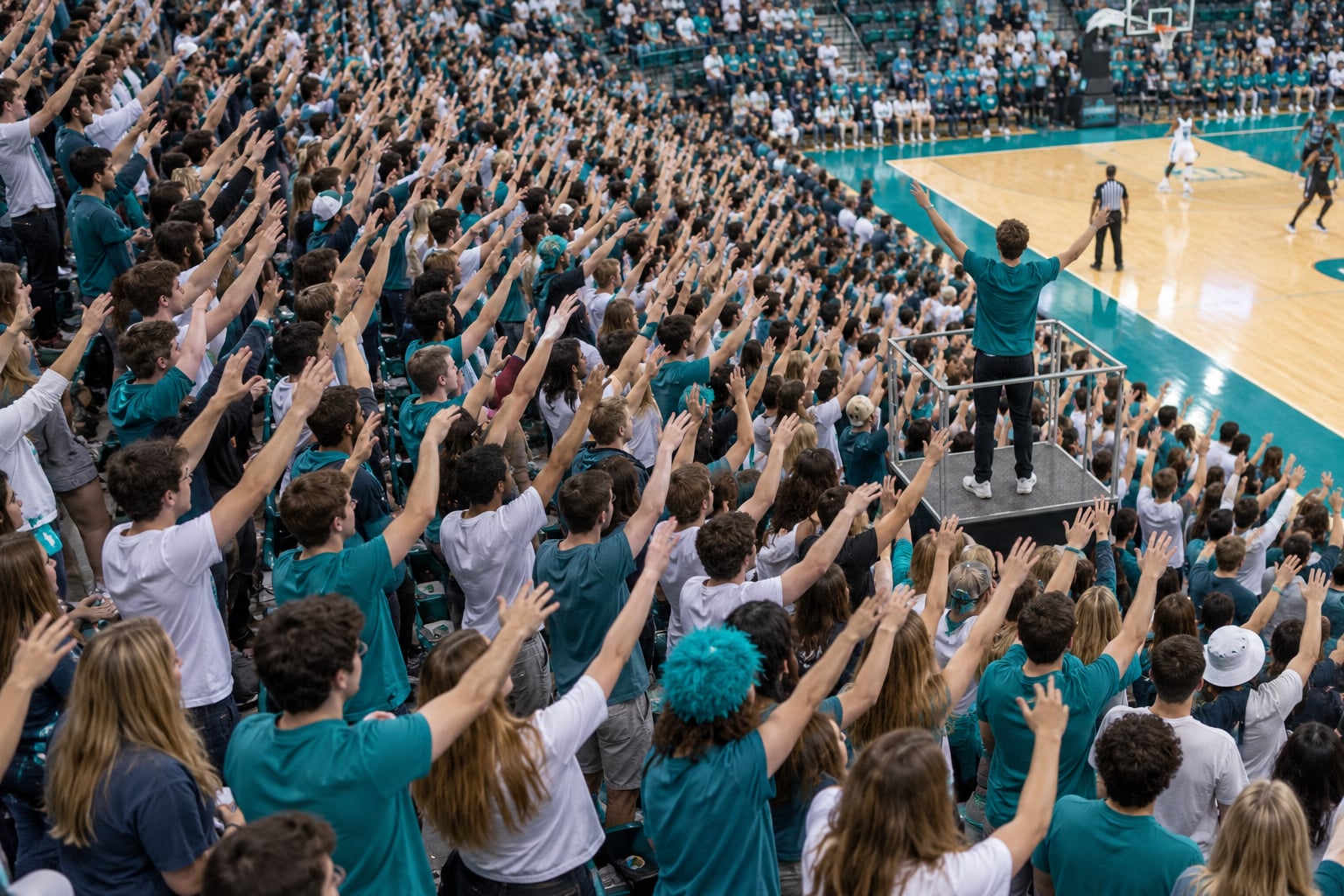
College student sections chant in coordination because a synchronized response does something a scattered noise can’t: it makes thousands of strangers sound like one group. It carries traditions from older students to freshmen, gives the home side a real voice during dead moments in the game, and turns a regular Saturday into a memory people keep for decades.
Below is the short version of how that works, who runs it, and what to listen for the next time you’re in the arena.
Table of Contents
- Why College Student Sections Do Coordinated Chants
- How Are Student Section Chants Planned and Led?
- What Makes a Chant Easy for a Whole Section to Join?
- How Call-and-Response Builds Energy
- How Student Section Chants Differ From Songs and Fight Songs
- Are College Chants Always Planned?
- What Do Chants Do for Team Spirit and Home-Field Energy?
- How Can New Students Join the Student Section?
- A Simple Chant Sequence to Hear at a College Game
- What Makes a Chant Become a College Tradition?
- Frequently Asked Questions
- The Main Thing to Notice at Your Next Game
Why College Student Sections Do Coordinated Chants
Student sections chant together to do four jobs at once. Coordination preserves school tradition, builds group identity and belonging, sharpens the home crowd’s energy during lulls in play, and gives visiting teams a communication problem. Do it alone and you get a person shouting. Do it as a section and you get something the visiting side can hear across the floor.
There’s a practical reason underneath the tradition, too. A coordinated chant fills dead time in a game, which is exactly when a home crowd tends to go quiet. Without something to do, people check their phones. With a chant, thirty thousand people have a job.
Which is why the chant leaders who study cadence and hand signals care so much about the details. Understanding why college student sections do coordinated chants means looking less at the noise and more at what the noise is carrying.
How Are Student Section Chants Planned and Led?
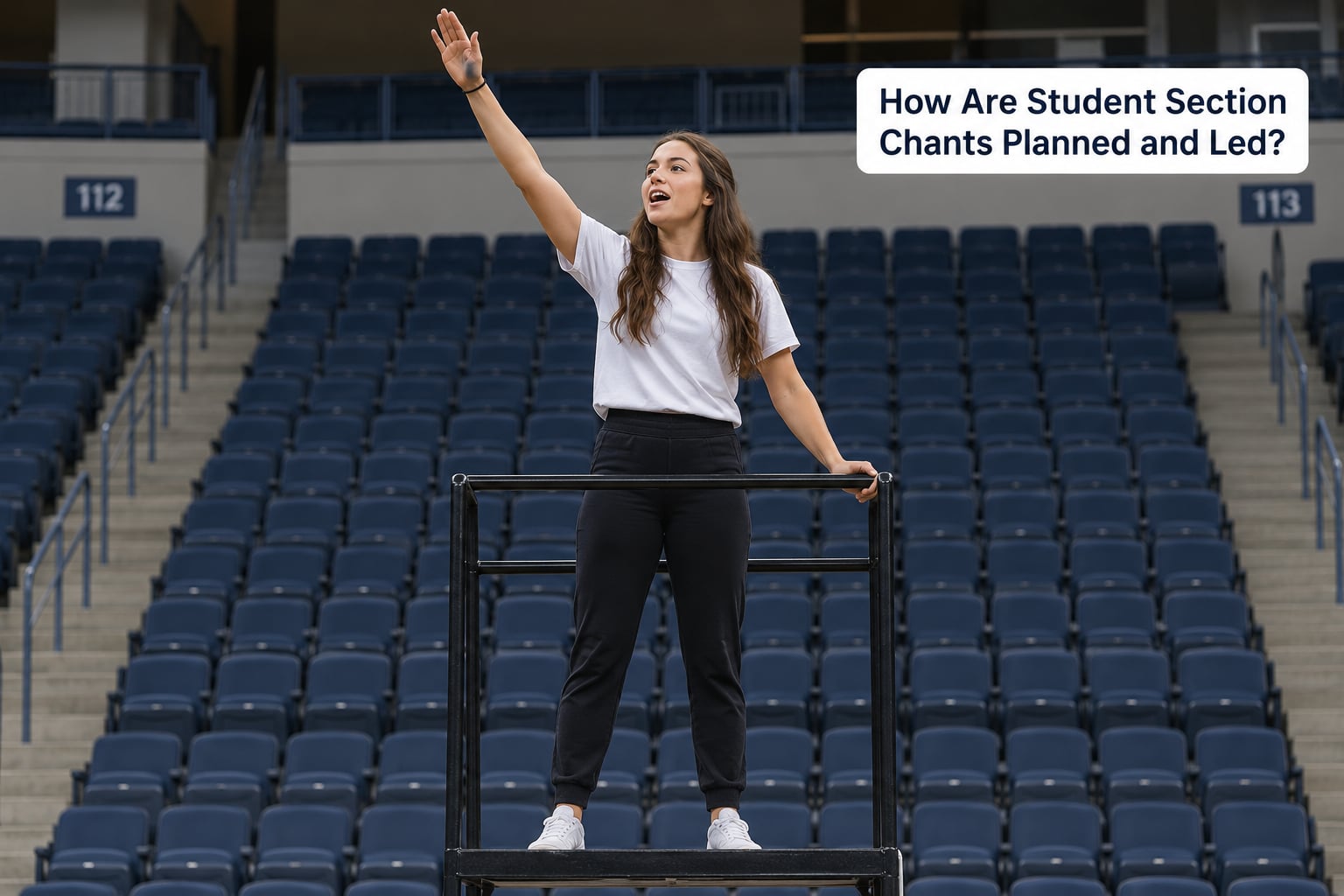
Most sections have a small group of students who run the noise. A game day committee or game day operations chair organizes the schedule, picks the themes, and decides which chants run at which moments. Section leaders handle the game itself, standing at the front where they can be seen by the first fifteen rows and, past them, by everyone else.
Yell leaders run a different lane. Cheerleaders perform routines and stunts; yell leaders drive the voice. At schools with a band and a drum major, the drum major often sets the tempo for everything, and the chant leaders time their cues to the band rather than against it. Some sections also have a band liaison or theme coordinator who handles theme nights and section shirts.
A chant usually travels through a predictable sequence before it reaches a game:
- Someone pitches it, usually an upperclassman or a returning leader who got tired of the section only knowing two or three chants.
- It gets tested out loud at a game, badly, at first. That’s normal.
- The cadence gets simplified. Long lines get cut down to something a stranger can join on the second repetition.
- Cue leaders are assigned so the front rows start it on cue instead of waiting for a chant to start by accident.
- It gets written down. Some sections hand out a chant sheet at the door; others post the list in the section’s group chat and trust people to screenshot it.
- Freshmen learn it from the people around them, which is the handoff that keeps a chant alive.
Not every school structures it that formally. What every school has is somebody in front who decides when.
What Makes a Chant Easy for a Whole Section to Join?
The best chants are built to be learned in about sixty seconds by someone who has never heard them before. That comes down to a handful of specific choices.
Short phrases. Six to ten words per line, with the team name landing on a beat. Long sentences die in a crowd because someone has to breathe.
A repeated rhythm. The same pattern three or four times in a row. Repetition is what lets a person who missed the first line catch the second one.
A melody they already know. Many chants borrow a cadence from a song people hear constantly. A line that fits onto a familiar tune needs no music knowledge at all.
Hand motions. Gestures give late joiners an entry point. You can watch the row in front of you, see the hands go up, and join a beat late without dropping the words.
A visible cue. The leader starts it on a clear signal, not on a hope that people are ready.
Compare that to a chant built on an obscure phrase from a nineteenth-century song. Technically brilliant. Practically, the response falls apart, and the section returns to the two chants it already knows.
How Call-and-Response Builds Energy
Call-and-response is the engine. One side delivers a line, the section answers, then the first side repeats. The call can be a handful of front-row voices or a leader with a microphone, and the answer is the same volume of people hitting the same word on the same beat.
Psychologists call the underlying effect entrainment, which is a plain way of saying that people sync their timing and their expression when they do something together. Shouting in unison raises arousal, and raised arousal reads as enthusiasm from fifty feet away and from fifty yards away.
That is the part that surprises new students. A dozen people starting a chant in the front row can pull the response out of the whole arena, because the arena has spent an hour learning to watch that section. Everyone already knows what to watch for.
The payoff only lands if there’s a shape. Energy that spikes and then drops leaves people sitting down. A good call-and-response has a beginning, a build, and a place to stop on a high note rather than trailing off.
How Student Section Chants Differ From Songs and Fight Songs
Chants, fight songs, and anthems overlap in a college arena, but they do different jobs.
A chant is participatory. The crowd is the instrument, the words repeat, and there is no correct pitch. A fight song is a performance: the band plays it, sometimes with a dance or a fight formation, and the crowd watches and joins the final tag. An anthem is formal, tied to the institution, and usually sung with reverence rather than volume.
A single game can run all three. The band plays the fight song in pregame, the section runs chants through the first half, and the school anthem closes it out. They are not competing formats.
What are they chanting at football games?
Mostly two things: short songs with a call-and-response structure that a whole stadium can answer, and fight songs arranged for tens of thousands of voices. Yard-line and scoreboard traditions add a third layer, since a team’s down-and-distance often has a matching call the visiting sideline can hear.
Are College Chants Always Planned?
No. There are usually four kinds running at any home game, and only one of them is rehearsed.
Rehearsed staples. These are the anchors. Everyone knows them, the section can start them without a cue, and they appear at dead-ball moments when nothing else is going on.
Adapted versions. A known chant with new words tied to a player, a rivalry, a scoring run, or a coach. The melody and cadence stay identical, so the section can pick it up on the second pass.
Short improvised responses. A chant about something that just happened, built in the moment and gone in a minute. These are usually the ones that end anticlimactically.
Venue-specific traditions. Some arenas have a call that only happens in that building, at that school, because of a seating arrangement or a quirk nobody planned for.
The line between the second and third categories is where sections argue. Fans debate borrowed cadences constantly, and a fair amount of that debate is about identity rather than volume.
What Do Chants Do for Team Spirit and Home-Field Energy?
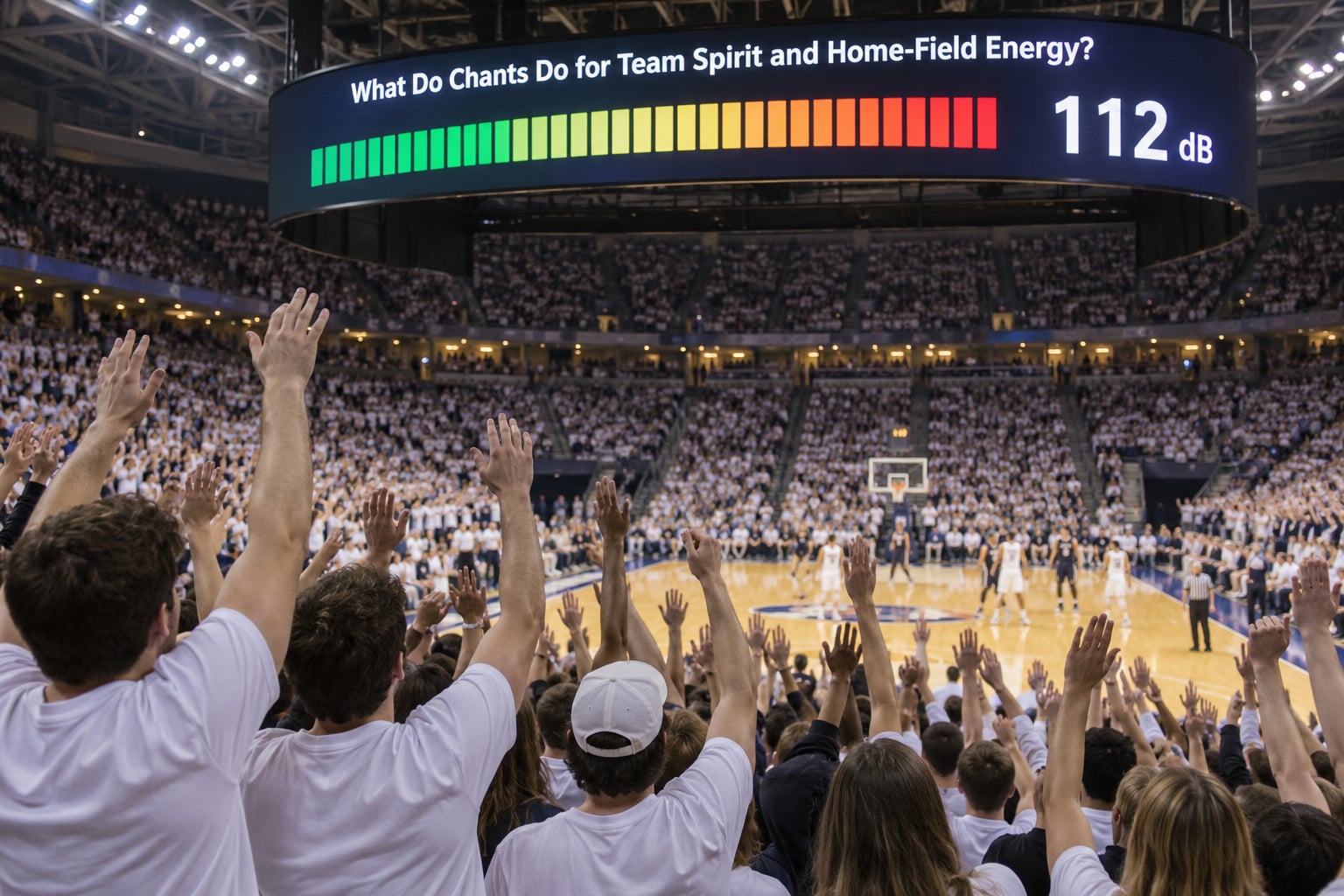
Coordinated chanting produces several measurable effects on a crowd. They’re worth separating, because people credit chants with things they don’t actually cause.
| What the section is doing | Who drives it | What it looks like in the arena |
|---|---|---|
| Carrying tradition forward | Returning students and alumni with seats near the section | The same chant at the same moment in the game as it was twenty years ago |
| Building belonging | Section leaders and the game day committee | A freshman three rows in shouting the right word at the right time |
| Steadying momentum | Leaders watching the floor and the bench | A section calling during a dead ball rather than sitting down |
| Adding crowd noise near the floor | Whole section, led from the front rows | Visiting players and staff raising their voices to communicate |
| Supporting recruiting and attendance | Game day committee and spirit program staff | Recruits sitting behind a section they can hear from the tunnel |
That last row matters more than chant fans sometimes admit. Schools that put resources into the section are partly making a case to prospective students and to visiting recruits. A loud section is one of the easier things to show a recruit in twenty minutes.
What chants do not do is decide games. They’re one input among venue, talent, and coaching. Nobody has ever won a possession because a section was loud. What the noise can do is make a normal possession harder to organize, which compounds across a whole game.
How Can New Students Join the Student Section?
Most newcomers don’t need to memorize anything before they sit down. The section around them does the teaching. A workable sequence looks like this.
- Learn the hand motions first. Hands tell you when to start and what the beat is. That’s the fastest way in.
- Find where the section sits. Usually a designated block, sometimes with a student-only requirement and sometimes not. Check your athletics page or ask the section directly.
- Watch the leader, not the section. The cue comes from the front, every time.
- Listen for the call, then join the response. The response is the loud half and it needs the fewest words.
- Get the chant sheet. Many sections hand one out or post one online. Use it without embarrassment.
- Record only if the venue allows it. Check the rules first. Some arenas restrict filming during warmups or between periods.
A short checklist for first-time participants
- Stand for the section’s established traditions, even if you don’t know them yet. Sitting is the loudest statement in a student section.
- Learn the routine before you change the words.
- Keep taunts aimed at the play, the program, or the score, not at individual players.
- Follow the section leaders when you disagree with a chant decision. Arguing mid-chant is the fastest way to kill a call-and-response.
- Be early enough to be in the block. The back ten rows hear differently than the front.
Nobody in a well-run section minds a freshman who is a half-beat behind. They mind a section that talks through a call.
A Simple Chant Sequence to Hear at a College Game
Here’s the anatomy, using invented words so the shape is visible.
1. The call. Four or five voices in front, or a leader on the microphone: “Hey, hey, what’s the word tonight?”
2. The response. The whole section, on the same beat: “RIVER CITY.” Three words, same beat, repeated.
3. The name or short phrase. The call comes back, this time with the team’s nickname inserted: “Hey, hey, what’s the word tonight? / RIVER CITY / River City Rollers.”
4. The final repetition. Tempo rises, hands go up, the last cycle gets louder and a half-step faster, and the leader cuts it on a held beat.
That four-part shape, call, response, name, repeat, covers most of what a section needs. Tempo and volume climbing through the cycle is the part people remember, and it’s the part most often left out by accident.
What Makes a Chant Become a College Tradition?
Repetition is the whole mechanism. A chant that’s used three times is a moment. The same chant used at the same moment across five seasons is a tradition, and by then the section owns it rather than borrowing it.
Adaptations have to balance two things at once. Something completely new gets ignored, because nobody recognizes it. Something completely unchanged gets boring, and sections add lyrics for exactly that reason. The workable versions keep the cadence and the response word, then change a line or two around them.
A simple version survives because later sections keep choosing it. The chant that works on the third game with a third group of freshmen, without anyone having to explain it, is the one still there in ten years. Chants die when the group that made them graduates and nobody teaches the next one.
Frequently Asked Questions
Who leads the chants in a college student section?
Usually a game day committee, its game day operations chair, and a group of section leaders standing in the front rows. Yell leaders drive the voice and the drum major sets tempo when the band is involved. The chair handles schedules, themes, and which chants run when, while the front-row leaders cue the section in real time.
Do you have to know every word before joining a college student-section chant?
No. The response half of a call-and-response chant is the part you need, and it is usually two or three words on a single beat. Watch the row in front of you, catch the leader’s cue, and join on the second repetition. The people beside you will correct you faster than any chant sheet.
How do student sections learn new chants?
Someone pitches it, the section tests it out loud at a game, the cadence gets simplified to a few short phrases, and section leaders are assigned to cue it from the front. Many sections print or post a chant sheet, and the rest is transmission: the upperclassmen teach the freshmen sitting next to them.
Why do student sections use hand motions with chants?
Hands give people an entry point into a chant they have never heard before. Watching for a gesture means you can join a beat late without dropping the words, and a section full of moving arms reads as energy from across the arena. Motions also mark the start and stop so the chant has a shape instead of trailing off.
Can fans outside the student section join the chants?
Almost always, yes, especially on the response. Alumni, families, and fans in the upper decks are expected to answer a call. Some traditions are reserved for the student block itself, and some sections hand out chant sheets or host an orientation game for newcomers. Ask at the section before game day and nobody will mind you joining.
The Main Thing to Notice at Your Next Game
Watch the handoff. A leader at the front raises an arm, the first rows answer, and the response travels outward until the upper deck is shouting the same word. Then watch what happens to the building’s volume, because that drop and rise is the whole mechanism, not a side effect. Do one thing first: listen for the call before you join the response. The response is louder, easier, and always right.