Rivalry games are played at the end of the season because that is the only point on the calendar when the standings still mean something. Division titles, bowl berths and playoff positions are all unsettled, so a loss in late November can erase an eight-win season in one night. Put the same game in September and it becomes a data point instead of a verdict.
That answer explains a habit, not a rule. Not every rivalry finishes the season, and a few famous ones have been moved on purpose. Here is how the custom works, who actually decides it, and what it looks like from Arizona.
Updated for 2026.
Table of Contents
- What Does It Mean to Play a Rivalry Game at the End of the Season?
- Why Late-Season Rivalry Games Carry More Weight
- How Late-Season Timing Creates a Strategic Test
- Can a Late-Season Rivalry Game Decide a Championship?
- How Do Bowl Games and Playoffs Change Rivalry Games?
- What Fan Traditions Make Late Rivalry Dates Memorable?
- Frequently Asked Questions
- Conclusion
What Does It Mean to Play a Rivalry Game at the End of the Season?
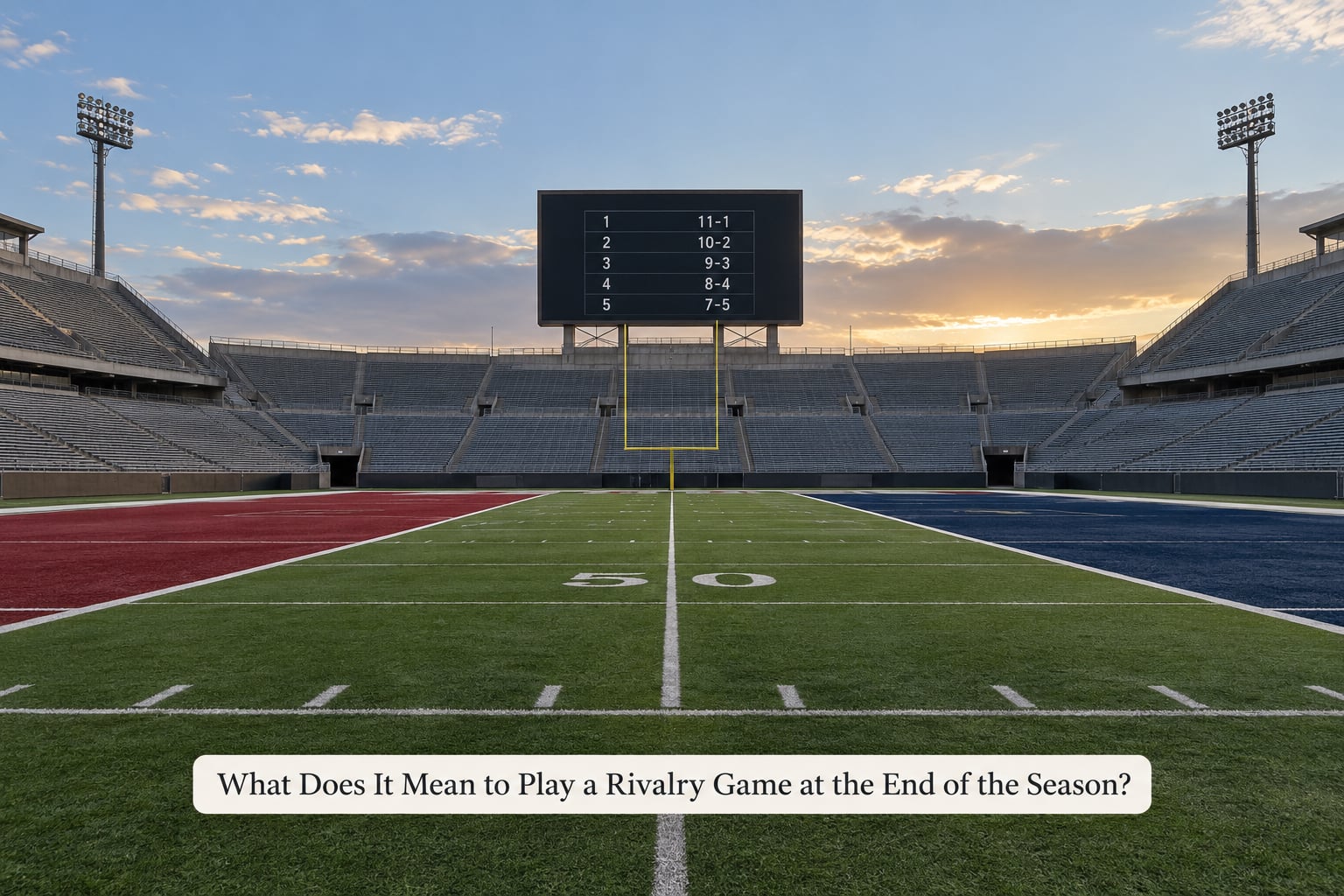
Playing a rivalry game at the end of the season means the matchup carries full season consequences: a division race, a bowl spot, a conference championship berth or a shot at the College Football Playoff. The term is most common in the major conferences, where conferences schedule their in-state and in-division games into the same late window.
The custom exists because a rivalry late in the year produces a result somebody has to live with. Arizona against Arizona State, for example, decides more than a trophy for fans of the Territorial Cup series — it shapes the losing side’s entire December, whether that is the postseason or a long offseason.
Three things make the late slot meaningful, and all three have to be true at once. Records have accumulated, so games now separate contenders from also-rans. Rankings and standings are live, so a win moves a team in both directions at once. And the postseason is close enough to see, so fans can trace the path from Saturday to a selection committee meeting.
Why Late-Season Rivalry Games Carry More Weight
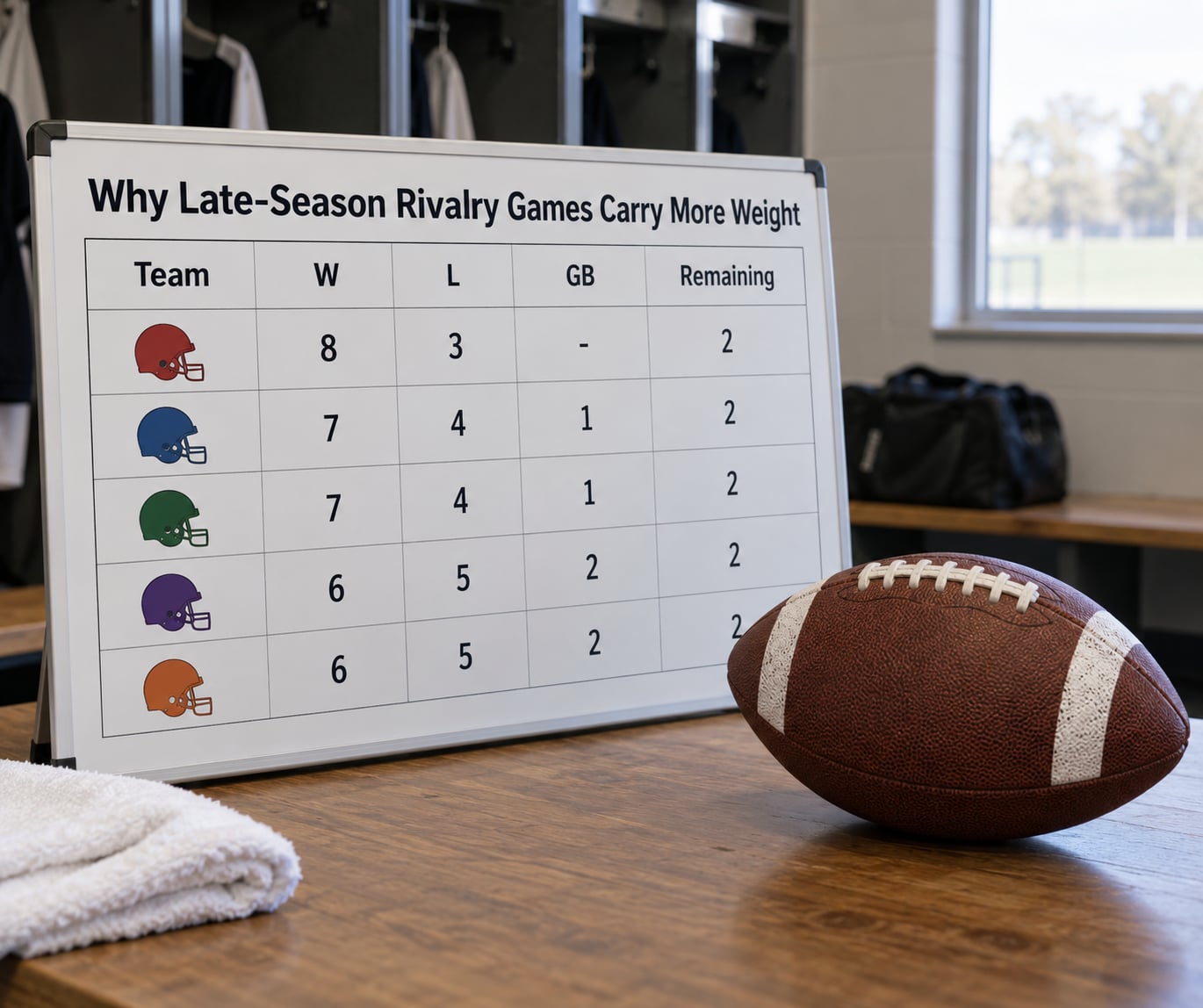
Early in the season, a loss costs almost nothing and a win says little. Teams have not yet separated, and there is no committee picking four teams from a field of dozens. Late in the season the same 25-point margin can knock a program out of a division race entirely.
This is why conferences cluster their marquee games in the final window. Here is how the custom shows up across several conferences, with the traditional slot and what each matchup is typically competing for.
| Conference | Marquee late-season rivalry | Traditional slot | What it competes for |
|---|---|---|---|
| SEC | Georgia-Auburn | Final regular-season weekend | Division standing and CFP position |
| Big Ten | Michigan-Ohio State | Final regular-season weekend | Division title and CFP seeding |
| Big 12 | Kansas-Kansas State | Final regular-season weekend | Conference standing and postseason path |
| ACC | Clemson-South Carolina | Late-November window | Division standing and bowl placement |
| Pac-12 | Oregon-Oregon State | Late-November window | Ranking and bowl berth |
| SWAC | Alabama A&M-Alabama State | Final regular-season weekend | Division crown and HBCU postseason access |
Four forces push important games into that weekend. A division structure forces it, since rivals must play each other and every team needs the same number of games in hand. The postseason deadline forces it, since selection happens in early December. Ticket revenue pushes toward it, because a rivalry sells season-ticket packages in a way an October game does not. And tradition holds the slot once it is set, which makes the next decade of scheduling predictable.
The calendar also explains the quiet week before. When the biggest opponent sits in late November, the weekend ahead of it is often the safest non-conference game left on the schedule. Those games carry guaranteed payouts for smaller opponents and become the closest thing college football has to a bye week, and the results have mostly stayed predictable, though the margin narrows with conference strength.
How Late-Season Timing Creates a Strategic Test
The difference between a rivalry in week three and a rivalry in week twelve is not just emotion. It changes what each team is trying to accomplish, which changes the risk profile.
| Factor | Rivalry in September | Rivalry in late November |
|---|---|---|
| Primary goal | Install new schemes and survive depth chart competition | Win a division, reach a bowl, protect a ranking |
| Typical risk tolerance | Higher, especially at home against a new starter | Lower, since injuries now carry December consequences |
| Turnover emphasis | Managed, particularly in the fourth quarter | Sharpened, since a single mistake can end a season |
| Preparation | Mostly a scout’s first look at new personnel | Second and third looks against a familiar system |
| Result’s afterlife | One of twelve games to grade | Decides a postseason path |
Coaches describe the late version as a test of execution rather than talent. Field position, third downs and ball security all carry more weight when a turnover in the fourth quarter costs a division lead. Arizona fans watching the territorial series know the pattern: the first half is a coin flip, and the last twenty minutes decide what December looks like.
Why Rivalry Games Are Played at the End of the Season
Six forces put rivalries at the end of the schedule. Scheduling tradition holds a slot once conferences agree to it, usually through multi-year agreements that lock rival dates years in advance. Meaningful standings require both teams to still be in contention. Fan demand concentrates travel, tailgates and family trips around a single weekend. Television windows reward the highest-stakes games with better slots and more attention. Travel limits keep rival games within regional footprints where possible, and a single in-state trip is easier than a September road date that becomes a season opener. Finally, the desire to crown a champion or qualifier pushes the decisive meetings as close to the postseason as the calendar allows.
None of these are romantic reasons, which is exactly why they hold. Scheduling is built by athletic directors and conference offices negotiating over several seasons at once, and the final weekend is usually the only date both schools can make work without breaking a home-and-home rotation.
Can a Late-Season Rivalry Game Decide a Championship?
It can settle a division, and it can settle a postseason path, but it is not the same thing as winning a championship game. A regular-season rivalry win is one input among several: the head-to-head result, the full conference record, non-conference strength and the committee’s read on how a team played all season.
A win that clinches a division title is as close to a championship as a regular-season game gets. It decides who represents the conference in a title game weeks later. A win that pushes a team over an at-large selection threshold carries similar weight, because the field is built from a limited number of spots and the margin is thin.
What a late rivalry game cannot do is settle anything by itself. Teams in the same division play one another on different weekends, so the math changes week to week. What the late date does is place the biggest emotional result at the point where the least is settled. That is the whole logic of the custom in one sentence.
How Do Bowl Games and Playoffs Change Rivalry Games?
The postseason upends the assumption that a rivalry is a fixed fixture. Rival teams that finished close together in the standings can meet again in a conference championship or playoff game, which converts a season-ending tradition into a postseason rematch.
Bowls work the other way. Because a postseason opponent is often chosen from a ranked pool rather than agreed to years ahead, a scheduled non-conference rivalry can be replaced late in the year by a team with a stronger claim. Arizona fans have seen this in both directions, when a late opponent was upgraded and a familiar name was dropped.
Selection happens in early December, and that hard date shapes everything upstream of it. Conferences need the last regular-season games to finish before they can hold title games, and the playoff committee needs the field complete. Rivalries sit at the front of that queue because nobody wants to hold the sport’s most watched regular-season games back from the calendar, and nobody wants them finished so early that the season’s biggest moments pile up in one week. The late slot is a compromise between tradition and arithmetic.
What Fan Traditions Make Late Rivalry Dates Memorable?
A November rivalry is an occasion, and the occasion is built by people who travel. Alumni chapters charter buses, students buy standing-room tickets the day they release, and families who have attended for decades treat the game as a fixed date on the family calendar.
Tailgates in cold weather carry their own appeal. So does the senior sendoff, which is why moving a rivalry earlier feels wrong to so many fans: the last home game of a career should be the loudest one, not the third. For Arizona and Arizona State supporters, the late date means the season ends with the state on the field, and the outcome is discussed through the winter.
The loudest complaints tend to come from people who feel the slot was changed on them. Fans object most strongly to two things, neutral-site games and earlier dates, because both remove something specific. A neutral site trades the on-campus atmosphere for a logistics exercise, and earlier dates trade a season verdict for an early-season experiment. Players sometimes disagree about which loss matters more, and the honest answer is that intensity and stakes are not the same thing.
When rivalries have moved earlier, the results have been mixed. Auburn-Georgia played early in 2020 and the series lost part of its identity, though the games stayed competitive. The Apple Cup moved to week three and to a shared stadium in the Pacific Northwest, and the attendance and ticket-market response disappointed fans who wanted the game back in the state where it belongs. USC pushed to move its Notre Dame game to September, arguing for easier travel and a lighter calendar, and drew pushback over giving up a home rivalry weekend in Los Angeles. The pattern is consistent: the emotion survives a date change, and the stakes do not move with it.
Frequently Asked Questions
What is rivalry week in college football?
Rivalry week is the informal name for the final regular-season weekend, when conferences stack their in-state and in-division games on the same dates. It is not an official designation, so conferences define it differently. In the SEC and Big Ten it usually means the last two weekends of November, when division rivals still have a shot at a title game.
Are college football schedules made years in advance?
Yes. Schedules are built through multi-year agreements between athletic departments, which lock in rivalry dates, home-and-home rotations and non-conference games before the season starts. Conference schedules run on set grids, so a division structure dictates which teams meet each year. Change one piece, like a conference realignment, and years of dates have to be rebuilt.
Why is football associated with Thanksgiving?
Football grew out of fall campus life, and late-November weekends have become the natural end of a season that runs from late summer through December. Thanksgiving falls in the middle of the term, when students are still on campus and alumni are home for the holiday. Rivalries landing on the Saturday after Thanksgiving inherit both the attendance and the holiday travel that come with it.
Why are some college football rivalries played in September now?
Conference realignment pushed some traditions out of their old slots. When in-state schools land in different conferences or the same conference with uneven divisions, their traditional dates can disappear or shift. Financial pressure plays a role too, since a September game can be paired with a second home date and packaged for season tickets. The emotion tends to survive the move, but the stakes and atmosphere usually fall.
Why is Bedlam not part of rivalry week?
Bedlam, the Oklahoma-Texas series, moved to an October date in 2021 after a scheduling dispute, and it has stayed off the traditional late-November weekend since. Conference realignment added another layer, as Oklahoma left the Big 12 and later realigned its schedule again. The result is one of the sport’s loudest rivalries played in a slot most fans consider early.
Conclusion
Why rivalry games are played at the end of the season comes down to one reason: a result still decides something. Records have piled up, standings are live, and the postseason is one or two weekends away, so the same 25-point margin that meant little in September can end a season in November.
When you look at a late rivalry on the schedule, check three things first: where each team sits in the standings, what the game does to its postseason position, and whether a division or conference title is on the line. Those three answers explain the date, the atmosphere and the noise.