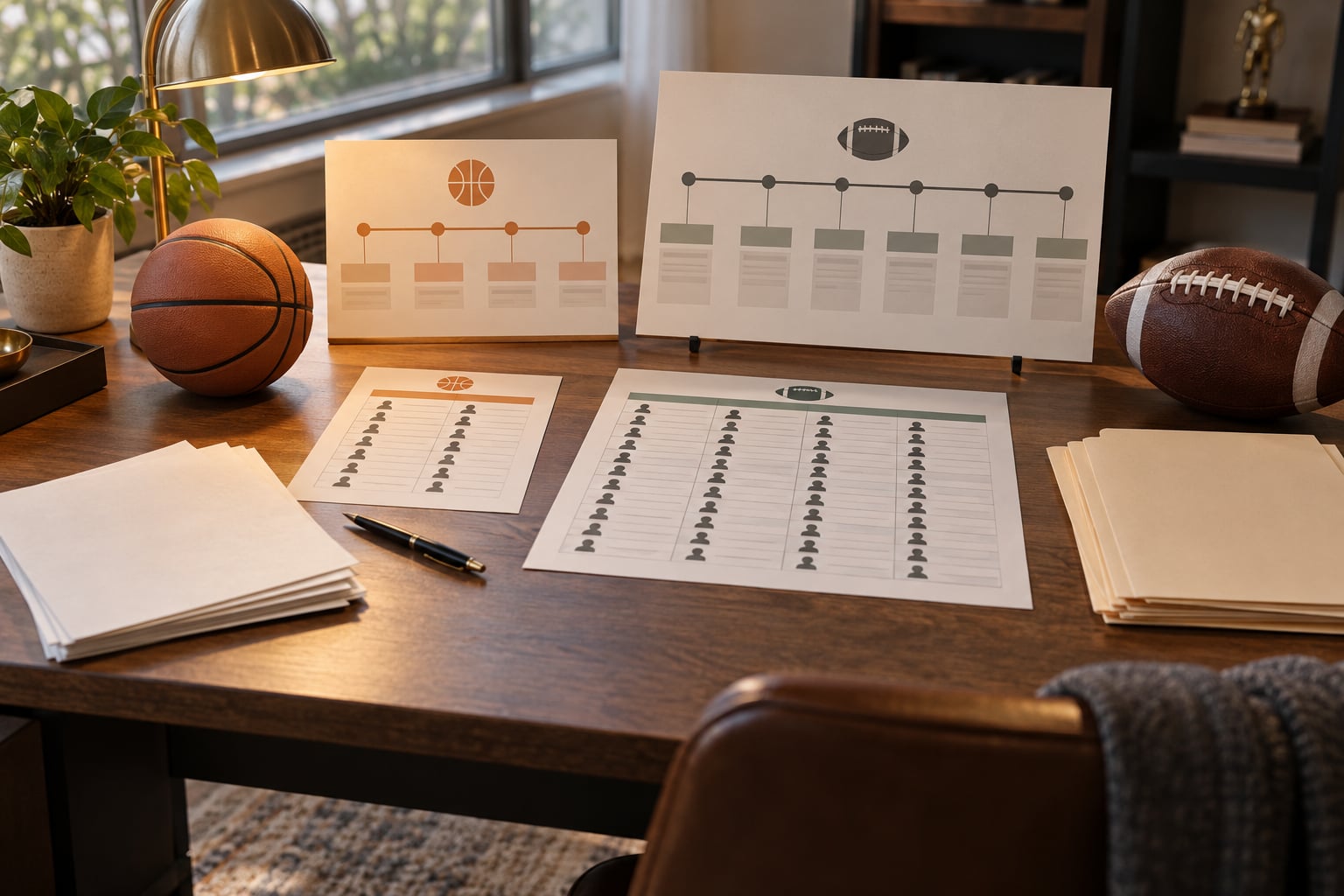
How college basketball recruiting differs from football comes down to three things: timing, offer behavior, and how many roster spots actually exist. Football classes fill early and lock in through December and February signing windows, while basketball coaches build rosters closer to tip-off, which means offers arrive later, get reopened more often, and depend as much on a player’s fit in the rotation as on talent. Add different visit rules, different scholarship limits, and two separate recruiting calendars, and the two processes can feel like different sports entirely.
The practical version: a family that treats basketball recruiting like football recruiting tends to panic early and settle late. A family that treats football recruiting like basketball recruiting ends up with a full commitment board and nowhere to go.
Everything below reflects how NCAA Division I programs generally operate. Rule specifics, contact windows and roster limits shifted in the most recent rules cycle, so verify the current cycle on the NCAA’s recruiting calendar before you act on a date.
Table of Contents
- How College Basketball Recruiting Differs From Football at a Glance
- How recruiting timelines and roster limits shape the process
- Offers, scholarships, and roster planning
- Coaching relationships, official visits, and communication
- Playing time, roster fit, and early versus late decisions
- NIL, the transfer portal, and changing paths to a roster spot
- What parents and athletes should track at every stage
- Which recruiting model fits each player?
- Frequently Asked Questions
- Is college basketball recruiting more important than football recruiting?
- Can college athletes receive recruiting offers before their senior year?
- Do college basketball players have to commit earlier than football players?
- Can a football player switch to college basketball at the same school?
- Does NIL guarantee more basketball and football recruits choose your program?
- How early should families start building a recruiting plan?
How College Basketball Recruiting Differs From Football at a Glance
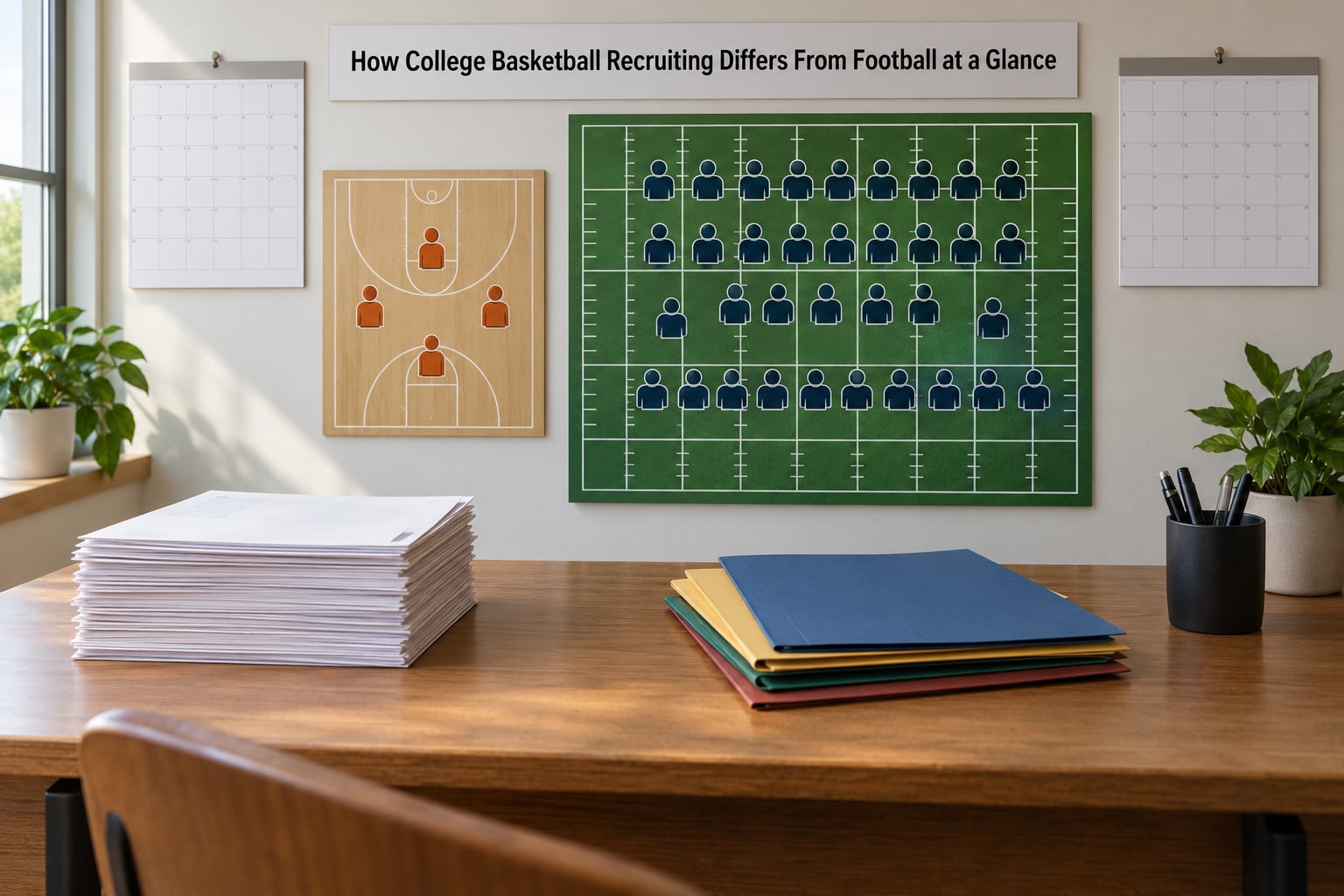
The fastest way to see the gap is to line the two processes up criterion by criterion. The single biggest difference is scale: a Division I basketball roster holds roughly 15 scholarship players, while an FBS football roster carries the equivalent of about 85 players on the initial-game-day roster.
| What a family is asking | College basketball | College football |
|---|---|---|
| When does serious recruiting start | Often sophomore and junior year, with real offers in junior year spring | Often sophomore year through the spring of junior year, frequently earlier offers |
| Roster size that drives recruiting | About 15 scholarship spots, so one decision reshapes the class | About 85 initial-game-day spots, so attrition creates steady openings |
| Typical offer pattern | Extended verbally, formalized late, frequently revised or withdrawn | More likely to arrive as a scholarship offer with a known framework |
| Recruiting class size | Small, coach-specific, often assembled season by season | Large, produced across a national board with many specialists |
| Recruiting periods | Calendar set by NCAA for basketball | Separate calendar set for football |
| Official visits | Six per recruit under NCAA limits for basketball | Five per recruit under NCAA limits for football |
| Coach-funded unofficial visits | Allowed, including travel and one-on-one coaching time | Allowed, with a national framework limiting how often one coach can host the same recruit |
| How a player is evaluated | Role fit in the rotation, ball skills, shooting and decision-making | Position specialization and depth chart fit |
| Where most players enter | High school recruiting, with late adds and walk-ons filling gaps | High school recruiting or the transfer portal |
| What moves after signing | De-commitments and late offers stay common through spring | Commitments lock harder, though portal entry still happens |
| Ranking services matter most | Position and class ranking within a smaller pool | Ranking carries more weight in national visibility |
Read that table as a timeline, not a rulebook. The rows near the top explain why a basketball offer in February can still mean something, while a football offer in October is usually closer to final.
How recruiting timelines and roster limits shape the process
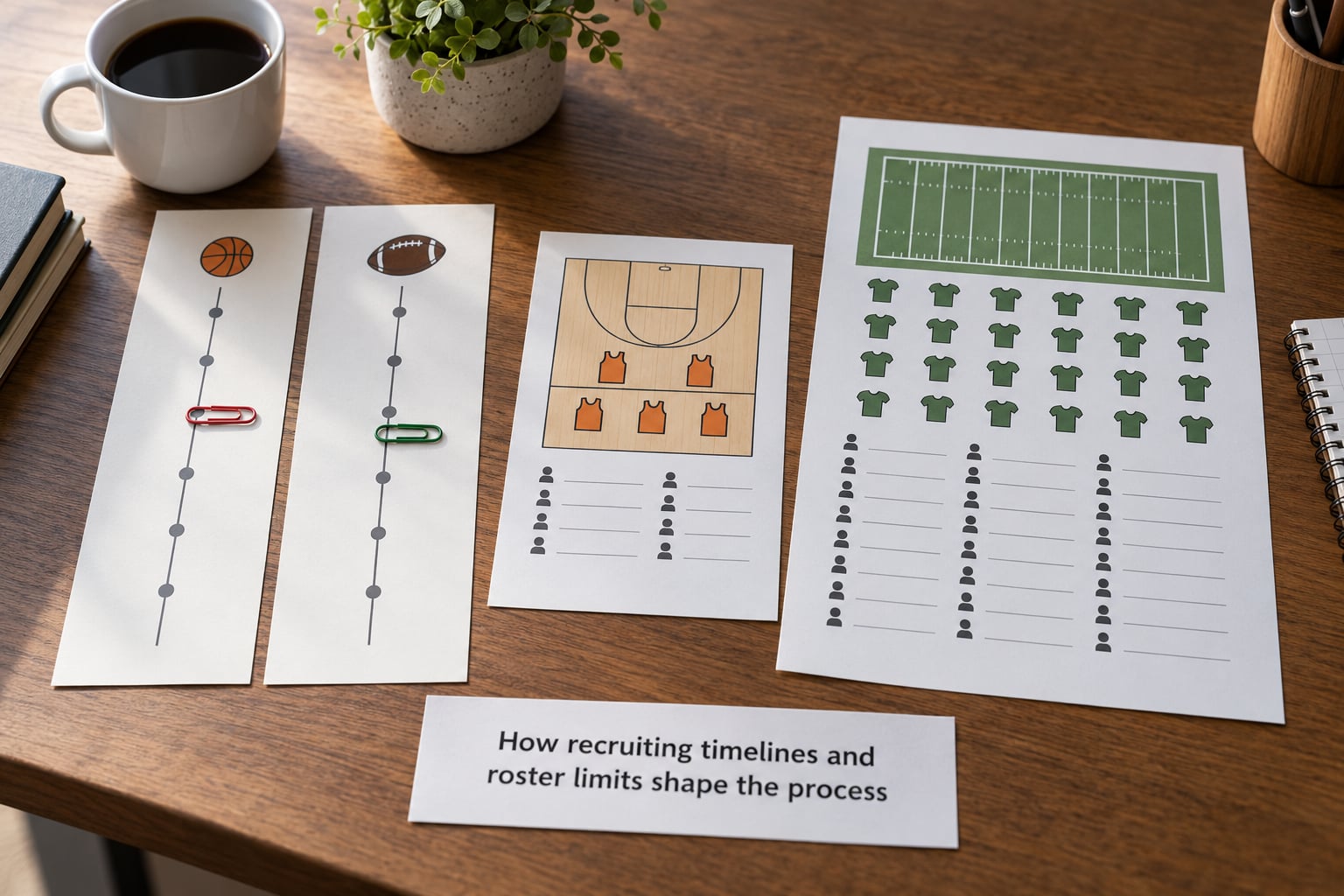
Roster limits are the engine underneath everything else. A basketball coach losing one starter to the transfer portal does not replace a role; they replace a rotation, a shot profile, and a recruiting class that suddenly needs a shooting guard rather than a big man. Football coaches manage attrition across dozens of positions, so a single departure rarely reshapes the class.
That math is why basketball coaches hold offers loosely in the spring. They are reading their roster, reading other boards, and reading scholarship numbers that can move with an administrative decision, a scholarship rescission, or a revised roster limit.
How college basketball recruiting differs from football, grade by grade
Both sports follow the same named recruiting periods. The calendar that governs basketball is not the calendar that governs football, and the same recruiting class can be at different stages in each sport during the same month.
| Grade year | College basketball | College football |
|---|---|---|
| Freshman year | Build skills, play on a team, join a program or league where possible | Same base, with more early weight on position and size |
| Sophomore year | Full game film, live practice reps, some early contact | Camp circuit and early contact ramp up sooner |
| Junior year spring | Offer decisions cluster early, though many come in spring and summer | Early offers are common; many commitments form before senior year |
| Junior year summer | AAU and showcase circuit is often the main scouting window | Camp and showcase circuit as well, plus position camps |
| Senior year fall | Visits and decisions, with the class still being shaped | Early Signing Period in December closes many classes |
| Senior year spring | National Signing Day, then late offers for leftover spots | National Signing Day, with portal entries filling gaps |
| Post-grad or junior college | A common re-set point that draws new coach interest | Less common as a recruiting route than a transfer portal entry |
The rule changes most families hear about are the dead period, the quiet period, the contact period and the evaluation period. During a dead period, in-person contact is off the table while calls, texts, emails and direct messages can still happen, which surprises a lot of freshmen. The quiet period sits around early signing, and the contact period is the window when coaches can talk with recruits directly and host visits in person.
Recent NCAA decisions have also loosened parts of that framework, so treat the calendar you find online as out of date unless you check the current one. Rules around eligibility and roster limits were both in play in the most recent cycle, and schools publish their own interpretations of contact on their athletic department pages.
Offers, scholarships, and roster planning
An offer, a roster spot and money are three different things in both sports, and families routinely collapse them into one. A verbal offer means a coach wants you. A roster spot means the coach has a spot. Money means the program can pay for it out of a scholarship pool.
Basketball is where those three things drift apart most visibly. A coach can extend an offer in April and sign a point guard in May. The same coach may also offer a scholarship that later turns into an academic aid package once the roster math changes.
Football programs run closer to a published framework. A scholarship offer in football usually comes with a clearer sense of what it covers, because the recruiting class is large and the roster math is planned years in advance at many programs.
One more wrinkle worth knowing: how long an offer stays open depends on the signing period involved. A commitment made during the Early Signing Period is a signed National Letter of Intent and carries far more weight than a commitment made the week before National Signing Day. Between those windows, players can still decommit, which is why football families watch December and basketball families watch the whole spring.
Coaching relationships, official visits, and communication
Visit rules are the clearest numeric difference between the sports. NCAA limits allow a Division I basketball recruit six official visits and a football recruit five. Unofficial visits matter far more than that one-visit gap, though, because coaches can pay for travel, lodging and time with a recruit in both sports, subject to a national framework that limits how often the same coach can host the same player.
That framework is where the 40-60-80 guideline comes from, a common shorthand among coaches for dividing recruiting time across a season. It is a guideline rather than a published rule, but programs do work inside it.
The relationship structure is different too. Basketball coaches usually recruit a small class personally, so contact with a player’s coach is frequent and specific: a text about a role, a phone call after a game, a visit that doubles as a workout. Football programs run larger staffs, so a recruit might interact with a position coach early and a head coach later.
Parents have a bigger visible role in football recruiting, particularly on official visits and on campus relationships, and that is normal rather than something to be embarrassed about. The line that matters is who is doing the work. A parent can drive, host recruits, and support film sessions. A parent should not be the one making the coach-to-coach contact.
Paid recruiting services are where the two ecosystems diverge most. Football has a long, visible services industry with ranking names families recognize and a clear fee structure. Basketball services are smaller and often sell exposure events, which is why a summer camp or showcase fee can be the actual product. Neither one can manufacture an offer, and any service promising guaranteed placement is overselling.
Playing time, roster fit, and early versus late decisions
Football evaluators are usually looking at specialization. A linebacker is measured against linebackers, and a quarterback against quarterbacks, which makes depth-chart projection fairly reliable at the top of the class. Basketball evaluations are about role: who handles the ball, who defends the primary wing, who runs the bench unit.
That is why a four-star football recruit can be a well-known name with a clear path, while a highly rated basketball guard can be a perfect fit at one school and a redundant piece at another. Role questions get asked out loud in basketball recruiting, sometimes bluntly, which is a cultural difference more than a rule difference.
Practical consequences show up in the fallback options. Football recruits talk about a redshirt year and about joining a deep position group. Basketball players talk about walking on at a program where they can practice and earn minutes, because a late add has to be ready immediately and the roster is smaller.
Early commitment protects a player in football because the class is nearly full by December. In basketball, an early commitment can leave a family bound to a role the program no longer needs, which is part of why more basketball players hold their options until the spring.
NIL, the transfer portal, and changing paths to a roster spot
Money has entered both sports through name, image and likeness deals, and football generates far more aggregate media revenue than basketball. That gap matters for families weighing which sport to pursue, though individual NIL income depends almost entirely on personal following and sport rather than on team sport alone.
The transfer portal is where the two sports diverge again. Basketball players arrive as high school recruits more often and can also enter as transfers, but with a small roster, each transfer is a meaningful reshuffle. Football has a deeper portal traffic problem, and programs are more practiced at replacing players through it. Recent rules cycles included changes around eligibility and roster construction that affect this directly, so read the current NCAA and school guidance rather than last season’s summary.
Eligibility itself is an age-based clock rather than a fixed four years of sitting in a classroom, and it can be paused by injury or by circumstances schools have petitioned for. Families who assume an extra year is simply available are usually wrong.
What parents and athletes should track at every stage
A simple tracker beats a private group chat full of rumors. Here is what I would put on one page per athlete and update weekly during the season.
- Which calendar applies. Track the basketball calendar or the football calendar, never both from memory.
- Every coach contact with a date, method, and what was actually discussed.
- Offer status for each school: verbal, written, scholarship funded, unsigned.
- Visit dates and limits used, counting official visits against the NCAA cap.
- Film and showcase inventory, with full game film available and a cut highlight reel sent to coaches directly.
- Academic tracking: core courses, grade point average, class rank, and eligibility certification timing.
- Roster fit notes, especially the role the program described out loud.
- Contact rule changes, re-checked at the start of each cycle rather than once a year.
- NIL decisions deferred until after a school choice is final, since deals follow the roster spot more than the offer.
If a family wants the one habit that separates the two sports best, it is this: in football, protect the early commitment; in basketball, protect the option. Understanding how college basketball recruiting differs from football means knowing which of those your athlete is in.
Which recruiting model fits each player?
For a late developer whose skills are still arriving, basketball tends to be kinder, because offers can still arrive in a player’s spring year and even after the early signing window. Football punishes late development harder, since classes are filled a full cycle ahead.
For a pure specialist, football offers a clearer map: pick the position, find the schools that develop it, project the depth chart. Basketball specialists exist too, but they compete against role players rather than against a roster chart.
Multi-sport athletes face a genuine choice. Recruiting services and forums both report parents asking whether a two-sport athlete can play both in college. Practically, a full-time roster spot in one sport consumes the time, practice load and injury risk that the second sport needs, and roster limits make dual rosters rare at the top level. The realistic version is one primary roster spot plus summer or casual play in the other.
For players who value a direct relationship with the person making the decision, basketball wins on frequency. For families who value a more structured national network of specialists and a longer, more predictable cycle, football wins on process.
None of this should pick the school for you. A great fit at a program that sees you weekly beats a stronger brand that sees you once a semester.
Frequently Asked Questions
Is college basketball recruiting more important than football recruiting?
Neither is more important; both are selective. Football has more total participants and larger rosters, so more athletes get roster spots. Basketball rosters are smaller, so a single offer carries more weight for the selected player. Importance depends on the player’s goal, the level of the program, and how much scholarship money is attached to the spot, not on which sport recruits harder.
Can college athletes receive recruiting offers before their senior year?
Yes, in both sports. Coaches can extend offers during a player’s junior year and sometimes earlier, and early commitments before senior year are common in football. Offers given that early are often softer than they sound, because a coach is building a board and a player’s ranking can move before signing day. Treat a junior-year offer as real interest, not as a finished roster spot.
Do college basketball players have to commit earlier than football players?
No, the opposite is usually true. Football classes fill before and around the Early Signing Period in December, so many commits happen during junior year or early senior year. Basketball coaches often keep options open longer because their rosters are small and roles can change, so meaningful decisions frequently land in the spring near National Signing Day.
Can a football player switch to college basketball at the same school?
Sometimes, but rarely as a first move. A student-athlete can try to join a basketball team as a walk-on at the school he already attends, though roster limits mean there may be no room and practices take time away from football. More common routes are competing for both spots as a walk-on, transferring to a school that offers both, or using a post-grad year to restart at one sport.
Does NIL guarantee more basketball and football recruits choose your program?
No. NIL money depends on an athlete’s personal following and marketability, not on the sport’s revenue alone, and it usually arrives after a player is already committed to a roster spot. Families should treat NIL as a later career question rather than a recruiting decision factor. Verify current rules, since compensation policies and revenue sharing arrangements are still being revised.
How early should families start building a recruiting plan?
Start in the freshman or sophomore year with the basics rather than the recruiting: academics, core courses, a repeatable skill set, and full game film. Real outreach to coaches generally ramps up around sophomore to junior year. A senior-year plan that begins with finding a coach usually starts too late, especially in football, where classes fill a full cycle ahead of graduation.
Start with roster fit and the right calendar. Figure out which role a program actually needs and whether the sport’s recruiting cycle leaves you room to decide, then work backward from that program’s signing dates. In football, protect the early commitment; in basketball, protect the option until the role is confirmed in writing.