Neutral site games affect fans in four concrete ways: the home crowd and its noise advantage disappear, both fan bases travel the same distance, ticket and lodging costs climb, and rituals like Senior Day and the player walkout get dropped. The venue is neutral. The experience never is.
That mismatch is why these games bother people so reliably. Fans get sold home-field advantage as part of what a season ticket buys, and a neutral site quietly removes it while keeping most of the bill. Fans in college forums reach the revenue motive on their own, usually within a few comments, without needing anybody to explain it.
Table of Contents
- How Neutral Site Games Affect Fans
- How the Location Changes the Fan Experience
- How Travel Costs Affect the Decision to Attend
- How Neutral Site Games Affect Ticket Access
- How Neutral Site Games Affect Attendance
- Why Bowl Games Create New Fan Traditions
- How the Setting Changes Team and Rivalry Identity
- How to Decide Whether a Neutral-Site Game Is Worth Attending
- Frequently Asked Questions
- Why do some teams have a large fan presence at neutral-site games?
- Are neutral-site games usually harder to attend than home games?
- Do fans consider a neutral-site game a genuine rivalry game?
- Why can ticket resale prices be lower for some neutral-site matchups?
- How do stadium traditions differ at a neutral-site bowl game?
- What factors matter most when choosing whether to travel?
- Conclusion
How Neutral Site Games Affect Fans
The short version: a neutral site changes the deal for everyone in the stadium, and it changes it more for the fans who expected to be at home.
- The crowd advantage goes away. Home-field advantage in a stadium is mostly noise and familiarity. Neither survives a neutral site, for either team.
- The travel doubles. The visiting fan travels about as far as the supposed home fan, which is the part nobody planned for.
- The cost goes up. Tickets come from an allocation instead of your season, and a night game usually adds lodging and a missed workday.
- Traditions get skipped. Senior Day, the senior player introductions, the student section, the band playing under your home end zone — none of it travels well, and some of it simply does not happen.
What a neutral site game is, and what it is not
A neutral site game is one played at a venue where neither team has a permanent home field. Neither fan base is technically at home. A school, a conference, or a league picks the site, splits the tickets, and still designates a nominal home team so records and statistics stay tidy.
It is not the same as a true away game. On the road, one team shows up in numbers and the other side takes the loss of tradition for granted. At a neutral site, both sides show up, and often the nominal home team is the one outnumbered in its own designated section.
It is also not the same as a bowl game, even though bowls are neutral by definition. A bowl is the reward at the end of a season. A neutral-site regular season game is a scheduling choice made months earlier, before anyone has earned the right to be neutral.
And it is not the same as a relocated on-campus game, which confuses fans more than anything else on this list. When a school plays at a temporary stadium on its own campus, or hosts in a nearby pro facility because its own venue is under construction, the campus is still there and the tailgates still work. Fans argue about this constantly, and they are right to keep the categories apart.
How the Location Changes the Fan Experience
Put a home game, a neutral-site game, and a true away game side by side and the differences are stark. Only one of the three keeps everything a season ticket holder paid for.
| What changes | Home game | Neutral-site game | True away game |
|---|---|---|---|
| Atmosphere | Your section, your traditions, your walkout | Mixed crowd, traditions rebuilt on the fly | Host crowd, hostile by design |
| Travel burden | Often under an hour, often no hotel | Same for both fan bases, often a full trip | Full trip for one fan base only |
| Ticket source | Season package, prepaid, resale protected | Allocation, individual sale, lottery, or resale | Sold out locally years in advance for big rivals |
| Home-field edge | Crowd noise plus venue familiarity | Whichever fan base travels harder | Absent for the visitor, and expected |
| Traditions | Senior Day, band, student section intact | Some dropped, some improvised | None of yours, by definition |
| Family logistics | Easy, repeat with the same group | Overnight stay or a long round trip | Same as neutral, but fans chose it |
The row that separates the three most clearly is tradition. A road trip is a known quantity — you accept the trade because you followed your team. A neutral site is that same trip without the acceptance built in.
How Travel Costs Affect the Decision to Attend

Travel is the biggest practical difference, and it is the one almost nobody in the argument quantifies. Every other effect is a matter of taste. This one lands on a budget.
Run it as a simple sum. Start with the distance from your seat to the stadium, multiplied by two for the round trip. Add the drive time or the airfare and the rideshares on both ends. Add a hotel night if the game ends too late to get home, or if the drive home is unsafe. Then add the lost wages or the missed class, because a neutral site game on a Thursday night is not a weekend.
The asymmetry is what stings. When your team’s home game moves to a city two hours away, you now drive two hours. The opponent’s fans drive the same two hours. In a road game, that cost belongs to one side and the other side shrugs it off as part of being the away team. At a neutral site, both sides pay the same bill for a game only one of them claimed as home.
Short trips stay manageable. A neutral site inside your conference footprint, where the drive is under three hours and you can be home by midnight, mostly costs you a tank of gas and a good night at a friend’s place. Long trips stop being about the game at all. Past roughly six hours of driving each way, most season-ticket holders I know treat it as a vacation decision, not a football decision, and the vacation has to be worth more than the football.
Time away from work does more damage than people admit. A Friday night kickoff in a rival city means missing a workday and losing the weekend. That cost never shows up on a receipt, but it is the one that turns an easy yes into a maybe.
How Neutral Site Games Affect Ticket Access
Ticket access changes more than fans expect, because the way you normally get into a game quietly stops existing.
How neutral site games affect fans who already bought season tickets
A season-ticket holder’s access is contractual and prepaid. A neutral-site game has no season, no renewal, and no guarantee. You are buying into an allocation, and allocations are set by the host school, the conference, or the bowl, in whatever way that body decides. The three common paths are an allocation split with the opponent, an individual sale that opens weeks later to anyone, or a lottery when a rivalry sells out before the general sale.
The resale market behaves differently too. Normally a season package lets you sell a single game without hurting the rest, and fans know exactly what their seat is worth. At a neutral site, the value is set by demand in a market with no history, which makes it lumpy. A rivalry against a ranked opponent can go fast and high. A matchup with a lopsided record can sit.
Group sales change the texture of the crowd. Travel packages, alumni blocks, and coordinated fan-section sales mean large blocks of the stadium end up seated together by purchase rather than by decades of attendance. That is where bowl culture comes from, and it also explains why some neutral-site crowds feel organized and others feel like a collection of people who happened to be in the same building.
How Neutral Site Games Affect Attendance
Attendance at a neutral site is a poor proxy for support, and reading it as one leads to bad arguments. A big crowd can mean two traveling fan bases, a host city that wants the economic win, or a corporate block buying seats to impress clients.
What actually drives the number: distance and travel burden, kickoff time, what else is happening in that city that weekend, local interest in the sport, ticket availability, and whether it falls on a school break. A weekday afternoon kickoff in a city where neither team has any following will look bleak. The same matchup on a Friday night during a holiday weekend can be sold out in a day.
Why a neutral site rarely feels neutral
One team’s alumni base usually travels harder, and when that happens the venue quietly becomes an away game with home uniforms. This is the so-called mini home-field advantage, and it explains most of what fans actually notice. The visiting end fills up, the noise tilts toward one side, and the announced home team is playing away in front of its own designated section.
The effect is strongest for schools with huge alumni networks in the host city and for older rivalries with generations of travel built in. It is weakest for a nonconference showcase between two programs with no local following and no history there.
Why Bowl Games Create New Fan Traditions
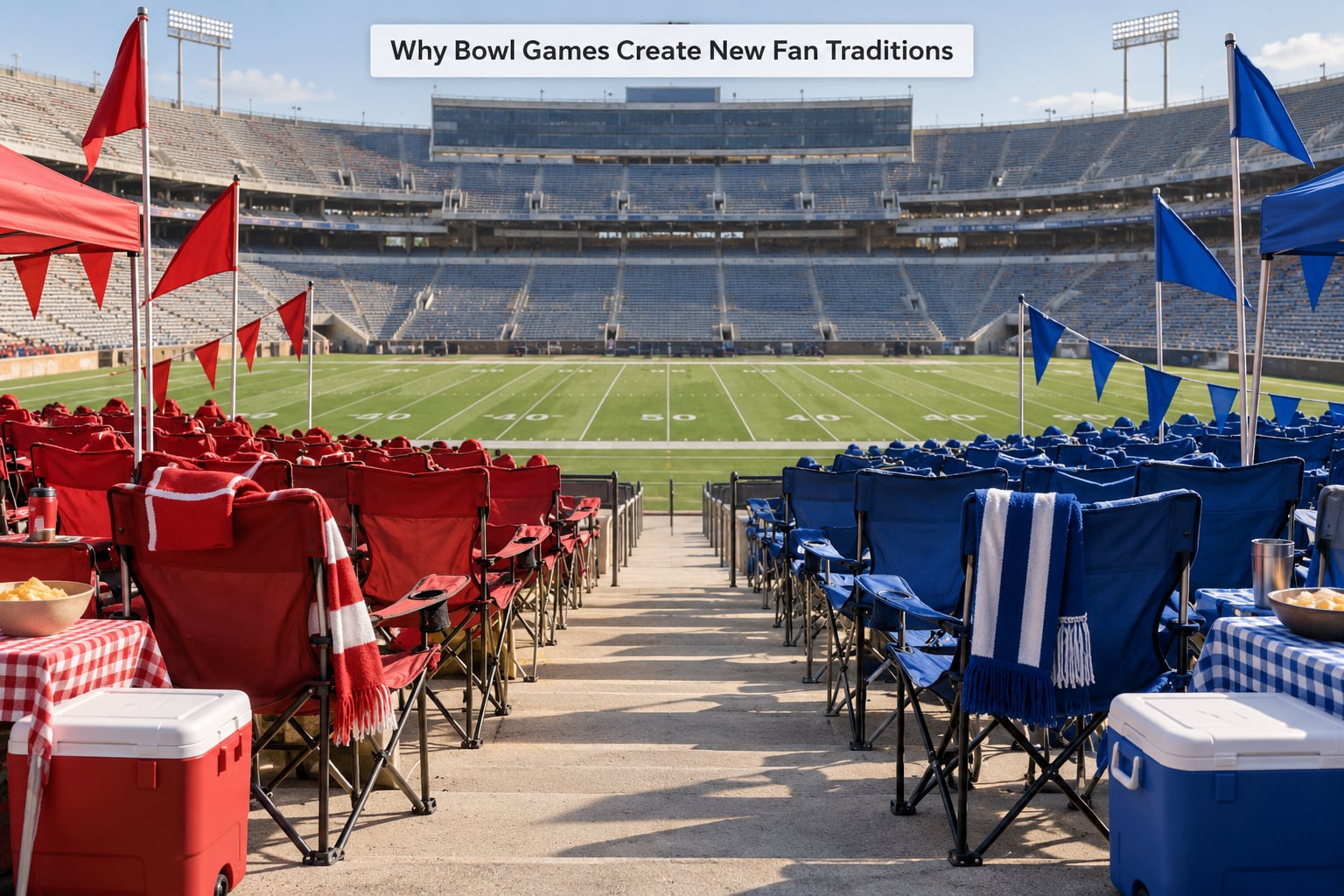
Bowl sites have no student section, no home band parked under the same end zone all season, and no seat anyone has held down for a decade. So fans build the atmosphere from scratch, and the result is a recognizable set of customs.
Coordinated team-color blocks come first. Then the walk-out, improvised by whichever high school or marching band shows up to play the pregame set, because the ritual matters more to fans than the venue. Temporary tailgate lots become the social center, with coolers and folding chairs replacing season-long parking permits. Some fans bring the same flags and banners they have had rolled up in a trunk for years.
None of it is imitation, exactly. Long-running neutral rivalries have developed their own culture that does not owe anything to either campus. The Florida-Georgia game in Jacksonville and the Oklahoma-Texas game in Dallas are the obvious examples, and fans defend them fiercely precisely because the venue stopped being the point years ago.
The difference shows up in the moment after the game. A home win feels like a shared win. A neutral-site win is shared too, just in smaller pieces — a parade through a hotel lobby, a road trip that took a full day, a group chat that runs until two in the morning.
How the Setting Changes Team and Rivalry Identity
Venue shapes how a team is perceived, in ways that are hard to argue with and harder to prove. Familiar sightlines, a surface a team has played on ten times, a stadium that has absorbed that team’s noise for twenty years — those are real inputs, not sentimental ones.
Remove them and the team looks slightly different. Offense built on timing and communication suffers more than anything else when a quarterback is calling from a building where he has never heard his own offense. Defenses built on noise and pressure get used to a quieter, flatter stadium. Local sports culture matters too: a basketball arena in a dead-end-of-December market produces a different crowd than a football stadium in a football town in September.
Rivalries take the biggest hit, because rivalries are stored in venues. A series that only ever happened in one building carries that building’s weight, and moving it can strip the meaning out for the older fans who grew up in it. Fans will still call it a rivalry, but they will describe it differently, usually as a road trip with extra history rather than a home game.
None of this means the game is worse football. Plenty of neutral-site games are the most intense on the schedule. It means the thing fans show up for is partly a place, and a neutral site is not that place.
How to Decide Whether a Neutral-Site Game Is Worth Attending
Run through this list before you commit, and you will usually have your answer in about five minutes.
- The opponent. A ranked team or a genuine rival changes the calculus. A nonconference showcase against a program with no following does not.
- The drive or the flight, each way. Under three hours is a day trip. Over six is a trip on its own.
- Where the seats come from. Allocation, official resale, or the open market. Individual-sale seats are usually easier to get and easier to lose money on.
- The full total, not the ticket. Travel both ways, lodging, parking, food, and the workday you miss.
- Kickoff time and schedule. Weekday night games cost more than weekend ones because of the day you lose.
- The weather and the venue. A dome is comfortable. An outdoor December game at a site with no shelter is a different plan.
- Whether both fan bases will be there. One-sided crowds change the atmosphere for everyone, including you.
- What you are traveling for. If the trip is already happening for another reason, the game is nearly free. If not, it has to earn the trip.
My rule is blunt. If you would never take that drive for a home game, you will not enjoy taking it for a neutral one.
Frequently Asked Questions
Why do some teams have a large fan presence at neutral-site games?
Because the host school or league decides how tickets are allocated, and the bigger program’s alumni base travels harder. Georgia fans fill Jacksonville every year, and Oklahoma and Texas fans show up in Dallas in numbers that surprise people who have never been. When one side outsells the other, the neutral stadium quietly becomes an away game with home uniforms.
Are neutral-site games usually harder to attend than home games?
Usually, yes. A home game is a short drive or a bus ride, often with season-ticket pricing and a parking pass you already paid for. A neutral site means new travel, likely a hotel night, and a ticket bought on the open market. The exceptions are the traditional neutral sites near one team’s campus, where the drive is short and the crowd skews heavily to one side.
Do fans consider a neutral-site game a genuine rivalry game?
Fans split on this, and the split tracks geography. Florida and Georgia fans treat Jacksonville as a rivalry game with a travel problem, because the rivalry predates the venue. Move a rivalry that only ever happened in one stadium, and many fans say the game stops being that rivalry. The venue carries part of the meaning, though it never carries all of it.
Why can ticket resale prices be lower for some neutral-site matchups?
Supply and demand do the work. No season-ticket base owns those seats, and both fan bases bid on the same inventory at once. When the matchup is lopsided on paper or the game is sold through an official allocation, demand can flatten and resale prices settle close to face value. When the opponent is a rival or a ranked team, the same seats can move fast.
How do stadium traditions differ at a neutral-site bowl game?
The rituals survive, but they get rebuilt from scratch. Bowl sites have no student section, no home band under the same section, and no season-ticket holders who have sat in the same seats for a decade. What you do get is coordinated team-color blocks, a walk-out before kickoff from wherever the band is set up, and tailgates in temporary lots that turn a parking area into a neighborhood for a day.
What factors matter most when choosing whether to travel?
Distance and the ticket source matter more than the opponent, in that order. Work out the drive or flight both ways, add a hotel night if the game ends too late to get home, then check where the seats come from. A ninety-minute drive with easy seats is an easy yes. A six-hour drive for a single regular-season game is usually a no.
Conclusion
Neutral site games take four things away from fans: the noise advantage, the short trip, the season-ticket deal, and the traditions that only work on campus. They hand back a different thing, which is a reason to travel with your team once a year and a story that belongs to nobody’s campus.
Sort the trip cost first, because it decides more than opinion does. Then check where the seats actually come from, and expect the crowd to skew toward whichever fan base travels harder. If both of those work, go, and lean into the traditions rather than mourning the ones you left behind.