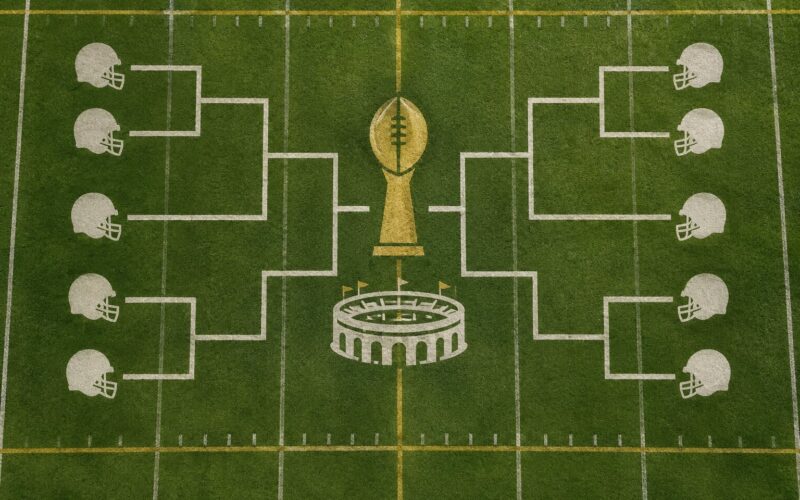
Bowl game matchups are selected by bowl committees and conferences acting under contract, not by one national committee. The College Football Playoff committee picks its 12 teams first, and then every other bowl chooses from the pool of bowl-eligible teams in a fixed order of selection.
That single mechanic explains nearly everything confusing about the postseason. A 9-3 team can land in a mediocre bowl while a 6-6 team gets passed over, because record and destination are decided by two different sets of hands. Rules below reflect the current cycle for the 2026 season, and they change often enough that it is worth checking the CFP and your conference’s own selection-order page each December.
Table of Contents
What Determines the First Bowl Game Matchups?
How bowl game matchups are selected, in four stages
The process runs in a fixed order, and the order is everything. Once teams are bowl eligible, the playoff is filled before any other bowl gets to pick.
| Stage | Who decides | What happens |
|---|---|---|
| 1. Eligibility | NCAA rules, then each conference | A team posts a winning record in FBS games, normally 6-6, and is certified bowl eligible. |
| 2. Playoff field | CFP selection committee | 12 teams are selected. Automatic bids go to conference champions, the rest are at-large. |
| 3. Tie-in assignment | Bowl contracts and conference rules | Each bowl decides which conference it must take from, and from which position in that order. |
| 4. Order of selection | Bowl committees | Bowls select one at a time in a numbered order until the eligible pool is empty. |
When six wins is not enough
The baseline NCAA requirement is a .500 winning percentage against FBS opponents, which in a 12-game season means 6-6. Four exceptions exist, and they explain most of the odd cases fans argue about each December.
- Conference championship games. Teams playing in a league title game get an alternate route to eligibility, which is why a team can reach a championship game with five wins.
- FCS transition. A team in its first year after moving up from FCS has its own standard, based on wins in its final FCS season.
- Academic Progress Rate fallback. When there are not enough eligible teams to fill every bowl, committees may extend invitations to 5-7 teams, with Academic Progress Rate (APR) used to prioritize who gets in.
- Multi-year scheduling and consecutiveness rules. Some conferences limit how often a team can appear in a given bowl or require a year out after certain appearances.
The bylaw is written in legal language and gets restated slightly differently by each conference, so the official conference release beats any summary you find online, including this one.
How Do College Football Playoff Teams Get Selected?
The playoff is filled before anyone else picks, and under the format that begins this season, the four Power conferences no longer have to finish in the top four rankings to earn a berth. The ACC, Big Ten, Big 12 and SEC champions each receive an automatic bid regardless of ranking, and one additional slot goes to another conference champion, for five automatic bids in all. The remaining seven teams are at-large selections made by the committee.
The committee ranks all eligible teams, not just those competing for a bid, and those rankings shape what happens later. Eight teams go home from the field, and those teams immediately become available to bowls that select after the playoff announcement. Every playoff berth from a conference pushes that conference’s other teams one spot down the order, which is why a team’s postseason fate is often decided by whether its conference-mate made the field.
Why the automatic bids change everything downstream
Under the older rules, a conference champion had to land in the top four to get in, so two teams from the same conference could take up spots and leave a champion out. The new arrangement removes that possibility in four conferences and reduces the number of at-large slots that everyone else competes for.
Conferences outside the four power leagues get no automatic bid. The Group of Five champion has to be ranked into the field on its own, and the same goes for independents, which is the whole of Notre Dame’s path to a playoff berth.
How Are Other Bowl Teams Chosen?
Once the playoff field is announced, the remaining bowls select one at a time in a numbered order that is published before the season by each conference. The bowl with the first pick chooses the best available team within the teams its contract allows it to choose from, and its pick number, not its opinion, is what constrains it.
What a pick number actually means
A pick number is a position in the pool, not a rank in the standings. A bowl picking third does not have to take the conference’s third-best team; it takes the third-best team available from the specific conference or group its tie-in requires, after every team picked before it has been removed from the pool.
This is the single most misunderstood point in the whole process, so it is worth sitting with. If two teams from one conference go to the playoff, every other bowl tied to that conference moves down two positions instead of one, and a bowl that expected the No. 1 team from that group may end up with the No. 3.
| Playoff teams from the tied-in conference | Effect on the next bowl tied to that conference |
|---|---|
| None | The bowl’s pick number is unchanged. |
| One | Every later bowl in that group moves up one position in the pool. |
| Two or more | Later bowls in that group move up two or more positions, often reshuffling tiers. |
Bowls are not required to take the best team on the table in any category. Travel distance, ticket guarantees, rematch avoidance, the opponent’s fanbase and the size of the alumni base in the bowl’s region all sit in the committee’s room, and those factors routinely push a team down one slot in exchange for a shorter trip and a fuller stadium.
Two ways conferences run their bowl picks
In the Big Ten model, the bowl requests a specific team and the conference approves or redirects the request. In the ACC and SEC models, work happens in tiers, where the top tier of teams is assigned to the New Year’s Six first, then later tiers, then a pool of lower bowls with flexibility at the end.
Both systems end the same way. The last bowls to select have the widest choice of teams remaining, which is why the final announcements can include teams with worse records than teams left home.
What Role Do the CFP Rankings and Tiebreakers Play?
The committee ranks teams using win-loss record, strength of schedule, quality of wins, head-to-head results and, in the ACC, the head-to-head tiebreaker among teams tied in the standings. Coaches polls carry no weight at all in this ranking.
Where teams are tied, the committee uses the conference’s stated tiebreak order, and where those still produce a tie, the committee decides. It has wide latitude on where a team is placed, and it can move a team up or down within a tier on the strength of schedule, strength of opponent wins and geographic logic even when a higher-ranked team exists.
The team’s ranking before the playoff announcement matters most because it decides whether it is available at all on Selection Sunday. After the playoff teams are gone, most remaining bowls use their own conference standings rather than the CFP ranking to order their choices, which is why the final list of bowl destinations can look wildly different from the final CFP Top 25.
How Do Bowl Agreements Affect the Matchups?
A tie-in is a contractual promise between a bowl and a conference that the bowl will select from that conference first. Contracts run for several years and are worth millions to each side, so the tie-in is far more durable than any single season’s record. It is the reason a strong team can be pointed at a bowl nobody expected, and the reason a conference can hold onto a New Year’s Six berth through a down year.
| Tie-in type | How it works |
|---|---|
| Automatic bid | The conference champion goes to the designated bowl or playoff slot, no committee involved. |
| At-large | The bowl may select from any eligible team, usually used for leftovers and for the non-power conference champions. |
| Guaranteed | The conference sends a team to that bowl every season whether or not it is the best available. |
| Tiered | Teams are assigned in ordered groups, from the New Year’s Six down to the lower bowls. |
| Pool | A late group of bowls picks from what is left, often with input from the conference. |
Geographical and contractual rules limit who can play whom in ways that have nothing to do with football. Some bowls have an institutional or state rule against hosting a particular opponent, and conference realignment reshuffles these relationships whenever a school changes leagues, which is why a long-standing Pac-12 tie-in and a new one look very different in practice.
Independents and the Notre Dame arrangement
Notre Dame plays a full ACC schedule under a separate agreement but is not a conference member for bowl purposes, and it plays its own postseason game each December. A long-standing term in that agreement restricts Notre Dame from being selected ahead of an eligible ACC team with meaningfully more wins, which is the source of most of the annual speculation about where the Fighting Irish end up.
Other independents, including BYU and UConn, have no such protection and are treated as at-large teams by every bowl.
Can the Selection Process Change Each Year?
Yes, and it usually does at the edges. The playoff format is the slowest-moving part but the most visible, having gone from four teams to 12 and now to the current automatic-bid arrangement. The rest moves conference by conference through contract cycles, realignment and eligibility rules.
The order of announcements on Selection Sunday stays remarkably stable, and reading it is the fastest way to follow along. The CFP field and bracket come first, then the playoff semifinal matchups, then the bowls in their numbered order of selection, working down toward the last and least flexible games.
If you want to predict a destination before the announcement, read your conference’s published order of selection and count backwards from the playoff. Everything else follows from that list.
Frequently Asked Questions
How are college football matchups determined?
Bowl matchups are set in four stages. Teams become bowl eligible by winning as many FBS games as they lose, normally 6-6. The CFP selection committee then picks 12 teams, five of them automatic bids for conference champions. Every other bowl is bound by tie-in contracts to select from a specific conference, and bowls pick one at a time in a numbered order until the eligible pool is gone.
What teams get automatic bids to the College Football Playoff?
Under the format running this season, the ACC, Big Ten, Big 12 and SEC champions each receive an automatic bid regardless of where they rank, and one additional automatic bid goes to another conference champion, for five in total. Seven remaining spots are at-large selections made by the committee. Conferences outside the four power leagues have no automatic bid and must be ranked into the field.
What does bowl eligible mean?
Bowl eligible means a team posted a winning record against FBS opponents, which in a 12-game season is normally 6-6. Exceptions apply, including teams that reach a conference championship game and teams in the first year after transitioning from FCS. When there are not enough eligible teams, bowls may invite 5-7 teams, with Academic Progress Rate used to decide who goes first.
Why does my 6-6 team not have a bowl game?
Six wins makes a team eligible, not invited. Eligibility is the entry ticket; selection is competitive, and most bowls must choose from one specific conference under contract. If every eligible team in that conference was picked by an earlier bowl, there is nothing left for a later one. In rare seasons a school can win its conference at 6-6 and stay home if the whole group is exhausted.
What is a bowl game tie-in?
A tie-in is a multi-year contract between a bowl and a conference that obliges the bowl to select from that conference first. It also sets where in the numbered order of selection the bowl picks. Tie-ins are why a strong team is sent somewhere unexpected and why a conference can keep a major bowl berth through a losing season. Contracts, not standings, set the map; the order of selection fills it.
Which bowl game is considered the most prestigious?
It depends on what you mean by prestigious. The national championship game sits above all the others, and its host bowl rotates on a cycle. Among the rest, the Rose Bowl is the oldest bowl game and typically hosts the highest-seeded playoff semifinal, while the Sugar, Orange, Cotton, Fiesta and Peach bowls are the other five New Year’s Six sites. Regular-season prestige and playoff hosting are not the same thing.
If you only remember one thing from this guide, remember that the playoff is chosen first and every other pick number is relative to it. Check your conference’s published order of selection in December, add up the playoff teams from your league, and most of the surprises stop being surprising.